

Digital skills training in Luxembourg: SME guide 2026
April 17, 2026
Digital consulting for Luxembourg SMBs: Unlock growth
April 18, 2026
TL;DR:
- Prioritizing UX design leads to higher revenue growth and better customer retention for SMEs.
- Simple, low-cost UX improvements can significantly enhance conversion rates and search engine rankings.
- Continuous testing and iteration of UX are essential for sustained growth and improved digital performance.
Businesses that treat design as a strategic priority consistently outperform their peers. Design-led companies achieve 32% higher revenue growth and 56% higher total returns to shareholders over five years compared to industry averages. Yet many small and medium-sized business owners across Europe still view UX design as an optional extra, something reserved for large corporations with deep pockets and dedicated design teams. That assumption is both common and costly. This article will show you precisely what UX design means for your business, how the data supports prioritising it, which myths are holding you back, and how to implement practical improvements without disrupting your operations or exhausting your budget.
Table of Contents
- What UX design really means for SMEs
- The impact of prioritising UX design: Data and ROI
- Common misconceptions about UX and how to overcome them
- How to implement effective UX design in your SME
- Our perspective: UX is business growth, not just design
- Unlock bigger results with expert-driven UX and web strategy
- Frequently asked questions
Key Takeaways
| Point | Details |
|---|---|
| UX drives growth | Businesses that prioritise UX see measurable boosts in revenue and customer loyalty. |
| Start small, win big | Free tools and early user feedback let SMEs elevate UX without major spend. |
| ROI stacks up fast | Even minor UX improvements can significantly increase retention and overall profits. |
| Iterate, don’t set-and-forget | Continuous feedback and adjustments are more effective than a single redesign. |
What UX design really means for SMEs
UX design, short for user experience design, is the practice of shaping every interaction a person has with your product, service, or website so that it feels intuitive, efficient, and satisfying. For small and medium-sized businesses, this is not about aesthetic polish or pixel-perfect layouts. It is about ensuring that your customers can find what they need, trust what they see, and complete their intended actions without friction.
The core components of UX design that matter most to SMEs are:
- Usability: Can visitors navigate your website or digital tool without confusion? Clear menus, logical page structures, and consistent labelling all contribute to usability.
- Accessibility: Can all users, including those with visual or motor impairments, access your content? Accessible design also improves SEO and broadens your audience.
- Visual flow: Does the layout guide the eye naturally towards key information and calls to action? Good visual hierarchy reduces cognitive load and increases conversions.
- Responsiveness: Does your site perform well on mobile devices? With the majority of web traffic now coming from smartphones, a responsive design is non-negotiable.
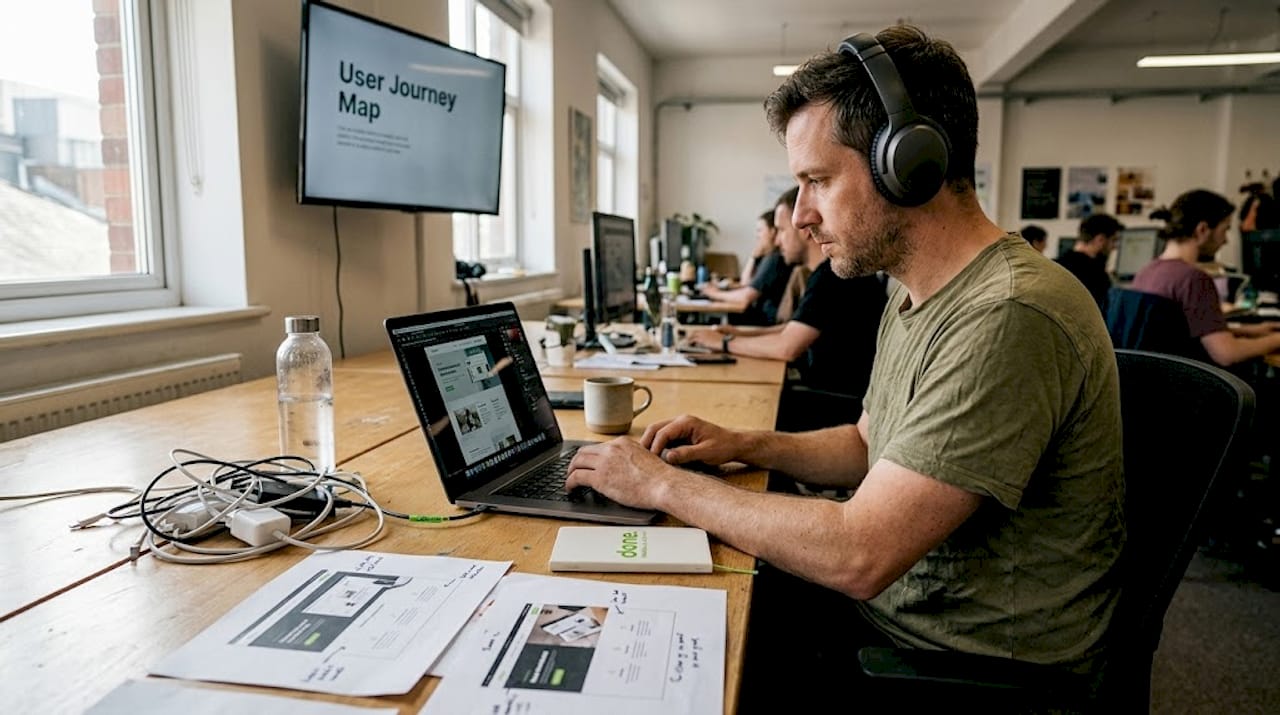
One of the most powerful UX methodologies available to SMEs is Customer Journey Mapping (CJM). CJM visualises customer interactions, identifies silos, pain points, and missed opportunities, and accelerates digital transformation by revealing exactly where your customers struggle or disengage. Rather than guessing why visitors leave your site without converting, a journey map gives you a structured, evidence-based view of the entire experience from first contact to post-purchase.
The immediate benefits SMEs can expect from improving UX include:
- Reduced bounce rates and longer session durations
- Higher conversion rates from existing traffic
- Improved customer retention and repeat business
- Clearer communication of your value proposition
- Greater team productivity through well-designed internal tools
Understanding the web design impact on business outcomes helps frame UX not as a cosmetic concern but as a structural one. When your digital presence is easy to use, customers stay longer, trust you more, and return more often. These are outcomes that directly affect your bottom line.
Pro Tip: Before investing in any redesign or new feature, create a simple journey map for your most important customer type. Walk through their experience step by step, from discovering your business online to completing a purchase or enquiry. You will almost certainly identify at least one friction point you can fix quickly and at low cost.
The impact of prioritising UX design: Data and ROI
Understanding what UX is, let’s explore how prioritising it boosts business results, backed by hard data.
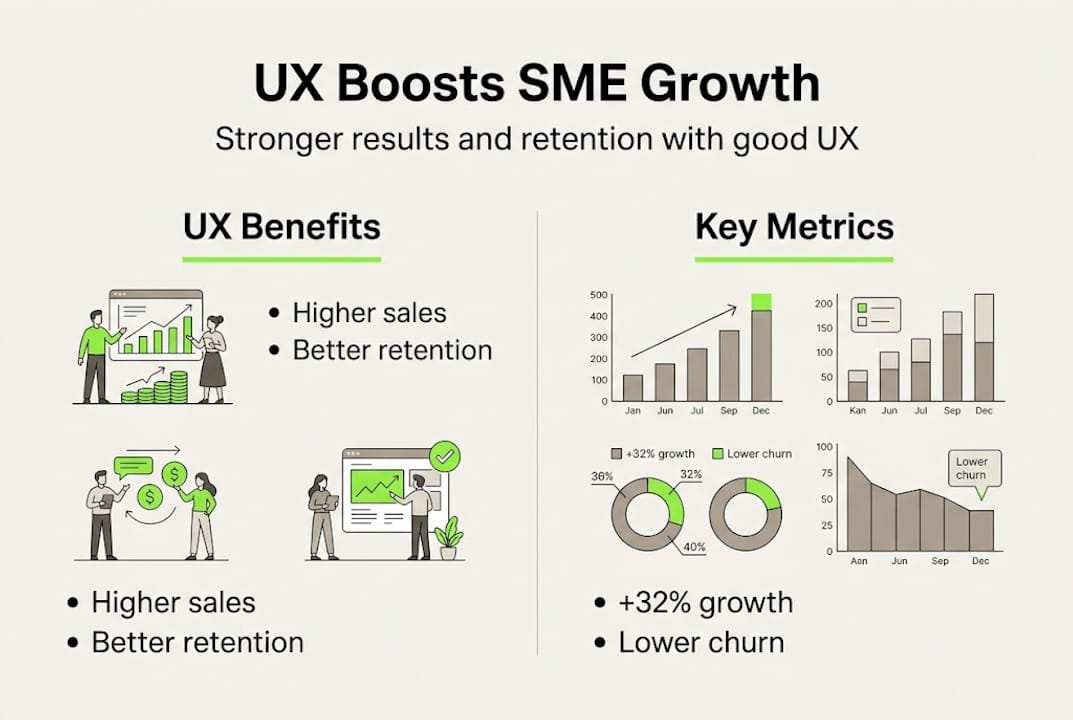
The financial case for UX investment is well established and the numbers are striking. Design-led companies see 32% higher revenue growth and 56% higher total returns to shareholders compared to industry averages over a five-year period. These are not marginal gains. They represent a fundamental competitive advantage that compounds over time.
For SMEs, the ROI argument becomes even more compelling when you consider customer retention. Research consistently shows that a 5% increase in customer retention can produce profit increases of between 25% and 95%. Retaining customers costs significantly less than acquiring new ones, and a frictionless digital experience is one of the most effective retention tools available to you.
“Investing in UX is not a design decision. It is a revenue decision. The businesses that understand this earliest gain the most ground.”
Here is a comparison of how design-led businesses perform against those that lag behind:
| Metric | Design-led companies | Industry average |
|---|---|---|
| Revenue growth (5-year) | +32% | Baseline |
| Total returns to shareholders | +56% | Baseline |
| Customer retention rate | Significantly higher | Lower |
| Marketing conversion efficiency | Improved | Inconsistent |
| Brand trust and loyalty | Stronger | Variable |
The relationship between UX and your broader digital marketing strategy advantages is also significant. A well-designed website amplifies the return on every marketing pound you spend. If your paid search campaigns drive traffic to a poorly structured landing page, you are wasting budget. Conversely, a site that converts efficiently makes every campaign more profitable without increasing spend.
There is also a direct connection between UX quality and search engine performance. Google’s ranking algorithms now factor in Core Web Vitals, which measure real-world user experience signals such as loading speed, interactivity, and visual stability. Poor UX does not just frustrate visitors; it actively suppresses your visibility in search results. Understanding the UX impact on SEO reveals how closely these two disciplines are intertwined.
The data is clear. Prioritising UX is not a speculative investment. It is a proven driver of revenue, retention, and competitive advantage for businesses of every size.
Common misconceptions about UX and how to overcome them
Having seen the quantifiable value of UX, let’s address the myths that stop SMEs from starting or improving further.
The most persistent barrier to UX improvement among SMEs is not a lack of tools or talent. It is a set of deeply held misconceptions that make the whole discipline feel out of reach. Let’s address the most common ones directly.
Misconception 1: UX design is expensive. Many business owners assume that meaningful UX work requires a large agency retainer or a full-time designer. In reality, many of the highest-impact improvements cost very little. Speed optimisation, clearer calls to action, and simplified navigation can be achieved with existing resources and free tools.
Misconception 2: UX is too complex for non-designers. User experience design is ultimately about empathy and observation. You do not need a design degree to notice that customers are struggling to find your contact form or that your checkout process has too many steps. Simple observation and structured feedback collection are accessible to any business owner.
Misconception 3: UX is a one-time project. This is perhaps the most damaging myth. Many businesses invest in a website redesign and then consider the UX problem solved. In practice, user needs evolve, technology changes, and new friction points emerge constantly. UX is an ongoing process, not a destination.
Misconception 4: Best practices are always correct. Interestingly, UX best practices can be ignored when user testing demonstrates better results for a specific audience. What works for a large e-commerce platform may not suit a local professional services firm. Validated, iterative design that responds to your actual users will always outperform generic rules applied without context.
Here are practical, low-cost UX tactics any SME can implement immediately:
- Use Figma’s free tier to create simple wireframes before building or changing any page. This prevents costly development rework.
- Run a five-second test by showing a page to someone unfamiliar with your business and asking what they think the page is about. The results are often revealing.
- Check your mobile load speed using Google PageSpeed Insights. A score below 70 on mobile is costing you traffic and conversions.
- Simplify your navigation by limiting top-level menu items to five or fewer. More options create decision paralysis.
- Add a single, clear call to action to every key page rather than presenting visitors with multiple competing options.
The growth-driven design methodology is built on exactly this kind of iterative, evidence-based improvement. Rather than overhauling everything at once, you prioritise the highest-impact changes, test them, learn, and repeat. This approach suits SMEs perfectly because it manages risk and delivers visible results quickly.
Pro Tip: Recruit five real customers or contacts to test a key page or process on your website. Ask them to complete a specific task, such as finding your pricing or submitting an enquiry, while thinking aloud. Five users will surface roughly 85% of your most significant usability issues, and this kind of guerrilla testing costs nothing but an hour of your time.
How to implement effective UX design in your SME
Disproving the roadblocks, here is how your business can embrace practical, sustainable UX design right away.
The most common mistake SMEs make when starting a UX improvement programme is trying to fix everything simultaneously. Prioritisation is the key. A focused, repeatable framework will deliver far more value than an ambitious overhaul that stalls halfway through.
Here is a practical UX improvement framework designed for SMEs:
- Step 1: Audit your current experience. Use Google Analytics to identify pages with high exit rates or low engagement. These are your starting points.
- Step 2: Map the customer journey. Document the steps your most valuable customer type takes from first awareness to conversion. Note where they encounter friction.
- Step 3: Prioritise your quick wins. Identify the two or three changes that will have the greatest impact for the least effort. Fix these first.
- Step 4: Test with real users. Before committing to larger changes, validate your assumptions with feedback from actual customers or prospects.
- Step 5: Implement, measure, and iterate. Make the change, track the relevant metric, and use the result to inform your next decision.
Free tools like Figma, Google Analytics, and guerrilla testing enable affordable, quick UX improvements that generate long-term gains. Here is a summary of the most useful tools available to SMEs:
| Tool | Primary use | Cost | Key benefit |
|---|---|---|---|
| Figma | Wireframing and prototyping | Free tier available | Visualise changes before building |
| Google Analytics | Behaviour and traffic analysis | Free | Identify drop-off points and weak pages |
| Google PageSpeed Insights | Performance testing | Free | Pinpoint speed and Core Web Vitals issues |
| Hotjar | Heatmaps and session recordings | Free tier available | See exactly how users interact with pages |
| Typeform | User feedback collection | Free tier available | Gather structured qualitative insights |
The principle that quick wins snowball into major improvements is well supported by experience. When you fix a confusing navigation structure, your bounce rate drops. When your bounce rate drops, your SEO improves. When your SEO improves, more qualified traffic arrives. Each improvement reinforces the next.
Connecting your UX work to your digital marketing workflow ensures that every campaign you run lands on an experience that converts. SMEs that align UX improvements with their digital marketing for SME leads strategy consistently see better returns from the same budget. The two disciplines are most powerful when they work in tandem.
Our perspective: UX is business growth, not just design
Now that you have a clear framework, here is a candid perspective from years of working with SMEs across Europe.
After supporting over 150 digital projects for small and medium-sized businesses, we have observed a consistent pattern. The businesses that grow fastest online are not necessarily those with the largest budgets or the most sophisticated technology. They are the ones that treat their digital presence as a living, evolving asset rather than a completed project.
UX design is the engine behind that mindset. It is not a surface layer applied at the end of a build. It is the discipline that determines whether your website actually serves your customers or simply exists. We have seen businesses lose significant revenue not because of poor products or weak marketing, but because a confusing checkout flow or an unclear contact page eroded trust at the critical moment.
The ‘website redesign’ fallacy is one we encounter regularly. A business invests in a new site, launches it, and then waits for results. When results plateau, the assumption is that another redesign is needed. In reality, what is needed is a continuous process of observation, testing, and refinement. The digital branding’s role in this process is to ensure consistency and trust at every touchpoint, not just at launch.
Small UX improvements, consistently applied, are the hinges that swing big doors in digital growth. Every other investment you make in marketing, content, or technology performs better when the underlying experience is sound. That is the perspective we bring to every project, and it is the one we encourage every SME owner to adopt.
Unlock bigger results with expert-driven UX and web strategy
Inspired to act but want confidence or a partner for your next digital move? Here is how you can accelerate.
Prioritising UX design is one of the highest-return decisions an SME can make in its digital journey. The evidence is compelling, the tools are accessible, and the framework is straightforward. But knowing where to start and how to sustain momentum is where many businesses benefit from expert guidance.
At Done.lu, we work with small and medium-sized businesses across Europe to build digital experiences that are not just visually strong but strategically effective. Whether you are exploring web development essentials for the first time, weighing up a web development investment, or ready to explore the full range of custom web development benefits, our team brings a growth-driven, ROI-focused approach to every engagement. We would be glad to help you identify your highest-impact UX opportunities and build a plan that fits your resources and ambitions.
Frequently asked questions
Is UX design affordable for small businesses?
Yes, many improvements can be made with free tools and user feedback, giving long-term gains for modest investment. Free tools like Figma and Google Analytics make meaningful UX work accessible to businesses of any size.
How soon can I see results from improved UX design?
UX improvements can boost engagement and satisfaction within weeks, with long-term impact visible in retention and sales metrics. Design-led companies achieve 32% higher revenue growth and 56% higher total returns to shareholders over five years, demonstrating that early action compounds over time.
What UX mistakes should SMEs avoid?
Avoid ignoring user feedback or treating UX as a one-time fix, as iterative changes consistently deliver the greatest cumulative results. Iterative, validated design that responds to your actual users will always outperform generic rules applied without testing.
Which UX activities deliver the fastest ROI?
Journey mapping and mobile speed optimisation offer the quickest improvements in customer experience and retention. CJM accelerates digital transformation by identifying exactly where customers disengage, making it one of the highest-value starting points for any SME.