

How to optimise web content for digital marketing success
April 16, 2026
Why prioritise UX design for SME digital success
April 17, 2026
TL;DR:
- Luxembourg SMEs have high digital skills but low AI adoption coverage presents growth opportunities.
- Structured assessment and targeted training, supported by funding, enable effective digital transformation.
- Early action and continuous upskilling are critical to maintain competitiveness in a fast-evolving digital landscape.
Luxembourg SMEs are sitting on a significant opportunity, and many are not yet seizing it. While 60.1% of the population aged 16 to 74 have at least basic digital skills, well above the EU average of 55.6%, the gap between general awareness and actual business transformation remains wide. AI adoption among Luxembourg SMEs stands at 33.61%, compared to an EU average of around 20%, which signals strong appetite but also highlights that the majority still have considerable ground to cover. This guide gives you a clear, step-by-step path to assess your team’s skills, tap into available funding, build lasting digital and AI competencies, and measure the real business impact of every training hour invested.
Table of Contents
- Assessing your digital needs and setting goals
- Exploring funding and key digital skills programmes
- Building digital and AI skills: step-by-step for teams
- Measuring impact and scaling up digital transformation
- Why Luxembourg SMEs can’t wait: a hard-won lesson
- Unlock your SME’s full potential with expert support
- Frequently asked questions
Key Takeaways
| Point | Details |
|---|---|
| Assess and plan | Evaluate current team skills and set specific digital adoption goals before investing. |
| Use funding programmes | Leverage co-financing options like Skills-Plang and Digital Europe to reduce upskilling costs. |
| Adopt proven training steps | Follow a structured, team-oriented approach starting with basic to advanced digital courses. |
| Track and scale results | Measure ROI with clear KPIs and expand successful digital practices across your business. |
Assessing your digital needs and setting goals
Having set the stage for why digital upskilling is crucial, the next step is to examine your current capacity and pinpoint where training will drive the best results. Many SME owners make the mistake of jumping straight into courses without first asking a simple question: where exactly is our biggest skills gap?
A structured self-assessment helps you see your situation clearly. Use the table below to rate your team’s current proficiency across core digital areas on a scale from 1 (no capability) to 5 (fully confident).
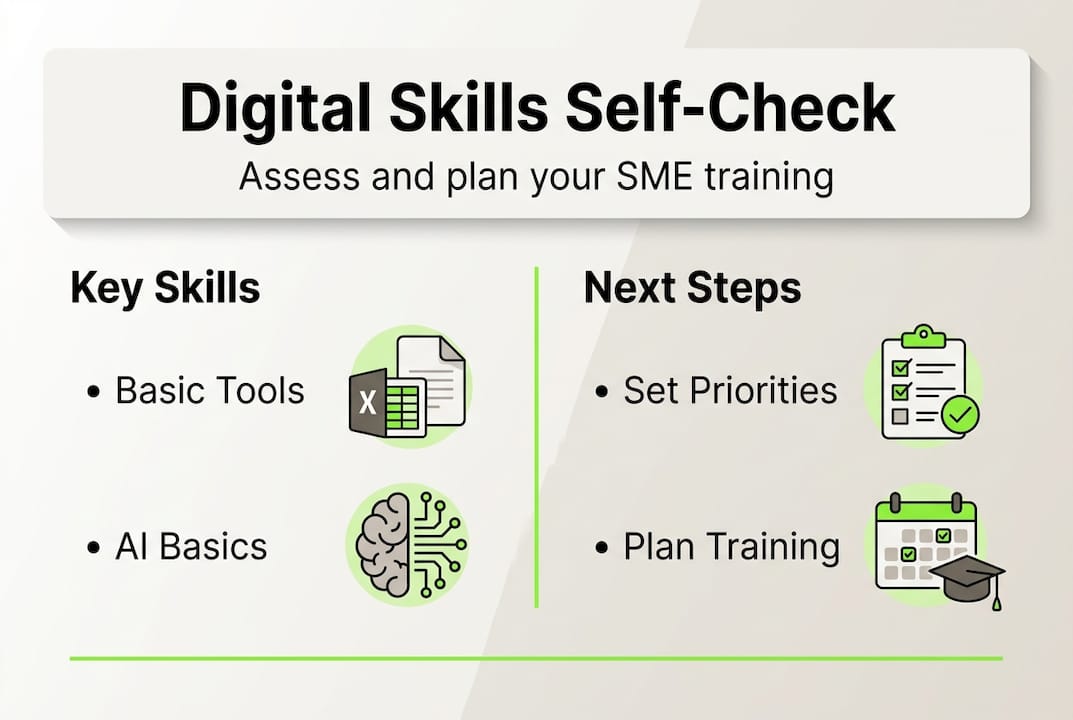
| Digital area | Current team score (1-5) | Priority level | Recommended action |
|---|---|---|---|
| Basic digital tools (email, cloud, docs) | — | High | Foundational course |
| Online marketing and SEO | — | High | Targeted training |
| Data analysis and reporting | — | Medium | Workshop or bootcamp |
| AI tools and automation | — | High | Structured programme |
| Cybersecurity awareness | — | High | Short course + policy |
| E-commerce management | — | Medium/High | In-house or external course |
Once you have scored each area, the pattern tells you where to focus first. AI adoption in Luxembourg SMEs sits at 33.61% versus the EU average of roughly 20%, which means early movers have a real competitive edge, but the window is narrowing fast.
Aligning your skills gaps with your business goals is the second step. For example, if your priority is generating more leads online, then digital marketing and SEO knowledge become critical. If you want to cut administrative time, automation and AI tools move to the top of your list. Each training investment should connect directly to a measurable business outcome.
Common pain points Luxembourg SMEs report include managing multiple digital platforms without a coherent strategy, failing to convert website traffic into leads, and spending excessive time on tasks that automation could handle. Understanding the digital marketing advantages available to local businesses helps frame why these skills gaps have real revenue consequences, not just operational ones.
Key areas where upskilling delivers the fastest returns include:
- Lead generation: SEO, paid advertising, and landing page optimisation
- Client communication: CRM tools, email automation, and chatbots
- Operations: Cloud-based project management, document automation, and workflow tools
- Analytics: Reading dashboards, interpreting data, and making data-driven decisions
- AI readiness: Prompt engineering, AI tool selection, and output quality control
Applying digital growth tips early on, even before formal training begins, can help your team build confidence and see tangible results quickly.
Pro Tip: Begin your training journey with the most repetitive, time-consuming tasks your team handles every week. Automating or improving just one of these delivers visible ROI within weeks and builds internal buy-in for wider transformation.
Exploring funding and key digital skills programmes
Once you’ve defined your skills gaps and business objectives, it’s time to map out which Luxembourg and EU-backed programmes can help, and how to secure funding support. The good news is that financial barriers are lower than many SME owners realise.

The Skills-Plang programme co-finances upskilling and reskilling training of a minimum 120 hours for employees in companies that have been operating for more than three years and are facing digitalisation-driven change. It covers consultant fees, direct training costs, and even employee wages during the training period. This is one of the most generous schemes available to Luxembourg SMEs and is worth applying for before you spend a single euro on external training.
At the European level, the EU Digital Europe Programme has open calls running from April to October 2026, funding advanced digital skills in areas such as AI, health technology, and EdTech for SMEs. Luxembourg SMEs can access these through the national digital skills coalition.
| Programme | Who qualifies | What’s covered | How to apply |
|---|---|---|---|
| Skills-Plang (ADEM) | Companies >3 years old facing digitalisation | Training costs, consultant fees, wages during training | Apply via ADEM portal |
| EU Digital Europe Programme | SMEs via Luxembourg national coalition | Advanced AI, EdTech, data skills | Via coalition or EU portal |
| Fit4Skills (Luxinnovation) | SMEs across all sectors | Digital strategy, innovation readiness | Contact Luxinnovation |
| Chamber of Commerce programmes | Members across sectors | Short courses, workshops, events | Via Chamber website |
The most valuable skill areas to prioritise with subsidised funding include AI basics and applied AI, marketing automation, data literacy, cybersecurity fundamentals, and cloud adoption. Understanding how digital marketing training boosts leads reinforces why these investments pay back rapidly once applied in real business contexts.
To prepare your Skills-Plang application, work through this checklist:
- Confirm your company has been legally operating for more than three years
- Document the specific digitalisation changes impacting your business operations
- Identify the employees who will participate and obtain their consent
- Select a certified training provider and request a formal cost proposal
- Prepare a skills gap analysis report to support your dossier
- Submit your application through the ADEM online portal before your training start date
Combining short, accessible courses such as Elements of AI with subsidised in-company training through Skills-Plang gives you speed and depth together. Free courses build awareness quickly, while structured programmes ensure skills are embedded across your team.
Building digital and AI skills: step-by-step for teams
Securing funding is only half the battle. Now let’s look at how to structure your team’s actual learning for lasting results. A phased approach prevents overwhelm and ensures that each layer of knowledge builds on the previous one.
Here is a step-by-step action plan you can follow regardless of your team’s current level:
- Start with free foundational courses. Enrol key team members in Elements of AI Luxembourg, a free course requiring no technical background. It provides a solid grounding in what AI is, how it works, and where it applies.
- Identify two or three priority tools. Based on your earlier assessment, choose the platforms your team will use daily, such as a CRM, a marketing automation tool, or a data dashboard.
- Run internal knowledge-sharing sessions. After each team member completes a module, hold a 30-minute session where they share what they learned with colleagues. This reinforces retention and spreads skills without extra cost.
- Enrol in a subsidised in-company programme. Use Skills-Plang to fund a deeper, certified training programme focused on your top two skills gaps.
- Assign accountability. Designate one team member as your internal digital champion to track progress and troubleshoot adoption challenges.
- Review, iterate, and expand. After 90 days, revisit your assessment table. Identify which skills have improved and where the next training cycle should focus.
Must-have topics for any Luxembourg SME training plan include:
- Cybersecurity basics: Password management, phishing awareness, GDPR compliance
- Cloud tools: Shared storage, remote collaboration, document version control
- Automation: Email sequences, invoice processing, appointment scheduling
- Analytics: Google Analytics basics, dashboard reading, KPI tracking
- AI tools: Generative AI for content, AI-assisted customer service, workflow automation
Elements of AI Luxembourg has already reached over 5,300 participants and is targeting 1% of the population trained by 2030, with its 5th edition launched in 2026 and open to all business owners at no cost.
Understanding how AI boosts digital marketing for European SMEs gives context for why these foundational AI skills translate directly into competitive marketing performance. For SMEs unsure where AI fits into their operations, AI consulting for SMEs provides a structured starting point to map tools to business needs.
Common obstacles include resistance from employees who fear being replaced by technology, costs that feel prohibitive before subsidies are factored in, and difficulty finding time to train during busy periods. The most effective counter to resistance is showing, not telling. Run a small pilot that saves time visibly, and team members become advocates rather than sceptics.
Measuring impact and scaling up digital transformation
With your digital and AI training underway, the final piece is ensuring your investment actually delivers measurable business value and can be scaled across your whole organisation. Without clear metrics, even excellent training disappears into the background noise of daily operations.
Use this mini-dashboard to track the impact of your digital training investment over three to six months:
| KPI | Baseline (before training) | Target (after 3 months) | Actual result |
|---|---|---|---|
| Monthly website leads | — | +20% | — |
| Time spent on admin tasks (hrs/week) | — | -30% | — |
| Email campaign open rate | — | +15% | — |
| Sales conversion rate | — | +10% | — |
| Customer response time | — | -40% | — |
These are practical, measurable outcomes that any SME can track without a data science team. The key is to capture your baseline before training begins, so you have a genuine comparison point.
SMEs face skills shortages and cost pressures as common AI adoption barriers, despite 82% expressing interest. However, businesses that start small with repetitive tasks typically see ROI within 2 to 6 months, and subsidies covering 40 to 70% of costs make the financial case even stronger.
Common mistakes SMEs make when scaling digital projects include:
- Trying to transform everything at once rather than piloting one area first
- Neglecting to train frontline staff and focusing only on managers
- Choosing tools that don’t integrate with existing systems
- Failing to document new processes, leading to inconsistent adoption
- Not revisiting the ROI calculation after the first cycle
Pro Tip: Appoint an internal digital champion, someone who is enthusiastic about technology and respected by colleagues. This person does not need to be technical. Their role is to keep momentum alive, answer basic questions, and flag issues early before they stall progress.
For reporting ROI to co-founders or senior leadership, keep it simple. Present three numbers: time saved per week, cost reduction in a specific process, and revenue impact where measurable. A clear digital marketing strategy for Luxembourg SMEs provides the broader framework within which these training gains compound over time. As you scale, use benchmarking guides and peer forums from local digital coalitions to compare your progress and identify the next frontier. Reviewing how SEO drives business growth for Luxembourg SMEs is a useful next step once your team has the digital foundations in place.
Why Luxembourg SMEs can’t wait: a hard-won lesson
With all the steps laid out clearly, it is worth stepping back to address something that data alone cannot fix: the gap between knowing and doing.
We work closely with Luxembourg SMEs every day, and the pattern we see most consistently is not a lack of interest. It is a tendency to wait. Businesses wait for the perfect tool, the right moment, a quieter quarter, or a clearer signal from the market. Meanwhile, competitors who act imperfectly but act early pull ahead in ways that become very difficult to close.
High enthusiasm at 82% versus actual SME AI adoption at 20 to 33% tells a story that should concern every SME owner in Luxembourg. Government initiatives via the Recovery Plan and Fit4Skills are pushing hard, but critiques from the Chamber of Commerce indicate that Luxembourg still lags in real SME digitalisation. The gap is not closing fast enough.
Basic competence is no longer sufficient. A team that knows how to use email and spreadsheets is not digitally transformed. The competitive advantages now belong to businesses that can run automated campaigns, interpret data in real time, and use AI to respond to customers faster and more personally than their competitors.
The cost of inertia is invisible right up until it is not. By the time a business notices it is losing ground to a more digitally capable competitor, months of compounding advantage have already been built up on the other side. Continual upskilling is no longer a growth strategy. For Luxembourg SMEs in 2026, it is a survival requirement. The tools, the funding, and the support all exist. The impact of AI on marketing for European SMEs is already documented and measurable. What remains is the decision to act.
Unlock your SME’s full potential with expert support
If you’re ready to accelerate your digital journey in Luxembourg, specialist support can make all the difference between slow progress and sustained transformation.
At Done.lu, we work with Luxembourg SMEs to move from strategy to implementation, covering everything from initial digital audits and team training plans through to full AI consulting for SME transformation, workflow automation, and GDPR-compliant AI deployment. Whether you are building your online presence from scratch or scaling an existing operation, our team brings the experience of over 150 completed projects to every engagement. Explore how investing in web development creates a foundation for all your digital skills to deliver measurable returns. For those focused on converting traffic into leads, our digital marketing workflow expertise gives you the practical frameworks to make it happen. Get in touch with us today to discuss your next step.
Frequently asked questions
What digital skills are most important for Luxembourg SMEs in 2026?
Core priorities include data literacy, cloud and AI basics, digital marketing, automation, and cybersecurity essentials. While 60.1% of Luxembourg’s population have basic digital skills, SMEs still lag in practical digitalisation, making targeted upskilling a competitive differentiator.
Can SMEs get funding for digital skills training in Luxembourg?
Yes, programmes like Skills-Plang and EU Digital Europe offer significant subsidies covering 40 to 70% of eligible training costs. The Skills-Plang programme co-finances upskilling for employees in qualifying companies, covering consultant fees, training costs, and wages during the training period.
How long does it take to see ROI from digital skills and AI training?
Most SMEs observe measurable efficiency gains within 2 to 6 months when starting with automation of repetitive tasks. Starting small with automation in focused areas delivers the fastest and most visible returns before scaling wider.
What’s the best starting point for a small Luxembourg company?
Begin with free foundational courses like Elements of AI and map out a realistic skills roadmap based on your team’s needs. The Elements of AI Luxembourg course is free, requires no technical background, and is specifically open to business owners and their teams.
Recommended
- Digital marketing advantages for Luxembourg SMEs in 2026
- What is digital marketing: 25% more leads for Luxembourg SMEs
- How SEO drives business growth for Luxembourg SMEs in 2026
- Website accessibility guide for Luxembourg SMEs 2026
- Flexible Bürolösungen optimal nutzen: Der Guide für KMU | ProOffice Business Center Blog