
AI strategies for SME success: a European guide 2026
April 1, 2026
Top 7 Website Builders 2026
April 3, 2026
Branding is frequently dismissed by SME owners as something reserved for large corporations with generous marketing budgets. Yet empirical research confirms that strong branding provides a direct competitive advantage for smaller businesses, positively influencing sales, financial performance, and the ability to attract both customers and talent. In a digital landscape where your website, social media presence, and online reputation are often a prospect’s first impression, branding is not a cosmetic exercise. It is a strategic business tool. This article breaks down the evidence, the frameworks, and the practical steps you need to build a brand that genuinely drives growth for your SME.
Table of Contents
- Why branding matters for SMEs in the digital age
- The four pillars of SME branding success
- Leveraging digital channels to amplify your brand
- Overcoming the SME branding paradox: confidence, investment, and the digital overload
- Best practices for future-proof SME branding
- Why most SME branding advice misses the mark
- Level up your SME branding with expert support
- Frequently asked questions
Key Takeaways
| Point | Details |
|---|---|
| Branding drives SME growth | Evidence shows branding directly increases sales and business performance for SMEs. |
| Strategic framework essential | Adopting a four-pillar branding framework enables structured and sustainable digital brand building. |
| Digital channels magnify reach | Using social media and digital tools amplifies SME brand visibility in a cost-effective way. |
| Consistency and adaptation matter | Regular brand audits and local adaptation ensure ongoing relevance and compliance. |
| Confidence comes from clarity | SMEs that treat branding as an investment—not a cost—achieve better results and higher confidence. |
Why branding matters for SMEs in the digital age
With the strategic importance of branding introduced, it is vital to examine the evidence of why branding truly matters for SMEs today. Many business owners still view branding as an intangible luxury, something to invest in once the core operations are running smoothly and the budget allows for it. This mindset is understandable, but it is also costly.
Research consistently shows that branding boosts business growth by creating a measurable competitive edge, not simply by making a business look more polished. A strong brand communicates reliability, builds emotional connection, and reduces the effort a customer needs to make before choosing you over a competitor. In digital environments where attention spans are short and options are plentiful, that trust signal matters enormously.
“Branding is no longer a differentiator for large enterprises alone. For SMEs, it is increasingly the mechanism through which sustainable growth is achieved in competitive digital markets.”
The evidence is clear: SME branding links directly to improved sales performance and stronger financial health. Businesses that invest consistently in their brand identity, messaging, and digital presence outperform those that treat branding as an afterthought. Beyond sales, a recognisable brand also helps you attract skilled employees and reassure investors, both of which are critical for scaling.
What do SMEs risk by neglecting brand development? Consider the following:
- Lost visibility: Without consistent branding, your business blends into a crowded digital marketplace.
- Reduced trust: Inconsistent messaging across channels signals unprofessionalism to potential clients.
- Weaker pricing power: Unbranded businesses compete primarily on price, which erodes margins over time.
- Talent gaps: Candidates research employers online; a weak brand makes recruitment harder.
Exploring branding strategies for more sales reveals that even modest, focused branding investments can produce measurable returns. The key is understanding which elements of branding to prioritise and how to activate them digitally.
The four pillars of SME branding success
Having identified why branding cannot be ignored, the next step is understanding the core building blocks that make up an effective SME brand. Research identifies four core mechanics of SME branding: orientation, identity, marketing, and performance. Together, these pillars form a practical framework you can apply regardless of your sector or budget.
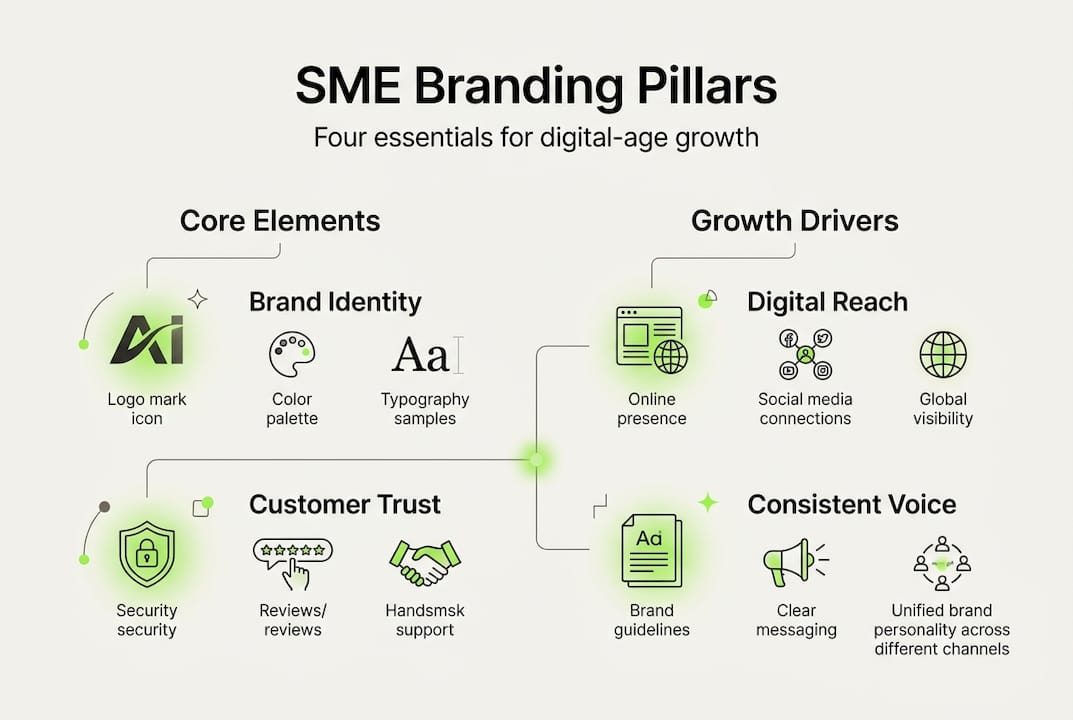
| Pillar | Objective | Quick-action tip |
|---|---|---|
| Orientation | Make branding a strategic priority | Assign a brand owner internally, even part-time |
| Identity | Define visuals, values, and tone of voice | Create a one-page brand guide for consistency |
| Marketing | Activate your brand across digital channels | Start with two channels and do them well |
| Performance | Measure ROI and refine continuously | Track at least three brand-linked KPIs monthly |
To operationalise this framework in your business, follow these steps:
- Audit your current brand position. Review how your business appears across your website, social media, and any printed materials. Note inconsistencies in logo use, colour palette, and messaging.
- Define your brand identity clearly. Document your core values, target audience, and unique selling proposition in a concise brief that your team can reference.
- Select your digital marketing channels. Choose platforms where your audience is most active and where you can commit to regular, quality content.
- Set measurable performance targets. Decide which metrics matter most, whether that is website traffic, lead volume, or social engagement, and review them monthly.
- Invest in branding iteratively. Treat your brand as a living asset that evolves with your business and market feedback.
Pro Tip: Review each pillar quarterly and ask yourself honestly which one is weakest. Most SMEs have strong identity but poor performance measurement. Closing that gap often produces the fastest visible improvement in branding ROI.
Leveraging digital channels to amplify your brand
With the branding framework clarified, we can now explore which digital tools work best for amplifying your SME’s message. The good news is that digital channels have dramatically lowered the cost of brand building. The challenge is choosing the right ones.

Digital channels amplify SME branding in distinct ways, from social media awareness to electronic word-of-mouth (E-WOM) and employer branding. Each channel requires a different level of resource commitment and delivers a different type of impact.
| Channel | Resource requirement | Brand impact |
|---|---|---|
| Website | Medium (initial build) | High: central hub for all brand activity |
| Social media | Low to medium (ongoing) | High: visibility and community building |
| E-WOM (reviews, referrals) | Low | Very high: trust and credibility |
| Employer branding (LinkedIn) | Low to medium | Medium: talent attraction and reputation |
Understanding social media for SMEs is particularly valuable because social platforms offer precise audience targeting at relatively low cost. The benefits of social networks extend beyond reach; they enable two-way dialogue with your audience, which builds loyalty over time.
Here are proven best practices for digital branding on a budget:
- Publish content consistently rather than in bursts; frequency signals reliability.
- Repurpose one piece of content across multiple formats, such as a blog post becoming a social graphic and a short video.
- Actively request and respond to online reviews; E-WOM is one of the most cost-effective trust builders available.
- Align your website design and copy with your social media voice to create a seamless brand experience.
- Use free analytics tools to identify which content resonates and double down on what works.
Pro Tip: Before selecting a new digital channel, ask whether your target audience is genuinely active there and whether you have the internal capacity to maintain it consistently. A neglected channel damages your brand more than having no presence at all.
Overcoming the SME branding paradox: confidence, investment, and the digital overload
Understanding channel selection is only part of the puzzle; it is equally important to address common stumbling blocks and uncertainties SME leaders face. One of the most striking findings in recent research is that SMB confidence in marketing is actually falling even as budgets rise. More spending, less certainty. This is the branding paradox.
“Only 18% of small and medium-sized businesses trust that their marketing is truly effective, despite increasing their budgets year on year.”
This confidence gap often stems from digital overload. There are simply too many platforms, tools, and tactics competing for your attention. The result is scattered effort, inconsistent messaging, and difficulty attributing results to specific actions. The fix is not more activity; it is more focus.
Another tension many SMEs face is the choice between building a company brand and leveraging a personal brand. A personal brand, typically built around a founder or key executive, can generate rapid trust and engagement. However, it carries risk: if that individual leaves or steps back, the brand equity may not transfer to the business. A company brand is more durable but requires greater investment to build recognition.
To build confidence and avoid digital overload, follow these steps:
- Reduce your active channels to the two or three that deliver the clearest results.
- Define a simple monthly content calendar so that branding activity becomes routine rather than reactive.
- Invest in digital marketing for SMEs that is measurable; set clear KPIs before launching any campaign.
- Review your digital marketing advantages quarterly to assess what is generating real business value.
- Treat branding as a long-term investment with compounding returns, not a short-term cost with immediate payback expectations.
The businesses that navigate this paradox successfully are those that commit to a clear, evidence-driven strategy and resist the temptation to chase every new platform or trend.
Best practices for future-proof SME branding
Having faced the paradox and common pitfalls, readers are now ready to master actionable best practices that safeguard SME branding for the future. Future-proofing your brand means building systems and habits that remain effective even as technology and market conditions evolve.
For European SMEs, structured branding frameworks that combine orientation, identity, marketing, and performance measurement offer the most resilient foundation. Alongside this, the following practices are essential:
- Conduct regular brand audits. At least twice a year, review your digital presence for consistency across all touchpoints, including your website, social profiles, email signatures, and any advertising.
- Leverage EU funding for digitalisation. European funding programmes exist specifically to support SME digital transformation. Researching available grants can significantly reduce the cost of branding and technology investment.
- Integrate AI tools cautiously. AI can accelerate content creation, personalise customer communications, and automate routine marketing tasks. However, any AI tool you adopt must align with GDPR requirements. Understanding AI and GDPR for SMEs is not optional; it is a compliance necessity.
- Maintain brand consistency across all formats. Whether a prospect encounters you via a Google search, a LinkedIn post, or a referral, the experience should feel coherent and recognisable.
- Build internal brand champions. Train your team to understand and embody your brand values, because every customer interaction is a brand moment.
Pro Tip: The European Commission’s Digital Innovation Hubs and national digitalisation support schemes are often underutilised by SMEs. A quick enquiry to your national business development agency can open doors to subsidised consultancy, tools, and training that make branding investment far more accessible.
Why most SME branding advice misses the mark
Now that you have the best practices, it is worth stepping back to offer a perspective on why so much mainstream branding advice fails SMEs in practice. The majority of branding guides are written with large enterprises in mind, or they offer generic tactics that ignore the realities of limited budgets, lean teams, and local market nuances.
The truth is that copying what a well-funded competitor does rarely works. What does work is building a brand strategy grounded in your specific audience, your sector’s expectations, and the compliance environment you operate in. In Europe, that means taking GDPR seriously as a brand trust signal, not just a legal obligation.
Iterative experimentation consistently outperforms copycat tactics. Test a message, measure the response, refine, and repeat. This approach, which mirrors how AI boosts digital marketing for forward-thinking SMEs, treats branding as a continuous process rather than a fixed campaign. The SMEs that build lasting brand equity are those that combine strategic clarity with the flexibility to adapt based on real evidence.
Level up your SME branding with expert support
For those ready to put these insights into practice, the next step is straightforward: get expert support for a transformative branding journey.
At Done Web Agency, we work with SMEs across Luxembourg and Europe to build brands that perform online. Whether you need a sharper digital marketing strategy for SMEs or a fully responsive website built for web development for SME growth, our team brings together branding expertise, technical capability, and a deep understanding of the European digital landscape. We design solutions around your business goals, your resources, and your compliance requirements, so that every investment you make in your brand generates measurable returns. Get in touch to start a conversation about what your brand could achieve.
Frequently asked questions
How does branding impact SME growth in the digital age?
Strong branding directly boosts sales, customer trust, and overall SME growth by making your business stand out in a crowded online marketplace. It also supports talent attraction and investor confidence, both of which are vital for scaling.
Can small businesses afford digital branding?
By prioritising cost-effective digital channels and focusing on consistency over volume, even small businesses can build powerful brands without large budgets. Strategic resource allocation is the key differentiator between SMEs that succeed and those that stall.
What are the biggest mistakes SMEs make in branding?
The most common pitfalls include treating branding as a one-off activity and copying larger competitors rather than developing a clear, data-driven strategy. Digital overload and falling confidence compound these errors when there is no structured framework in place.
How can SMEs measure branding success online?
Monitor key performance metrics including website traffic, social media engagement rates, and sales conversion figures to assess the real impact of your branding activity. Tracking these consistently, as part of the performance pillar of your branding framework, turns branding from a cost into a measurable investment.