

Why Responsive Web Design Matters for E-Commerce
February 14, 2026
Role of Web Design in Driving Conversions
February 16, 2026
Choosing the right web development approach can feel complex for business owners in Luxembourg and surrounding European countries. Many believe web development is just design, but it is actually a broad field combining technical skills, creativity, and strategic problem-solving. By understanding the distinction between web development and web design, you gain valuable insight into how a strong digital presence supports your business goals and engages a wider audience.
Table of Contents
- Definition Of Web Development And Common Misconceptions
- Types Of Web Development Explained
- Core Technologies And How Websites Work
- Web Development Process From Planning To Launch
- Cost, Risks, And Mistakes To Avoid For Businesses
Key Takeaways
| Point | Details |
|---|---|
| Web Development Overview | It involves creating functional websites, requiring various skills beyond design. |
| Development Specializations | Front-end, back-end, and full-stack developers have distinct roles, each critical to digital experiences. |
| Core Technologies | HTML, CSS, and JavaScript are essential for building web functionality. |
| Risk Management in Projects | Proper vendor selection and project scope definition are vital to minimize costs and mistakes. |
Definition of Web Development and Common Misconceptions
Web development is a dynamic technical discipline focused on creating, maintaining, and optimizing websites and digital applications. Far more than just designing visual layouts, web development encompasses a complex process of building functional, interactive online experiences that solve business challenges and engage users.
According to MDN’s comprehensive web development guide, web development involves multiple specialized skills and technical competencies. These skills include:
- Writing clean, efficient code in programming languages like HTML, CSS, and JavaScript
- Designing responsive layouts that work across different devices
- Implementing interactive user interfaces
- Managing backend infrastructure and database connections
- Ensuring website performance and security
Web development isn’t a monolithic field but rather a diverse ecosystem with distinct specializations. Professionals typically focus on three primary development categories:
- Front-end development: Focuses on user-facing elements and visual interactions
- Back-end development: Manages server-side logic, databases, and application infrastructure
- Full-stack development: Combines expertise in both front-end and back-end technologies
Web development goes far beyond aesthetic design – it’s about creating functional, purposeful digital experiences that solve real-world problems.
Common misconceptions about web development often stem from oversimplifying the profession. Many people mistakenly believe web development is just about making websites look attractive. However, mimo’s industry overview highlights that true web development requires sophisticated problem-solving skills, technical expertise, and continuous learning.
Some prevalent myths include:
- Myth: Anyone can become a web developer overnight
- Reality: Developing expertise requires dedicated study, practice, and ongoing skill refinement
- Myth: Web development is purely technical without creativity
- Reality: Successful developers blend technical skills with innovative problem-solving
- Myth: Web development is a static field
- Reality: Technologies evolve rapidly, demanding continuous learning and adaptation
Pro tip: Invest time in understanding core programming principles and staying updated with emerging web technologies to build a sustainable career in web development.
Types of Web Development Explained
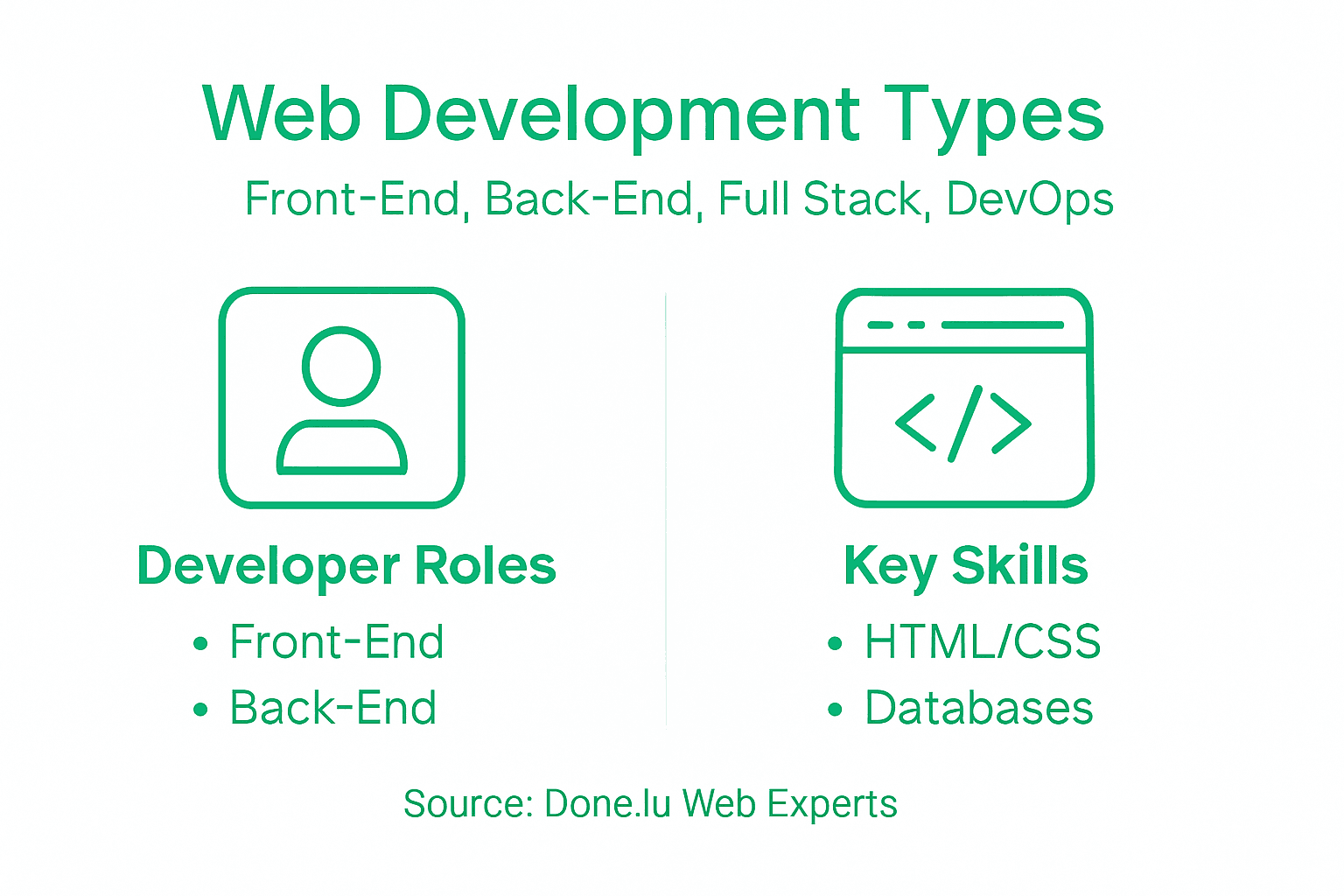
Web development encompasses several specialized disciplines, each playing a crucial role in creating comprehensive digital experiences. Modern web development approaches reveal three primary categories that power today’s online ecosystem: front-end, back-end, and full-stack development.
Front-end development focuses on the user-facing side of websites and applications. Professionals in this domain work directly with visual and interactive elements that users see and engage with. Key responsibilities include:
- Creating responsive design layouts
- Implementing user interface (UI) interactions
- Ensuring cross-browser and cross-device compatibility
- Optimizing visual performance and user experience
- Developing intuitive navigation systems
Back-end development operates behind the scenes, managing server-side logic, databases, and application infrastructure. These technical experts build the foundational systems that enable websites to function effectively. Their core responsibilities include:
- Developing server-side application logic
- Managing database connections and data storage
- Creating and maintaining APIs
- Implementing security protocols
- Optimizing application performance and scalability
Web development is a complex ecosystem where front-end and back-end technologies work together to create seamless digital experiences.
Full-stack development represents the most comprehensive approach, combining expertise in both front-end and back-end technologies. Full-stack developers possess a holistic understanding of web development, enabling them to:
- Design user interfaces
- Write server-side code
- Configure database systems
- Manage deployment processes
- Troubleshoot end-to-end application challenges
Each development type requires distinct technical skills and programming languages. Front-end developers typically use HTML, CSS, and JavaScript, while back-end developers work with languages like Python, Ruby, PHP, and Java. Full-stack developers must be proficient in multiple programming languages and understand complex system interactions.

Here’s how the main types of web development compare on key factors:
| Development Type | Primary Focus | Typical Technologies | Business Value |
|---|---|---|---|
| Front-end | User interfaces and visuals | HTML, CSS, JavaScript | Enhances engagement and usability |
| Back-end | Data processing and storage | Python, PHP, Java, Ruby | Supports scalability and performance |
| Full-stack | End-to-end application flow | Both client and server tech | Reduces handoff delays and improves agility |
Pro tip: Develop a comprehensive skill set by learning multiple programming languages and understanding how different web development technologies interconnect.
Core Technologies and How Websites Work
Web technologies form the backbone of digital communication, enabling complex interactions between users and online platforms. Web standards define how internet technologies interconnect, creating a structured ecosystem that powers modern digital experiences.
Three core technologies form the foundation of website functionality:
- HTML (HyperText Markup Language): Provides the structural framework of web content
- CSS (Cascading Style Sheets): Manages visual presentation and design elements
- JavaScript: Enables dynamic, interactive user experiences
The website creation process involves a complex interaction between client-side and server-side technologies. When a user enters a web address, multiple technical processes occur simultaneously:
- DNS server translates domain name into IP address
- Browser sends request to web server
- Server processes request and returns HTML, CSS, and JavaScript files
- Browser renders these files into a visible webpage
- JavaScript adds interactivity and dynamic content
Websites are intricate systems where multiple technologies work seamlessly to deliver smooth, responsive user experiences.
Understanding the client-server model is crucial for comprehending web functionality. Clients (web browsers) make requests to servers, which process these requests and send back appropriate responses. This communication happens through the HTTP/HTTPS protocol, enabling secure and efficient data transfer.
Modern web development emphasizes responsive design and progressive enhancement, ensuring websites function across different devices and browsers. Developers must consider:
- Cross-browser compatibility
- Mobile responsiveness
- Performance optimization
- Accessibility standards
- Security protocols
Pro tip: Always test your website across multiple devices and browsers to ensure consistent user experience and functionality.
Web Development Process From Planning to Launch
Successful web development requires a strategic, methodical approach that transforms initial concepts into functional digital platforms. Web development follows a structured process designed to minimize risks and maximize project effectiveness across multiple complex stages.
The web development journey begins with comprehensive demand analysis, which involves critical preliminary steps:
- Defining clear project goals and objectives
- Identifying target audience demographics
- Mapping specific website feature requirements
- Establishing key performance indicators (KPIs)
- Conducting competitive landscape research
Project planning represents the crucial second phase, where technical and logistical foundations are established. Key considerations during this stage include:
- Selecting appropriate technology stack
- Allocating development resources
- Creating detailed project timelines
- Defining budget constraints
- Establishing communication protocols
Effective web development is a collaborative process that transforms abstract ideas into tangible digital experiences.
The development process typically progresses through several interconnected stages:
- Prototype Design: Creating wireframes and initial user interface mockups
- Frontend Development: Building visual and interactive website elements
- Backend Development: Developing server-side logic and database integrations
- Testing: Comprehensive quality assurance and functionality verification
- Deployment: Launching the website and monitoring initial performance
Continuous iteration and maintenance are critical for long-term website success. Modern web development emphasizes adaptive design and ongoing optimization, ensuring websites remain responsive, secure, and aligned with evolving user expectations.
Pro tip: Document every stage of your web development process to create a valuable reference for future projects and continuous improvement.
Cost, Risks, and Mistakes to Avoid for Businesses
Web development represents a significant investment for businesses, with potential pitfalls that can dramatically impact project success and financial outcomes. Common web development mistakes pose substantial risks that can undermine digital strategy and waste critical resources.
The most prevalent costly mistakes businesses encounter during web development include:
- Inadequate requirement gathering: Leading to scope creep and budget overruns
- Poor vendor selection: Choosing inexperienced development partners
- Security negligence: Ignoring critical cybersecurity considerations
- Scalability oversight: Failing to design for future growth
- Lack of mobile optimization: Neglecting responsive design principles
Financial risks in web development stem from multiple interconnected factors:
- Undefined project scope
- Unclear budget boundaries
- Insufficient technical expertise
- Inadequate testing protocols
- Limited long-term maintenance planning
Strategic planning and thorough due diligence are essential to mitigate web development risks and protect business investments.
Business leaders must prioritize comprehensive strategies to manage web development challenges:
- Conduct rigorous vendor assessments
- Establish clear project documentation
- Define precise technical requirements
- Implement robust security frameworks
- Create flexible, scalable architectural designs
Effective risk management requires understanding potential financial implications. Development costs can vary significantly, ranging from $5,000 for basic websites to $100,000+ for complex enterprise platforms. Businesses must carefully balance technical requirements with budgetary constraints.
This table summarizes essential risk management steps for web development projects:
| Step | Why It Matters | Positive Outcome |
|---|---|---|
| Define project scope | Minimizes misunderstandings | Clear deliverables and timeline |
| Choose skilled vendors | Ensures technical proficiency | Reliable, quality outcomes |
| Plan for scalability | Supports future business growth | Website adapts to new demands |
| Enforce cybersecurity | Protects sensitive information | Reduces breach risk |
Pro tip: Request detailed project proposals with explicit cost breakdowns, potential risk assessments, and comprehensive service level agreements before initiating any web development project.
Elevate Your Business with Expert Web Development Solutions
Understanding the complexity of web development and overcoming challenges like scalability, security, and responsive design is vital for any business aiming for online success. If you are navigating the demanding process of building functional, user-friendly websites that truly connect with your audience, know that you don’t have to face these obstacles alone. Concepts such as front-end and back-end development or full-stack approaches are crucial, but implementing them effectively requires dedicated expertise.

Ready to transform your digital presence and avoid costly mistakes? At Done.lu, we specialize in crafting tailored, fully responsive websites backed by growth-driven design methodologies. Our comprehensive services cover everything from website creation and e-commerce development to branding and inbound marketing. With over 150 successful projects, we help small and medium-sized enterprises across Luxembourg and Europe generate leads and optimize digital strategies with confidence. Discover how our expert team can guide your next project toward measurable success by visiting Done.lu and exploring our portfolio and client testimonials. Take the first step now to secure a scalable, secure, and engaging website built specifically to meet your business goals.
Frequently Asked Questions
What is web development?
Web development is the process of creating, maintaining, and optimizing websites and digital applications. It involves writing code, designing user interfaces, managing server-side logic, and ensuring overall site functionality and security.
What are the main types of web development?
The main types of web development are front-end development, which focuses on user-facing elements; back-end development, which manages server-side logic and databases; and full-stack development, which combines both front-end and back-end skills.
Why is web development important for businesses?
Web development is crucial for businesses as it creates functional and engaging digital experiences that solve real-world problems, enhance user engagement, and help companies establish a robust online presence, ultimately driving growth and revenue.
What common misconceptions exist about web development?
Common misconceptions about web development include the belief that anyone can become a developer overnight, that it is purely a technical field without creativity, and that it is a static discipline. In reality, it requires ongoing learning, problem-solving skills, and a blend of technical and creative expertise.