

AI training employees: a practical guide for SMEs
May 28, 2026
AI data privacy: a practical guide for SME leaders
May 30, 2026
TL;DR:
- Data sovereignty in Luxembourg involves comprehensive governance over data access, traceability, and reuse, not just storage location.
- Businesses must implement policies and participate in certified data spaces to ensure compliance and secure data sharing.
Data sovereignty Luxembourg is a term that many local business owners hear regularly but rarely understand in full. Most assume it simply means keeping data on servers within Luxembourg’s borders. The reality is considerably more demanding. Since the government launched its Accelerating Digital Sovereignty 2030 initiative on 19 May 2025, sovereignty has been redefined as a governance challenge. It covers who can access your data, under what conditions, how it can be reused, and whether you can demonstrate compliance at every step. This guide unpacks what that means for your organisation in practical terms.
Table of Contents
- Key takeaways
- The regulatory framework shaping data sovereignty
- What data sovereignty means in practice
- Luxembourg’s Data Spaces Hub and sovereign data sharing
- Balancing compliance with business agility
- My perspective on Luxembourg’s sovereignty challenge
- How Done can support your data strategy
- FAQ
Key takeaways
| Point | Details |
|---|---|
| Sovereignty goes beyond storage | Data sovereignty covers access controls, traceability, and reuse policies, not just physical data location. |
| GDPR enforcement is active | The CNPD issues fines and monitors compliance records, making governance gaps a real financial risk. |
| Luxembourg’s 2025 Data Strategy sets the framework | New laws and the Once Only principle create specific obligations for both public and private sector organisations. |
| Data Spaces offer a structured path | Joining certified data spaces gives businesses a compliant, interoperable way to share data securely. |
| Balance compliance with agility | Sovereign cloud and hybrid solutions allow businesses to meet regulatory requirements without sacrificing operational speed. |
The regulatory framework shaping data sovereignty
Luxembourg’s approach to data sovereignty is not built on a single law. It rests on an interlocking set of European and national rules, reinforced by a government strategy that runs through 2030.
GDPR and the CNPD’s enforcement role
The General Data Protection Regulation remains the bedrock of data protection Luxembourg. The National Data Protection Commission (CNPD) acts as Luxembourg’s supervisory authority, responsible for enforcing GDPR obligations including Data Protection Officer appointments, breach notifications, and records of processing activities. What changed significantly since November 2025 is the class action framework. Businesses can now face collective legal challenges in addition to regulatory fines, which raises the stakes considerably for organisations that treat compliance as a box-ticking exercise.
GDPR enforcement in Luxembourg has focused heavily on transparency, data retention periods, and the adequacy of consent records. If your organisation cannot demonstrate that it knows where personal data sits, who can access it, and how long it is retained, you are exposed.
Luxembourg’s 2025 Data Strategy and the new legal instruments
Beyond GDPR, the Luxembourg Data Strategy introduced a national governance framework with several concrete instruments:
- The Law of 19 December 2025 establishes legal backing for secure data sharing and valorisation across sectors.
- The Once Only principle requires that data collected once by public bodies can be shared securely rather than collected again, reducing duplication and improving efficiency.
- FAIR data principles (Findable, Accessible, Interoperable, Reusable) are embedded in the strategy as the standard for how data should be structured and shared.
- The Accelerating Digital Sovereignty 2030 initiative aligns Luxembourg’s AI, quantum computing, and data ecosystem policies under a single coordinated governance approach.
For businesses, these instruments create both obligations and opportunities. You are now operating in an environment where the government has defined what good data governance looks like, and regulators will increasingly measure you against that standard.
Data residency requirements and cloud regulations
Luxembourg has not mandated blanket data localisation for private sector businesses. However, Luxembourg cloud regulations do require that any processing of personal data by cloud providers meets GDPR adequacy standards. For regulated sectors such as finance, healthcare, and legal services, additional sector-specific rules apply on top of GDPR. The key point is that choosing a cloud provider headquartered outside the EU without an adequacy decision or appropriate safeguards in place creates a compliance gap, regardless of where the data physically sits.
What data sovereignty means in practice
If you take one thing from this article, let it be this: data sovereignty is not a storage policy. It is a governance policy.

Luxembourg’s data strategy frames sovereignty as an end-to-end challenge covering access controls, traceability, reuse conditions, and interoperability. A business can host all its data in Luxembourg and still fail a sovereignty audit if it cannot answer basic questions: Who has access to this dataset? Under what contractual conditions? What happens to the data after the processing purpose ends?
The four pillars of practical sovereignty
The national governance framework organises practical sovereignty around four interconnected requirements:
- Access control: You must define and enforce who can access specific datasets, with documented policies and technical controls to match.
- Traceability: Every access event and data transfer should be logged in a way that supports audits and incident investigation.
- Reuse conditions: Data shared with third parties must carry clear conditions governing how it can be used, for how long, and for what purpose.
- Interoperability: Systems must be able to exchange data in standardised formats so that compliance controls travel with the data, not just the storage.
The Once Only principle adds a further practical dimension. When public sector partners share data with your organisation under this principle, you inherit governance obligations. That data cannot simply be absorbed into your general processing environment without controls.
Pro Tip: Before mapping your data residency requirements, map your data flows first. Many organisations discover that their sovereignty gaps are not about where data is stored, but about undocumented sharing with third-party processors and SaaS tools that sit outside their governance perimeter.
Aligning with FAIR data principles also matters operationally. Data that is findable, accessible under clear conditions, interoperable with partner systems, and reusable within defined boundaries supports both compliance and collaboration. Organisations that structure their data assets this way find it considerably easier to participate in cross-sector projects and public-private partnerships without creating new compliance risks.
Luxembourg’s Data Spaces Hub and sovereign data sharing
One of the most concrete outcomes of Luxembourg’s data sovereignty strategy is the emergence of certified data spaces as the preferred infrastructure for compliant data sharing.
What a data space actually is
A data space is not a database or a storage platform. It is a governed environment in which multiple organisations can share data under agreed conditions, with each participant retaining control over their own assets. Think of it as a trusted marketplace where the rules of exchange are defined before any data changes hands.
The Data Spaces Hub Luxembourg, managed by the Luxembourg National Data Service (LNDS), supports organisations in joining these environments. It operates in alignment with Gaia-X principles and the International Data Spaces Association (IDSA) standards, which define how federated trust for data sharing is established technically and contractually.
How the Hub supports sovereignty in practice
Participation in a certified data space addresses several sovereignty requirements simultaneously:
- Contractual governance: Access conditions are defined in advance, specifying who can use data, for what purpose, and under what legal basis.
- Metadata standards: Every dataset carries structured metadata that describes its origin, conditions, and permitted uses, supporting traceability.
- Technical interoperability: Data connectors follow IDSA specifications, so compliance controls are enforced at the point of exchange, not just at rest.
- Audit readiness: Participation logs and governance artefacts are structured to support regulatory review.
The DataSpace for Health project illustrates how this works in a regulated sector. Healthcare organisations sharing patient-adjacent data need not only GDPR compliance but also sector-specific governance. A certified data space provides the infrastructure for that governance without each participant building it independently.
Sovereign cloud versus conventional cloud: a comparison
| Criterion | Conventional cloud | Sovereign cloud or data space |
|---|---|---|
| Data access control | Provider-defined policies | Organisation-defined, contractually enforced |
| Regulatory compliance | Shared responsibility model | Built-in governance artefacts |
| Audit trail | Provider logs (may be limited) | Full traceability per IDSA standards |
| Cross-border transfers | Often implicit | Explicitly governed per data space rules |
| Cost and complexity | Lower initial cost | Higher setup, lower compliance risk |
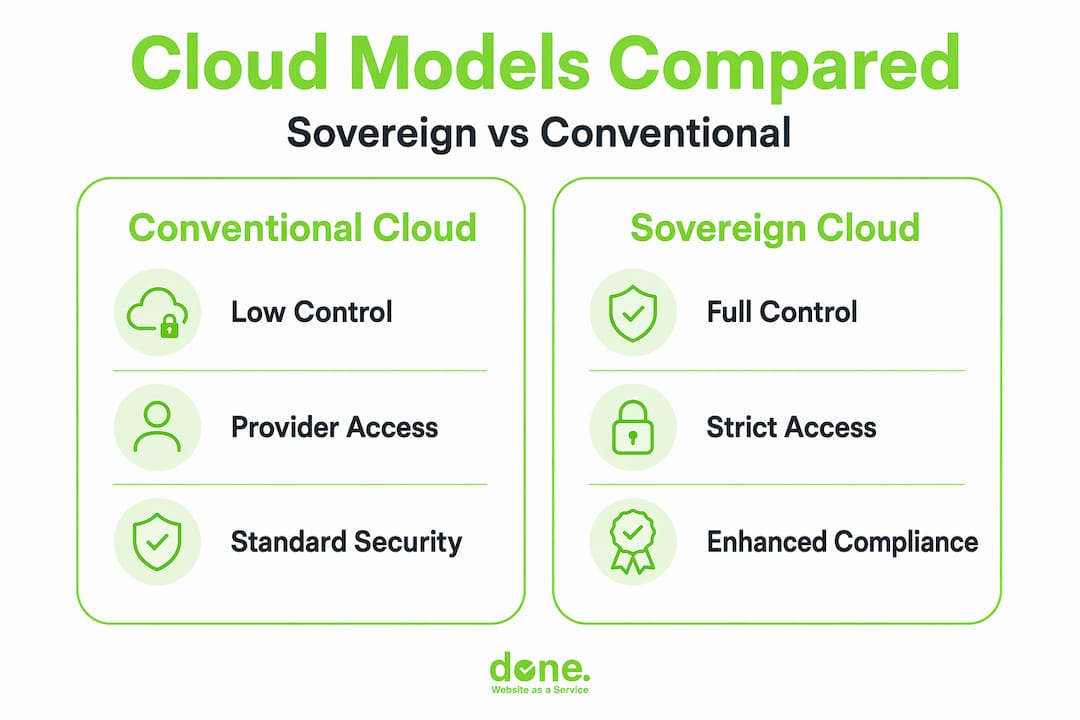
For businesses handling sensitive or regulated data, the right-hand column is not optional. It is where Luxembourg’s regulatory direction is heading.
Balancing compliance with business agility
The most common concern we hear from Luxembourg SMBs is that compliance will slow them down. That concern is understandable, but it is usually based on a misunderstanding of what sovereign infrastructure actually enables.
Luxembourg’s digital sovereignty strategy explicitly aims to expand sovereign cloud infrastructures while promoting innovation. The two goals are not in conflict. The friction usually comes from organisations that try to retrofit governance onto existing systems rather than designing it in from the start.
Common compliance pitfalls to avoid
- Undocumented processor agreements: Many businesses use SaaS tools and cloud services without a Data Processing Agreement (DPA) in place. Under GDPR, this is a breach waiting to be discovered.
- Ambiguous data retention policies: Keeping data indefinitely because deletion is inconvenient is one of the most common triggers for CNPD scrutiny.
- Shadow IT: Departments adopting tools independently of IT creates data flows that no one governs, which directly undermines your sovereignty posture.
- Inadequate breach response procedures: The CNPD requires notification within 72 hours of a breach. Without a tested procedure, most organisations miss this window.
Pro Tip: When evaluating any new digital tool or AI solution, add three governance questions to your standard vendor assessment: Where does this tool process personal data? What is the data retention policy? Who at the vendor has access to our data? These three questions will surface 80% of your sovereignty risks before you sign a contract.
Hybrid approaches often provide the most practical path forward. Organisations can maintain sovereignty over sensitive datasets by processing them on private or sovereign infrastructure, whilst using conventional cloud services for less sensitive workloads. This approach aligns with how AI adoption in Luxembourg is progressing in practice, where data-sensitive sectors are deploying private on-premise models rather than sending data to third-party AI services.
Business automation in Luxembourg also benefits from this hybrid model. Workflow automation tools that process internal documents or client communications can be configured to keep data within your governance perimeter, provided the architecture is designed with that goal in mind.
My perspective on Luxembourg’s sovereignty challenge
I’ve spent years working with SMBs in Luxembourg across legal, financial, and healthcare sectors, and the pattern I see repeatedly is the same. Businesses treat data sovereignty as a compliance deadline rather than an infrastructure decision.
What I’ve learnt is that the organisations that navigate this well are not the ones with the largest compliance budgets. They are the ones that treat sovereignty as a design constraint from the start. When you build a system, a website, a data pipeline, or an AI tool with governance baked in, compliance is not a retrofit. It is a feature.
The thing most businesses overlook is the contractual layer. Everyone focuses on technical controls, encryption, access logs, storage location. But the CNPD and the data space frameworks both place enormous weight on governance artefacts: contracts, data sharing agreements, processing records. I’ve seen organisations with technically excellent infrastructure fail audits because the paperwork was missing or inconsistent.
My practical advice: map your data before you map your compliance. You cannot govern what you cannot see. A proper data inventory, including third-party processors and SaaS tools, will reveal more about your actual sovereignty posture than any technical audit. Once you know what you have and where it goes, the regulatory requirements become much easier to address systematically.
Luxembourg’s direction through 2030 is clear. The government is building sovereign infrastructure and expects businesses to use it. Organisations that engage with the Data Spaces Hub, adopt FAIR data principles, and align their digital strategies with the national governance framework will be in a considerably stronger position than those waiting to see how enforcement evolves.
— Thomas
How Done can support your data strategy
Navigating Luxembourg data privacy laws and data residency requirements is not something most SMBs can handle alone, particularly when the regulatory picture is evolving as quickly as it is now.
At Done, we work with Luxembourg businesses in data-sensitive sectors including legal, finance, and healthcare to build digital infrastructure that is compliant by design. Our services span web development, AI consulting, and private on-premise AI deployment, all structured around GDPR compliance and Luxembourg’s sovereignty requirements. Whether you need a data governance audit, a compliant web platform, or guidance on digital consulting for Luxembourg SMBs, we bring over a decade of hands-on experience from 350+ local projects. Visit Done.lu to explore how we can support your compliance and digital strategy.
FAQ
What is data sovereignty in Luxembourg?
Data sovereignty in Luxembourg refers to an organisation’s ability to control who accesses its data, under what conditions, and for what purpose. It goes beyond data localisation to include governance, traceability, and compliance with GDPR and Luxembourg’s 2025 Data Strategy.
Does Luxembourg require data to be stored locally?
Luxembourg does not mandate blanket data localisation for private sector businesses. However, any cloud provider processing personal data must meet GDPR adequacy standards, and regulated sectors face additional data residency requirements on top of that baseline.
What is the CNPD’s role in data protection Luxembourg?
The CNPD is Luxembourg’s national data protection authority. It enforces GDPR obligations, investigates breaches, and can issue fines. Since November 2025, businesses also face potential class action claims under a new enforcement framework.
What are Luxembourg data spaces and why do they matter?
Data spaces are governed environments where organisations share data under agreed contractual and technical conditions. The Data Spaces Hub Luxembourg supports participation in these spaces, which align with Gaia-X and IDSA standards and provide a structured path to sovereign data sharing.
How to ensure data sovereignty for your business in Luxembourg?
Start with a data inventory covering all processing activities, third-party processors, and SaaS tools. Establish Data Processing Agreements with all vendors, document retention policies, and consider participating in certified data spaces for cross-sector data sharing. Aligning with FAIR data principles supports both compliance and operational efficiency.