

Website Optimization: Boosting Visibility and Leads Online
February 19, 2026
Responsive Web Design: Boosting User Engagement Online
February 21, 2026
Running an e-commerce business in Luxembourg means juggling technology, design, and customer needs every day. Sorting out what web development really covers is key for making smart investments that drive growth and avoid costly mistakes. This guide helps you cut through confusion by separating creating and maintaining websites from common myths, giving you clarity on what matters most for your online store’s visibility and sales.
Table of Contents
- Web Development Defined and Common Myths
- Types of Web Solutions for Businesses
- Key Features Driving Online Success
- ROI, Costs, and Potential Risks Explained
- How to Choose a Development Partner
Key Takeaways
| Point | Details |
|---|---|
| Understanding Web Development is Crucial | Web development encompasses both front-end and back-end processes, crucial for creating effective e-commerce solutions. Recognizing this distinction helps in making informed investment choices. |
| Ongoing Maintenance is Essential | Post-launch website updates for performance, security, and content are necessary for sustained success and customer trust. Continuous improvement should be integrated into your web strategy. |
| Choose the Right Development Solution | Selecting an appropriate web solution type—like e-commerce platforms or informational sites—aligns your website capabilities with your business goals, preventing costly mismatches. |
| Prioritize Security and Scalability | Investing in security measures and scalable solutions upfront can prevent significant financial losses from data breaches and allow your website to grow with your business needs. |
Web Development Defined and Common Myths
Web development is far more than just making websites look pretty. It’s the complete process of creating and maintaining websites, involving technical coding, creative design, performance optimization, and accessibility features. Think of it as building a digital storefront—you need the foundation (code), the visual appeal (design), and smooth operations (functionality).
When you’re running an e-commerce business in Luxembourg, understanding what web development actually covers helps you make smarter investment decisions. Many business owners confuse web development with web design, but they’re different disciplines working together.
What Web Development Actually Includes
Front-end development handles everything visitors see and interact with—buttons, navigation, layouts, colors. Back-end development manages the invisible systems running behind the scenes—databases, security, payment processing, inventory management.
Full-stack development combines both, meaning developers can build complete solutions from user interface to server operations. Creating and maintaining websites requires this mix of technical and creative skills.
For SMEs, knowing these distinctions matters because it affects how you budget, hire, and set expectations for your project.
Common Myths Holding Businesses Back
Myth 1: Web development and web design are the same thing.
They’re complementary but distinct. Designers focus on user experience, layout, and visual hierarchy. Developers write the code making everything work. Your online store needs both to succeed.
Myth 2: Once your website launches, the work is done.
This is backwards. A website requires ongoing updates for security, feature additions, performance improvements, and content changes. Think of it like your storefront—you don’t paint it once and ignore it forever.
Myth 3: Web development is a single skill.
It’s a combination of specialized skills including programming languages, databases, frameworks, and tools. No single developer knows everything—teams with different expertise produce better results.
Myth 4: Cheaper development always means lower quality.
Actually, the right approach matters more than price. Agencies using structured methodologies like growth-driven design deliver better outcomes than those simply coding fast. Quality comes from process, not just hourly rates.
Myth 5: You need constant changes to stay competitive.
You need strategic changes based on data, not constant tinkering. Too many updates without direction waste budget and confuse customers.
Why This Matters for Your Business
E-commerce firms need websites handling transactions, security, inventory integration, and mobile responsiveness. Understanding what web development covers helps you communicate effectively with developers and avoid costly miscommunications.
When you invest in proper web development, you’re investing in a strategic tool in permanent development—something that grows with your business, adapts to customer needs, and generates measurable returns.
The right web development investment turns your website into a sales engine, not just an online brochure.
Many Luxembourg SMEs underestimate web development’s impact on growth. Your competitors investing in proper development are likely seeing better conversion rates, lower bounce rates, and stronger customer loyalty.
Pro tip: Clearly define what you want your website to accomplish before discussing development. Whether it’s 200 online sales monthly or 50 qualified leads, having measurable goals helps developers build the right solution and helps you measure ROI.
Types of Web Solutions for Businesses
Not all websites are created equal. Your e-commerce store needs different functionality than a blog or portfolio site. Choosing the right web solution type directly impacts your ability to generate sales, manage customers, and scale operations.
Luxembourg SMEs often struggle because they pick generic solutions instead of matching their website to their actual business goals. Understanding your options prevents costly mistakes and wasted investment.
Website Types for Different Business Goals
Small business websites serve as digital storefronts, displaying products, services, contact information, and business hours. E-commerce websites handle transactions, inventory management, and payment processing—this is what your online store needs.
Portfolio sites showcase work samples and credentials. Blog platforms focus on content publication and audience building. Different website types serve different business purposes, so matching your site to your goals matters enormously.
For SMEs, the most critical distinction is whether you’re selling products online (e-commerce), gathering leads (informational), or building authority (content-driven).
To clarify different web solution types for business goals, see the comparison below:
| Website Type | Core Purpose | Typical Features | Best For |
|---|---|---|---|
| Informational Site | Provide basic business info | Services, contact details | Service providers |
| E-commerce Platform | Sell products/services online | Payments, inventory, orders | Online retail businesses |
| Portfolio Website | Showcase work and credentials | Galleries, testimonials | Freelancers, creatives |
| Blog Content Site | Publish and organize articles | Categories, comments | Thought leadership |
Web Applications vs. Static Websites
Static websites display fixed content that rarely changes. They’re fast and cost-effective for businesses with straightforward messaging. But they can’t handle customer accounts, real-time inventory, or dynamic pricing.

Web applications behave like software tools running in browsers. They process data, store customer information, and adapt to user actions. Your e-commerce platform is a web application—it needs to handle hundreds of simultaneous customers, process payments securely, and manage orders.
Web applications scale better as your business grows. They support features like customer dashboards, personalized recommendations, and automated workflows.
Service Models for Scalability
SaaS (Software as a Service) means you use cloud-based software on a monthly subscription. No servers to maintain, automatic updates included.
PaaS (Platform as a Service) gives developers tools to build custom applications without managing infrastructure.
IaaS (Infrastructure as a Service) provides raw computing power you control and configure yourself.
For most Luxembourg SMEs, understanding cloud service models helps explain why some solutions cost $50 monthly while others require thousands in setup. Managed services (SaaS) cost more per month but save time and technical headaches.
Choosing Your Path Forward
Your choice depends on three factors: budget, technical capacity, and growth timeline.
Rapid growth requires scalable solutions handling increased traffic without crashes. Monthly subscription models let you start lean and expand infrastructure as sales increase.
Limited IT staff points toward managed solutions where vendors handle updates and security. Growing complexity suggests custom development tailored to your specific workflow.
The right web solution grows with your business instead of becoming a constraint at $50,000 annual revenue.
Many SMEs underestimate how quickly they’ll outgrow basic platforms. Starting with a foundation supporting future expansion prevents expensive migrations later.
Pro tip: Ask potential developers or agencies whether your solution can handle 10 times your current traffic without major rebuilding. Scalability planning prevents costly rewrites as your business succeeds.
Key Features Driving Online Success
A beautiful website means nothing if customers abandon it after two seconds. Online success depends on specific technical and user-focused features working together seamlessly. Missing even one creates friction that costs sales.
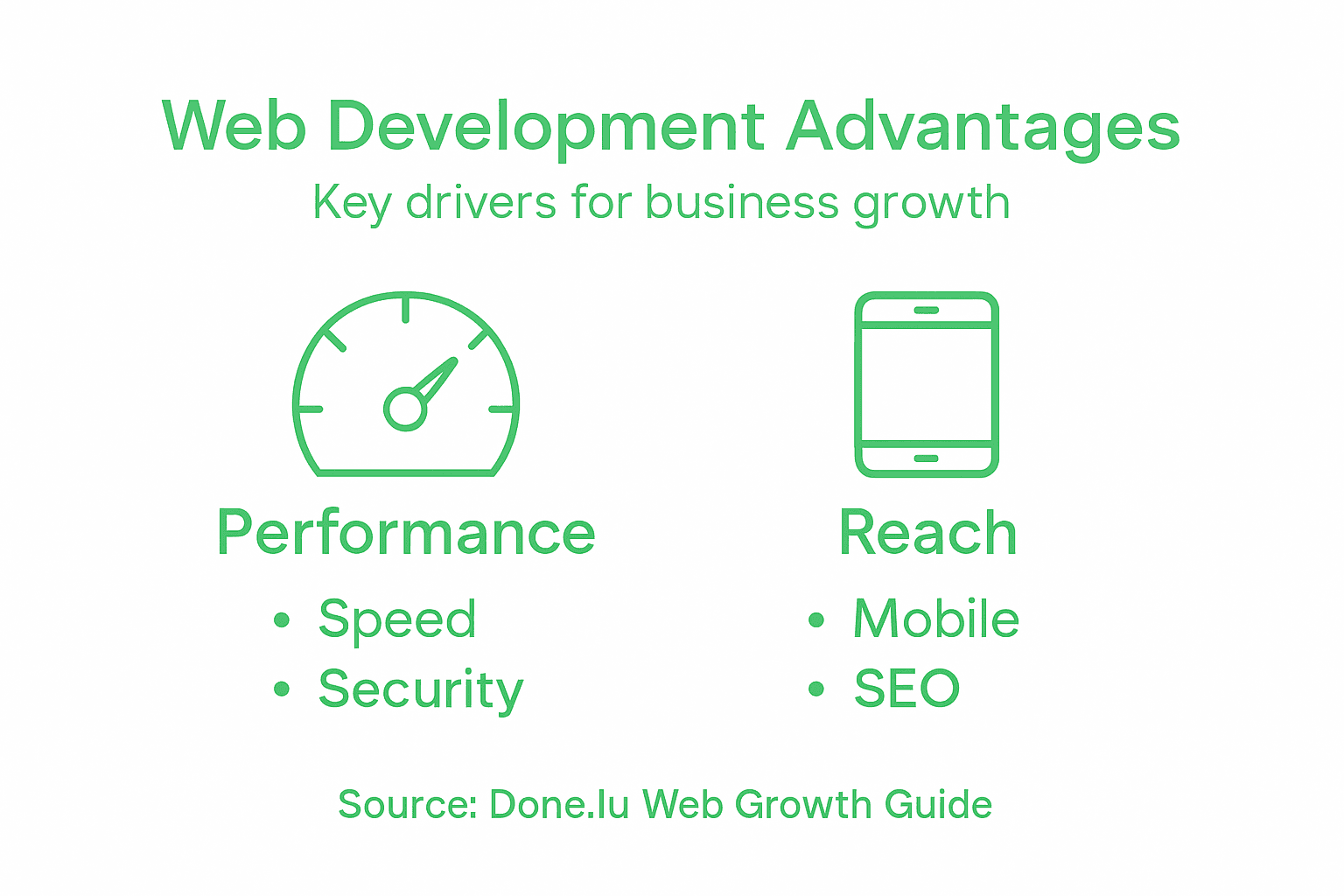
Luxembourg e-commerce businesses compete globally now. Your website must perform like competitors in Germany, France, and beyond. That means meeting standards your customers expect without even thinking about them.
Speed and Performance Matter More Than You Think
Page load speed directly impacts conversions. Studies show that every additional second of loading time reduces sales by 7 percent. A 3-second wait feels like an eternity to online shoppers.
Performance optimization means compressing images, minimizing code, and using efficient hosting. It’s not glamorous, but it’s profitable. Fast websites also rank better in search results.
Mobile users experience slowdowns more than desktop visitors. Optimizing for slower connections ensures your store works everywhere, not just high-speed offices.
Mobile Responsiveness is Non-Negotiable
Over 70 percent of e-commerce traffic comes from mobile devices. Your website must look perfect on phones, tablets, and desktops automatically. This isn’t a nice-to-have anymore—it’s baseline.
Responsive design adapts layouts to different screen sizes without requiring separate mobile apps. One codebase, multiple device displays. This saves maintenance costs and ensures consistency.
Testing on actual devices reveals problems that desktop browsers hide. Buttons too small to tap, text that requires zooming, or images that break formatting all hurt conversions.
Accessibility Opens Markets You’re Ignoring
Accessibility means people with disabilities can navigate your store. This includes screen readers for blind users, keyboard navigation, and color contrast standards.
It’s also profitable. People with disabilities represent purchasing power. Plus, accessibility standards improve overall user experience for everyone—better contrast helps people viewing on bright outdoor screens, keyboard navigation helps power users move faster.
Many businesses skip this thinking it costs extra. Actually, building accessibility into development saves money versus retrofitting later.
Security Builds Customer Trust
SSL certificates (the padlock in your browser) encrypt customer data. Without encryption, payment information travels unprotected. One breach destroys years of reputation building.
Security goes beyond encryption—regular updates, secure hosting, and malware scanning protect your database from attacks. Hackers target e-commerce sites constantly.
Customers notice security indicators. They won’t buy if your site looks unsafe. One warning message tanks conversions.
SEO Integration Drives Organic Visibility
Your website needs to exist in Google’s index. That means search-friendly structure, fast loading, mobile optimization, and quality content. These factors work together—you can’t optimize one and ignore the others.
User experience improvements strengthen both SEO and conversions simultaneously. Google ranks sites that visitors actually enjoy using.
The features driving success aren’t trendy or flashy—they’re foundational elements working invisibly to build trust and remove friction.
Pro tip: Test your website on a 4G connection using actual mobile devices before launch. Desktop testing misses real-world performance problems that cost customers.
Here’s a look at how key web application features impact business performance:
| Feature | What It Does | Benefit to Business |
|---|---|---|
| Performance Speed | Loads pages rapidly for users | Increases sales, better ranking |
| Mobile Responsive | Adapts to all device screens | Reaches broader audience |
| Accessibility | Enables use for people with disabilities | Expands customer base, legal compliance |
| Security | Protects data and payment information | Builds customer trust, prevents breaches |
| SEO Integration | Optimizes structure for search engines | Drives organic traffic and leads |
ROI, Costs, and Potential Risks Explained
Web development requires upfront investment. But skipping it costs more than paying for it. The real question isn’t whether you can afford to invest—it’s whether you can afford not to.
Luxembourg SMEs often hesitate because they don’t understand what returns to expect or what risks could derail the investment. Both matter for making confident decisions.
Understanding Real Costs
Web development costs vary dramatically based on complexity. A simple brochure website might cost $3,000 to $8,000. A full e-commerce platform handling inventory, payments, and shipping easily reaches $15,000 to $50,000 or more.
Hidden costs often surprise businesses:
- Ongoing hosting and server maintenance ($50-$500 monthly)
- Security updates and SSL certificates ($100-$300 annually)
- Content updates and optimization (time or contractor costs)
- Marketing integration and analytics setup ($500-$2,000)
- Performance monitoring and speed optimization
Many businesses underestimate the “after launch” budget. Your website isn’t finished when it goes live—it needs continuous improvement to compete.
ROI Looks Better Than You Think
An effective website increases revenue through multiple channels. It captures leads 24/7, reduces support costs through automation, and builds credibility with potential customers.
Consider this: If your website generates just 5 additional qualified leads monthly at an average sale value of $500, that’s $30,000 annual revenue from a single channel. Most businesses recover development costs within 6 to 12 months.
e-commerce sites show faster ROI. Accepting online payments eliminates phone-based orders, reduces payment processing delays, and increases average order value through cross-selling features.
Identifying Project Risks Early
Schedule risks happen when projects extend beyond estimates. Unclear requirements, scope creep, or technical complications delay launches. This keeps you offline longer and extends costs.
Budget risks occur when projects cost more than projected. Underestimating complexity, discovering legacy system problems, or adding features mid-project all inflate expenses.
Operational risks emerge after launch when your team can’t maintain the website properly. Security breaches, downtime incidents, or compatibility issues disrupt business.
Understanding different types of development risks helps you plan mitigation strategies upfront. Asking your developer about risk management practices separates professionals from amateurs.
Security Risks Cost More Than Development
Data breaches devastate businesses financially and reputationally. Average breach costs exceed $4.4 million including recovery, notifications, and legal expenses. One attack can eliminate years of growth.
Common web application vulnerabilities include weak authentication, unencrypted data, and inadequate access controls. These aren’t theoretical—hackers actively exploit them.
Skipping security investment guarantees security problems. Cheap development cutting corners on encryption or updates creates liability before your site even launches.
The cost of preventing security issues is tiny compared to paying for breaches, lawsuits, and lost customer trust.
Proper development includes regular security audits, automated scanning, and penetration testing. These feel expensive until you calculate breach costs.
Pro tip: Request a detailed cost breakdown and ask specifically about timeline risks and security measures before signing any contract. The developer should confidently explain their process for preventing project delays and security vulnerabilities.
How to Choose a Development Partner
Picking the wrong development partner wastes money and delays your growth. The wrong agency delivers mediocre work, communicates poorly, or abandons you after launch. The right partner becomes a strategic extension of your business.
Luxembourg SMEs have options—local agencies, freelancers, offshore teams. Each comes with tradeoffs. The goal is finding a partner aligned with your goals, budget, and communication style.
Evaluate Portfolio and Past Results
Portfolio quality reveals what a developer actually delivers. Look beyond design—check whether sites are fast, mobile-friendly, and function smoothly. Visit live projects and test them like a customer would.
Ask specific questions about past work: How long did projects take? Did they stay on budget? What happened after launch—do they provide ongoing support?
Red flags include vague portfolios, no contact information for past clients, or refusal to discuss previous projects. Quality agencies proudly share their work.
Verify Industry Experience and Expertise
Developers specializing in e-commerce understand payment systems, inventory management, and conversion optimization. Developers focused on corporate sites don’t.
Ask about their technology stack and why they chose it. Do they use modern frameworks? Can they explain their architectural decisions? Vague answers suggest they’re learning on your dime.
Experience matters because it prevents mistakes costing you thousands. Someone who’s built 20 e-commerce sites knows pitfalls that first-time developers discover mid-project.
Assess Communication and Project Management
You’ll communicate with your developer constantly. Bad communication creates misunderstandings, missed deadlines, and scope creep.
During initial conversations, notice whether they:
- Listen carefully to your goals
- Explain technical concepts in understandable language
- Ask clarifying questions
- Respond promptly to messages
- Provide regular status updates
Ask how they manage projects. Do they use formal project management tools? How often do you review progress? What happens if requirements change mid-project?
Strategic partner alignment requires clear communication channels and shared understanding of success metrics. Without this, even talented developers deliver disappointing results.
Check Security and Compliance Standards
Ask directly about security practices. Do they conduct code reviews? How do they handle data protection? Are they familiar with GDPR compliance requirements?
Developers cutting corners on security seem cheaper initially but create liability. One breach costs far more than upfront security investment.
Request references from past clients and ask specifically about their security experience. Don’t accept vague answers about this—it’s non-negotiable.
Understand Pricing Models and Long-Term Support
Cheap projects often mean rushed work or hidden costs appearing later. Understand exactly what’s included: hosting, domain registration, ongoing maintenance, support hours?
Ask about post-launch support. Most websites need updates, security patches, and optimization. Does your partner provide this? At what cost?
Fixed-price projects clarify costs but risk cutting corners. Time-and-materials contracts offer flexibility but create budget uncertainty. Discuss this explicitly.
The cheapest option rarely delivers the best results—but the most expensive option doesn’t guarantee quality either. Focus on value and long-term partnership potential.
Pro tip: Request a detailed contract specifying deliverables, timelines, payment schedule, revision limits, and post-launch support before signing. Any reputable agency welcomes this transparency and protects both parties.
Unlock Business Growth with Strategic Web Development
The article highlights the real challenges Luxembourg SMEs face when investing in web development, from confusing design with development to underestimating ongoing maintenance and scalability needs. You want a website that not only looks good but performs seamlessly, drives sales, and grows with your business through proven concepts like growth-driven design and robust security practices.
At Done.lu, we specialize in turning these challenges into growth opportunities. With over 150 successful projects, our tailored approach combines responsive web development, e-commerce solutions, and strategic digital marketing that aligns perfectly with your goals. We understand the importance of clear communication, security compliance, and scalable platforms that keep your online presence strong in Luxembourg and beyond.
Discover how to transform your website into a powerful sales engine that delivers measurable ROI.
Ready to elevate your business? Visit Done.lu to explore our services and connect with experts who will guide you through every step. Learn more about creating and maintaining websites that truly work for you and benefit from our expertise in digital marketing and growth-driven design. Don’t settle for average when your business deserves the best online presence today.
Frequently Asked Questions
What is the difference between web development and web design?
Web development involves the technical coding and functionality of a website, such as back-end systems and databases, while web design focuses on the visual layout and user experience of the site.
Why is ongoing website maintenance important after launch?
Ongoing website maintenance is crucial to ensure security, performance, and the addition of new features. A website is a dynamic tool that requires regular updates to remain effective and competitive.
How can investing in web development improve my business’s ROI?
By creating an effective website that captures leads, facilitates online sales, and automates processes, businesses can see significant revenue increases, reducing costs associated with traditional customer interactions.
What key features should my e-commerce website include for success?
Essential features for an e-commerce website include fast performance, mobile responsiveness, strong security measures, effective SEO integration, and accessibility for all users.