

Digital marketing automation guide for SMEs: 25% more leads
April 4, 2026
Best e-commerce platform types for European SMEs 2026
April 6, 2026
TL;DR:
- Most SMEs mistake maintaining a website and occasional social media posts for a digital strategy.
- A true digital strategy is a structured plan aligned with business goals, not reactive tactics.
- Small, focused AI pilots and continuous adaptation are key for sustainable SME digital growth.
Most small and medium-sized businesses in Luxembourg and Europe believe they have a digital strategy because they maintain a website and run occasional social media posts. That assumption is costly. A genuine digital strategy is a structured, business-aligned roadmap that connects every technology decision to a measurable commercial outcome. Digital strategy differs from ad hoc digital tactics in precisely this way: one is reactive, the other is deliberate. This guide cuts through the confusion, explains what a real digital strategy looks like for SMEs, and gives you practical frameworks to build, refine, and sustain one, even if you are starting from scratch.
Table of Contents
- Defining digital strategy: more than just tech adoption
- The essential components of a digital strategy for SMEs
- How AI and new technologies reshape SME digital strategy
- Common pitfalls and best practices for digital strategy success
- Our take: why digital strategy is the make-or-break factor for SME growth
- How you can take the next step with digital strategy
- Frequently asked questions
Key Takeaways
| Point | Details |
|---|---|
| Digital strategy is a plan | It maps technology choices to business goals, unlike ad hoc online tactics. |
| AI drives real results | Integrating AI can increase SME revenue and operational efficiency significantly. |
| Start small and adapt | Test, measure, and scale pilots to avoid costly mistakes and drive sustainable growth. |
| Success needs alignment | Strategies work best when consistently tied to business objectives and internal buy-in. |
| Funding can help | Leverage local and EU programmes to fund your digital and AI journey. |
Defining digital strategy: more than just tech adoption
Now that we have highlighted why most SMEs get digital strategy wrong, let us clarify the difference between strategy, transformation, and everyday digital marketing.
A digital strategy is a structured, phased plan that aligns your technology choices with your core business goals. It answers three questions: where are we now, where do we want to go, and which digital tools and channels will get us there most efficiently. Without those answers, you are not executing a strategy. You are reacting.
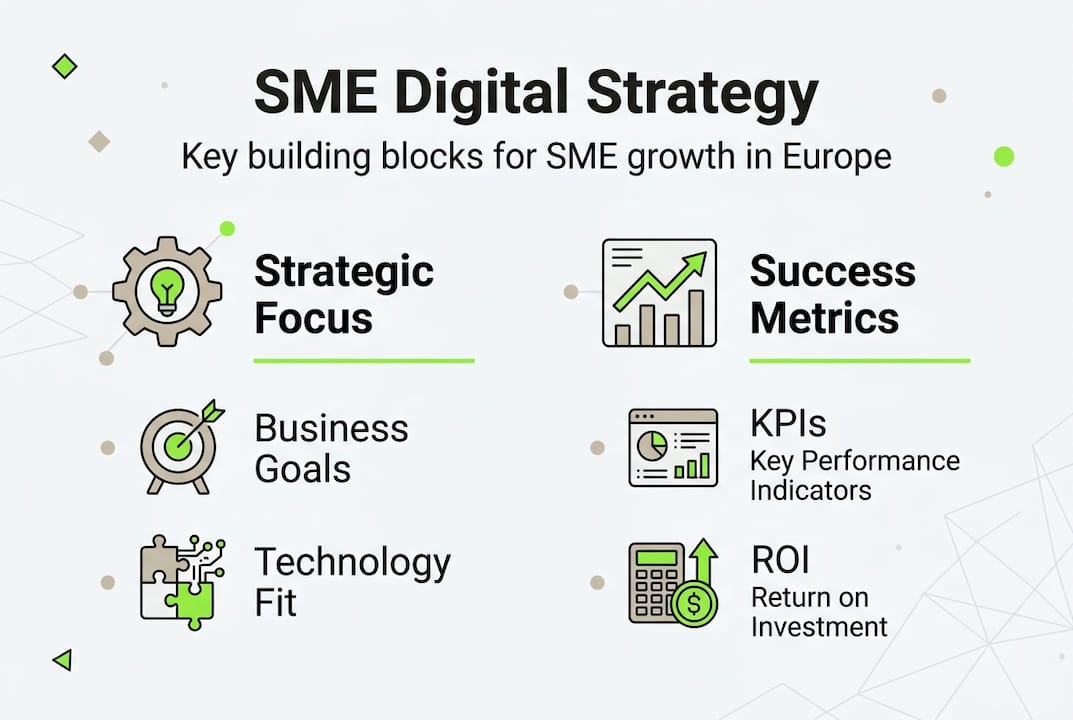
The confusion between digital strategy and digital transformation is common and consequential. Think of it this way: digital strategy is the blueprint while transformation is the execution that reshapes business operations. One is the plan, the other is the change programme that follows. Skipping the plan and jumping straight into transformation is a leading reason why so many initiatives fail.
The numbers are sobering. 71% of SMEs lack a clearly articulated digital strategy, yet they continue investing in tools, platforms, and campaigns without a coherent framework to guide those investments. The result is wasted budget and missed growth opportunities.
Here is how the three concepts differ in practice:
- Digital strategy: A deliberate plan linking technology decisions to business objectives, with defined KPIs (key performance indicators) and timelines.
- Digital transformation: The operational and cultural change that happens when you execute your strategy at scale, reshaping processes, teams, and customer experiences.
- Digital marketing: A subset of digital strategy focused specifically on acquiring and retaining customers through online channels such as SEO, paid advertising, email, and social media. Explore business-aligned digital marketing to see how marketing fits within a broader strategic framework.
The hard truth: Most SMEs invest in digital marketing without a digital strategy. That is like running paid ads without knowing your target customer. The spend happens, but the results rarely compound into sustainable growth.
Common pitfalls include the reactive approach, where businesses adopt a new tool because a competitor did, and the tech-first mindset, where platforms are chosen before goals are defined. Both lead to the same outcome: technology that does not serve the business. Reviewing AI strategies for SME growth can help you see how goal-setting must precede tool selection, even when the technology in question is genuinely powerful.
The key feature that separates a real digital strategy from a collection of tactics is measurability. Every initiative within your strategy should have a defined output, whether that is lead volume, conversion rate, customer acquisition cost, or revenue per channel. If you cannot measure it, you cannot improve it.
The essential components of a digital strategy for SMEs
With a clearer definition in mind, let us look at exactly what should go into a digital strategy designed for SME realities.
Building a digital strategy is not a single event. It is a structured process that moves through distinct phases, each one informing the next. Key methodologies include assessment, goal setting, and structured framework application, and skipping any phase weakens the entire plan.
Here are the five main steps for SMEs building a digital strategy:
- Digital maturity assessment: Evaluate your current capabilities across technology, data, processes, and people. A digital maturity assessment gives you an honest baseline and prevents overinvestment in areas that are not yet ready.
- Vision and goal setting: Define what success looks like in 12 to 36 months. Goals should be specific, measurable, and tied directly to business priorities such as revenue growth, cost reduction, or market expansion.
- Framework selection and strategic alignment: Choose a structured approach that fits your size and sector. Common frameworks include DASAT (Diagnose, Align, Select, Act, Track), the ACT model, and the four-pillar approach covering customers, operations, data, and innovation.
- Technical foundation and tool selection: Only after goals and frameworks are in place should you select platforms and AI tools in digital strategy. This sequence prevents the common mistake of buying technology before knowing what problem it needs to solve.
- Data-driven execution and ongoing optimisation: Launch, measure, learn, and adjust. Digital strategy is not a document you file away. It is a living process that evolves as your market, customers, and capabilities change.
| Framework | Primary focus | Typical timeline | Best suited for |
|---|---|---|---|
| DASAT | Diagnosis to tracking | 6 to 12 months | SMEs starting from scratch |
| ACT model | Agility and customer focus | 3 to 9 months | Growth-stage businesses |
| Four-pillar approach | Balanced transformation | 12 to 24 months | Multi-department SMEs |
| Growth Driven Design | Web and inbound marketing | Ongoing | SMEs prioritising lead generation |
Connecting your strategy to core business objectives is non-negotiable. Whether your priority is cost reduction, product differentiation, market entry, or customer retention, every digital initiative must map back to one of those objectives. If it does not, it is a distraction.

Pro Tip: Do not attempt to transform everything at once. Choose one or two targeted pilots with clear goals, measure their impact rigorously, and use those results to build internal confidence before scaling. Small wins compound into lasting change.
How AI and new technologies reshape SME digital strategy
Now, as digital technologies evolve rapidly, integrating AI tools has become a game-changer for SME strategy, especially in forward-looking markets like Luxembourg.
The current landscape is encouraging but uneven. Luxembourg leads EU AI adoption with 33.61% of businesses using AI compared to the EU average of 20%, and AI can boost SME revenue by 30% or more. Yet many SMEs across Europe still treat AI as a future concern rather than a present opportunity.
The contrast between strategies with and without AI is stark:
| Capability | Without AI | With AI |
|---|---|---|
| Customer support | Manual, business hours only | 24/7 chatbot, instant response |
| Marketing personalisation | Broad campaigns, low precision | Behaviour-based targeting |
| Data analysis | Periodic, manual reporting | Real-time dashboards and alerts |
| Content production | Time-intensive, inconsistent | Assisted drafting, faster output |
| Operational efficiency | Reactive processes | Predictive and automated workflows |
The AI ROI can reach 140% in the first year, with payback periods as short as five months. Those figures are not reserved for large enterprises. SMEs with focused pilots and clear goals are achieving them regularly.
Key AI tools and use cases relevant to SMEs in Luxembourg and Europe include:
- AI chatbots: Handle customer enquiries, qualify leads, and book appointments automatically, saving 8 to 15 hours per week for small teams.
- Predictive analytics: Identify which customers are likely to churn or convert, allowing proactive outreach rather than reactive responses.
- Marketing automation: Personalise email sequences, social content, and ad targeting based on real user behaviour. See how AI in digital marketing is reshaping campaign performance for European SMEs.
- Document processing: Automate invoice handling, contract review, and compliance checks, particularly valuable in legal, finance, and accounting sectors.
- Predictive maintenance: For businesses with physical assets, AI can flag issues before they become costly failures.
For SMEs curious about where to begin, exploring the best AI tools for SMEs provides a practical starting point organised by business function.
Pro Tip: Luxembourg’s Fit 4 AI programme and Luxembourg AI Factory offer co-financing of up to 50% for qualifying digital and AI projects. Using these programmes to fund your first pilot significantly reduces financial risk and accelerates your team’s confidence with new technology. Check Luxembourg small business AI trends for current programme details.
Common pitfalls and best practices for digital strategy success
But adopting digital strategy without caution can backfire. Here are the top mistakes SMEs make and what works instead.
Even well-intentioned digital strategies fail. 70% of transformation failures are traced to culture and mis-execution rather than technology itself. The tools are rarely the problem. The process and the people around them usually are.
The most common mistakes SMEs make include:
- Skipping strategic alignment: Launching digital initiatives without connecting them to specific business goals. The result is activity without impact.
- Overinvesting in tools before building capability: Purchasing expensive platforms before your team has the skills or processes to use them effectively.
- Ignoring change management: Assuming that deploying a new system will automatically change how people work. It will not, without training, communication, and leadership support.
- Measuring the wrong things: Tracking vanity metrics such as follower counts or page views instead of revenue-linked outcomes like cost per lead or customer lifetime value.
- Treating strategy as a one-time project: Writing a digital strategy document and then filing it away. Markets shift, customer behaviour evolves, and your strategy must adapt accordingly.
Proven best practices for SMEs in Luxembourg and Europe include:
- Start with a focused pilot rather than a wide rollout. One well-measured experiment teaches you more than five simultaneous launches.
- Secure internal champions early. Identify team members who are enthusiastic about digital change and empower them to support their colleagues.
- Set a review cadence. Revisit your strategy quarterly, not annually, to course-correct before small misalignments become expensive problems.
- Invest in skills alongside tools. Every technology investment should be paired with training so your team can use it confidently. Explore digital marketing advantages to understand how capability-building amplifies tool investments.
- Document what works. Build an internal knowledge base of successful processes so that growth is replicable, not dependent on individual memory.
- Review avoiding common pitfalls in SME AI adoption for specific guidance on AI-related risks.
Expert perspective: The SMEs that sustain digital growth are not those with the biggest budgets or the most sophisticated tools. They are the ones that run disciplined, measurable pilots, learn quickly, and build on what works. Phased execution beats ambitious transformation every time. Review SME digital pitfalls for a structured checklist of what to avoid.
Cultural buy-in is not a soft concern. It is a hard dependency. When teams understand why a digital initiative exists and how it makes their work easier, adoption rates climb and results follow. Without that understanding, even the best strategy stalls.
Our take: why digital strategy is the make-or-break factor for SME growth
After laying out the facts and frameworks, here is a perspective born from real-world experience working with SMEs across Luxembourg and Europe.
Most guides on digital strategy focus almost entirely on the technical side: which tools to choose, which frameworks to apply, which metrics to track. What they consistently underplay is the human dimension. In our experience, the businesses that struggle with digital strategy are rarely struggling because they chose the wrong platform. They struggle because they did not bring their people along.
Here is a view that runs counter to much of the advice you will find online: large-scale digital transformation projects are overrated for SMEs. A bold, multi-year transformation initiative sounds impressive but carries enormous execution risk. A series of small, low-cost AI pilots, such as a chatbot handling customer enquiries or an automation tool managing invoice processing, delivers faster results, builds team confidence, and creates a foundation for genuine change.
We have seen real-world digital strategy results confirm this repeatedly. The SMEs that grow sustainably are those that treat digital strategy as an ongoing discipline rather than a one-time investment. They review, adjust, and experiment continuously. They do not wait for the perfect plan before acting.
Digital maturity is a journey, not a destination. The goal is not to reach a fixed endpoint. It is to build an organisation that learns and adapts faster than its competitors. For Luxembourg and European SMEs, that capacity for continuous adaptation is the real competitive advantage.
Pro Tip: Use government co-financing programmes such as Fit 4 AI to fund your first digital or AI pilot. Early wins funded at reduced cost give your team tangible proof that digital strategy works, and that proof is the most powerful tool for driving broader adoption.
How you can take the next step with digital strategy
Ready to implement an actionable digital strategy? Here is how we help SMEs bridge the gap between intention and results.
At Done.lu, we work with small and medium-sized businesses across Luxembourg and Europe to turn digital ambition into measurable outcomes. Whether you are building your first structured plan or looking to integrate AI into an existing strategy, our team brings hands-on expertise across web development, digital marketing, and AI consulting.
We begin every engagement with a thorough audit of your current digital position, then co-develop a customised digital strategy planning roadmap aligned to your specific business goals. Our expert AI consulting service helps you identify the right tools, run focused pilots, and measure ROI from day one. We also provide web development guidance to ensure your technical foundation supports your strategic ambitions. Get in touch with our team to discuss your goals and find out how we can help you move forward with confidence.
Frequently asked questions
What is the difference between digital strategy and digital transformation?
Digital strategy is the blueprint aligning technology with business goals, while digital transformation is the process of executing that strategy to reshape operations and culture. One defines the direction; the other is the journey of getting there.
How can AI benefit my SME’s digital strategy?
AI can boost SME revenue by 30% or more, automate routine tasks, and deliver fast ROI, particularly through chatbots, predictive analytics, and marketing automation tools tailored to your business size.
What are the first steps in building a digital strategy?
Start by completing a digital maturity assessment to understand your current capabilities, then set clear business goals, and map digital initiatives that directly support those objectives before selecting any tools.
Are there funding programmes for digital and AI projects in Luxembourg?
Yes, initiatives such as Fit 4 AI and Luxembourg AI Factory offer up to 50% co-financing for qualifying SME digital adoption projects, significantly reducing the financial risk of your first pilot.