

AI readiness audit: a practical guide for SMBs
May 27, 2026
Data sovereignty Luxembourg: your 2026 compliance guide
May 29, 2026
TL;DR:
- Deploying AI tools in your business requires structured employee training to ensure effective usage and operational safety. SMEs must conduct a skills audit, tailor training to roles, and integrate learning into daily workflows to achieve lasting impact. Continuous measurement and addressing human concerns are essential for sustained AI adoption and success.
Deploying AI tools across your business is only half the equation. The other half is making sure your people actually know how to use them well. Yet most SME managers underestimate what structured AI training employees really requires, assuming staff will pick it up on their own through trial and error. They rarely do. AI literacy is now considered a baseline skill comparable to digital literacy, and the absence of structured training creates real operational risks: inconsistent outputs, poor data handling, and wasted tool investment. This guide gives you a clear, practical framework to assess, plan, deliver, and measure AI skills development across your team.
Table of Contents
- Key takeaways
- AI training employees: assessing what your team actually knows
- Choosing the right AI training programmes
- Implementing AI training: practical steps
- Measuring training effectiveness
- Common pitfalls in AI employee training
- My honest take on what actually works
- How Done can support your AI training strategy
- FAQ
Key takeaways
| Point | Details |
|---|---|
| Start with a skills audit | Map your team’s existing AI knowledge before designing any training programme to avoid wasted effort. |
| Match training format to role | Generic courses rarely work; choose content aligned to each employee’s specific job function and tools. |
| Embed learning in daily work | Just-in-time and conversational learning platforms outperform standalone courses for lasting skill adoption. |
| Track measurable outcomes | Define KPIs for AI skill acquisition before training begins so you can prove and improve ROI. |
| Plan for cultural resistance | Address employee concerns about AI monitoring and job security early to keep engagement high. |
AI training employees: assessing what your team actually knows
Before you design a single training session, you need to know where your team stands. Most organisations fail to assess existing AI skills before building training programmes, which leads directly to poor results. You either bore experienced employees with basics they already know, or overwhelm beginners with concepts they are not ready for. Both outcomes waste time and money.
A proper skills audit does not need to be complicated. For most SMEs, a combination of structured self-assessments, short practical tasks, and direct manager observations is enough to get a clear picture.
Here is what a practical AI skills audit for an SME typically covers:
- Current tool usage: Which AI tools, if any, are employees already using? How frequently, and for what tasks?
- Conceptual understanding: Can employees explain what a large language model does, or why a prompt matters? You are not testing for a computer science degree, just functional awareness.
- Data handling habits: Do staff understand basic data privacy rules when using AI tools? This matters especially under GDPR in Luxembourg and the broader EU.
- Confidence and appetite: Are employees curious about AI or anxious about it? Motivation levels affect how you design the programme.
- Role-specific needs: A finance officer needs different AI competencies from a marketing coordinator. Map the gaps per role, not just per person.
Once you have audit data, group employees into readiness tiers. A simple three-tier model works well: foundational (little to no AI experience), intermediate (uses AI tools occasionally but inconsistently), and advanced (actively integrates AI into daily workflows). Setting training goals then becomes straightforward because you are targeting specific gaps rather than guessing.
Pro Tip: Run the audit anonymously for the initial round. Employees who fear judgment tend to underreport their struggles with AI tools, which skews your data and leads to training that misses the real gaps.
Linking the skills audit findings to specific business outcomes is where most managers stop short. Do not just note that someone lacks prompt-writing skills. Connect it to a business problem: slower content production, inconsistent customer responses, or manual data tasks that could be automated. Training feels far more urgent when the skills gap has a price tag attached to it.
Choosing the right AI training programmes
Not all AI training is created equal, and for an SME with limited budgets and limited time to take staff off the floor, the wrong choice is genuinely costly. The good news is that the range of options has expanded significantly, and there is something suitable for nearly every role and budget.

The three main formats you will encounter are formal online courses, structured workshops, and on-the-job learning. Each has its place.
| Format | Best for | Typical cost | Time commitment |
|---|---|---|---|
| Online self-paced course | Technical roles, motivated self-starters | Low to medium | 5 to 15 hours per week |
| Facilitated workshop | Team-wide fundamentals, culture building | Medium to high | 1 to 3 days |
| On-the-job / embedded learning | All roles, daily skill reinforcement | Low ongoing | 15 to 30 minutes daily |
| Internal certification programme | Technical staff, long-term upskilling | High upfront | Several months |
For technical roles, structured courses provide genuine depth. The Machine Learning Specialization by Andrew Ng on Coursera covers Python-based ML models and neural networks across approximately ten hours per week for two months. It is not light, but it is among the most respected entry points for employees moving into technical AI roles.
For the majority of your workforce, however, role-specific workshops and embedded learning tools will deliver better results faster. A customer service team does not need to understand backpropagation. They need to know how to write effective prompts, how to verify AI-generated responses, and when not to use AI at all.
When evaluating any programme, consider these factors:
- Relevance to actual tools your team uses. Training on theoretical machine learning concepts will not help an operations manager who needs to automate reports in your existing software.
- Delivery format and accessibility. Employees with heavy workloads need short, modular content they can complete in segments, not full-day blocks.
- Language and localisation. For Luxembourg SMEs operating in French, German, or Luxembourgish environments, language-appropriate materials matter more than most training providers acknowledge.
- Cost per employee versus impact. Large corporate AI readiness programmes can reach around €8,000 per employee over several months. That model is built for enterprise scale. SMEs need targeted, modular programmes that respect tighter budgets without sacrificing substance.
A practical blend for most SMEs: one foundational course or workshop per role tier, supplemented by daily embedded learning tools for ongoing reinforcement. You can read more about selecting the right tools in Done’s guide to AI tools for small businesses.
Pro Tip: Ask any training provider for example completion rates and post-training assessment scores from past SME clients. Providers who cannot or will not share this data are worth treating with caution.
Implementing AI training: practical steps
Even a well-designed training programme fails if the rollout is poorly managed. Engagement drops, attendance slips, and the skills never translate into changed behaviour. A structured implementation approach prevents this.
Here is a step-by-step process that works reliably for SMEs:
-
Set a clear programme calendar. Give employees four to six weeks’ notice before training begins. Ambiguity about timing breeds anxiety and absenteeism. Define start dates, module deadlines, and any assessment windows upfront.
-
Assign an internal training lead. This does not need to be a dedicated learning and development professional. A technically confident team leader or HR manager who understands the business goals works perfectly. Their role is to coordinate, answer questions, and keep momentum going.
-
Integrate training into the working day. Conversational, just-in-time learning platforms embed AI skills into everyday workflows far more effectively than standalone courses. Think of tools that deliver short lessons triggered by the actual tasks employees are doing, rather than requiring them to log into a separate learning management system at an arbitrary time.
-
Build in hands-on application from day one. Every module should include a real task your team will recognise. If you are training a content team on AI writing tools, the hands-on exercise should use your actual content types, your actual tone of voice guidelines, and your actual workflows. Abstract exercises lose employees quickly.
-
Track participation actively, not passively. Do not rely solely on automated completion reports. A brief weekly check-in with line managers reveals who is struggling, who has questions, and where the content is not landing.
-
Address resistance directly and early. Employees sometimes disengage from AI training because they fear the technology is being introduced to replace them, or that their usage is being monitored to evaluate their performance. Be explicit about what is being tracked, why, and what the data will be used for. Transparency here is not optional. Cultural friction around AI monitoring is a well-documented barrier to adoption and it is entirely manageable when addressed openly.
-
Celebrate early wins publicly. When an employee applies a new AI skill to solve a real problem, make that visible. Recognition creates a positive feedback loop that motivates the rest of the team to engage more seriously.
Pro Tip: Build a short internal knowledge base where employees can share prompts, workflows, and tips they discover during training. Peer learning accelerates skill adoption faster than any formal course, and it costs you almost nothing.
For a broader view of how to structure the adoption process, Done’s guide on team AI adoption for SMBs walks through the full integration journey in practical detail.
Measuring training effectiveness
Delivering training is straightforward compared to proving it worked. Many managers run a programme, see reasonable completion rates, and assume the job is done. It rarely is. Skills decay quickly without reinforcement, and completion rates measure attendance, not competence.
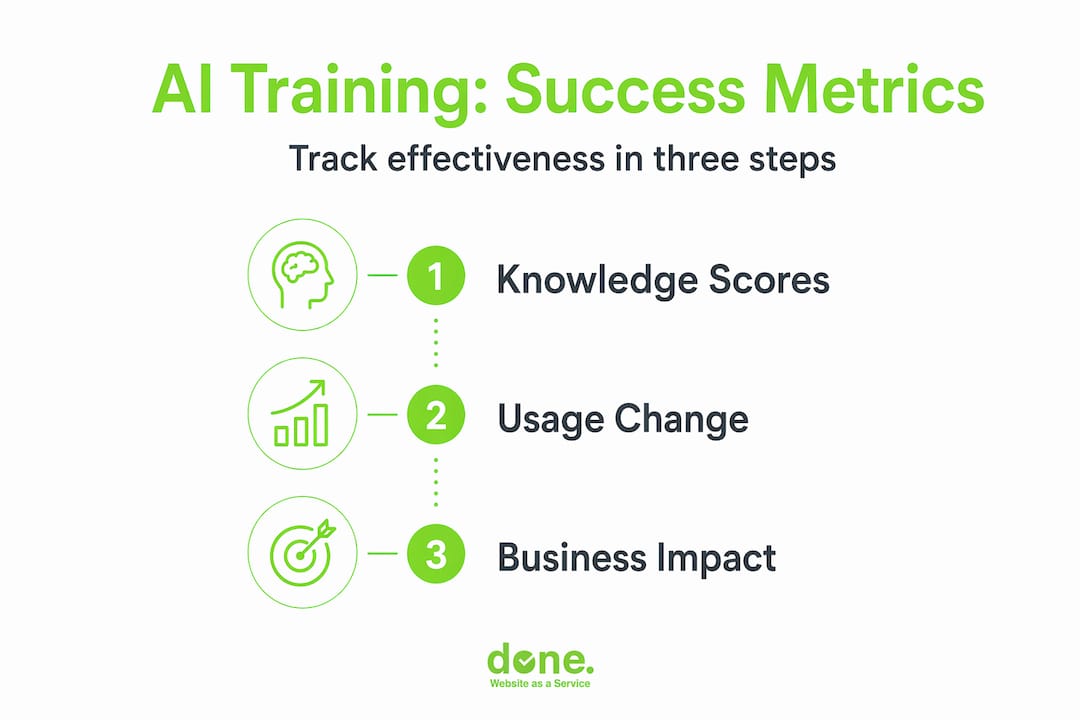
Define your KPIs before the programme launches, not after. The table below outlines a useful set of metrics across three measurement levels.
| Measurement level | What to track | How to measure |
|---|---|---|
| Knowledge acquisition | Pre and post-test scores per module | Short assessments built into the programme |
| Behavioural change | Frequency and quality of AI tool use on the job | Manager observations, tool usage logs |
| Business impact | Time saved on specific tasks, error rates, output quality | Comparison of before and after data across 30 to 90 days |
| Engagement | Completion rates, dropout points, employee satisfaction scores | LMS data, anonymous surveys |
The most common mistake here is focusing entirely on the first level and ignoring the second and third. Test scores tell you whether someone understood the concept. Behavioural data tells you whether they are actually using it. Business impact data tells you whether the investment was worth it.
Adaptive, continuously updated training models consistently outperform annual or one-off programmes. Once you have baseline data from your first cycle, use it to update content, retire what is not landing, and add modules that address gaps the data reveals.
Key practices that support ongoing improvement:
- Re-run the skills audit every six months. The AI tools market moves fast. Skills that were advanced six months ago are now baseline. Your audit must reflect this.
- Solicit structured employee feedback mid-programme, not just at the end. Waiting until completion means you cannot act on feedback until the next cohort.
- Connect training outcomes to your HR performance reviews. When AI skill development is part of a formal career conversation, employees treat it with greater seriousness.
- Use usage analytics from your AI tools. Most enterprise-grade AI platforms provide data on how features are being used. Cross-reference this with training completion data to spot where skills are or are not transferring to real work.
Common pitfalls in AI employee training
The same mistakes appear repeatedly across SMEs attempting AI upskilling for teams. Knowing them in advance saves significant time and budget.
- Skipping the skills audit. Without a structured audit, training design is essentially guesswork. You will either over-invest in areas employees already understand or miss critical gaps entirely.
- Choosing generic content over role-specific material. An AI training course designed for any employee in any industry will feel irrelevant to your sales team in Luxembourg. Specificity drives engagement.
- Underestimating the true cost. Training costs are not just the course fees. Factor in the time employees spend away from their regular tasks, the management time needed to coordinate the programme, and the cost of replacing productivity during the learning period.
- Treating AI training as a one-time event. Traditional annual compliance-style training is ineffective for dynamic, fast-moving skill areas like AI. A single workshop in January does not prepare your team for the tools they will be using in September.
- Ignoring the human side. Employees who believe AI is being used to monitor them, grade their performance, or justify redundancies will disengage regardless of how good the content is.
The organisations that get AI education for their workforce right share one characteristic: they treat it as an ongoing business capability investment, not a compliance tick-box. As McKinsey’s research on workforce transformation consistently shows, the companies that build internal AI learning cultures early maintain a compounding advantage over those that rely on periodic external training sprints.
“The biggest risk for SMEs is not moving too fast with AI. It is moving fast with tools and slow with people. The tools are the easy part.”
My honest take on what actually works
I have been involved in AI adoption projects with SMEs across Luxembourg and broader Europe for several years now. What I have learned does not always match the advice you read in generic training guides.
The first uncomfortable truth is that most AI training programmes fail not because of the content, but because of timing. Companies buy AI tools, roll them out, and then, weeks later, decide to arrange some training. By that point, employees have already formed habits, many of them bad ones, and unlearning them takes far more effort than teaching correctly from the start. Training needs to precede or run parallel to tool deployment, not follow it.
The second thing I have noticed is that the employees who benefit most from AI training are rarely the ones managers expect. In my experience, it is often the mid-level staff in operations, finance, or customer support who become the most effective AI users. They have deep process knowledge, clear use cases, and a strong motivation to reduce repetitive work. Technical staff sometimes get fixated on the mechanics of the tools rather than on practical outcomes.
I am also sceptical of the argument that on-the-job learning is sufficient on its own. Embedding learning into workflows, as Cognizant’s research supports, is genuinely effective for reinforcement. But it assumes someone already has the foundational knowledge to apply. Without a structured starting point, just-in-time learning becomes just-in-time confusion.
What I consistently recommend to clients is a three-phase approach: a focused initial programme (four to eight weeks, role-specific), followed by embedded daily reinforcement tools, followed by a quarterly review that feeds back into the next training cycle. It is not glamorous, but it is what actually produces lasting results rather than a temporary boost in completion metrics.
The Infosys model of immersive, project-aligned training is instructive even for SMEs who cannot replicate it at scale. The principle, that training must be aligned to the actual work employees will be doing rather than general curricula, applies regardless of company size.
— Thomas
How Done can support your AI training strategy
Done works with SMEs across Luxembourg and Europe to design and implement AI adoption programmes that are grounded in real business outcomes. We start with a thorough audit of your team’s current AI readiness, map gaps to specific business goals, and recommend training structures that fit your budget, your team’s roles, and your existing tools.
We also help you select, configure, and deploy the AI platforms your team will be trained on, so there is no disconnect between the skills your staff are building and the tools they are actually using day to day. Our AI strategy consulting for SMEs covers the full journey from initial assessment through to implementation and ongoing optimisation.
If you want practical guidance rather than generic advice, explore Done’s AI consulting services for SMBs or get in touch to discuss what an AI training programme would look like for your specific team.
FAQ
What is AI training for employees?
AI training for employees is the process of developing your team’s ability to use, interpret, and work alongside artificial intelligence tools effectively. It covers everything from basic AI literacy to role-specific skills such as prompt writing, data interpretation, and workflow automation.
How long does it take to train employees in AI?
It depends on the depth of training required. Foundational AI literacy programmes typically run four to six weeks. More technical machine learning training, such as Coursera’s specialisation, requires around two months at approximately ten hours per week.
How do I know if my AI training programme is working?
Measure at three levels: knowledge scores from assessments, changes in actual tool usage behaviour, and measurable business impact such as time saved or output quality. Completion rates alone are not sufficient evidence that training has been effective.
How much does AI upskilling for teams cost?
Costs vary widely. Off-the-shelf online courses can be under €100 per employee. Facilitated workshops run from a few hundred to several thousand euros per cohort. Corporate-level immersive programmes can reach €8,000 per person. For most SMEs, a blended approach of targeted courses and embedded tools delivers the best return.
Should I use external trainers or build training internally?
For foundational AI literacy, external trainers or quality online platforms are usually more cost-effective and bring wider expertise. For advanced, role-specific training tied to your own tools and workflows, internal expertise combined with external content gives you the best of both. The goal is training aligned to your actual work, not generic curricula that could apply to any organisation.