

Social media marketing for SMEs: boost visibility in 2026
March 20, 2026
How to use AI tools to boost your SME’s digital marketing
March 22, 2026
More than half of European SMEs already use AI to transform their marketing, and those who adopt it properly see revenue growth exceeding 30%. Yet many business owners remain uncertain about how to apply these technologies effectively whilst navigating compliance requirements like GDPR and the EU AI Act. This guide clarifies AI’s practical benefits for your online presence, explains which tools deliver the strongest results for customer engagement and lead generation, and outlines the essential steps to implement AI marketing strategies that align with European regulations and your business goals.
Table of Contents
- Key takeaways
- Why AI matters for small and medium businesses in Europe
- How AI technologies enhance digital marketing and online presence
- Navigating challenges and compliance when adopting AI
- Implementing AI in your SME’s marketing strategy: practical steps
- Explore expert digital marketing and web development solutions
- Frequently asked questions
Key Takeaways
| Point | Details |
|---|---|
| Revenue uplift | AI adoption yields 30% plus revenue growth for European SMEs by boosting customer engagement, data analysis and automation. |
| Core AI uses | Chatbots, data analytics and email marketing are the primary technologies driving customer acquisition and retention. |
| EU AI Act compliance | Businesses must ensure transparency and meet GDPR and EU AI Act requirements when deploying AI marketing tools. |
| Foundational readiness | Prioritise basic data hygiene, infrastructure and staff capability before scaling AI to reduce risk. |
| One tool at a time | Begin with a single AI solution addressing your biggest marketing bottleneck to measure impact clearly before expanding. |
Why AI matters for small and medium businesses in Europe
Artificial intelligence has moved from experimental technology to essential business tool. Research shows that 58% of European SMEs have adopted AI mainly for customer engagement, data analysis and email marketing. These aren’t massive corporations with unlimited budgets. They’re businesses like yours discovering that AI tools offer practical solutions to everyday marketing challenges.
The financial impact speaks clearly. Studies confirm that AI adoption yields 30%+ revenue growth for European SMEs. This growth stems from several core applications:
- Customer service chatbots that respond instantly to enquiries 24/7, reducing support costs whilst improving satisfaction
- Data analytics platforms that identify purchasing patterns and predict customer behaviour more accurately than manual analysis
- Email marketing automation that personalises content based on user actions and preferences
- Content optimisation tools that analyse engagement metrics and suggest improvements
These technologies don’t replace your marketing team. They amplify what you already do well by handling repetitive tasks, processing vast amounts of customer data, and identifying opportunities that human analysis might miss. The digital marketing advantages for SMEs become more accessible when AI handles time-consuming processes like audience segmentation and performance tracking.
Pro Tip: Start with one AI tool that addresses your biggest marketing bottleneck rather than implementing multiple solutions simultaneously. This focused approach lets you measure results clearly and build confidence before expanding.
Competitive pressure makes AI adoption increasingly strategic. When your competitors respond to customer queries instantly through chatbots whilst you rely solely on email, you lose opportunities. When they personalise offers based on browsing behaviour whilst you send generic campaigns, conversion rates suffer. AI levels the playing field by giving smaller businesses access to capabilities previously available only to enterprises with large marketing departments.
How AI technologies enhance digital marketing and online presence
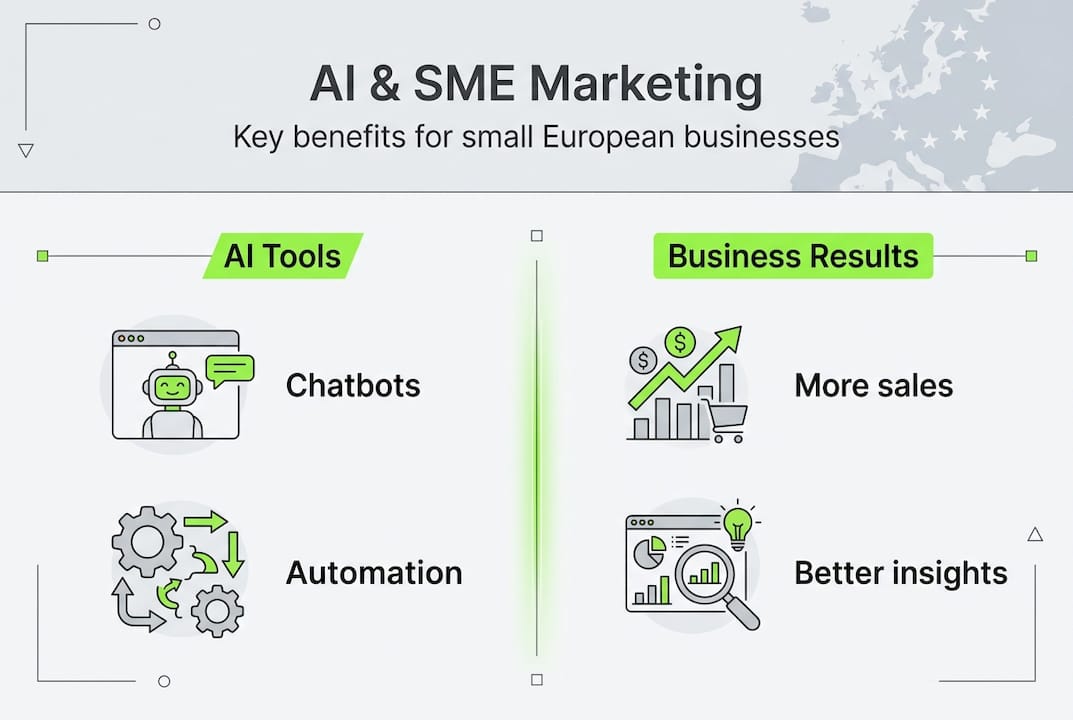
Understanding which AI tools deliver the strongest marketing results helps you invest wisely. European SMEs focus on three primary technologies that directly impact customer acquisition and retention.
1. Chatbots for customer engagement
Chatbots are adopted by 12% of SMEs to boost customer engagement, and this percentage grows rapidly as implementation becomes simpler. Modern chatbots do far more than answer basic questions. They qualify leads by asking relevant questions, schedule appointments, process simple transactions, and escalate complex issues to human staff. The best implementations feel conversational rather than robotic, using natural language processing to understand context and intent.
Your website visitors expect immediate responses. A chatbot provides that instant gratification whilst capturing contact information and understanding visitor needs before your sales team gets involved. This combination of speed and data collection transforms casual browsers into qualified prospects.
2. Email marketing automation and personalisation
AI-powered email platforms analyse subscriber behaviour to determine optimal sending times, subject lines, and content variations. They segment audiences automatically based on engagement patterns, purchase history, and browsing activity. Instead of sending identical messages to your entire list, you deliver targeted content that matches each subscriber’s interests and stage in the buying journey.
These systems test different approaches continuously, learning which variations generate the highest open rates and conversions for specific audience segments. The digital marketing for more leads becomes measurably more effective when your messages reach the right people with relevant offers at precisely the right moment.
3. Text mining and customer insight extraction
Perhaps the most powerful yet underutilised AI application, text mining is used in 34% of marketing functions in EU enterprises. This technology analyses customer reviews, social media comments, support tickets, and survey responses to identify patterns, sentiment, and emerging concerns.

Text mining reveals what customers actually think about your products, which features they value most, and which pain points drive them to competitors. This intelligence informs product development, messaging strategy, and customer service improvements. You stop guessing what matters to your audience and start making decisions based on their actual words.
Pro Tip: Combine text mining insights with your email automation to create hyper-relevant campaigns. If analysis reveals customers frequently mention a specific concern, address it directly in your next campaign with solutions.
These tools work best when integrated rather than isolated. Your chatbot conversations feed data to your email platform, which uses text mining insights to refine messaging, which improves website lead generation through better targeting. This interconnected approach multiplies the value of each individual technology.
Navigating challenges and compliance when adopting AI
AI’s benefits come with genuine challenges that SMEs must address proactively. Understanding these obstacles helps you avoid costly mistakes and regulatory penalties.
The digital readiness gap creates the most common failure point. Research shows that 46% of SMEs rush into AI without digital readiness, risking instability. You cannot successfully implement AI marketing tools if your customer data lives in disconnected spreadsheets, your website lacks proper analytics, or your team struggles with basic digital workflows.
Data silos undermine AI effectiveness catastrophically. When your email platform, website analytics, CRM system, and sales records don’t communicate, AI tools cannot build accurate customer profiles or make reliable predictions. Unified data infrastructure becomes the foundation for everything else.
Compliance requirements demand serious attention. The EU AI Act requires transparency for AI systems, especially chatbots, with no SME exemptions. Your obligations include:
- Clear disclosure when customers interact with AI rather than humans
- Risk classification of your AI systems based on their potential impact
- Regular audits to verify accuracy and prevent discriminatory outputs
- Documentation of how AI systems make decisions and use customer data
- GDPR alignment ensuring AI processes personal data lawfully with proper consent
These aren’t optional suggestions. Non-compliance brings substantial fines and reputational damage. The regulations aim to protect consumers whilst encouraging responsible innovation, but they require deliberate effort to implement correctly.
“The EU AI Act applies to all businesses using AI in customer-facing applications, regardless of company size. Transparency and accountability are mandatory, not negotiable.”
Pro Tip: Document your AI implementation process from the start, including tool selection criteria, data sources, testing procedures, and monitoring protocols. This documentation proves compliance and helps troubleshoot problems.
Human oversight prevents the most damaging AI failures. Automated systems make mistakes, sometimes spectacular ones. They generate inappropriate responses, misinterpret customer intent, or perpetuate biases present in training data. Regular human review catches these errors before they reach customers.
Start with limited AI deployment in controlled areas where mistakes cause minimal harm. Test thoroughly with real users before expanding. Monitor outputs continuously for quality and appropriateness. This cautious approach aligns with digital marketing trends 2026 emphasising responsible technology adoption that builds rather than damages customer trust.
Implementing AI in your SME’s marketing strategy: practical steps
Moving from understanding to action requires a structured approach. These steps guide you through successful AI implementation that delivers measurable results whilst managing risks.
1. Audit your digital readiness and data quality
Before selecting any AI tools, assess your current infrastructure honestly. Can you access clean, organised customer data? Do your systems integrate or operate independently? Does your team possess basic digital skills? Gaps in these areas sabotage AI projects before they begin. Address foundational weaknesses first.
2. Identify high-impact use cases aligned with business goals
Don’t adopt AI because competitors do. Choose applications that solve specific problems or exploit clear opportunities. If customer service enquiries overwhelm your team, chatbots make sense. If email campaigns generate poor engagement, AI-powered personalisation offers value. Match technology to genuine needs.
3. Select tools designed for SME budgets and capabilities
Enterprise platforms offer impressive features you’ll never use whilst charging premium prices. SMEs focusing first on customer tools and data analysis achieve better adoption rates and ROIs. Look for solutions with transparent pricing, straightforward implementation, and responsive support.
4. Integrate gradually with existing marketing workflows
Your digital marketing workflow shouldn’t require complete reconstruction. Add AI capabilities incrementally to proven processes. Start with email subject line optimisation before rebuilding entire campaigns. Deploy chatbots for FAQs before complex transactions. Small wins build momentum and confidence.
5. Establish measurement frameworks and optimisation cycles
Define success metrics before launching AI tools. Track performance against baseline data to quantify impact. Research indicates benchmarks show 250% conversion improvement, 50% cost reduction and up to 690% ROI possible with AI, but your results depend on implementation quality and ongoing refinement.
| Implementation phase | Timeline | Key activities | Success metrics |
|---|---|---|---|
| Foundation building | 1-2 months | Data consolidation, team training, compliance review | Unified customer database, documented processes |
| Pilot deployment | 2-3 months | Single tool implementation, testing, monitoring | Tool adoption rate, initial performance gains |
| Optimisation | 3-6 months | Performance analysis, refinement, expansion planning | ROI achievement, error rate reduction |
| Scaling | 6-12 months | Additional tools, deeper integration, automation expansion | Revenue growth, efficiency improvements |
Pro Tip: Apply email prospecting rules to AI-generated content. Even automated messages must offer genuine value, respect recipient preferences, and maintain your brand voice.
6. Maintain active compliance monitoring and human review
Compliance isn’t a one-time checkbox. Regular audits verify that AI systems operate within legal boundaries and produce appropriate outputs. Schedule monthly reviews of chatbot conversations, email performance, and data processing activities. Update documentation as you refine implementations.
This structured approach transforms AI from overwhelming technology into manageable business improvement. You build capabilities progressively whilst controlling costs and risks.
Explore expert digital marketing and web development solutions
Implementing AI-powered marketing strategies effectively requires both technical expertise and strategic insight. Done.lu specialises in helping European SMEs enhance their online presence through tailored web development and comprehensive digital marketing solutions. Whether you’re exploring why invest in web development or need guidance on building a digital marketing workflow for lead generation, professional support accelerates results whilst avoiding costly mistakes.
Our team understands the unique challenges facing SMEs in Luxembourg and broader Europe. We’ve completed over 150 projects combining web development excellence with data-driven marketing strategies that generate measurable business growth. From responsive website design to marketing automation and AI integration, we provide the expertise you need to compete effectively in increasingly digital markets.
Frequently asked questions
How can AI improve customer engagement in small businesses?
AI automates personalised responses through chatbots, providing instant availability that dramatically improves customer experience and satisfaction. These systems handle routine enquiries efficiently whilst capturing valuable data about customer needs and preferences. AI also analyses engagement patterns to identify the optimal timing, messaging, and channels for reaching specific audience segments, allowing you to deliver relevant content that resonates rather than generic communications that get ignored.
What compliance requirements must European SMEs consider when adopting AI?
European SMEs must ensure transparency in AI applications, clearly disclosing when customers interact with automated systems rather than humans. GDPR requirements for data privacy apply fully to AI processing, demanding proper consent and security measures. The EU AI Act requires risk classification of your AI systems, regular audits to verify accuracy and fairness, and documentation of decision-making processes, with no size-based exemptions for smaller businesses. Regulatory sandboxes and reduced compliance fees help SMEs meet these obligations without prohibitive costs.
How can SMEs avoid common risks when implementing AI?
Ensure unified data infrastructure before deploying AI tools, as disconnected systems prevent accurate analysis and reliable predictions. Maintain active human oversight to catch errors, biases, and inappropriate outputs before they reach customers or damage your reputation. Build solid digital foundations including clean data, integrated systems, and team capabilities before adopting complex AI applications. Start with limited deployments in controlled environments, test thoroughly, measure results rigorously, and expand only after proving value and stability.
Which AI marketing tools deliver the strongest ROI for European SMEs?
Chatbots for customer service and lead qualification typically deliver immediate value through reduced support costs and improved response times. Email marketing automation with AI-powered personalisation generates measurable conversion improvements by delivering relevant content to properly segmented audiences. Text mining and sentiment analysis tools provide strategic insights that inform product development and campaign messaging, though benefits take longer to materialise. The strongest ROI comes from selecting tools that address your specific bottlenecks rather than adopting technology for its own sake.
How long does successful AI implementation typically take for SMEs?
Foundation building including data consolidation and team preparation typically requires one to two months before deploying any AI tools. Initial pilot implementations run two to three months with active testing and refinement. Optimisation and expansion planning extend three to six months as you measure results and adjust approaches. Full scaling with multiple integrated AI tools generally takes six to twelve months from project start. Rushing this timeline by skipping foundational work significantly increases failure risk, whilst patient implementation builds sustainable capabilities that compound over time.