
Best e-commerce platform types for European SMEs 2026
April 6, 2026
TL;DR:
- Luxembourg SMEs must comply with WCAG 2.1 AA standards due to the European Accessibility Act.
- Accessibility benefits include wider audience reach, improved SEO, and stronger brand reputation.
- Proper accessibility requires ongoing manual testing and cannot rely solely on automated tools or plugins.
Many Luxembourg SMEs assume website accessibility is a costly, technical burden reserved for large corporations or niche disability charities. That assumption is increasingly dangerous. Compliance is crucial for SMEs of all sizes, and the legal landscape shifted significantly in June 2025 with the European Accessibility Act coming into force. If your business offers digital services to consumers and employs more than ten people, you are likely already within scope. This guide explains what website accessibility genuinely means, which standards apply to your business in Luxembourg, how to test and improve your site, and why getting this right is one of the smartest investments you can make in your digital presence.
Table of Contents
- Understanding website accessibility: principles and impact
- Core accessibility standards: WCAG, POUR, and EU compliance
- How to test and improve your website accessibility
- Practical challenges, grey areas, and SME myths debunked
- Website accessibility for Luxembourg SMEs: the overlooked growth lever
- Take the next step: accessible web solutions for Luxembourg SMEs
- Frequently asked questions
Key Takeaways
| Point | Details |
|---|---|
| Accessibility matters for SMEs | Every Luxembourg SME can benefit from website accessibility for legal, business, and user experience reasons. |
| WCAG 2.1/2.2 standards apply | Compliance with WCAG 2.1 or 2.2 AA is required by law for many SMEs from 2025 onwards. |
| Testing goes beyond automation | Real accessibility improvement needs both automated checks and human/user testing. |
| Myths can cost your business | Misconceptions about cost, complexity, or ‘overlays’ can block growth and compliance. |
| Early action saves money | Starting accessibility work now is much cheaper than facing legal or technical problems later. |
Understanding website accessibility: principles and impact
Website accessibility is the practice of designing and building web content so that people with a wide range of abilities can perceive, navigate, and interact with it effectively. That definition sounds straightforward, but its implications are broad. It is not simply about adding alt text to images or making fonts larger. It touches every layer of your site, from its underlying code to the language you use in your content.
The internationally recognised framework for accessibility comes from the World Wide Web Consortium, commonly known as W3C. Their Web Content Accessibility Guidelines organise requirements around four core principles, known by the acronym POUR:
- Perceivable: All information and interface components must be presented in ways that users can perceive, including through assistive technologies such as screen readers.
- Operable: Users must be able to navigate and interact with your site using a keyboard, voice control, or other input methods, not just a mouse.
- Understandable: Content and navigation must be clear and predictable. Confusing layouts, inconsistent labelling, and complex language all create barriers.
- Robust: Your site must work reliably across a range of browsers, devices, and assistive technologies, both current and future.
These four principles matter because the audience affected by accessibility barriers is far larger than most SMEs realise. People with visual impairments, hearing loss, motor difficulties, cognitive differences, and temporary conditions such as a broken arm or bright sunlight glare all benefit from accessible design. Older users, who represent a growing share of online consumers, frequently rely on features that accessibility standards mandate.
Over 1.3 billion people worldwide live with some form of disability, and many more experience situational or age-related limitations that make accessible design directly relevant to their online experience.
Accessibility also reinforces good design practice more broadly. A well-structured, clearly labelled, fast-loading website is simply a better website. It supports your branding for SMEs by projecting professionalism and trustworthiness. It also contributes directly to SEO for SME growth, since search engines reward many of the same qualities that make sites accessible: semantic HTML, descriptive links, logical heading structures, and mobile responsiveness.
The misconception that accessibility is only relevant to the visually impaired or to large organisations is one of the most persistent and costly errors an SME can make. In reality, every business with a public-facing website has both an opportunity and, increasingly, a legal obligation to make that site work for everyone.
Core accessibility standards: WCAG, POUR, and EU compliance
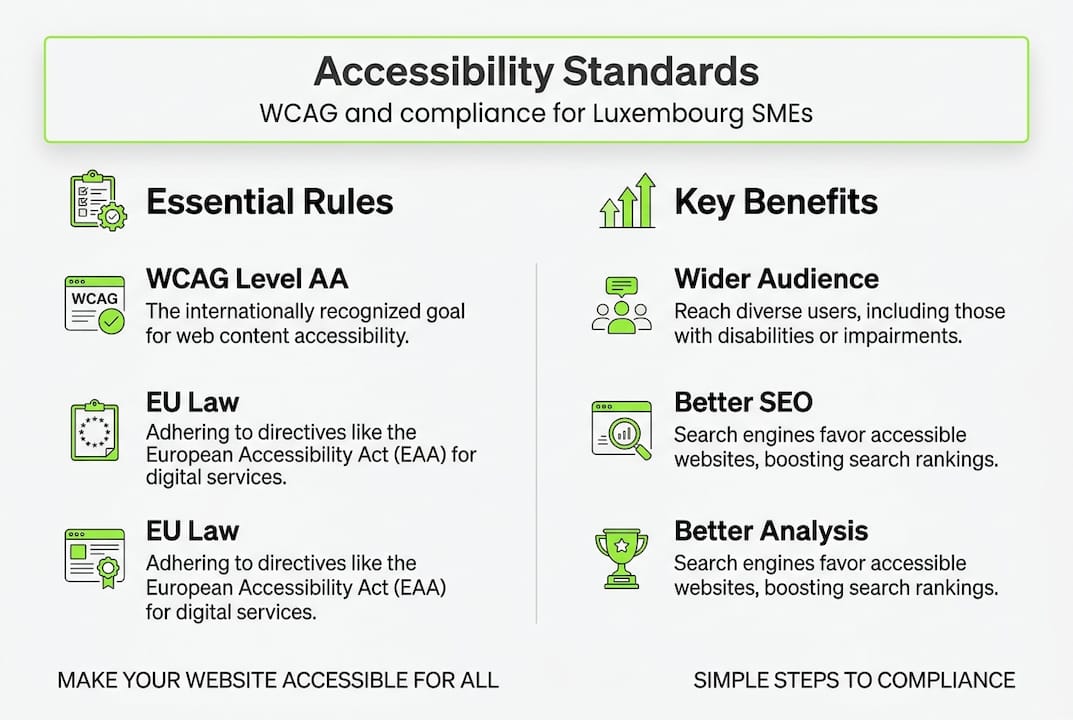
Understanding the principles is one thing. Knowing exactly which rules apply to your Luxembourg business is another. The technical benchmark for accessibility worldwide is the Web Content Accessibility Guidelines, currently at versions 2.1 and 2.2. WCAG 2.2, published in 2023, contains 56 testable success criteria, building on the 50 criteria in WCAG 2.1. These criteria are grouped into three conformance levels.
| Level | Description | SME obligation |
|---|---|---|
| A | Minimum baseline requirements | Necessary but insufficient alone |
| AA | Standard compliance level | Required under EAA and most regulations |
| AAA | Enhanced accessibility | Best practice, not legally mandated for most |
For most Luxembourg SMEs, WCAG 2.1 Level AA is the practical and legal target. It covers issues such as sufficient colour contrast, keyboard navigability, descriptive form labels, and captions for video content. Level AAA, while admirable, includes criteria that are not always achievable for all content types and is not required by current law.
In Luxembourg, the regulatory picture involves two distinct frameworks. The public sector follows RAWeb and RAAM, which are national transpositions of the European standard EN 301 549. Private businesses, including SMEs, fall under the European Accessibility Act. The EAA, effective from June 2025, applies to private companies with more than ten employees or annual turnover exceeding €2 million that offer consumer-facing digital services. Non-compliance carries penalties of up to €1 million, depending on the severity and duration of the breach.
Here is a practical checklist of what your SME should address now:
- Audit your current website against WCAG 2.1 AA criteria
- Ensure all images have descriptive alternative text
- Verify that your site is fully navigable by keyboard alone
- Check colour contrast ratios meet the 4.5:1 minimum for normal text
- Add captions or transcripts to any video or audio content
- Publish an accessibility statement on your website
- Establish a process for receiving and responding to accessibility complaints
The business case for early compliance is strong. Beyond avoiding fines, accessible websites reach a wider audience, perform better in search rankings, and signal to customers that your brand values inclusion. Investing in custom web design advantages that embed accessibility from the start is significantly more cost-effective than retrofitting an existing site. Your digital marketing in Luxembourg efforts also gain more traction when the site those campaigns drive traffic to is usable by every visitor who arrives.
How to test and improve your website accessibility
Knowing the standards is essential. Knowing how to measure your site against them is where real progress begins. The W3C’s WCAG-EM 2.0 evaluation methodology provides a structured, step-by-step process for assessing website conformance. It involves defining the scope of the evaluation, exploring the website to understand its structure, selecting a representative sample of pages, evaluating each page against the relevant success criteria, and reporting the findings with clear recommendations.
Critically, automated tools alone cover only around 30% of accessibility issues. Tools such as Axe, WAVE, and Lighthouse are valuable starting points, but they cannot detect problems that require human judgement, such as whether an image description is genuinely meaningful or whether the reading order of a page makes logical sense. Manual testing and direct involvement of users with disabilities are essential components of a thorough evaluation.
Here are five practical starting steps for Luxembourg SMEs:
- Run a free automated scan using a tool such as WAVE or Google Lighthouse and review the flagged issues.
- Navigate your entire website using only a keyboard, with no mouse, and note any points where you get stuck.
- Test your site with a free screen reader such as NVDA (Windows) or VoiceOver (Mac/iOS) to experience how assistive technology interprets your content.
- Check all colour combinations on your site against a contrast ratio checker such as the WebAIM Contrast Checker.
- Review all forms, buttons, and interactive elements to confirm they have clear, descriptive labels.
The table below shows the most common accessibility failures and practical solutions for SMEs:
| Issue | Impact | SME-friendly solution |
|---|---|---|
| Missing image alt text | Screen readers skip images entirely | Add descriptive alt text to every meaningful image |
| Poor colour contrast | Text unreadable for low-vision users | Use a contrast checker and adjust your colour palette |
| No keyboard navigation | Keyboard-only users cannot access content | Test with Tab key and fix focus order in your code |
| Unlabelled form fields | Screen readers cannot identify input fields | Add visible labels and ARIA attributes to all forms |
| Videos without captions | Deaf users miss audio content | Add closed captions or transcripts to all video content |
Improving site navigability and adopting responsive design for accessibility are two areas where relatively modest investments yield significant accessibility gains.
Pro Tip: Accessibility overlays and widgets that claim to fix your site automatically are not a compliant solution. They often introduce new barriers and do not address underlying code issues. Embedding accessibility into the design and development process from the outset is always more effective and less costly than adding a plugin after launch.
Practical challenges, grey areas, and SME myths debunked
Even SMEs that are committed to accessibility often encounter situations where the right answer is not obvious. WCAG contains several criteria that are genuinely difficult to interpret without expert guidance. Ambiguous criteria such as link purpose, non-text contrast, and sensory characteristics require contextual judgement, user testing, and sometimes legal interpretation. The forthcoming WCAG 3.0 draft introduces more flexible scoring approaches to address some of these grey areas, but WCAG 2.2 remains the operative standard for compliance purposes in 2026.
Beyond technical ambiguity, several persistent myths prevent SMEs from acting. Let us address the most damaging ones directly:
- “Accessibility only matters for blind users.” False. Over 1.3 billion people live with some form of disability globally, and many more benefit from accessible design due to age, slow connections, or temporary impairments.
- “We are too small to be affected.” Incorrect. The EAA applies to businesses with more than ten employees or €2 million turnover. Many Luxembourg SMEs cross this threshold.
- “Making our site accessible will ruin our design.” Untrue. Accessibility constraints often improve design clarity, hierarchy, and usability for all visitors.
- “An overlay plugin will handle it for us.” Overlays do not suffice. They cannot fix structural code issues and may actually create new barriers for screen reader users.
- “We did an audit once, so we are covered.” Accessibility is an ongoing process. Every content update, new feature, or redesign can introduce new barriers if accessibility is not embedded in your workflow.
Businesses that address accessibility proactively report lower long-term costs, stronger customer loyalty, and measurable improvements in SEO performance compared to those that treat it as a one-time compliance exercise.
The business case is straightforward. Accessible websites convert better because they work better for everyone. They support high-conversion web design by removing friction from the user journey. They also contribute to web design and ROI by extending the effective lifespan of your site and reducing the cost of future redesigns.
Pro Tip: Small changes made during the design phase cost a fraction of what they cost after launch. If you are planning a new website or a significant update, now is the ideal moment to build accessibility in from the start rather than bolt it on later.
Website accessibility for Luxembourg SMEs: the overlooked growth lever
Most conversations about accessibility in the SME context start and end with compliance. Avoid the fine, tick the box, move on. We think that framing misses the bigger picture entirely.
Accessibility, when treated as a design ethos rather than a legal obligation, becomes a genuine competitive advantage. Luxembourg’s digital market is maturing rapidly. Consumers are more discerning, regulators are more active, and the businesses that will lead in the next decade are those building digital presences that work for everyone, not just the majority.
The SMEs we work with who invest properly in accessible, bespoke SME web design consistently report benefits that go well beyond compliance. Their sites rank better in organic search. Their customer service teams field fewer usability complaints. Their brand perception improves among a wider demographic, including older consumers who control a significant share of spending power.
Shortcuts do not work here. Overlays, one-time audits, and minimum-viable compliance approaches will not hold up as standards evolve and enforcement increases. The businesses that embed accessibility into their digital culture now will find it far easier to adapt as WCAG 3.0 matures and regulatory scrutiny intensifies.
Accessibility is also perfectly aligned with the agility that defines successful SMEs. You do not need a large team or a massive budget to do this well. You need the right approach, the right partners, and the discipline to treat your website as a living, evolving tool rather than a static brochure.
Take the next step: accessible web solutions for Luxembourg SMEs
Accessible design is not simply about meeting a legal threshold. It is about building a digital presence that genuinely serves your customers, strengthens your brand, and positions your business for sustainable growth.
At Done.lu, we work with Luxembourg SMEs to create websites that are modern, compliant, and built for performance from day one. Our team understands what web development involves at every level, from technical accessibility audits to full redesigns that embed WCAG 2.1 AA compliance into the design process itself. Whether you need a compliance review of your existing site or a custom development for impact built to the highest standards, we can guide you through every step. Investing now means avoiding legal exposure later and gaining a site that works harder for your business every day. Get in touch with our team to discuss your accessibility goals and find out how we can help.
Frequently asked questions
Does my SME in Luxembourg legally need to comply with web accessibility standards?
Most Luxembourg SMEs with over ten employees or €2 million turnover offering digital consumer services must comply with WCAG 2.1 AA under the European Accessibility Act, which came into force in June 2025, with penalties reaching up to €1 million for non-compliance.
What are the main benefits of having an accessible website?
Accessible websites reach more customers, improve SEO performance, enhance brand reputation, and reduce the risk of regulatory fines or legal action, making them a sound investment for any growth-focused SME.
Are accessibility overlays or plugins enough to ensure compliance?
No. Overlays alone do not suffice and cannot replace proper design, manual testing, and ongoing updates, as they fail to address the underlying structural issues that create accessibility barriers.
How is web accessibility measured or tested?
Accessibility is measured using a combination of automated tools, manual testing, and real user feedback, following the structured WCAG-EM 2.0 process developed by the W3C to ensure thorough and reliable evaluation.