

How AI progress is making app security riskier in 2026
April 15, 2026
Digital skills training in Luxembourg: SME guide 2026
April 17, 2026
TL;DR:
- Effective web content improves search rankings, engagement, and conversions for Luxembourg SMEs.
- Continuous, audience-focused optimisation and local relevance are key to long-term success.
- Using proper tools, regular audits, and clear goals maximizes content’s business impact.
Your website might look polished, but if the content sitting on it is not optimised, it is quietly costing you business every single day. For small and medium-sized enterprises (SMEs) in Luxembourg, this is a particularly pressing concern. Competition for visibility online is intensifying, and a page that fails to rank, engage, or convert is a missed opportunity with a real price tag. Studies confirm that strong SEO is essential for digital marketing success, yet many businesses still treat content as an afterthought rather than a strategic asset. This guide walks you through what effective web content looks like, what tools and preparation you need, and exactly how to carry out optimisation in a way that delivers measurable results for your Luxembourg business.
Table of Contents
- Understanding what makes web content effective
- Essential tools and prerequisites for optimising content
- Step-by-step: How to optimise your web content
- Common mistakes and how to measure success
- Why most content optimisation advice falls short — and what SMEs in Luxembourg need instead
- Ready to see real business results? Let web content expertise guide you
- Frequently asked questions
Key Takeaways
| Point | Details |
|---|---|
| Define goals first | Effective optimisation starts by setting clear business goals and target metrics. |
| Use the right tools | SEO software and analytics make it easier to identify and address weak spots in site content. |
| Prioritise audience needs | Content that answers real audience questions outperforms generic, keyword-stuffed copy. |
| Buffer for common errors | Avoiding typical mistakes such as neglecting UX or failing to track results can save resources and boost ROI. |
| Continuous review wins | Regularly update and improve content to maintain top rankings and relevance over time. |
Understanding what makes web content effective
Web content optimisation is the process of improving your website’s text, images, structure, and metadata so that it ranks better in search engines, communicates more clearly to visitors, and converts more of those visitors into leads or customers. It is not simply about stuffing pages with keywords. Done well, it aligns your content with what your audience is actively searching for, and it presents that content in a way that builds credibility.
High-performing content shares several defining characteristics. Clarity comes first: your visitor should immediately understand what you offer and why it matters to them. Relevance follows closely, meaning your content must match the intent behind the search query that brought someone to your page. Strong readability, with short paragraphs, clear headings, and plain language, keeps visitors engaged long enough to act. And underpinning all of this is solid SEO in digital marketing, which ensures search engines can find, interpret, and rank your pages correctly.
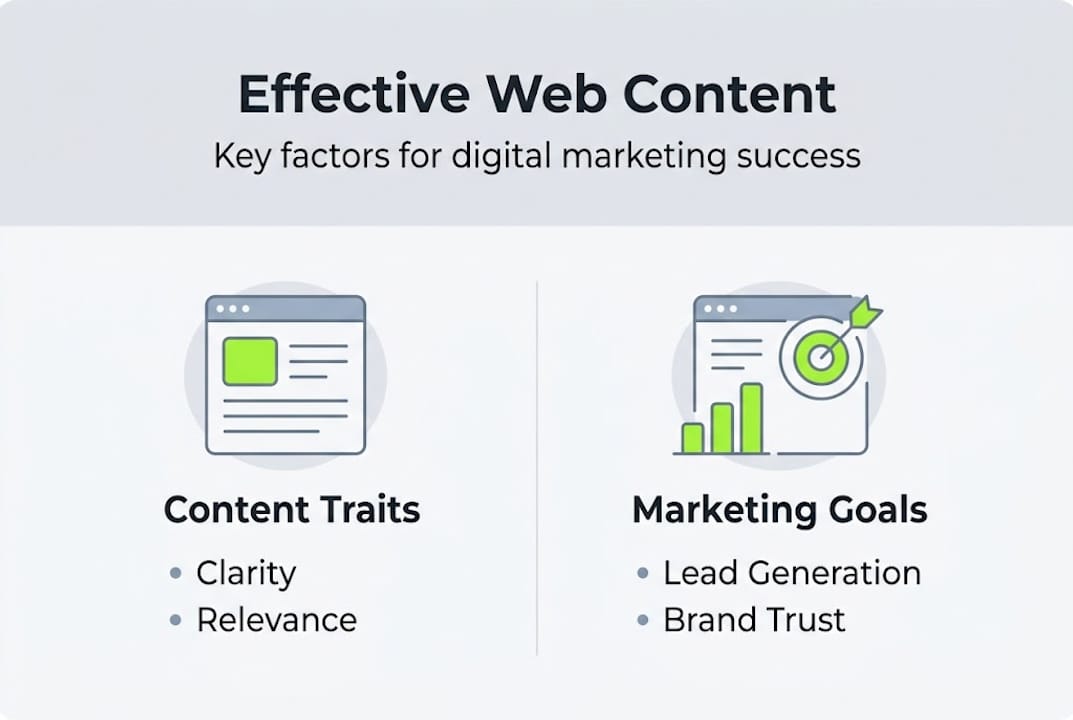
Content quality also has a direct bearing on brand trust. When a visitor lands on a page that is well-written, logically structured, and visually coherent, they form a positive impression of your business almost instantly. Poor content, by contrast, signals carelessness. In Luxembourg’s B2B environment, where reputation carries significant weight, this matters enormously. Your web design and branding choices reinforce this perception at every touchpoint.
The business impact of optimised versus unoptimised content is stark:
| Factor | Unoptimised content | Optimised content |
|---|---|---|
| Search visibility | Low, buried on page 2+ | Higher rankings, page 1 potential |
| Bounce rate | High, visitors leave quickly | Lower, visitors stay and explore |
| Conversion rate | Weak, unclear calls-to-action | Stronger, guided user journeys |
| Brand perception | Inconsistent, untrustworthy | Professional, credible |
| Lead generation | Sporadic, low volume | Consistent, scalable |
A few common misconceptions are worth addressing directly. Many business owners believe that publishing more content automatically improves rankings. It does not. Volume without quality dilutes your authority. Others assume that optimisation is a one-time task. In reality, it is an ongoing part of a healthy digital marketing strategy.
“Businesses that treat content optimisation as a continuous process, rather than a one-off project, consistently outperform those that do not. Quality and relevance, sustained over time, are what search engines reward.”
The key takeaway here is that effective content is purposeful. Every page on your site should have a clear objective, a defined audience, and a measurable outcome.
Essential tools and prerequisites for optimising content
Before you begin rewriting a single sentence, you need the right foundations in place. Optimisation without preparation is guesswork, and guesswork wastes time and budget.

From a skills perspective, you need a basic understanding of how search engines work, the ability to write clearly for a non-specialist audience, and enough familiarity with your CMS (Content Management System) to edit pages, update metadata, and manage images. You do not need to be a developer, but you do need to be comfortable making changes confidently.
The tools you use will shape the quality of your work. Here is a practical overview:
| Tool category | Examples | Primary use |
|---|---|---|
| SEO analysis | SEMrush, Ahrefs, Moz | Keyword research, ranking tracking |
| Analytics | Google Analytics 4, Matomo | Traffic, behaviour, conversions |
| CMS plugins | Yoast SEO, Rank Math | On-page SEO guidance |
| Page speed | Google PageSpeed Insights | Load time and core web vitals |
| Heatmaps | Hotjar, Microsoft Clarity | User behaviour visualisation |
Keyword research basics are foundational for natural referencing and content optimisation, and they should inform every page you create or revise. Without knowing what terms your target audience uses, you are writing in the dark.
Before you touch any live content, work through this checklist:
- User personas: Do you have a clear picture of who visits your site, what they need, and what language they use?
- Keyword lists: Have you compiled primary and secondary keywords for each key page?
- Analytics access: Is Google Analytics or an equivalent tool installed and tracking correctly?
- Baseline data: Do you know your current traffic levels, bounce rates, and conversion rates?
- Image audit: Are your images properly compressed and tagged? Image SEO is frequently overlooked but has a measurable impact on both rankings and page speed.
- UX review: Have you assessed how easily visitors navigate your site? The UX and SEO link is well established and should not be ignored.
Pro Tip: Set up automated weekly or monthly crawl reports using a tool like Screaming Frog or SEMrush Site Audit. These reports flag broken links, missing metadata, and slow pages before they become serious problems, saving you hours of manual checking.
With these foundations in place, you are ready to move from preparation into action.
Step-by-step: How to optimise your web content
A systematic approach to content optimisation consistently leads to higher search rankings and better user engagement. Here is a clear process you can follow, tailored to the realities of running a business in Luxembourg.
-
Conduct a content audit. Review every key page on your site. Score each one for relevance, clarity, keyword alignment, and conversion potential. Flag pages that are thin (fewer than 300 words of substantive content), outdated, or duplicated.
-
Prioritise by business impact. Not every page needs equal attention. Start with your homepage, your main service pages, and your top-traffic blog posts. These pages drive the most value and will show results fastest.
-
Research and map keywords. For each priority page, identify one primary keyword and two to four supporting terms. In Luxembourg, consider multilingual intent: your audience may search in French, German, English, or Luxembourgish. This is a genuine competitive advantage if you address it.
-
Rewrite for clarity and intent. Revise your content so the primary keyword appears naturally in the title, the first paragraph, at least one subheading, and the meta description. Avoid forced repetition. Write for your reader first, the search engine second.
-
Improve structure and formatting. Use H2 and H3 headings to break up content logically. Add bullet points for lists. Keep paragraphs to three or four sentences. Visitors scan before they read, so structure guides their attention.
-
Optimise images and media. Compress images to reduce load time, add descriptive alt text for accessibility and SEO, and use file names that reflect the content rather than generic codes.
-
Strengthen calls-to-action (CTAs). Every page should tell the visitor what to do next. Whether that is booking a consultation, downloading a guide, or contacting your team, your CTA must be visible, specific, and compelling. A well-structured website can generate more leads when CTAs are placed strategically.
Pro Tip: When targeting Luxembourg audiences, include location-specific language and references where relevant. Mentioning sectors, regulations, or local context signals to both visitors and search engines that your content is genuinely relevant to this market.
A few quick wins to action immediately:
- Update page titles and meta descriptions that are missing or duplicated
- Add internal links between related pages to improve navigation and SEO authority
- Fix any broken links flagged in your audit
- Replace vague CTAs like “Click here” with action-oriented phrases like “Request your free audit”
Following a structured process like this, rather than making ad hoc edits, is what separates businesses that see consistent improvement from those that spin their wheels.
Common mistakes and how to measure success
Even with the best intentions, SMEs frequently make errors that undermine their optimisation efforts. Knowing what to avoid is just as important as knowing what to do.
The most common mistakes include:
- Keyword stuffing: Forcing keywords into text unnaturally harms readability and can trigger search engine penalties.
- Ignoring mobile experience: A large proportion of web traffic comes from mobile devices. Content that looks fine on desktop but breaks on mobile loses visitors immediately.
- Neglecting page speed: Slow-loading pages frustrate users and are penalised by search engines. This is particularly relevant for image-heavy pages.
- Writing for everyone: Content that tries to appeal to all audiences ends up resonating with none. Define your audience and write specifically for them.
- Skipping internal linking: Failing to connect related pages leaves both visitors and search engines unable to understand your site’s structure.
- Overlooking UX: User experience is an often-overlooked factor that is crucial for SEO results. A confusing layout or poor navigation actively damages your rankings.
For e-commerce businesses, SEO for e-commerce introduces additional considerations around product pages, structured data, and category architecture that deserve dedicated attention.
Once you have made your optimisations, you need to measure whether they are working. Track these key performance indicators (KPIs):
| KPI | What it tells you | Target direction |
|---|---|---|
| Organic traffic | How many visitors arrive via search | Increase over time |
| Keyword rankings | Where your pages appear in search results | Move towards page 1 |
| Bounce rate | Whether visitors engage or leave immediately | Decrease |
| Average session duration | How long visitors spend on your site | Increase |
| Conversion rate | Percentage of visitors who take a desired action | Increase |
| Pages per session | Depth of engagement with your content | Increase |
Give your changes time to take effect. Search engines typically take four to twelve weeks to re-index and re-rank updated pages. Do not make multiple major changes simultaneously, as this makes it difficult to attribute improvements to specific actions.
“Businesses that invest in content quality and user experience see measurably better engagement and conversion rates. The data consistently supports prioritising the visitor’s experience over short-term SEO tricks.”
Regular measurement creates a feedback loop. You learn what works for your specific audience, refine your approach, and compound your gains over time.
Why most content optimisation advice falls short — and what SMEs in Luxembourg need instead
Most content optimisation guides are written for a generic, English-speaking market. They offer solid fundamentals, but they miss something critical for businesses operating in Luxembourg: the local context is genuinely different, and those differences have real consequences for your strategy.
Luxembourg is a multilingual market where your audience may expect content in French, German, or English depending on the sector and the relationship. A checklist built for a London agency or a Paris startup does not account for this. Nor does it account for the regulatory environment, the relatively small but highly competitive local market, or the fact that personal relationships and local credibility often outweigh pure digital visibility.
We have seen businesses in Luxembourg invest heavily in technically correct optimisation, ticking every box on a standard checklist, only to see modest results because their content did not speak authentically to their actual audience. The algorithm rewarded them mildly. Their customers were not moved.
The lesson we draw from this is that optimisation must be audience-first, not algorithm-first. Tools and frameworks matter, but they serve a human purpose. Authentic, locally relevant content that genuinely answers your audience’s questions will always outperform technically perfect but generic copy.
For digital marketing tips for startups and established SMEs alike, the most effective strategy blends rigorous technical optimisation with a deep understanding of who you are actually talking to. That combination is harder to replicate than any checklist, and it is where sustainable competitive advantage lives.
Ready to see real business results? Let web content expertise guide you
Optimising your web content is one of the highest-return investments you can make in your digital presence. But knowing the steps and executing them consistently are two different things. Many business owners find that the process stalls once day-to-day priorities take over.
At Done.lu, we work with SMEs across Luxembourg to turn underperforming websites into reliable lead-generation assets. From web development and content strategy to a fully integrated digital marketing strategy, our team brings both technical expertise and genuine local market knowledge to every project. Whether you need a full content audit, a new website built to convert, or ongoing support to generate more business leads, we are here to help you move forward with clarity and confidence. Reach out to us today to discuss what your website could be doing better.
Frequently asked questions
What is the first step in optimising web content?
Start by auditing your existing content for clarity, relevance, and keyword alignment to identify gaps and opportunities. Content audits are an essential starting point in any optimisation process.
Which tools are recommended for content optimisation?
Use analytics platforms, SEO tools, and CMS plugins to evaluate, refine, and track your web content’s performance. Tools are necessary for content evaluation and ongoing optimisation.
How often should I update or review web content?
Review and update core business pages at least quarterly to maintain relevance and SEO strength. Regular content updates are key to maintaining strong search performance.
How do I know if my optimisation efforts are working?
Track site traffic, keyword rankings, and conversions to measure improvement resulting from your optimisation work. KPIs should be monitored post-optimisation to measure results accurately.
Can content optimisation help all types of businesses?
Yes, effective optimisation boosts discoverability and engagement for nearly any business type online. Content optimisation drives better discoverability and engagement regardless of sector or size.