

Artificial intelligence for SMBs: top 10 uses in 2026
May 26, 2026
AI training employees: a practical guide for SMEs
May 28, 2026
TL;DR:
- Most AI project failures stem from organizational unpreparedness rather than flawed technology. Conducting a targeted AI readiness audit helps identify critical gaps in data, governance, talent, and infrastructure before implementation. This enables SMBs to develop a practical roadmap, focusing on impactful, prioritized actions to ensure successful AI deployment.
Most AI projects don’t fail because the technology is wrong. They fail because the organisation wasn’t ready to use it. Skipping or rushing an AI readiness audit is one of the most expensive mistakes an SMB can make, often costing months of rework and wasted budget once problems surface in deployment. This guide gives you a clear, business-focused framework for conducting an AI readiness audit that actually moves your organisation forward. No abstract scoring for its own sake. Just a structured way to identify where you stand, what’s blocking progress, and what to fix first.
Table of Contents
- Key takeaways
- What an AI readiness audit actually covers
- Setting up for a successful audit
- Conducting the audit step by step
- From audit results to an AI roadmap
- Pitfalls that derail good audits
- My honest take on AI readiness audits
- How Done can support your AI readiness
- FAQ
Key takeaways
| Point | Details |
|---|---|
| Audit before you build | Conduct a structured AI readiness audit before committing budget to any AI implementation project. |
| Data problems come first | 95% of AI failures trace back to data quality issues, so assess data readiness before evaluating technology. |
| Focus on business outcomes | Define the specific business problem you are solving before scoping the audit, not after. |
| Lowest pillar is highest risk | Your weakest audit dimension sets the ceiling for your AI project success, regardless of strength elsewhere. |
| Treat readiness as ongoing | Update your audit as your organisation and use cases evolve; readiness is a capability, not a one-off checkbox. |
What an AI readiness audit actually covers
An AI readiness audit is a structured diagnostic process that evaluates how prepared your organisation is to successfully design, deploy, and sustain AI-powered solutions. It is not a technology review. It cuts across your data, your people, your processes, and your governance practices.
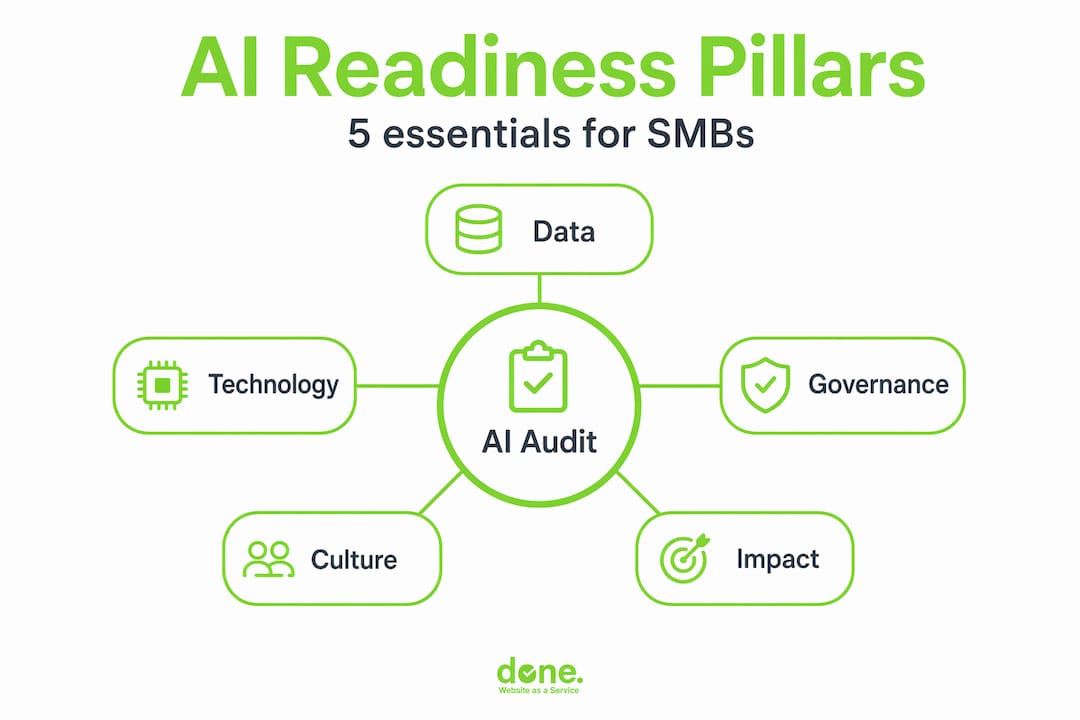
Most audit frameworks assess organisations across five or six core pillars: Data Readiness, Technology and Infrastructure, Governance and Strategic Alignment, Talent and Culture, and Business Impact. Each pillar is scored, typically on a 25 to 50 point scale, and the results reveal where gaps exist and what they will cost you if ignored.
For SMBs, the standard enterprise audit framework needs adaptation. A 50-person professional services firm in Luxembourg does not have the same infrastructure or governance complexity as a 500-person manufacturer. The pillars remain relevant, but the depth and focus shift.
Here is how each pillar applies at the SMB level:
- Data Readiness: Are your data sources accessible, consistent, and documented? Can you extract usable data without manual effort every time?
- Technology and Infrastructure: Do your current systems support API connections, data pipelines, or cloud-based tools? Are you locked into legacy platforms?
- Governance and Strategic Alignment: Is there a named owner for AI decisions? Does leadership understand what AI can and cannot do in your specific context?
- Talent and Culture: Do your teams have the basic AI literacy to work alongside AI tools? Is there resistance or appetite for adoption?
- Business Impact: Have you mapped which processes, if improved, would generate measurable ROI? Can you quantify the before and after?
The goal of the audit is not a maturity badge. It is a prioritised list of gaps you need to close before your AI project can succeed.
| Pillar | What you are measuring | SMB-specific focus |
|---|---|---|
| Data Readiness | Quality, accessibility, governance of data | CRM, ERP, and document data often fragmented |
| Technology | Infrastructure suitability for AI tools | Cloud adoption, API readiness, legacy constraints |
| Governance | Strategy, ownership, risk controls | Often absent or informal in SMBs |
| Talent and Culture | Skills, literacy, adoption mindset | Training needs and change appetite |
| Business Impact | ROI potential and use case viability | Specific process improvement targets |
Setting up for a successful audit
The biggest mistake organisations make is launching an AI readiness audit with no clear business problem in mind. Assessments without business focus become delay tactics rather than progress tools. Before you open a single spreadsheet or interview a single stakeholder, define the specific problem you want AI to solve.
Here is a practical setup process to follow before the audit begins:
-
Define two or three candidate use cases. Not “we want to use AI.” Instead: “We want to automate invoice processing to reduce manual entry by 80%” or “We want a knowledge base assistant so our support team stops answering the same questions 40 times a day.” Specific use cases make the audit measurable.
-
Identify your executive sponsor. Cross-functional participation is non-negotiable. Without a senior sponsor, audit findings get ignored. This person must have the authority to allocate resources and make decisions based on results.
-
Map your key stakeholders. Involve department heads who own the data, IT or your technical contact, and at least one frontline team member who will actually use the AI output. Missing any one of these creates blind spots you will regret later.
-
Set measurable success metrics in advance. Decide what good looks like before you audit. For example: “Our data readiness score must reach at least 70% before we commence any ML-based deployment” or “We need documented AI ownership before we proceed with vendor selection.”
-
Gather documentation before day one. Collect your data inventory (what data exists and where), your current technology stack, any existing process documentation, and a list of active software licences. The audit stalls when information is missing and people spend time searching instead of assessing.
Pro Tip: Set a firm time boundary for the audit itself. Six to eight weeks is sufficient for most SMBs. Open-ended audits drift into endless discussions and become the delay they were meant to prevent.
A well-prepared audit takes days, not months. The preparation you do upfront is what keeps it focused and useful.
Conducting the audit step by step
With your scope defined and stakeholders aligned, you can work through each pillar in sequence. The order matters. Data readiness comes first because data problems underlie the majority of AI project failures and are often invisible until late in development.
Step 1: Assess data readiness
Start by cataloguing every data source relevant to your target use cases. For each source, ask: Is it digital? Is it structured? Is it accessible without manual intervention? Is it complete and up to date?
Score each source on quality (accuracy and consistency), accessibility (can systems reach it without human handling?), and governance (who owns it and who can change it?). A practical indicator: if preparing data for a proof-of-concept takes more than two days of manual work, you have a data readiness gap.
Step 2: Evaluate technology and infrastructure
Review your current software stack against the technical requirements of your target AI use cases. Key questions: Do your systems expose APIs? Are you on cloud-based infrastructure or dependent on on-premise servers? How easily can data flow between your CRM, ERP, and any AI tool you would want to deploy?

For SMBs in regulated sectors such as legal, finance, or healthcare in Luxembourg, also assess whether your infrastructure supports GDPR-compliant AI deployment, including data residency requirements.
Step 3: Review governance and strategic alignment
Many SMBs skip this pillar and pay for it later. Governance here means: Is there a named person responsible for AI decisions? Do you have a policy on acceptable AI use? Is there a process for reviewing AI outputs before they affect clients or operations?
Strategic alignment means your AI ambitions match your business priorities. If leadership sees AI as a cost-saving tool but the operational team is being asked to use it for growth, that misalignment will surface as resistance during deployment.
Step 4: Assess talent and cultural readiness
This is often the most underestimated pillar. Technical tools can be bought. People’s willingness and ability to use them cannot. Survey your teams on their current AI literacy. Identify who will champion adoption and who will resist it. Understand the gap between where your team is now and where they need to be to work effectively with AI-assisted processes. A practical guide to team AI adoption can help you structure this assessment.
Step 5: Measure business impact potential
Score each candidate use case on two dimensions: the size of the business problem it solves (time saved, cost reduced, revenue enabled) and the effort required to implement AI effectively. The use cases that score high on impact and are not blocked by critical readiness gaps are your starting point.
| Indicator | Low readiness | High readiness |
|---|---|---|
| Data access | Manual extraction required | Automated data pipelines exist |
| AI ownership | No named decision maker | Clear AI lead with executive support |
| Team literacy | No AI training completed | Staff have used AI tools in workflow |
| Use case definition | Vague or enterprise-wide | Specific, measurable business outcome |
| Infrastructure | On-premise legacy systems | Cloud-based, API-connected stack |
Pro Tip: Score each pillar independently, then look at the lowest score. That pillar sets your real ceiling. Pillar interdependence means a high technology score cannot compensate for a low governance or data score. The weakest link determines your production risk.
From audit results to an AI roadmap
Once you have scores across all five pillars, resist the temptation to fix the easiest things first. Prioritise gaps based on business impact, not technical convenience. A gap in data governance may feel harder to fix than upgrading your cloud subscription, but if governance is what is blocking your highest-value use case, it must come first.
Start your roadmap by mapping dependencies. Some gaps unlock others. For example, you cannot effectively evaluate AI vendors until your use case is defined. You cannot guarantee GDPR compliance until data ownership is documented. Effective audits produce dependency maps that show you the sequence, not just the list.
Common SMB readiness gaps and how to address them:
- Inaccessible data: Start by centralising data from your core systems into a shared environment, even a simple data warehouse. The goal is one source of truth that systems can query without manual handling.
- No AI ownership: Appoint an internal AI lead, even if part-time. This person coordinates with external partners, tracks tool adoption, and owns the AI decision log.
- Legacy infrastructure: You do not need to replace everything at once. Identify which legacy systems block your priority use cases and phase replacements or add integration layers.
- Low team literacy: Run structured AI literacy sessions before deployment begins, not during. A team that understands what AI does and does not do is far less resistant and far more useful in flagging issues early. AI change management is a discipline in itself.
- Confusing pilots with production: A successful proof-of-concept is not evidence of production readiness. Pilots use clean, prepared data. Production uses real, messy data at scale. Your roadmap must include a production readiness review before full rollout.
Track your roadmap quarterly. As gaps close, your viable use cases expand. This is how readiness becomes a capability rather than a snapshot. Companies that invest meaningfully in AI and build it on a solid readiness foundation consistently outperform those that skip the groundwork.
Pitfalls that derail good audits
Even well-intentioned audits go wrong. Knowing where they fail saves you from repeating common mistakes.
- Scope creep: An audit that tries to assess every department, every data source, and every possible use case simultaneously becomes unmanageable. Limit scope to your two or three priority use cases and expand later.
- Siloed input: If only the IT department completes the audit, you will get an infrastructure assessment, not an AI readiness assessment. Operations, finance, legal, and customer-facing teams all carry information that changes the picture.
- Mistaking pilots for proof: A successful chatbot demo does not mean your customer data infrastructure is ready for production deployment. Build explicit production readiness checkpoints into your roadmap. Common SMB readiness gaps include exactly this assumption.
- Skipping infrastructure verification: Do not assume your cloud environment or API connections work as documented. Test them. Infrastructure assumptions that prove false mid-project are among the most expensive corrections you will make.
Pro Tip: Use your audit findings as a presentation to your executive team before any budget is committed. The audit is not just a technical document. It is your strongest tool for securing buy-in, because it translates technical risk into business language that decision-makers actually respond to.
Ongoing monitoring matters too. Define two or three KPIs for each AI initiative, review them monthly, and update your readiness assessment annually or when your business context changes significantly.
My honest take on AI readiness audits
I’ve seen organisations spend three months on an AI readiness assessment and end up with a 60-page report that sat on a shelf. I’ve also seen a focused four-week audit produce a single-page roadmap that led to a successful deployment within six months. The difference was not the depth of the assessment. It was whether the audit was built around a specific business question or a general desire to “understand AI maturity.”
In my experience working with SMBs, the ones that benefit most from readiness audits are the ones that come in with a concrete problem and genuine appetite to act on the findings. The ones that struggle are those using the audit to delay a decision they are uncertain about. A general, abstract audit without a business outcome target almost always becomes a delay tactic.
What I find works particularly well for Luxembourg SMBs is a phased approach: a two-week scoping session to define use cases, followed by a four-week structured assessment, followed immediately by roadmap creation. No gap between audit and planning. The moment you separate those two activities, momentum is lost and the findings go stale.
I also want to be direct about paralysis by analysis. If your data score is a six out of ten and your governance score is a four, you do not need to wait until both reach ten to start. You need to reach a threshold where your priority use case is viable. That threshold is usually lower than people expect. Holistic AI investment alongside proper readiness pays off. Waiting for perfection does not.
Readiness is not a gate. It is a continuous capability that grows as you deploy, learn, and iterate.
— Thomas
How Done can support your AI readiness
If you have read this far and are asking yourself where your organisation actually stands, that question is the right starting point. At Done, we work with SMBs across Luxembourg to run focused AI readiness assessments that lead directly to actionable roadmaps. No jargon. No generic scoring reports. We assess your data, your infrastructure, your governance, and your team’s readiness against the specific use cases that matter most to your business.
We have delivered over 350 projects across web, digital marketing, and AI consulting, and we apply the same practical, outcome-focused approach to every AI engagement. Our methods are GDPR-compliant by design, which matters in Luxembourg’s regulated environment. If you are in legal, finance, accounting, or healthcare, we have specific experience with private AI deployment that keeps your data on your terms.
Whether you are at the very start of your AI thinking or have already tried a tool that did not deliver, our AI consulting services give you an honest picture of where you stand and a clear path forward. Get in touch and we will start with a conversation, not a sales pitch.
FAQ
What is an AI readiness audit?
An AI readiness audit is a structured assessment that evaluates how prepared an organisation is to implement AI across dimensions including data quality, infrastructure, governance, talent, and business impact. The output is a prioritised list of gaps and a roadmap for closing them before committing to AI development.
How long does an AI readiness audit take for an SMB?
For most SMBs, a well-scoped AI readiness audit takes four to eight weeks. Limiting the scope to two or three specific use cases rather than assessing the whole organisation keeps the process focused and the findings usable.
What is the most common gap found in SMB AI audits?
Data readiness is consistently the weakest pillar. Data quality problems cause the majority of AI project failures, and they are usually hidden until months into deployment when they become expensive to fix.
How is an AI readiness audit different from an AI maturity assessment?
An AI maturity assessment measures where an organisation sits on a defined maturity scale, often for benchmarking purposes. An AI readiness audit is more targeted. It evaluates readiness for a specific use case or set of use cases and produces a gap-closure roadmap rather than a general maturity score.
When should an SMB repeat or update their AI readiness audit?
Update your audit annually or whenever your business context changes significantly, such as when you add new data systems, change your strategic priorities, or plan to scale an AI pilot into full production. Readiness is not static.