

Protecting confidential data AI workflows: 2026 guide
May 24, 2026
Artificial intelligence for SMBs: top 10 uses in 2026
May 26, 2026
TL;DR:
- Private AI deployment is a tailored solution designed for sensitive data environments and regulated industries, requiring significant infrastructure and ongoing maintenance. It offers control and customization but involves complex technical strategies and governance frameworks, often beyond small and medium-sized enterprises’ operational capacities. A hybrid or well-governed cloud solution may often provide most privacy benefits with less operational burden than full on-premise systems.
Most business leaders assume that private AI deployment means locking your data inside your own walls and calling it secure. The reality is more complicated and often more expensive than that assumption suggests. Private AI can deliver genuine advantages for businesses in regulated sectors such as legal, finance, and healthcare, but it comes with infrastructure demands, ongoing maintenance commitments, and governance responsibilities that most small and medium-sized enterprises are not prepared for. This guide cuts through the noise to give you a clear, practical picture of what private AI deployment actually involves, when it makes sense, and how to approach it without overextending your team or your budget.
Table of Contents
- Key takeaways
- What private AI deployment actually means
- Benefits and real challenges for SMBs
- Deployment tiers and technical strategies
- Governance and ongoing operations
- Practical steps to plan your private AI project
- My honest take on private AI for SMBs
- How Done can help you deploy AI safely
- FAQ
Key takeaways
| Point | Details |
|---|---|
| Private AI is not always superior | It is a tactical trade-off best suited to sensitive data environments and regulated industries. |
| Deployment tiers vary significantly | Options range from public SaaS to fully air-gapped on-premise systems, each with different cost and complexity profiles. |
| The maintenance trap is real | Sustaining private AI requires continuous investment in retraining, monitoring, and security patching beyond the initial setup. |
| Governance matters as much as infrastructure | Validating model provenance and data sources is as critical as the technical deployment itself. |
| Start with a pilot, not a full build | Incremental adoption lets you validate value before committing to costly on-premise infrastructure. |
What private AI deployment actually means
Private AI deployment refers to running artificial intelligence models and the data they process within an environment that your business controls, rather than relying on shared public infrastructure managed by a third party. That distinction sounds straightforward, but the range of what counts as “private” spans an enormous spectrum.
At one end, you have public SaaS tools where your data passes through a provider’s shared cloud. At the other end, you have fully air-gapped on-premise systems with no external network connections whatsoever. Between those two extremes sit several intermediate tiers, including private SaaS, virtual private cloud (VPC) isolation, and dedicated on-premise hardware that still connects to the internet for updates. Industry experts classify these into five deployment tiers, often called the Sovereignty Spectrum, and very few commercial systems actually achieve true air-gapped private deployment without some form of outbound data call.
The reason private AI has moved up the agenda for SMBs is not purely technical curiosity. It is driven by real regulatory pressure. The General Data Protection Regulation (GDPR) and the EU AI Act both impose requirements on how personal and sensitive data is processed, stored, and used in automated systems. For businesses operating in Luxembourg and across Europe, the question of where data resides and who can access it has become a compliance question, not just a preference. Our guide to GDPR and AI compliance covers the regulatory implications in depth for European SMEs.
Common drivers for private AI adoption among SMBs include the following.
- Client confidentiality requirements in legal and financial services
- Protection of proprietary business data from third-party model training
- Regulatory mandates that prohibit sending certain data types to external processors
- Competitive sensitivity around operational processes and pricing models
- Internal IT policy requirements from enterprise clients or parent organisations
Understanding which of these drivers applies to your business is the first decision you need to make. It shapes everything else, from your choice of deployment tier to the size of budget you need to commit.
Benefits and real challenges for SMBs
Private AI deployment offers genuine advantages, but they come with real trade-offs that are frequently underestimated.
What you gain
The primary benefit is control. When your AI models run on infrastructure you manage, you decide what data enters the system, how outputs are used, and who has access. For businesses handling client contracts, financial records, or medical data, that control is not optional. It is a core requirement.
You also gain the ability to customise models to your specific business context. A privately deployed language model can be fine-tuned on your internal documents, terminology, and workflows in ways that a shared public tool cannot replicate. The result is often more accurate and more relevant to your actual use cases.
Compliance is easier to demonstrate, too. When regulators ask how you process personal data, pointing to your own controlled environment is a cleaner answer than navigating the data processing agreements of multiple third-party vendors.
What you take on
The challenges are significant. Private deployment is not for every company. It is a tactical trade-off best justified when your data sensitivity and compliance requirements genuinely demand it, or when you have the deployment scale to make the economics work.

The cost picture extends well beyond the initial setup. Hardware procurement, GPU infrastructure (if required for large models), software licences, and implementation fees are just the beginning. Ongoing costs include model retraining, security patching, infrastructure monitoring, and the salaries or service fees for the technical staff needed to keep everything running.
The “maintenance trap” is where many private AI projects fail. Businesses invest in deployment, achieve early wins, and then underestimate the ongoing operational costs for retraining, monitoring, and security patching. Six months after launch, the system degrades because nobody budgeted for continuous maintenance.
Consider the healthcare sector, where 98% of executives want to implement or expand AI but many are stalled by fragmented platforms and the complexity of integrating sensitive patient data. That challenge is not unique to large hospital systems. Any SMB operating in a regulated sector faces a version of the same problem.
Pro Tip: Before choosing a deployment model, document your most sensitive data categories and map them against your actual AI use cases. If only 20% of your planned AI workloads touch genuinely sensitive data, a hybrid approach may serve you better than a full private deployment.
Deployment tiers and technical strategies
Choosing the right AI deployment strategy starts with understanding what each tier actually delivers and demands.
The five-tier sovereignty spectrum
The table below compares the main deployment options available to SMBs, from the simplest to the most technically demanding.
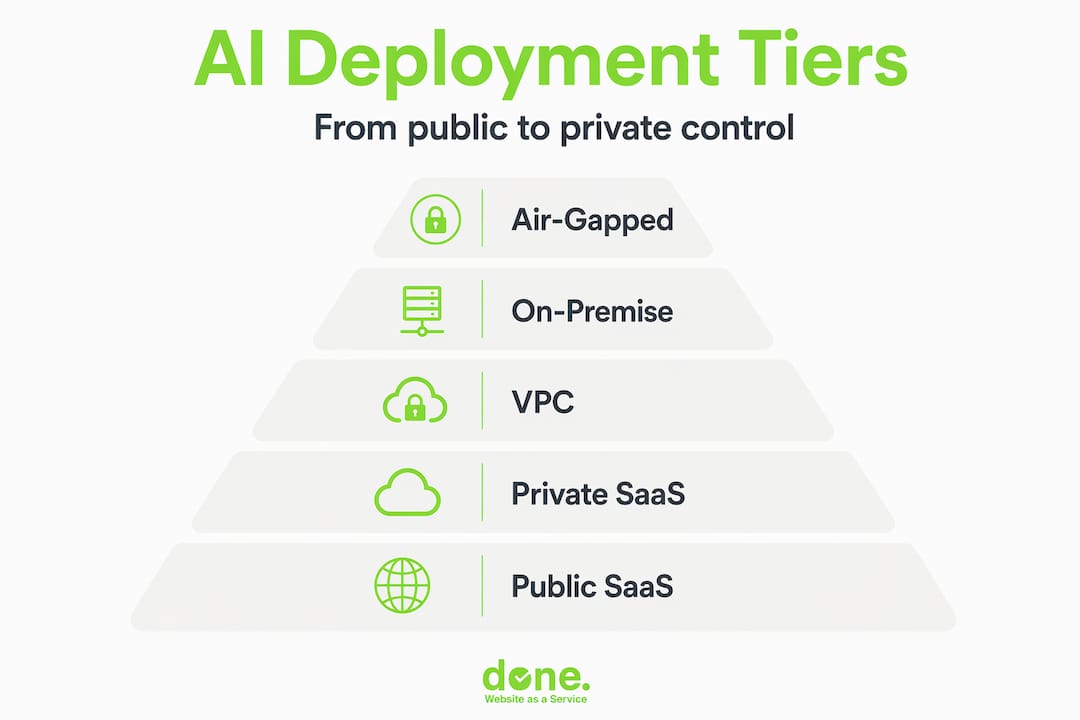
| Tier | Model | Data control | Security level | Estimated complexity | Relative cost |
|---|---|---|---|---|---|
| T1 | Public SaaS | Low | Standard | Very low | Low |
| T2 | Private SaaS (dedicated instance) | Medium | Enhanced | Low | Moderate |
| T3 | VPC-isolated cloud | High | Strong | Moderate | Moderate-high |
| T4 | On-premise (internet-connected) | Very high | Very strong | High | High |
| T5 | Air-gapped on-premise | Full | Maximum | Very high | Very high |
For most SMBs, the realistic options sit between T2 and T4. A VPC-isolated deployment keeps your data within a logically separated cloud environment, managed by your team or a trusted partner, without the full operational burden of owning physical hardware. This is often the most practical entry point for secure AI implementation in businesses that do not yet have dedicated LLM operations (LLM-ops) expertise in house.
On-premise and air-gapped realities
On-premise AI deployment (T4) gives you physical control over hardware and data. You run the models on servers you own or lease in a facility you manage. The main advantages are clear: data never leaves your premises and you can enforce your own security policies end-to-end. The disadvantages are equally clear: you bear full responsibility for hardware maintenance, power, cooling, network security, and software updates.
True air-gapped deployment (T5) takes isolation one step further. Air-gapped systems require no outbound network calls, local mirroring of all containers, packages, and model weights, plus sealed vaults for secrets management. Model weights must be transferred via signed physical media. No external DNS. No automatic updates. Every patch must be manually verified and applied. This level of isolation is appropriate for intelligence services, defence contractors, and certain highly regulated financial institutions. For a 30-person accounting firm, it is almost certainly excessive.
A common and costly mistake is assuming that on-premise deployment automatically achieves air-gapped security. Many on-premise AI tools still make outbound calls for licence verification, telemetry, or model updates. Auditing those network connections is not optional; it is a fundamental part of verifying your actual security posture.
Organising your security controls
When it comes to securing AI at any tier, AWS recommends three core layers to avoid overwhelming non-security stakeholders: infrastructure security, identity and data protection, and AI application security. This three-layer framing is practical for SMBs because it gives your IT team a clear mental model without requiring deep security expertise across every domain.
Pro Tip: If your team has no prior LLM-ops experience, start at T2 or T3 before committing to on-premise infrastructure. The skills required to operate private AI reliably are genuinely specialist, and the learning curve has real business cost attached to it.
Governance and ongoing operations
Deploying private AI is a decision you make once. Operating it responsibly is a commitment you make every day after that.
The governance requirements for private machine learning solutions are often treated as an afterthought, addressed only after something goes wrong. A more sustainable approach builds governance into your deployment plan from the start. Here is what that looks like in practice.
- Model provenance validation. You need to know where your AI models came from, what data they were trained on, and whether that training data creates any copyright, privacy, or compliance exposure. Failing to validate model provenance can create compliance exposure even in a fully internal environment. This is the AI supply chain risk that most SMBs overlook entirely.
- Drift monitoring. AI models degrade over time as the data they encounter in production drifts away from their training distribution. A model that performed well at launch may produce unreliable outputs six months later without any obvious warning sign. Regular monitoring and scheduled retraining cycles are not optional extras.
- Access controls and audit logging. Who in your organisation can query the AI system, what data can they access through it, and is every interaction logged? These controls are particularly important when AI agents can chain actions together, potentially accessing data through indirect routes that bypass your direct access policies.
- Security patching. Private AI infrastructure is software, and software has vulnerabilities. Establishing a patch management process for your AI stack is as important as patching your operating systems.
- GDPR and EU AI Act alignment. Depending on the risk classification of your AI applications under the EU AI Act, you may have specific documentation, transparency, and human oversight requirements. Integrating these into your governance framework early is significantly less costly than retrofitting them later.
For SMBs that are also implementing AI across their workflows, governance frameworks serve a dual purpose: they protect the business from regulatory risk and they build the internal confidence needed to expand AI adoption responsibly.
Practical steps to plan your private AI project
Moving from interest to implementation requires a structured approach. These steps reflect the process we use with clients at Done to take a private AI project from initial assessment through to a working deployment.
-
Assess your data sensitivity and compliance obligations. List every category of data your business handles and identify which categories are subject to GDPR special category protections, professional confidentiality requirements, or sector-specific regulations. This assessment determines whether private deployment is genuinely necessary or whether a well-configured private SaaS solution would meet your requirements.
-
Map your AI use cases by value and complexity. Not every potential AI application requires the same level of privacy protection. A document summarisation tool that processes internal policies is different from one that processes client medical records. Prioritise use cases where the business value is clear and the deployment complexity is manageable. Our AI implementation guide for Luxembourg SMBs provides a practical framework for this mapping exercise.
-
Conduct a realistic capacity audit. Do you have the internal technical staff to operate and maintain a private AI system? If not, can you engage a trusted partner to manage that function? Honest answers to these questions prevent the maintenance trap from derailing your project after launch.
-
Run a time-limited pilot. Choose one use case, deploy it at the appropriate tier (often T2 or T3 for SMBs), and measure results against clear business metrics over 60 to 90 days. This approach validates value before you commit to more expensive on-premise infrastructure.
-
Plan your full cost of ownership. Include hardware or cloud infrastructure, software licences, implementation services, internal staff time, ongoing maintenance, and periodic governance reviews. A realistic cost model over three years will look very different from the initial setup cost alone.
-
Engage specialised partners where needed. Choosing and deploying AI infrastructure without relevant experience is genuinely risky. A partner with experience in GDPR-compliant AI deployment can accelerate your timeline, reduce implementation errors, and help you avoid the governance gaps that create compliance exposure.
Pro Tip: Do not let “perfect private deployment” become the enemy of “useful AI adoption”. A well-governed T2 or T3 deployment that your team can actually operate delivers more business value than a T5 air-gapped system that nobody has the expertise to maintain.
My honest take on private AI for SMBs
I have spent years working alongside SMBs on AI adoption, and the pattern I see most often is this: businesses arrive convinced that private deployment is the gold standard, and they are surprised when the conversation becomes about trade-offs rather than absolutes.
Private AI is not a catch-all answer to data security concerns. It is a specific solution to a specific problem. When I work with a law firm that cannot send client documents to any external processor, or a financial services company with strict data residency requirements, private deployment is the right answer. The commitment and cost are justified. But when a 15-person marketing agency wants “private AI” because it sounds safer, the honest conversation is about whether a well-configured, GDPR-compliant SaaS solution with appropriate data processing agreements would serve them just as well at a fraction of the operational complexity.
The counterintuitive lesson I keep coming back to is this: simpler deployments, managed with strong governance, often outperform costly on-premise setups that lack the operational discipline to sustain them. Technology without governance is just infrastructure waiting to fail.
What I find genuinely promising is the middle ground. VPC-isolated deployments with strong access controls, monitored with appropriate tooling, and governed by clear internal policies can give SMBs most of the privacy benefits of full on-premise deployment without the operational burden of owning and maintaining physical AI infrastructure. That is often where the best return on investment sits.
My advice is to be honest about your team’s capabilities before you are honest about your technology preferences. The best AI deployment strategy for your business is the one your team can actually operate, govern, and improve over time.
— Thomas
How Done can help you deploy AI safely
At Done, we work with SMBs across Luxembourg and Europe to plan and implement private AI solutions that match their actual risk profile, regulatory obligations, and internal capacity. We do not recommend on-premise infrastructure to clients who would be better served by a well-governed private SaaS deployment. We start every engagement with an honest assessment of what your business genuinely needs and what it can sustainably operate.
Our AI strategy consulting for SMEs covers everything from initial use case mapping through to deployment, team training, and ongoing governance support. For businesses in data-sensitive sectors, we specialise in GDPR-compliant configurations and help you build the internal frameworks needed to operate AI responsibly. Whether you are exploring your first AI tool or planning a more complex AI consulting for operational transformation, we are ready to help you make a decision you can stand behind.
FAQ
What is private AI deployment?
Private AI deployment means running AI models and processing data within an environment your business controls, rather than on shared public cloud infrastructure. This can range from a dedicated private cloud instance to a fully air-gapped on-premise system with no external network connections.
Is private AI always more secure than public AI?
Not automatically. Security depends on how well the deployment is configured, governed, and maintained. A poorly managed on-premise system can be less secure than a well-configured private SaaS solution with strong access controls and regular security updates.
How much does private AI deployment cost for an SMB?
Costs vary significantly by deployment tier. A private SaaS or VPC-isolated solution can start at a few hundred euros per month, while full on-premise deployments involving dedicated hardware, specialist staff, and ongoing maintenance typically cost tens of thousands of euros per year. Always model the three-year total cost of ownership, not just the initial setup.
What regulations affect private AI deployment in Luxembourg?
The primary frameworks are GDPR, which governs personal data processing, and the EU AI Act, which introduces risk-based requirements for certain AI applications. Businesses in regulated sectors such as finance, legal services, and healthcare face additional sector-specific obligations that often make private deployment the most practical compliance route.
When should an SMB choose on-premise AI over a private cloud option?
On-premise AI deployment makes most sense when your regulatory requirements prohibit data from leaving your physical premises, when you have the internal technical capacity to manage hardware, or when your data volume and processing needs make dedicated infrastructure more cost-effective than cloud alternatives over a multi-year horizon.