

Ecommerce best practices that drive sales in 2026
June 6, 2026
Why measure website performance: a practical SMB guide
June 8, 2026
TL;DR:
- Website speed optimization reduces page load times and enhances server responsiveness, improving SEO, conversions, and AI visibility. Core Web Vitals like LCP, INP, and CLS directly influence ranking, crawl efficiency, and user experience, making ongoing monitoring essential. Slow sites are deprioritized by AI tools, leading to lost organic visibility, higher bounce rates, and decreased ad effectiveness, emphasizing speed as a vital business asset.
Website speed optimisation is the process of reducing page load times and improving server responsiveness so that visitors reach your content faster and search engines index your pages more efficiently. A one-second delay reduces conversions by up to 7%, and that figure compounds quickly across thousands of monthly visits. Google’s Core Web Vitals, which measure Largest Contentful Paint (LCP), Interaction to Next Paint (INP), and Cumulative Layout Shift (CLS), are now confirmed ranking factors. AI-powered search engines including ChatGPT, Perplexity, and Google AI Overviews have added a new layer of urgency: slow sites are quietly excluded from AI-generated summaries and citations, cutting off an increasingly significant source of organic visibility.
Why optimise website speed: what the metrics actually measure
Understanding why you should optimise website speed starts with knowing how speed is measured. Google and other search engines do not rely on a single number. They use a set of website performance metrics called Core Web Vitals, each targeting a different dimension of the user experience.
The three Core Web Vitals are:
- Largest Contentful Paint (LCP): measures how long it takes for the main visible content, typically a hero image or headline, to load. The target is under 2.5 seconds. Sites that pass Core Web Vitals can gain up to 70% more organic traffic compared to those that fail.
- Interaction to Next Paint (INP): measures how quickly your site responds to a user click or tap. The target is under 200 milliseconds. Anything above 500 ms feels broken to users on mobile devices.
- Cumulative Layout Shift (CLS): measures visual stability. A CLS score above 0.1 means elements are jumping around as the page loads, which frustrates users and signals poor quality to Google.
Beyond Core Web Vitals, Time to First Byte (TTFB) measures how quickly your server begins responding to a browser request. The optimal TTFB is under 200 ms. A TTFB above 600 ms significantly harms crawl efficiency and ranking, because Google’s crawlers move on when servers are slow.
| Metric | Target | Impact if missed |
|---|---|---|
| LCP | Under 2.5 seconds | Lower rankings, higher bounce rate |
| INP | Under 200 ms | Poor interactivity, reduced engagement |
| CLS | Under 0.1 | Visual instability, user frustration |
| TTFB | Under 200 ms | Reduced crawl budget, slower indexing |
Pro Tip: Use Google Search Console’s Core Web Vitals report alongside PageSpeed Insights to see both field data from real users and lab data from synthetic tests. The two together give you a far more accurate picture than either alone.
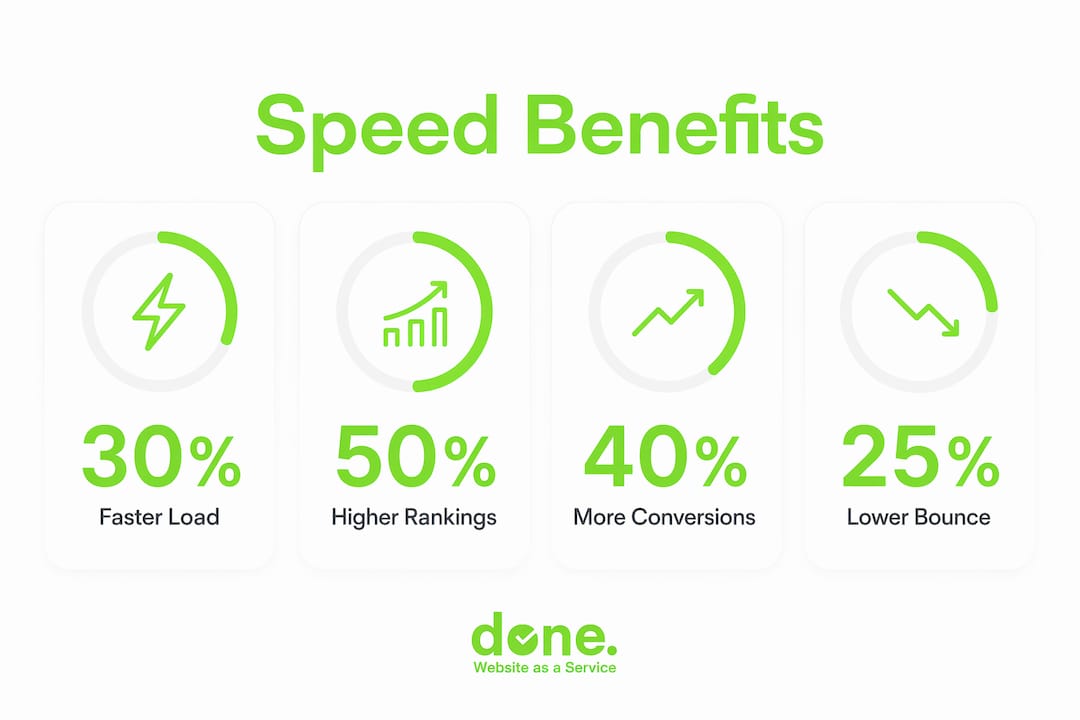
One figure that should concern every business owner: only 42% of mobile sites pass all Core Web Vitals metrics, despite mobile accounting for over 60% of web traffic. That means the majority of mobile visitors are landing on sites that Google already considers underperforming. The revenue sitting in that gap is substantial.
How does website speed affect SEO rankings in 2026?
Google has used speed as a ranking signal since 2021, but the weight it carries has grown with each core update. In 2026, the relationship between site speed and SEO is no longer indirect or theoretical. It is direct, measurable, and consequential.

The mechanism works on two levels. First, faster sites receive preferential crawl budget. Google allocates a finite number of crawl requests to each domain per day. When your server responds quickly with a low TTFB, Google’s bots crawl more pages per session, which means new content gets indexed faster and deeper pages get discovered at all. Second, Core Web Vitals scores feed directly into Google’s ranking algorithm as a page experience signal. A site that consistently fails LCP or INP is competing at a disadvantage against an otherwise equal competitor that passes.
The more significant shift in 2026 is the rise of Generative Engine Optimisation (GEO). AI search tools including ChatGPT, Perplexity, and Google AI Overviews pull from a curated pool of sources. AI search engines deprioritise slow or error-prone websites, making speed a gatekeeper for AI citation and visibility. The overlap between Google’s top organic results and AI-cited sources has dropped from 70% to under 20%, largely because AI crawlers apply stricter performance thresholds than traditional search bots.
“Search engines’ AI crawlers require fast, error-free, fully rendered server-side HTML to consider a site credible. Slow TTFB or rendering failures result in silent deranking and loss of AI citations.”
This is the part most business owners miss. You can produce excellent content and still be invisible in AI-generated answers if your server is slow or your JavaScript prevents clean rendering. The impact of loading speed on both traditional SEO and AI visibility is now one of the strongest arguments for treating performance as a core business function rather than a technical afterthought.
For digital marketers running paid campaigns, slow pages also reduce Google Ads Quality Scores. This directly increases cost-per-click and reduces the efficiency of every euro spent on SEM. Speed is not just an organic SEO concern. It affects your entire digital marketing budget.
What are the real business benefits of a faster website?
The benefits of website speed go well beyond rankings. The most direct impact is on conversion rates. Sites loading in one second convert at 3.05%, while the same site at five seconds converts at a fraction of that rate. For an e-commerce business or a lead generation site receiving 10,000 monthly visitors, a two-second improvement in load time can translate into dozens of additional enquiries or sales per month without changing a single word of copy.
Here are the four most quantifiable business outcomes from faster loading times:
- Higher conversion rates. A one-second delay reduces conversions by up to 7%. Removing three seconds of unnecessary load time can double or triple your conversion rate on mobile.
- Lower bounce rates. Bounce rates increase by over 100% when load times extend beyond three seconds. Visitors who leave immediately cost you the same acquisition budget as those who convert, but return nothing.
- Better paid advertising performance. Faster landing pages improve Google Ads Quality Scores, leading to 25% better return on ad spend (ROAS) and 15% lower cost-per-click (CPC). For businesses spending €2,000 or more per month on Google Ads, this is a meaningful cost reduction.
- Stronger brand perception. Users associate slow websites with untrustworthy or outdated businesses. A fast, stable site signals professionalism and builds confidence before a visitor has read a single line of content.
| Scenario | Slow site (5 seconds) | Fast site (1 second) |
|---|---|---|
| Conversion rate | Under 0.5% | Around 3% |
| Bounce rate | Over 90% | Under 40% |
| Google Ads CPC | Baseline | 15% lower |
| ROAS | Baseline | Up to 25% higher |
Pro Tip: When calculating the ROI of a speed optimisation project, include your monthly Google Ads spend in the model. A 15% CPC reduction on a €3,000 monthly budget saves €450 per month, which alone can justify the cost of professional optimisation work.
For businesses focused on generating more leads through their website, speed is one of the highest-leverage improvements available. It affects every visitor, every campaign, and every channel simultaneously.
What causes slow websites and how can you improve site speed?
Most slow websites share the same handful of root causes. Identifying which ones apply to your site is the first step in any speed optimisation project.
The most common performance bottlenecks are:
- Unoptimised images. Large PNG or JPEG files are the single most common cause of poor LCP scores. Switching to modern formats like AVIF or WebP and preloading key resources significantly improves LCP. Fixing LCP typically delivers the highest ROI among all speed improvements.
- Third-party scripts and tag manager sprawl. Every marketing pixel, chat widget, analytics tag, and A/B testing script added to your site adds HTTP requests and JavaScript execution time. A site with 15 or more third-party tags will almost always fail INP on mobile. Auditing and removing unused tags is often the fastest win available.
- Render-blocking CSS and JavaScript. Scripts loaded in the document head block the browser from rendering visible content. Deferring non-critical JavaScript and inlining critical CSS removes this bottleneck and directly improves both LCP and INP.
- Slow server response times. Shared hosting with high TTFB is a structural problem that no amount of front-end optimisation can fully compensate for. Moving to a managed hosting provider with edge caching or a Content Delivery Network (CDN) like Cloudflare or Fastly distributes your content geographically and cuts TTFB dramatically.
- No caching strategy. Without browser caching and server-side caching, every page visit triggers a full rebuild of the page. Implementing caching at both levels reduces server load and speeds up repeat visits significantly.
The less obvious problem is regression. Performance issues often arise from silent third-party script changes or tag manager updates that no one on your team initiated. A plugin update, a new marketing pixel, or a change to a third-party widget can degrade your Core Web Vitals scores overnight without triggering any alert. Periodic quarterly checks are insufficient to catch these regressions. Industry leaders treat performance as a live service level indicator, monitored continuously with real-browser testing tools.
Pro Tip: Set up automated performance monitoring using a tool like Dotcom-Monitor or SpeedCurve alongside Google Search Console. Configure alerts for any metric that drops below your target thresholds. This gives you early warning before a regression affects rankings or conversions.
For business owners who want to improve website navigability alongside speed, the two goals are closely related. Clean site architecture reduces the number of assets loaded per page and makes it easier for both users and crawlers to move through your content efficiently.
Key takeaways
Website speed optimisation directly determines your conversion rates, search rankings, and AI citation visibility, making it one of the highest-return technical investments a business can make.
| Point | Details |
|---|---|
| Core Web Vitals are ranking factors | LCP, INP, and CLS scores directly influence Google rankings and organic traffic volume. |
| Speed drives conversion rates | A one-second delay reduces conversions by up to 7%; faster sites convert at significantly higher rates. |
| AI search requires fast sites | ChatGPT, Perplexity, and Google AI Overviews exclude slow sites from citations, reducing AI-driven visibility. |
| Paid ads cost less on fast sites | Faster landing pages improve Quality Scores, cutting CPC by 15% and improving ROAS by up to 25%. |
| Monitoring must be continuous | Third-party scripts and updates cause silent regressions; quarterly checks are not sufficient. |
Speed is a service level, not a project: my honest view
After working on web performance across more than 350 client projects at Done, the pattern I see most often is this: a business invests in a well-built website, achieves good Core Web Vitals scores at launch, and then watches performance quietly degrade over the following 12 to 18 months. Nobody notices until a client mentions the site feels slow, or rankings start slipping.
The cause is almost always the same. A new marketing tool gets added. A plugin gets updated. A third-party script changes its loading behaviour. None of these changes are flagged as performance issues because they are not treated as such. Speed is still seen as a launch deliverable rather than an ongoing service level.
In my view, this is the most expensive mistake SMBs make with their websites. The compounding effect of gradual performance degradation is real. A site that slips from a 1.8-second LCP to a 3.5-second LCP over 18 months does not just lose some rankings. It loses conversion rate, it loses AI citation eligibility, and it loses ad efficiency simultaneously. By the time the problem is visible, months of revenue have already been affected.
What I recommend to every client is treating speed the same way you treat uptime. You would not accept your website being offline for two hours without an alert. You should not accept your LCP doubling without one either. Synthetic monitoring tools run tests from real browsers on a schedule and flag regressions before they compound. This is not a luxury for large enterprises. It is a basic operational practice for any business that depends on its website for leads or sales.
The businesses I have seen protect their performance most effectively are those that include speed targets in their website service agreements and review performance data monthly alongside traffic and conversion metrics. Speed is not a technical concern that lives in a developer’s backlog. It is a business metric that belongs in your monthly marketing review.
— Thomas
How Done helps Luxembourg businesses maintain fast, high-performing websites

At Done, we build websites with performance baked in from the start, not added as an afterthought. Our web development process covers server configuration, asset optimisation, caching strategy, and Core Web Vitals compliance as standard deliverables. We work with SMBs across Luxembourg who need their websites to perform consistently well, not just at launch.
If your site is losing ground on speed, or if you have never had a proper performance audit, our team can identify the specific bottlenecks affecting your rankings and conversions. Explore our web development services to understand how we approach performance-first builds, or read more about investing in web development as a long-term growth driver for your business. We are happy to start with a straightforward audit and give you a clear picture of where you stand.
FAQ
What is website speed optimisation?
Website speed optimisation is the practice of reducing page load times and improving server responsiveness to deliver content faster to users and search engine crawlers. It covers technical areas including image compression, caching, server configuration, and Core Web Vitals compliance.
How does site speed affect SEO rankings?
Google uses Core Web Vitals scores as direct ranking factors, and faster servers receive more crawl budget, leading to deeper and faster indexing. Sites that pass all Core Web Vitals can gain up to 70% more organic traffic compared to those that fail.
Why does speed matter for AI search engines like ChatGPT?
AI search tools including ChatGPT, Perplexity, and Google AI Overviews require fast, cleanly rendered pages to include a site in their citations. Slow or error-prone websites are deprioritised or excluded entirely, which reduces your visibility in AI-generated answers.
What is a good target for page load time?
LCP should be under 2.5 seconds, INP under 200 milliseconds, and TTFB under 200 ms for optimal performance. Sites meeting all three thresholds consistently rank better and convert at higher rates than those that do not.
How often should I check my website’s performance?
Continuous monitoring is the standard, not quarterly checks. Third-party script changes and plugin updates can silently degrade performance between manual reviews, so automated real-browser monitoring with threshold alerts is the recommended approach.