

RAG on SharePoint: a permission-aware guide for developers
August 11, 2026
Cookieless analytics: a practical guide for Central Europe
August 13, 2026
The highest-value B2B SEO keywords are long-tail, intent-rich phrases tied to specific buyer roles: technical specifications, compliance requirements, integration queries, and procurement terms. For SMEs in Central Europe, the right keyword strategy starts with sales transcripts, not keyword tools. Build a seed list from real buyer language, validate intent manually, map each phrase to a funnel stage, then publish hub-and-spoke content around it.
The five keyword types that consistently produce qualified leads in B2B:
- Compliance and certification phrases — “SOC 2 compliant cloud storage Luxembourg”, “GDPR-ready CRM for financial services”
- Integration and compatibility queries — “SAP integration with [product]”, “API rate limits [software name]”
- Procurement specification terms — “procurement specification stainless fittings EN 10216”, “technical datasheet [component] CE marking”
- Vendor evaluation phrases — “alternatives to [software] for mid-market”, “[product] vs [product] for manufacturing”
- Local and regional modifiers — “[service] provider Central Europe”, “[solution] anbieter Deutschland Österreich”
One-line plan: pull three recent RFPs or sales call transcripts, extract exact buyer phrasing, build a 30-keyword seed list, score each by intent and revenue fit, then assign one target page per cluster.
Pro Tip: The phrases your sales team hears on calls are almost always better seed keywords than anything a keyword tool suggests. Start there, every time.
Key takeaways
The most reliable B2B SEO result comes from targeting low-volume, intent-rich, buyer-role-specific keywords mapped to technical readiness pages, not from chasing broad search volume.
| Point | Details |
|---|---|
| Start with sales transcripts | Extract exact buyer phrasing from RFPs and calls before opening any keyword tool. |
| Prioritise BOFU compliance and integration queries | These convert fastest and face less competition than generic category terms. |
| Localise per language and country | Central Europe requires separate keyword clusters in EN, DE, and FR with correct hreflang tags. |
| Measure pipeline, not traffic | Track qualified leads and pipeline value from organic; ignore page views as a primary KPI. |
| Done as implementation partner | Done delivers seed-to-launch keyword strategy for Luxembourg SMEs with multilingual and GDPR support. |
Table of Contents
- Why B2B keyword selection is different from B2C
- How to run B2B keyword research as a small team
- A simple scoring formula to prioritise which keywords to target first
- Which content pages actually rank and convert in B2B
- A sample keyword map for Central Europe
- How to measure B2B SEO success without chasing vanity metrics
- Common mistakes and pro tips for Central Europe
- How Done helps SMEs implement B2B keyword strategies
- What we see working for Luxembourg SMEs right now
- Ready to build your B2B keyword strategy with Done?
- Practical tools and links for B2B keyword research
- Sources
Why B2B keyword selection is different from B2C
Most SME marketers fall into the volume trap early. A high-search-volume keyword may seem attractive but often attracts non-buyers like students and journalists instead of procurement managers with a budget. High-converting B2B keywords are typically low-volume, intent-rich long-tail phrases that match a specific buyer’s job at a specific moment in the purchase process.
B2B buying also involves multiple roles, each using different language:
- Technical evaluators search for specifications, API documentation, integration compatibility, and security standards
- Procurement managers use vendor comparison, RFP, and compliance language
- Finance decision-makers look for ROI models, total cost of ownership, and pricing structures
- C-suite sponsors search for case studies, analyst reports, and strategic fit
In Central Europe, this complexity is amplified by language. The same query appears in German, French, English, and sometimes Czech or Polish depending on the country and sector. Search volumes for niche industrial terms are often so low that tools report zero, yet those queries come from buyers ready to sign. B2B strategies require tactical, low-volume content targeted at decision-makers; CPC data can be misleading because a €0.50 keyword with genuine procurement intent outperforms a €15 keyword chased by competitors for brand awareness.
How to run B2B keyword research as a small team
A reproducible workflow matters more than expensive tools. Here is a process that works with a modest budget.
- Mine sales conversations first. Pull three to five recent RFPs, sales call notes, or purchase order specifications. Highlight the exact phrases buyers used to describe their problem, the solution they wanted, and the criteria they applied. These phrases are your seed keywords.
- Expand with free tools. Type each seed phrase into Google and record the Autocomplete suggestions and the “People also ask” and “Related searches” sections. These reflect real query patterns, not modelled estimates.
- Validate with Google Keyword Planner. Check monthly volume ranges and CPC. For B2B, a phrase showing 10–100 searches per month with a high CPC often signals strong commercial intent. Do not discard low-volume terms.
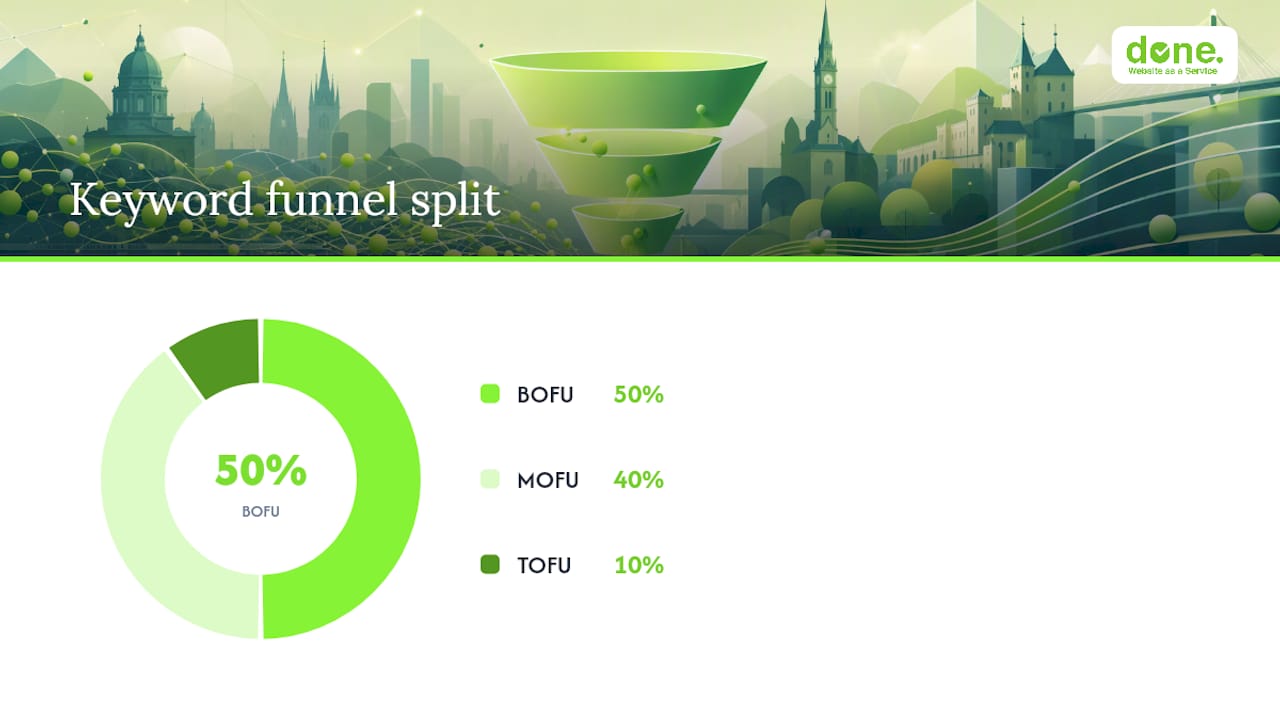
- Map each keyword to a persona and funnel stage. Buyer-journey mapping across TOFU, MOFU, and BOFU ensures every keyword has a logical home in your content architecture. A technical evaluator searching for API documentation is BOFU; a procurement manager reading “what is [category]” is TOFU.
- Assign a target page type. Each cluster needs one destination: a product page, a case study, an integration guide, or a compliance datasheet. Two clusters competing for the same URL dilute your ranking signal.
- Set milestones. At 30 days: seed list validated and first three pages published. At 90 days: internal linking complete and Google Search Console data flowing. At 180 days: first ranking movements visible and conversion tracking confirmed.
A simple scoring formula to prioritise which keywords to target first
Not every keyword deserves equal effort. Score each candidate on four inputs, each rated 1–5:
- Commercial intent strength — does the phrase indicate a buyer ready to act, or someone still researching?
- Revenue alignment — does ranking for this term bring in the type of client you want?
- Ranking difficulty — how competitive is the SERP, and do you have the domain authority to compete?
- Technical readiness fit — do you already have, or can you quickly build, a page that satisfies this query?
Formula: (Intent × Revenue alignment) ÷ (Difficulty × (6 minus Technical readiness))
A keyword scoring high on intent and revenue but low on difficulty and with a page you can publish quickly wins every time. Long-tail, industry- and location-specific keywords consistently score well on this model because competition is lower and intent is clearer.
Example scoring (anonymised):
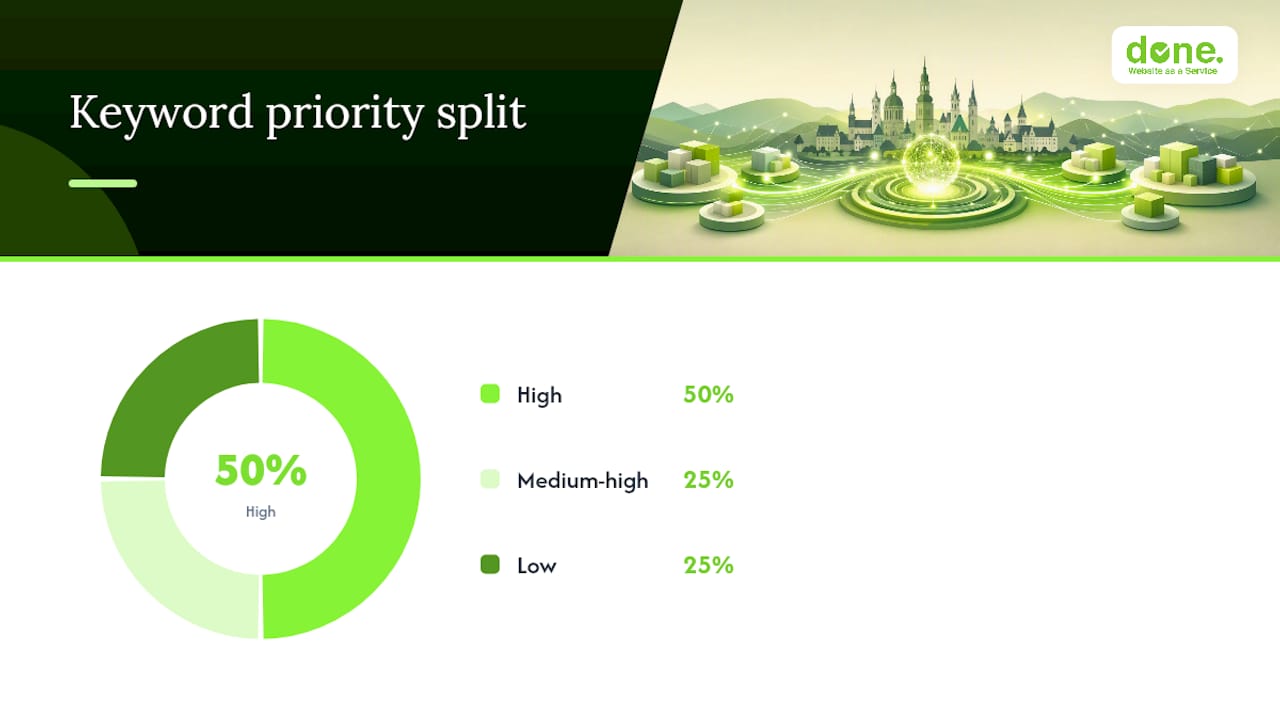
| Keyword | Intent | Revenue | Difficulty | Readiness | Score |
|---|---|---|---|---|---|
| “GDPR-compliant CRM Luxembourg” | 5 | 5 | 2 | 4 | High |
| “CRM software” | 2 | 3 | 5 | 2 | Low |
| “SAP integration guide [product]” | 4 | 4 | 3 | 3 | Medium-high |
| “ERP procurement specification DE” | 5 | 5 | 2 | 3 | High |
Which content pages actually rank and convert in B2B
Two categories of page do the heavy lifting: funnel-matched content and technical readiness pages.
AI-driven search now rewards pages that demonstrate technical depth and trust . Product specifications, integration guides, compliance documentation, and procurement datasheets. These pages satisfy technical evaluators and rank because they answer questions no thin marketing page can answer.
Match page types to funnel stages:
- TOFU: thought leadership articles, category explainers, industry trend posts
- MOFU: case studies with measurable outcomes, ROI calculators, vendor comparison guides
- BOFU: product specification sheets, integration how-to guides, compliance and certification pages, pricing and quote request pages
For technical readiness pages, structure metadata clearly: the title tag should include the specification standard or integration name, the meta description should state the compatibility or compliance claim directly, and internal links should connect the spec page to the relevant case study and the quote request page.
Pro Tip: Build a “compliance hub” page that links to all your certification and regulatory documentation. Procurement managers often search for “[your product] + [standard]” and a hub page with strong internal linking captures multiple variants of that query in one place.
Deep, instructional content such as integration guides and ROI models consistently outperforms thin pages in B2B contexts. One well-structured integration guide can rank for dozens of long-tail variants simultaneously.
A sample keyword map for Central Europe
The table below shows how a ten-keyword cluster might look for a mid-market B2B software provider operating across Luxembourg, Germany, and Austria.
| Keyword | Intent | Persona | Funnel stage | Priority |
|---|---|---|---|---|
| GDPR-compliant CRM Luxembourg | Transactional | Procurement | BOFU | High |
| SAP integration [product] guide | Informational/eval | Technical | MOFU | High |
| ERP vendor comparison Central Europe | Evaluative | Finance | MOFU | Medium |
| API documentation [product] | Informational | Technical | BOFU | High |
| cloud storage compliance DE AT | Transactional | Procurement | BOFU | High |
| workflow automation SME Österreich | Transactional | Operations | BOFU | Medium |
| ROI calculator CRM mid-market | Evaluative | Finance | MOFU | Medium |
| procurement datasheet [component] EN 10216 | Transactional | Procurement | BOFU | High |
| alternatives to [software] Luxembourg | Evaluative | All roles | MOFU | Medium |
| inbound marketing guide B2B FR | Informational | Marketing | TOFU | Low |
In Central Europe, localisation is not optional. The same buyer may search in English for technical specifications, in German for vendor comparisons, and in French for strategic content. Running separate keyword clusters per language, with hreflang tags and country-specific landing pages, captures intent that a single English-only strategy misses entirely.
In our experience working with Luxembourg SMEs, the fastest early wins come from BOFU compliance and integration queries in the local language. One client in the professional services sector saw their first qualified organic leads within 60 days of publishing three GDPR-specific landing pages, each targeting a distinct compliance query in German and French.
Pro Tip: Use Google Search Console’s “Search results” report filtered by country to identify which language variant is already generating impressions. Build the localised page for the language driving the most zero-click impressions first.
How to measure B2B SEO success without chasing vanity metrics
Rankings and traffic are inputs. Pipeline is the output. Track these KPIs:
- Qualified leads from organic search (not all form fills, only those matching your ICP)
- Pipeline value attributed to organic landing pages
- Conversion rate by page type (spec pages vs. case studies vs. quote pages)
- SERP position for your top ten transactional queries
- Time-to-first-contact for organic leads versus paid
For tools, a practical SME combination is Google Search Console (free, essential), Google Analytics 4 (free, conversion tracking), and one affordable paid tool such as Ahrefs Lite or Ubersuggest for rank tracking and competitor gap analysis. SEO drives measurable business growth for Luxembourg SMEs when measurement is tied to pipeline, not page views.
Realistic timeline: expect 6–9 months before meaningful pipeline movement from organic. The first 90 days are about publishing, indexing, and building internal links. Months 3–6 bring ranking movement on long-tail terms. Months 6–9 produce the first attributable leads.
First-90-days priorities: confirm Google Search Console is tracking all target pages, set up conversion goals in GA4 for quote requests and contact forms, and record baseline SERP positions for your top 20 keywords.
Common mistakes and pro tips for Central Europe
Mistakes that cost SMEs the most:
- Chasing high-volume generic terms and producing content that ranks for researchers, not buyers
- Ignoring intent: a page optimised for “what is [category]” will not convert a procurement manager searching for “[category] supplier Luxembourg”
- Building no technical readiness pages, leaving BOFU queries unanswered
- Treating Central Europe as a single market with one language
Tactical pro tips:
- Use sales transcripts as your primary keyword source; the language in RFPs is the language buyers type into Google
- Track transactional modifiers: “supplier”, “vendor”, “datasheet”, “specification”, “compliance”, “quote”, “pricing”
- Localise landing pages per country, not just per language; a German-language page hosted on a .lu domain with hreflang=“de-LU” signals differently from one on a .de domain
- Watch for tool volume blind spots: Ahrefs and SEMrush often show zero volume for niche industrial terms in smaller Central European markets, yet those queries exist and convert
- Build separate content hubs for each buyer persona rather than one generic blog
- For multilingual sites, use hreflang tags correctly and set a canonical per language variant to avoid splitting ranking signals across duplicate pages
Pro Tip: For multilingual canonicalisation in Central Europe, never set a single English page as the canonical for all language variants. Each language version should be self-canonical with correct hreflang annotations pointing to its counterparts. Getting this wrong means Google consolidates ranking signals onto one page and your German or French variants never rank.
How Done helps SMEs implement B2B keyword strategies
Done is a Luxembourg digital and AI agency with over 350 completed projects for SMEs across Central Europe. The B2B SEO and content services cover the full workflow described in this guide: keyword research grounded in sales conversations, technical readiness page production, multilingual localisation, and GDPR-compliant AI-assisted content.
Four things clients get from working with Done:
- Fast seed-to-launch workflow: from initial sales transcript review to first published pages within 30 days
- Central Europe language support: keyword research and content production in English, French, German, and Luxembourgish
- Technical documentation production: product spec pages, integration guides, and compliance datasheets built to rank and convert
- Measurable pipeline KPIs: tracking set up from day one, with reporting tied to qualified leads and pipeline value, not page views
What we see working for Luxembourg SMEs right now
The single most reliable early win for a small team is a cluster of three to five BOFU compliance or integration pages in the buyer’s preferred language. Not a blog post. Not a homepage refresh. Specific, technical pages that answer the exact question a procurement manager types at the end of their evaluation process.
We have seen this pattern repeat across sectors: a professional services firm publishes two GDPR-specific pages in German and French, and within 60 days those pages generate the first organic leads the business has ever tracked. The pages are not long. They are precise, well-structured, and they answer a question no competitor has bothered to answer in writing.
The mistake most SMEs make is starting with TOFU content because it feels safer and more creative. BOFU pages feel dry to write, but they are the ones that produce a phone call.
Ready to build your B2B keyword strategy with Done?
Done offers a structured starter engagement for SMEs who want to move from this guide to a live keyword strategy. A typical starter project includes a keyword audit drawing on your sales transcripts and RFPs, a prioritised 30-keyword seed list with persona and funnel mapping, and a 30-day content pilot targeting your highest-priority BOFU cluster.
Pricing for a starter keyword and content engagement typically falls within a project-based range suited to SME budgets, with no long-term lock-in and no setup fees. All work is GDPR-compliant and multilingual by default. To discuss your situation and get a clear scope, visit Done’s digital marketing workflow page or contact the team directly at Done.
Practical tools and links for B2B keyword research
- Google Autocomplete and Related Searches — free, reflects real query patterns; type your seed phrase and record every suggestion, including language variants
- Google Keyword Planner — free with a Google Ads account; use it to validate volume ranges and CPC for intent signals, not as a primary discovery tool
- Ahrefs Lite or Ubersuggest — affordable paid options for rank tracking, competitor gap analysis, and backlink data; both cover Central European markets and support multilingual queries
- Google Search Console — free and essential; filter by country and query to find existing impressions on keywords you have not yet targeted
- Done.lu resources for Luxembourg SMEs — the SEO strategy guide for SMBs and the Central Europe SEO trends playbook cover regional nuances in detail; the content marketing guide for SMBs maps content formats to funnel stages