

B2B SEO keywords: the Central Europe conversion playbook
August 12, 2026
Multilingual website SEO: a practical guide for SMBs
August 14, 2026
Cookieless analytics means collecting website measurement data without writing persistent identifiers to a visitor’s browser or device. The term is a technology descriptor, not a legal conclusion: many cookieless techniques still require consent under GDPR and the ePrivacy Directive if they access device characteristics or create stable identifiers. For Central European sites, the immediate practical question is architectural: does your measurement system touch terminal equipment at all? If it does not, a consent-free route exists. If it does, consent is still required regardless of whether you call it “cookieless.”
The single most important action you can take now:
- Run a 30-day parallel test alongside your current setup using a server-side, no-terminal-equipment architecture configured to Germany’s strict §25 TDDDG standard. That configuration satisfies the rest of the EU as well.
- Request a Done.lu audit if you are unsure whether your current analytics stack touches terminal equipment or transfers data outside the EU.
Key takeaways
Cookieless analytics is only GDPR-compliant when the underlying architecture genuinely avoids terminal-equipment access and processes no personal data, or when a valid lawful basis covers any residual processing.
| Point | Details |
|---|---|
| Cookieless ≠ automatically compliant | Many cookieless techniques still require consent if they access device characteristics or create stable identifiers. |
| Server-side host-only is the safe route | Discarding raw IPs, rotating salts daily, and storing only aggregates avoids the Article 5(3) ePrivacy trigger. |
| Germany’s §25 TDDDG sets the Central Europe baseline | Configuring to Germany’s strict standard satisfies the rest of the EU; no legitimate-interest escape exists for terminal-equipment access. |
| Accuracy trade-offs are manageable | Pageviews and aggregate conversions remain reliable; unique visitors and cross-device attribution degrade and require documented uncertainty ranges. |
| Done delivers the full audit-to-pilot path | Done’s fixed-fee audit covers technical review, LIA/DPIA templates, parallel implementation, and a 28-day validation for Central European SMEs. |
Table of Contents
- Why cookieless analytics matters for your measurement strategy now
- What are the core technical approaches to cookieless analytics?
- What accuracy do you actually lose with cookieless tracking?
- When does GDPR still require consent for cookieless analytics in Central Europe?
- How to migrate to cookieless analytics: a step-by-step checklist
- Comparing cookieless approaches: which one fits your situation?
- How Done implements GDPR-aware cookieless analytics for Central European clients
- When is cookieless measurement actually the right choice for your business?
- Done’s GDPR-aware cookieless analytics audit for Central Europe
- Sources
Why cookieless analytics matters for your measurement strategy now
Two forces are converging to make this urgent. The first is browser behaviour. Safari’s Intelligent Tracking Prevention and Firefox’s Enhanced Tracking Protection have blocked third-party cookies for years. Chrome completed its own deprecation path in 2024. The practical effect is that traditional cross-site tracking, which relied on third-party cookies, no longer works reliably across a large share of your audience.
The second force is regulation. Central Europe sits at the strict end of the EU enforcement spectrum. Germany’s §25 TDDDG (the national transposition of Article 5(3) ePrivacy) requires consent for any storage or access to a user’s terminal equipment, with no soft “legitimate interest” escape route. Austria’s DSB and the Czech ÚOOÚ have issued similar guidance. Consent banners are the visible result, and they carry a measurable cost.
Scale of the problem: Consent banner acceptance rates in European markets vary, with many visitors declining or ignoring consent prompts, creating a structural gap in analytics data that grows with every enforcement cycle.
The practical business impacts are:
- Measurement gaps: sessions from non-consenting visitors disappear entirely from standard analytics, understating traffic and engagement.
- Attribution failures: paid campaign attribution breaks when the conversion pixel cannot fire without consent, making ROAS calculations unreliable.
- Consent-banner fatigue: repeated prompts reduce conversion rates on landing pages, particularly on mobile.
The broader shift in digital marketing measurement is moving away from individual-level tracking towards aggregate, privacy-preserving signals. Cookieless analytics is the architectural response to that shift.
What are the core technical approaches to cookieless analytics?
The term covers several distinct techniques, and they differ substantially in compliance risk, engineering effort, and measurement fidelity.
Server-side first-party event collection
Your server receives the HTTP request, logs the event, discards the raw IP immediately, and stores only aggregate counts. No JavaScript writes to the browser. No cookie, no localStorage entry, no fingerprint. This is the only architecture that avoids Article 5(3) ePrivacy triggers entirely, because nothing is stored on or read from the visitor’s terminal equipment.
A minimal data flow looks like this:
Ingest (server receives request) → Transform (extract path, referrer host only, timestamp) → Discard (raw IP dropped before any write) → Aggregate storage (daily counts by path, no per-visitor rows)
The 2026 EU consent-free analytics playbook describes practical engineering controls for this pattern: daily-rotating BLAKE3-HMAC visitor signatures, host-only referrer truncation, and jurisdiction-aware consent-mode validators.
First-party client-side with no persistent storage
A JavaScript snippet fires on page load but writes nothing to cookies or localStorage. Session-scoped memory only. Compliance risk is lower than traditional analytics but not zero: if the script reads device characteristics to build a session identifier, regulators may treat that as terminal-equipment access.
Probabilistic modelling
Aggregate signals (traffic volumes, campaign spend, conversion counts) feed a statistical model that estimates attribution without individual-level identifiers. Google’s Consent Mode v2 uses this approach. Accuracy degrades with small sample sizes, and the model’s assumptions may not match your audience.
Privacy-preserving browser APIs
The Privacy Sandbox’s Topics API and Attribution Reporting API are browser-native alternatives to third-party cookies. They keep data on-device and return only aggregate or noisy signals. Adoption is still limited, and the APIs are not yet stable across all browsers.
Fingerprinting
Reading device characteristics (screen resolution, fonts, user agent, canvas rendering) to create a stable identifier. This is the highest-risk approach. Regulators treat fingerprinting as accessing terminal equipment, which triggers both ePrivacy and GDPR obligations. The EFF has long documented how fingerprinting changes the compliance analysis under GDPR. Avoid it for audience measurement purposes.
Pros and cons at a glance
| Approach | Accuracy | Engineering effort | Compliance risk | Best for |
|---|---|---|---|---|
| Server-side host-only | Moderate (aggregate) | High | Low (no terminal access) | Consent-free audience measurement |
| First-party no-storage | Moderate | Low–Medium | Low–Medium | Session analytics with consent |
| Probabilistic modelling | Low–Moderate | Medium | Low | Attribution estimation |
| Privacy APIs | Low (early stage) | Medium | Low | Future-proofing |
| Fingerprinting | High | Low | Very high | Not recommended |
What accuracy do you actually lose with cookieless tracking?
Some metrics survive the transition well. Others do not.
Metrics that remain reliable under a server-side, aggregate-only setup: total pageviews, page-level traffic trends, referrer source distribution (at host level), and aggregate conversion counts. These are the four core metrics most SMEs genuinely need to make decisions.
Metrics that degrade: precise unique visitor counts, cross-device attribution, detailed session stitching, and funnel drop-off at the individual level. Without a stable identifier, you cannot reliably distinguish one visitor returning three times from three different visitors.
Probabilistic modelling can partially recover attribution, but it introduces uncertainty that you must communicate honestly to stakeholders. Confidence intervals widen with smaller datasets. A campaign that drove 50 conversions in a cookieless model carries far more uncertainty than one that drove 5,000.
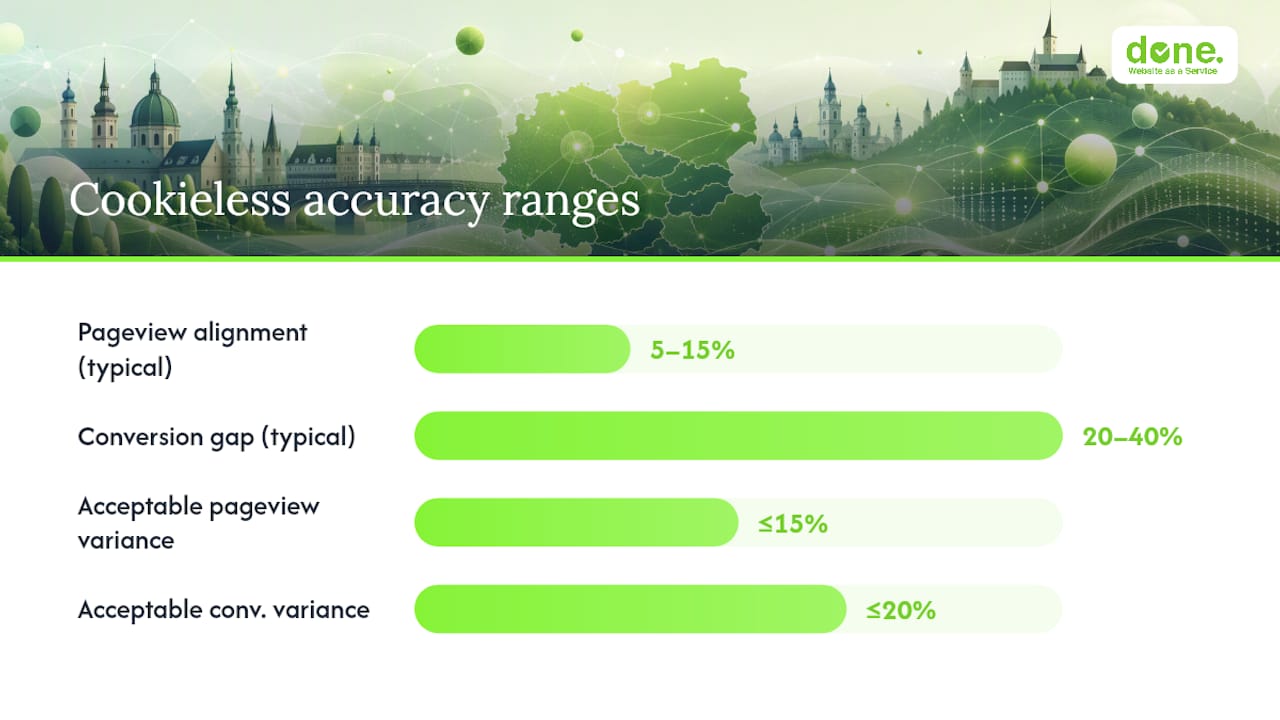
Practical accuracy note: In parallel-run tests we have seen with clients, server-side aggregate pageview counts typically align within 5–15% of consented client-side counts. Conversion attribution gaps are wider, often 20–40%, because attribution depends on identifier continuity that the cookieless setup deliberately removes.
Deduplication limits are a specific pain point. Without a persistent visitor ID, the same person visiting from desktop and mobile appears as two visitors. Salt rotation (changing the hashing key daily) is good for privacy but makes cross-session deduplication impossible by design.
Validation protocol for a parallel run:
- Compare total pageviews: acceptable variance is under 15%.
- Compare aggregate conversion counts (not attributed): acceptable variance is under 20%.
- Compare top-10 referrer sources by rank order: acceptable variance is two position shifts.
- Run for a minimum of 28 days to capture weekly patterns.
- If variance exceeds thresholds, audit the server-side ingest pipeline before proceeding.
Pro Tip: Before presenting cookieless data to stakeholders, document the measurement methodology explicitly. Stakeholders who understand the model trust the data more, not less.
When does GDPR still require consent for cookieless analytics in Central Europe?
The short answer: whenever your analytics system accesses or writes to a visitor’s terminal equipment, or processes personal data without a valid lawful basis.
§25 TDDDG in Germany requires consent for any storage or access to terminal equipment, with no legitimate-interest alternative. The only architecture that survives §25 without consent is one where the terminal-equipment trigger never engages: server-side processing only, nothing written to or read from the browser.
The DSK and BfDI guidance carves out a narrow exemption for anonymous audience measurement, but the conditions are specific:
Austria, the Czech Republic, Slovakia, and Hungary have transposed Article 5(3) ePrivacy in comparable terms. Configuring your system to satisfy Germany’s §25 TDDDG is therefore the conservative baseline that composes upward across Central Europe.
When consent is still required
- Any client-side JavaScript that writes a cookie, localStorage entry, or IndexedDB record.
- Any technique that reads device characteristics to build an identifier (fingerprinting).
- Any server-side processing that retains a raw IP address beyond the immediate request.
- Any cross-site or cross-device identifier, even a short-lived one, if re-identification is possible.
- Any data transfer to a processor outside the EU without an adequacy decision or appropriate safeguards.
Compliance steps for a consent-free server-side setup
- Discard raw IP before any write to storage. Log only the aggregate event.
- Rotate salts daily if you use any form of visitor signature. Hashing alone does not guarantee anonymity if the salt is static and the input space is small.
- Truncate referrers to host only. Full referrer URLs can contain personal data in query strings.
- Bound retention to the minimum necessary. Aggregate daily counts do not need to be retained for more than 13 months; raw event logs should not exist at all.
- Keep processing in the EU. Use EU-region infrastructure for your analytics pipeline.
- Update your privacy policy to describe the server-side measurement approach, the data minimisation controls, and the legal basis (or the absence of personal-data processing, if that is genuinely the case).
- Prepare a Legitimate Interests Assessment (LIA) or DPIA if you are processing any data that could be personal. Even a well-designed server-side setup benefits from documented reasoning.
How to migrate to cookieless analytics: a step-by-step checklist
Migration is a governance exercise as much as a technical one. Rushing the technical implementation without updating legal documentation is a common mistake.
Migration steps
- Discovery audit: inventory every analytics tag, pixel, and script on your site. Identify which ones write to terminal equipment and which transfer data outside the EU.
- Select your architecture: decide between a consent-free server-side setup (aggregate only, no terminal access) or a consented first-party setup (client-side with a consent management platform). Most Central European SMEs benefit from a hybrid of both.
- Instrument parallel tracking: deploy the new cookieless system alongside the existing one. Do not decommission the old system yet.
- Run the parallel validation protocol: use the variance thresholds described in the accuracy section above. Minimum 28-day run.
- Update privacy documentation: revise your privacy policy, cookie notice, and consent management platform configuration to reflect the new architecture.
- Complete LIA or DPIA: document the legal basis for any residual data processing. If you are genuinely processing no personal data, document that reasoning too.
- Set retention and monitoring controls: configure automatic deletion of any transient data, set up alerts for unexpected cookie writes, and schedule quarterly reviews.
- Roll out and decommission: once validation passes, remove the old tracking and confirm the new system is the sole measurement path.
Parallel run test template
- Metrics to compare: total pageviews, aggregate conversion counts, top referrer sources by rank, campaign click-to-session ratio.
- Sample size: minimum 1,000 sessions per variant per week.
- Duration: 28 days minimum, 56 days preferred for seasonal stability.
- Rollback criteria: if cookieless pageview variance exceeds 20% against the consented baseline, or if conversion count variance exceeds 30%, pause and audit the ingest pipeline before proceeding.
Rollback triggers
- Unexpected cookie or localStorage writes detected in DevTools on a clean profile.
- Raw IP addresses appearing in any log file or database table.
- Data transfers to non-EU processors discovered post-deployment.
- DPA inquiry or enforcement notice received during the pilot period.
Developer notes
- Host your analytics pixel on a first-party subdomain (e.g.
metrics.yourdomain.com) via CNAME. This avoids third-party domain blocking by browsers and ad blockers. - Use a CDN with EU-only routing for the analytics endpoint.
- Avoid any client-side storage API: no
document.cookie, nolocalStorage, nosessionStorage, noIndexedDB. Pre-launch testing in a clean browser profile should confirm zero writes to any of these. - Sanitise query strings before logging referrer data. Strip UTM parameters and any user-identifiable values from the referrer before the log write.
Comparing cookieless approaches: which one fits your situation?
The table above reflects compliance risk under Central European law specifically. Fingerprinting’s apparent accuracy advantage is irrelevant when the legal exposure makes it unusable.
Pro Tip: If your team is small and your regulatory exposure is high (financial services, healthcare, legal), start with server-side host-only and accept the accuracy trade-off. You can layer probabilistic modelling on top once the architecture is stable. Trying to recover full attribution accuracy on day one usually means cutting compliance corners.
How Done implements GDPR-aware cookieless analytics for Central European clients
In our experience, the gap between “we’ve gone cookieless” and “we have a defensible, accurate measurement setup” is where most SME projects stall. The architecture is not the hard part. The hard part is the governance: the LIA documentation, the privacy-policy update, the parallel validation, and the stakeholder communication about what the data now means.
A recent client project illustrates the pattern. A professional-services firm in Luxembourg had been running a standard client-side analytics setup with a consent management platform. Consent acceptance rates were low, leaving roughly a large share of sessions unmeasured due to consent rejection. The goal was to recover measurement coverage without expanding consent requirements.
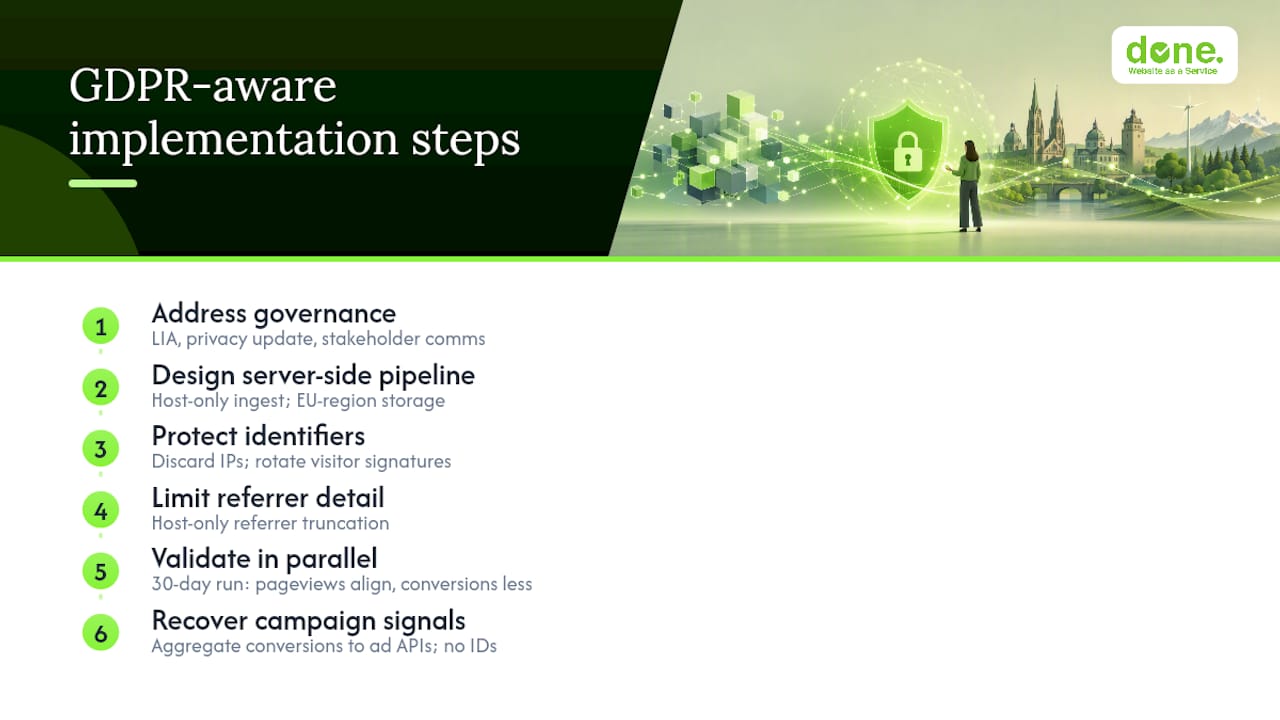
Done designed a server-side, host-only ingest pipeline: raw IPs discarded at the load balancer, daily-rotating visitor signatures, host-only referrer truncation, EU-region storage only. A 30-day parallel run showed pageview counts generally close to the consented baseline, with conversion counts somewhat less aligned, which the client accepted, given the methodology documentation provided. Campaign attribution was partially recovered by passing aggregated conversion signals back to the ad platforms via server-side conversion APIs, without individual-level identifiers.
What a Done audit and pilot covers
- Technical review: full inventory of existing analytics tags, pixels, and data flows; identification of terminal-equipment access points and non-EU transfers.
- Architecture recommendation: server-side host-only, consented first-party, or hybrid, with a written rationale tied to your specific regulatory exposure.
- LIA and DPIA templates: pre-populated with your architecture’s data flows, ready for legal review.
- Parallel implementation: Done instruments the new system alongside your existing setup and runs the 28-day validation protocol.
- Reporting dashboard: a clean, stakeholder-ready view of the cookieless data with uncertainty ranges documented.
- Staff handover: a written runbook and a 90-minute handover session so your team can maintain and extend the setup independently.
Done has completed over 350 client projects since 2014, with a particular focus on GDPR-compliant digital measurement for SMEs in Luxembourg and Central Europe. The digital consulting service covers the full audit-to-implementation path described above.
When is cookieless measurement actually the right choice for your business?
In our experience, SMEs often ask the wrong question. The question is not “should we go cookieless?” but “what measurement accuracy do we actually need, and what legal exposure are we carrying right now?”
Three scenarios cover most of the cases we see:
Prefer cookieless first if your primary need is audience measurement (traffic volumes, content performance, referrer mix) and you want to avoid consent banners entirely. A server-side, no-terminal-equipment setup gives you reliable aggregate data with minimal legal overhead. This fits most content-led businesses, professional-services firms, and B2B sites where individual-level attribution is not the core measurement goal.
Prefer consented first-party analytics if you are running paid campaigns and need conversion attribution at the campaign or keyword level. Probabilistic modelling degrades quickly at the traffic volumes most SMEs operate at. A well-configured consent management platform with a high acceptance rate will give you better attribution data than a cookieless model with wide confidence intervals. The trade-off is the consent-banner friction, which you can reduce with good UX design.
Prefer a hybrid if you need both: aggregate audience measurement for content and SEO, plus attributed conversion data for paid campaigns. The server-side layer handles the former without consent; the consented client-side layer handles the latter for visitors who accept. This is the setup Done most commonly recommends for Luxembourg and Central European SMEs running mixed organic and paid programmes.
One concrete recommendation for the Luxembourg market specifically: if you are operating in a regulated sector (finance, legal, healthcare), start with the server-side layer and get the LIA documentation in place before adding any client-side measurement. The CNPD has been active in enforcement, and a documented, conservative architecture is a stronger position than an undocumented one that claims to be “cookieless.”
Done’s GDPR-aware cookieless analytics audit for Central Europe
Measurement gaps from consent drop-off are costing Central European SMEs real campaign data, and the fix is architectural, not cosmetic. Done’s audit and pilot service gives you a clear picture of where your current setup creates legal exposure, a recommended architecture matched to your regulatory context, and a working implementation you can validate before decommissioning anything.

The audit covers a full technical inventory, written LIA and DPIA templates, a 28-day parallel implementation, and a stakeholder-ready reporting dashboard. The pilot is time-boxed and fixed-fee, so there are no open-ended commitments. Most audits complete within two to three weeks; the parallel pilot runs for 28 days alongside your existing setup.
To request an audit or discuss your current analytics architecture, contact Done directly at Done. If you are also reviewing your broader digital marketing workflow, the audit findings feed directly into campaign attribution and lead-generation reporting.
Sources
- Practical Cookieless GDPR Compliant Analytics Guide Guide
- Is cookieless tracking GDPR compliant? What the law actually says | Databuddy
- GDPR and browser fingerprinting: how it changes the game — EFF