

Website project management guide for digital transformation
March 16, 2026
How SEO drives business growth for Luxembourg SMEs in 2026
March 18, 2026
Many ecommerce business owners believe SEO is merely about sprinkling keywords across product pages and waiting for traffic to appear. This misconception costs European retailers thousands in lost revenue every month. The reality is far more sophisticated and rewarding. Effective SEO transforms how search engines discover, crawl, and rank your entire product catalogue whilst simultaneously improving user experience and conversion rates. This guide reveals evidence-based strategies that have generated substantial visibility increases and revenue growth for European ecommerce businesses, providing you with actionable frameworks to optimise your online store’s performance in 2026.
Table of Contents
- Understanding The Role Of SEO In Ecommerce Success
- Key Technical SEO Strategies For Ecommerce Websites
- Integrating SEO Across Your Ecommerce Business For Sustained Growth
- Measuring SEO Impact: Key Metrics And Continuous Optimisation
- How Our Web Development Services Can Boost Your Ecommerce SEO
Key takeaways
| Point | Details |
|---|---|
| Crawl efficiency matters | Smart pagination and technical optimisation allow search engines to discover your entire product inventory effectively |
| Integration drives results | Embedding SEO across all departments, from content teams to ecommerce managers, creates sustained organic growth |
| Measurable outcomes | Visibility improvements of 100% and revenue increases exceeding €600,000 demonstrate SEO’s tangible business impact |
| Technical errors hurt visibility | Common mistakes like poor pagination or indexing issues can prevent customers from finding your products |
| Continuous optimisation required | Regular monitoring and data-driven adjustments ensure your SEO strategy adapts to algorithm changes and market shifts |
Understanding the role of SEO in ecommerce success
Search engine optimisation for ecommerce extends far beyond traditional content marketing tactics. Whilst blog posts and articles attract informational searches, ecommerce SEO focuses on making your product pages visible when potential customers actively search with purchase intent. This fundamental difference shapes every aspect of your optimisation strategy, from technical architecture to content creation.
The role of SEO in digital marketing becomes particularly critical for online retailers because organic search often represents the highest converting traffic channel. Unlike paid advertising, which stops delivering results the moment you pause spending, SEO builds cumulative value over time. Each optimised product page, category structure improvement, and technical enhancement contributes to a foundation that continues generating traffic and revenue for months or years.
Consider the transformation achieved by European jewellery retailer PURELEI. Their systematic approach to ecommerce SEO delivered a 100% visibility increase within 8 months, fundamentally changing their business trajectory. This wasn’t achieved through a single tactic but rather through comprehensive optimisation across multiple dimensions.
Effective ecommerce SEO addresses several interconnected elements:
- Technical infrastructure that enables efficient crawling and indexing of thousands of product pages
- Strategic keyword targeting aligned with customer search behaviour throughout the purchase journey
- Content optimisation that balances search engine requirements with genuine user value
- Site architecture that distributes ranking authority effectively across your product catalogue
- Performance optimisation that ensures fast loading times and excellent mobile experiences
The measurable outcomes from proper implementation speak clearly. Increased visibility translates directly into more qualified visitors discovering your products. When these visitors arrive through organic search rather than paid channels, your customer acquisition costs drop substantially whilst maintaining or improving conversion rates. This economic advantage compounds over time, creating sustainable competitive differentiation in crowded European markets.
Pro Tip: Track your organic traffic’s conversion rate separately from paid channels. Most ecommerce businesses discover organic visitors convert 20 to 30% better because they’re actively searching for solutions rather than being interrupted by advertisements.
Key technical SEO strategies for ecommerce websites
Technical SEO forms the foundation upon which all other optimisation efforts build. Without proper technical implementation, even brilliant content and perfect keyword targeting cannot deliver results because search engines struggle to access and understand your product catalogue. European ecommerce managers must prioritise crawl efficiency to ensure Google discovers and indexes their entire inventory.
Smart pagination represents one of the most powerful yet underutilised technical strategies. Traditional pagination forces search engine crawlers to click through dozens or hundreds of pages sequentially to reach products at the end of your catalogue. This approach wastes crawl budget and often results in deeper products never being discovered. Smart pagination allows Google to access both the beginning and end of inventory efficiently, dramatically improving how many products get indexed and ranked.
Implementing smart pagination involves creating a logical structure where crawlers can jump to different sections of your product listings without sequential navigation. This might include category filters that create distinct URLs, alphabetical sorting options, or strategic internal linking that connects related products across different pagination depths. The goal is ensuring every product remains discoverable within three to four clicks from your homepage.
Common technical pitfalls sabotage even well-intentioned SEO efforts. Duplicate content across product variations confuses search engines about which version to rank. Slow server response times trigger crawl rate limiting, reducing how many pages Google examines during each visit. Missing or incorrect canonical tags create indexing chaos. Broken internal links waste crawl budget and create poor user experiences.
The table below illustrates typical crawlability improvements from implementing smart pagination:
| Metric | Before optimisation | After optimisation | Impact |
|---|---|---|---|
| Products crawled per visit | 340 | 890 | +162% |
| Average crawl depth | 8.2 clicks | 3.1 clicks | +62% efficiency |
| Indexed product pages | 2,100 | 4,650 | +121% |
| Crawl errors per week | 47 | 3 | +94% reduction |
Identifying technical issues requires systematic auditing. Google Search Console provides invaluable data about crawl errors, coverage problems, and indexing status. Regular monitoring reveals patterns like specific product categories consistently generating errors or mobile usability issues affecting particular device types. Many European ecommerce sites discover thousands of pounds in lost revenue simply by fixing SEO issues for missing natural referencing that prevented products from appearing in search results.
Pro Tip: Set up automated weekly reports from Google Search Console highlighting new coverage errors. Addressing technical issues within 48 hours prevents them from compounding and affecting broader sections of your product catalogue.
Integrating SEO across your ecommerce business for sustained growth
The most successful European ecommerce businesses treat SEO as a company-wide priority rather than isolating it within the marketing department. This integrated approach recognises that product teams, content creators, developers, customer service representatives, and executives all influence search performance through their daily decisions. Integrating SEO into the entire company, including ecommerce teams and content creators, proves crucial for sustained success.
When product managers understand SEO principles, they make better decisions about product descriptions, attribute structures, and category organisation. Developers who recognise SEO implications build features that enhance rather than hinder search visibility. Customer service teams who monitor search queries gain insights into customer needs that inform product development and content strategy. This cross-functional collaboration creates exponential improvements beyond what isolated SEO specialists can achieve.
Aligning teams around shared SEO objectives requires clear communication about how search performance connects to business outcomes everyone cares about. Product teams see how better visibility drives sales of their categories. Content creators understand how their work attracts qualified traffic that converts. Developers recognise how technical improvements reduce bounce rates and improve user satisfaction scores.
Implementing company-wide SEO integration follows these steps:
- Establish baseline metrics that matter to each department, showing current SEO performance in terms they understand like revenue per category or customer acquisition costs
- Create shared dashboards displaying real-time SEO performance alongside other business metrics, making search visibility as visible as sales figures or inventory levels
- Include SEO considerations in all relevant decision-making processes, from new product launches to website redesigns and social media management for ecommerce campaigns
- Provide targeted training for each department explaining how their specific responsibilities impact search performance and what actions improve results
- Celebrate SEO wins publicly and connect them to team efforts, reinforcing how collaborative optimisation drives measurable business growth
- Build SEO requirements into project specifications and quality checklists, ensuring web design for ecommerce success incorporates search best practices from inception
This integrated approach transforms SEO from a periodic project into an ongoing operational capability. When launching new products, teams automatically consider keyword targeting, content requirements, and technical implementation. When planning promotions, marketers coordinate organic and paid strategies for maximum impact. When redesigning site sections, developers proactively address potential SEO implications before deployment.
Pro Tip: Create a simple SEO checklist for each department covering their most common decisions that affect search performance. Product teams get a checklist for new listings, developers get one for feature launches, and content teams get one for category page updates.
Measuring SEO impact: key metrics and continuous optimisation
Tracking the right metrics separates successful ecommerce SEO programmes from those that consume resources without delivering measurable returns. European business owners need clear visibility into how optimisation efforts translate into commercial outcomes. Whilst vanity metrics like keyword rankings provide some insight, revenue-focused measurements reveal true performance.
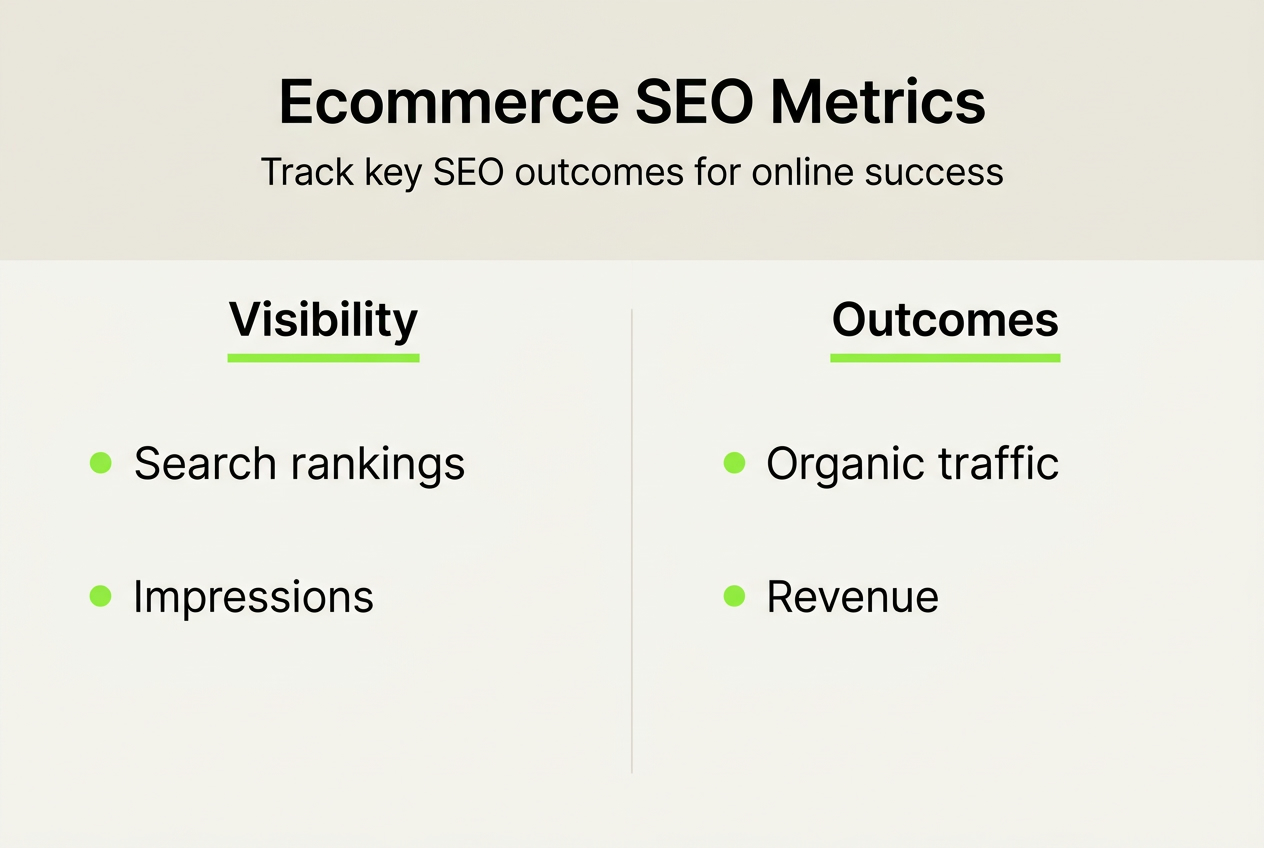
Visibility metrics show how prominently your products appear in search results across your target keywords. Tools measuring visibility track your average position weighted by search volume, providing a single number that reflects overall search presence. The PURELEI case study demonstrates how visibility improvements of 100% create the foundation for traffic and revenue growth.
Organic traffic volume indicates how many visitors discover your ecommerce store through unpaid search results. However, raw traffic numbers mean little without context. Segment organic traffic by landing page type, device, geographic location, and user behaviour to understand which optimisation efforts drive the most valuable visits. PURELEI’s 30% organic traffic increase represented thousands of additional qualified shoppers actively searching for jewellery products.
Revenue attribution connects SEO activities to actual sales. Track organic channel revenue separately from other sources, then drill deeper into which product categories, landing pages, and keyword themes generate the highest value. The €600,000 revenue increase PURELEI achieved from SEO optimisation provided clear justification for continued investment and expansion of successful tactics.
The comparison below shows typical metric improvements following comprehensive ecommerce SEO optimisation:
| Metric | Before optimisation | After 8 months | Improvement |
|---|---|---|---|
| Visibility index | 42 | 84 | +100% |
| Monthly organic sessions | 18,500 | 24,050 | +30% |
| Organic revenue | €95,000 | €170,000 | +79% |
| Average order value | €67 | €71 | +6% |
| Organic conversion rate | 2.8% | 3.4% | +21% |
Setting realistic goals based on data insights prevents both under-investment and unrealistic expectations. Analyse your current baseline performance, research competitor visibility levels, and understand your market’s search volume potential. Most European ecommerce businesses should expect gradual improvements over six to twelve months rather than overnight transformations.
Continuous optimisation practices that maintain momentum include:
- Monthly audits identifying new technical issues before they impact rankings
- Quarterly content refreshes updating product descriptions and category pages with current information
- Regular competitor analysis revealing new keyword opportunities or emerging threats
- A/B testing of title tags, meta descriptions, and on-page elements to improve click-through rates
- Seasonal adjustments aligning content and technical priorities with shopping patterns
Analytics tools provide the foundation for refinement. Google Analytics reveals user behaviour patterns, showing which organic landing pages engage visitors and which create immediate exits. Search Console exposes query data, highlighting unexpected search terms driving traffic and opportunities for new content. Specialist SEO platforms track rankings, backlinks, and competitive movements that inform strategic adjustments.
Understanding the impact of user experience on SEO helps connect technical metrics to business outcomes. Pages with excellent engagement signals like low bounce rates and high time-on-page tend to rank better over time. This creates a virtuous cycle where SEO improvements drive more traffic, better user experiences increase engagement, and stronger engagement signals improve rankings further.
Pro Tip: Create a monthly SEO scorecard combining visibility, traffic, revenue, and engagement metrics on a single page. Share this with stakeholders to maintain focus on outcomes that matter whilst celebrating incremental progress towards larger goals.
How our web development services can boost your ecommerce SEO
Implementing the strategies outlined above requires both technical expertise and strategic insight. At Done.lu, we specialise in building ecommerce platforms that prioritise search visibility from the foundation upward. Our approach to web development integrates SEO best practices into every aspect of site architecture, ensuring your products remain discoverable as your catalogue scales.

Our ecommerce development services combine technical excellence with commercial understanding. We’ve helped European retailers transform their organic performance through smart pagination implementation, strategic internal linking, and conversion-focused page optimisation. Our growth-driven design methodology means your site evolves based on real performance data rather than assumptions. When you partner with Done.lu, you gain a team committed to measurable results. We establish clear KPIs, track progress transparently, and continuously refine strategies based on what the data reveals. Our comprehensive approach to digital marketing workflow ensures SEO integrates seamlessly with your broader commercial objectives, creating sustainable competitive advantages in your market.
FAQ
What is the primary benefit of SEO for ecommerce businesses?
Increased organic traffic, visibility, and sustainable revenue growth represent SEO’s primary benefits for ecommerce. Effective optimisation ensures product pages appear prominently when potential customers search with purchase intent, reducing reliance on paid advertising whilst improving brand credibility. European retailers implementing comprehensive SEO strategies typically see visibility improvements exceeding 100% within twelve months, translating directly into substantial revenue increases.
How long does it take to see results from ecommerce SEO?
Most European ecommerce businesses observe initial improvements within three to four months, with substantial results appearing between six and twelve months. Technical fixes like resolving crawl errors may show impact within weeks, whilst content optimisation and authority building require longer timeframes. The PURELEI case demonstrates that systematic eight-month optimisation programmes can double visibility and generate hundreds of thousands in additional revenue.
What technical SEO issues most commonly affect ecommerce sites?
Poor pagination structures, duplicate content across product variations, slow page loading speeds, and missing canonical tags represent the most damaging technical issues. Many European online stores also struggle with inefficient crawl budget allocation, preventing search engines from discovering their entire product catalogue. Regular technical audits identifying and resolving these problems before they compound ensures maximum product visibility.
Should ecommerce SEO focus on product pages or category pages?
Both require optimisation but serve different purposes in your search strategy. Category pages typically target broader, higher-volume keywords and help users navigate your catalogue, whilst product pages capture specific, high-intent searches from customers ready to purchase. Successful European ecommerce sites optimise category architecture for discovery and navigation, then ensure individual product pages provide detailed, unique content that converts visitors into buyers.
How does integrating SEO across departments improve results?
Company-wide SEO integration ensures every team’s decisions support rather than undermine search performance. Product managers who understand SEO create better structured catalogues, developers build search-friendly features, and content creators produce material that attracts qualified traffic. This collaborative approach, demonstrated in successful European case studies, generates exponentially better results than isolated SEO specialists working independently from other business functions.