

Lead generation explained: What it is and how it drives growth
March 29, 2026How to launch your e-commerce site: A step-by-step guide
March 31, 2026
Consistent branding boosts ecommerce sales by up to 23% and enhances customer retention by over 30%, yet many small and medium-sized ecommerce businesses across Europe still treat branding as a secondary concern. It is easy to understand why. When budgets are tight, the appeal of quick-return tactics like paid ads or flash promotions can overshadow longer-term brand investment. But this trade-off is costly. Branding is not simply a logo or a colour palette. It is the cumulative impression your business makes at every touchpoint, and for European ecommerce SMEs competing in increasingly saturated markets, it is one of the most powerful levers available.
Table of Contents
- Why branding is a top priority for ecommerce in 2026
- How strong branding fuels growth: Evidence from European SMEs
- The real-world impact: Beyond sales to loyalty and value
- The building blocks of effective ecommerce branding
- Common branding pitfalls and advanced insights for SMEs
- Measuring branding success: What to track and what to expect
- Unlock your brand’s full potential with professional support
- Frequently asked questions
Key Takeaways
| Point | Details |
|---|---|
| Branding drives real growth | SMEs using consistent branding can see up to 23% higher sales and better loyalty. |
| Sustained impact over time | Branding’s biggest rewards compound over months and years, not days. |
| Build on evidence, not instinct | Leverage European SME case studies and robust metrics to shape your branding strategy. |
| Avoid common pitfalls | Unexpected rebrands, inconsistent visuals or over-relying on branded search can harm performance. |
| Track key metrics | Watch loyalty, direct traffic and customer feedback to spot branding improvements. |
Why branding is a top priority for ecommerce in 2026
European SMEs are prioritising branding as their top marketing focus in 2026, driven by the need to differentiate in crowded digital markets and navigate ongoing economic uncertainty. The EU ecommerce sector continues to grow, with hundreds of thousands of online retailers competing for the same customers. Standing out is no longer optional.
What makes branding particularly valuable right now is its compounding effect. Unlike a paid campaign that stops delivering the moment you pause spending, a well-built brand keeps working. Customers recognise you, trust you, and return without needing to be retargeted. That is a significant commercial advantage.
The factors European SMEs highlight most when discussing branding priorities include:
- Authenticity: Customers increasingly expect brands to reflect genuine values, not just polished marketing copy.
- Consistency: A unified visual and verbal identity across all channels builds recognition faster and more reliably.
- Customer recognition: Being instantly identifiable in a crowded feed or search result reduces the cost of every subsequent marketing effort.
- Differentiation: In markets where products are often similar, brand perception becomes the deciding factor.
Investing in digital branding for business growth is not a luxury reserved for large retailers. It is a strategic necessity for any SME serious about sustainable online growth. Pairing that with a strong social media presence for visibility amplifies the effect considerably.
How strong branding fuels growth: Evidence from European SMEs
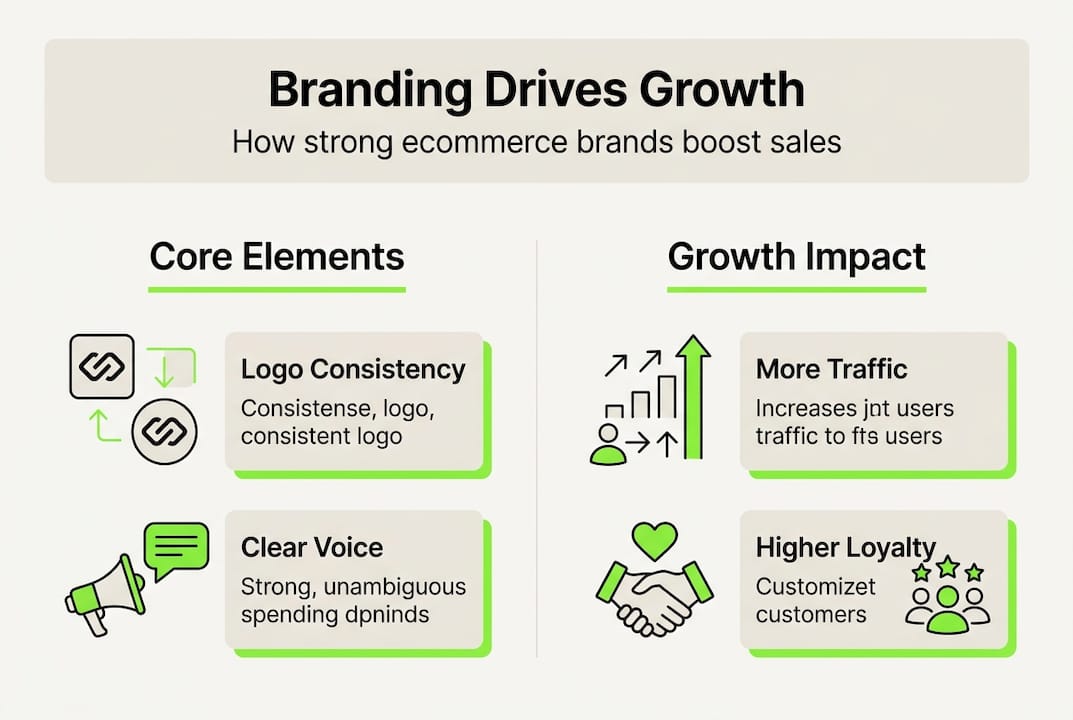
The evidence from real European ecommerce businesses is compelling. Case studies from Axel Accessories, Jessy at Sea, and Osprey London show that combining branding with SEO and multi-channel strategies produced revenue growth ranging from 32% to 541%. These are not outliers. They represent a pattern.

| Business | Strategy applied | Revenue growth |
|---|---|---|
| Axel Accessories (GR) | Branding refresh + SEO | 32% increase |
| Jessy at Sea (NL) | Visual identity + multi-channel | 541% increase |
| Osprey London (UK) | Brand positioning + content | 120% increase |
What these cases share is a deliberate approach to brand identity, combined with consistent execution across organic and paid channels. The results were not instant. But they were durable.
“Branding is not a cost centre. For these SMEs, it became the engine behind compounding organic growth, reduced paid dependency, and higher average order values.”
The compound benefits are worth spelling out clearly. Strong branding drives more direct and organic traffic, which reduces customer acquisition cost (CAC). It also increases average order value and repeat purchase rates, which raises customer lifetime value (LTV). For luxury ecommerce branding growth, these dynamics are even more pronounced.
Pro Tip: Do not treat branding and SEO for ecommerce as separate workstreams. Aligning your brand voice with your keyword strategy creates a consistent experience from search result to checkout, which improves both conversion rates and organic rankings. Salesforce research on branding strategy best practices confirms that integrated approaches consistently outperform siloed ones.
The real-world impact: Beyond sales to loyalty and value
While growth figures are persuasive, the broader benefits of strong branding extend well beyond a single revenue metric. Two of the most important commercial measures for any ecommerce business are CAC and LTV. CAC is what you spend to acquire each new customer. LTV is the total revenue that customer generates over their relationship with your business. Strong branding reduces CAC and increases LTV by building the kind of recognition and loyalty that keeps customers coming back without expensive re-engagement campaigns.
Here is a practical comparison of short-term tactics versus long-term brand building:
| Approach | Short-term effect | Long-term effect |
|---|---|---|
| Paid advertising | Immediate traffic spike | Stops when budget stops |
| Discount promotions | Quick sales boost | Trains customers to wait for deals |
| Brand building | Slower initial traction | Compounding loyalty and organic growth |
| SEO + branding combined | Moderate early gains | Sustained visibility and lower CAC |
The loyalty-building strategies that work best for ecommerce SMEs include:
- Consistent visual identity across your website, packaging, and social channels.
- Clear brand values communicated at every customer touchpoint.
- Personalised communication that makes customers feel recognised, not just targeted.
- Post-purchase engagement through branded email sequences and loyalty programmes.
- Reputation management by actively responding to reviews and building social proof.
Understanding the risks involved in web rebranding is equally important. Changing your brand without a clear strategy can undo years of recognition. The digital marketing advantages available to European SMEs today make it easier than ever to build and maintain a strong brand presence without starting from scratch.
The building blocks of effective ecommerce branding
Building a credible ecommerce brand does not require an enormous budget. It requires clarity, consistency, and commitment. Authentic visual identity, personalisation, and social media consistency are the three pillars that drive visibility and engagement for SMEs.
Here are five essential branding actions for European ecommerce SMEs:
- Define your brand identity clearly. This means your mission, your values, and the tone of voice you use across all communications. Write it down. Make it a reference document your whole team uses.
- Invest in a professional visual identity. Your logo, typography, and colour palette should be consistent across your website, social profiles, email templates, and packaging. Inconsistency erodes trust.
- Develop a content style that reflects your brand voice. Whether you are playful or authoritative, your content should feel recognisably yours. Customers notice when the tone shifts.
- Use personalisation strategically. Segment your email list, tailor product recommendations, and address customers by name. These small touches significantly improve engagement and repeat purchase rates.
- Automate social media without losing authenticity. Scheduling tools and AI-assisted content creation can maintain consistency without making your brand feel robotic. The key is to plan content that genuinely reflects your values.
Pro Tip: AI tools can accelerate the creation of on-brand visuals and copy, but always review outputs against your brand guidelines. Automation supports consistency. It does not replace the human judgement that makes a brand feel real. A custom web design approach ensures your digital presence reflects your brand identity from the first click.
Common branding pitfalls and advanced insights for SMEs
Knowing what to avoid is just as valuable as knowing what to pursue. Many SMEs make branding mistakes that are entirely preventable with a little foresight.
The most common errors include:
- Inconsistent brand voice across channels, which confuses customers and weakens recognition.
- Neglecting the customer experience as part of the brand. Your returns process, customer service tone, and delivery packaging are all brand touchpoints.
- Changing branding without a strategy. Refreshing your look is fine. Overhauling your identity without a clear rationale and communication plan is risky.
- Over-relying on branded search traffic. If most of your organic visits come from people already searching your brand name, you are vulnerable. A competitor rebrand or algorithm shift can erode that traffic quickly.
“Visual branding changes alone can shift perceived audience by 40%, which means even well-intentioned tweaks can alienate your existing customer base if not tested carefully.”
The typography strategy behind the Dewdrop case study illustrates how a single visual element, handled thoughtfully, can reposition a brand entirely. Conversely, controversial rebrands that lack product backing risk losing hard-won recognition overnight. The lesson is clear: test changes incrementally, communicate them to your audience, and monitor results before committing fully. If you are considering a significant change, reviewing the risks of rebranding in detail is a sensible first step.
Measuring branding success: What to track and what to expect
One of the most common frustrations SMEs express about branding investment is the difficulty of measuring its impact in the short term. This is a legitimate challenge. Branding is essential long-term but hard to measure short-term, particularly when compared to performance marketing metrics like return on ad spend (ROAS), which deliver immediate, quantifiable feedback.
The key is to track the right indicators and set realistic expectations about timelines. Branding effects typically compound over six to eighteen months, not six to eighteen days.
The five KPIs most useful for monitoring brand health are:
- Direct traffic volume: People typing your URL directly into a browser are a strong signal of brand recognition.
- Branded search volume: Growth in searches for your brand name indicates increasing awareness.
- Net Promoter Score (NPS): This measures how likely customers are to recommend you, which reflects brand trust.
- Repeat purchase rate: Returning customers are the clearest evidence that your brand is building loyalty.
- Organic traffic growth: Sustained increases in non-paid traffic reflect the long-term SEO and brand alignment benefits.
Understanding SEO’s role in brand measurement helps you connect branding activity to tangible search performance over time. Do not abandon your branding strategy because results are not immediate. The businesses that stay consistent are the ones that build durable competitive advantages.
Unlock your brand’s full potential with professional support
With a clear strategy in hand, the right expert support can accelerate your branding journey considerably. Building a strong ecommerce brand is achievable for any SME, but the path is faster and less risky when you have experienced partners guiding the process.
At Done.lu, we work with small and medium-sized businesses across Europe to develop brand-led digital presences that deliver measurable results. From web development that supports business growth to fully integrated digital marketing strategies for SMEs, our approach combines strategic clarity with practical execution. We bring together branding, SEO, web design, and digital marketing into a coherent programme that builds your visibility, reduces your acquisition costs, and grows your customer base over time. If you are ready to move from reactive marketing to a brand-led growth strategy, we would be glad to help you take that next step.
Frequently asked questions
How does branding differ from other ecommerce marketing activities?
Branding builds long-term recognition and trust, while most marketing activities focus on driving immediate visibility or sales. Branding is the foundation that makes every other marketing effort more effective and more efficient over time.
What is the fastest way for an SME to improve their ecommerce branding?
Focus on refreshing your visual identity, maintaining consistent messaging, and using social media to connect authentically with customers. Authentic visual identity and social media consistency are the quickest routes to improved visibility and engagement.
How can I tell if my branding is working?
Watch for increases in direct and repeat traffic, rising customer loyalty, and more positive brand mentions across channels. Consistent branding boosts retention by over 30%, so repeat purchase rates are one of the clearest early signals.
Are there risks in changing my ecommerce branding?
Yes. Drastic rebrands without product backing risk losing recognition and confusing existing customers. Always test changes incrementally and communicate them clearly before a full rollout.
Can branding strategy alone boost ecommerce sales significantly?
When branding is paired with multi-channel strategies like SEO, some European SMEs report sales increases of 32 to 541%. Branding alone builds the foundation, but the strongest results come from integrating it with broader digital marketing activity.