

Upskilling AI tools: a practical guide for SMEs
May 21, 2026
Knowledge base AI: a practical guide for SMBs
May 23, 2026
TL;DR:
- Most teams struggling with AI face challenges related to people, trust, and culture rather than technology.
- Successful AI adoption depends on early involvement, clear workflows, and ongoing change management, not just selecting tools.
Most teams that struggle with AI are not struggling with technology. They are struggling with people. 79% of organisations face significant challenges with team AI adoption in 2026, and yet most of the advice out there still focuses on choosing the right tool. This guide takes a different position. Successful AI integration in teams depends far more on culture, trust, and preparation than on which software you deploy. If you lead a small or medium-sized business and you want AI to actually change how your team works, this is where to start.
Table of Contents
- Key takeaways
- What teams need before adopting AI
- Preparing your team for AI integration
- Executing AI adoption: tools and workflows
- Measuring real AI adoption success
- My honest view on what actually works
- How Done can support your team AI strategy
- FAQ
Key takeaways
| Point | Details |
|---|---|
| Culture precedes technology | Address trust and psychological safety in your team before deploying any AI tool. |
| Involve the team early | Including team members in tool selection and workflow redesign reduces resistance significantly. |
| Use phased rollouts | Staged implementation with 30 and 90-day checkpoints builds habits and prevents drift. |
| Measure outcomes, not logins | Track productivity and quality improvements, not just who is logging into the platform. |
| Treat adoption as ongoing | AI adoption fails when treated as a one-off project rather than a continuous process. |
What teams need before adopting AI
The biggest mistake SMB leaders make is treating AI adoption as a procurement decision. You find a tool, buy it, and expect the team to get on with it. What actually happens is friction, confusion, and quiet non-use. Before you touch a single integration, you need to understand the conditions your team is actually in.
Trust is the foundation. High-trusting teams are 83% more likely to be active AI users compared to 63% in lower-trust environments. That gap is not about technical literacy. It is about whether people feel safe enough to experiment, fail, and learn. If your team already struggles with psychological safety, introducing AI will make those tensions worse, not better.
You also need to be honest about where your team currently stands on AI readiness. Consider:
- Attitude toward change. Are people generally open to new tools, or do they tend to resist workflow changes? This predicts adoption speed more reliably than technical skill.
- Current digital fluency. Teams that already use project management software, CRMs, or automation tools adapt to AI far more quickly than those who do not.
- Fear and misconceptions. Many employees believe AI will replace their role. Unless you address this directly, you will face resistance that no training programme can resolve.
- Clarity of purpose. Does your team know why you are introducing AI? Vague explanations about efficiency create anxiety. Specific use cases create curiosity.
- Cognitive diversity. Larger, cognitively diverse teams report significantly higher AI-powered innovation and efficiency gains. If your team is small and homogeneous in thinking style, that affects what AI can realistically achieve.
Setting clear, realistic objectives matters before you do anything else. Define which specific tasks AI will support, which decisions will remain entirely human, and what success looks like at 60 and 180 days. Ambiguity here is where most team AI strategies fall apart.
Pro Tip: Before introducing any AI tool, run a 30-minute team conversation about fears and expectations. The insights will tell you more about adoption readiness than any survey.
Preparing your team for AI integration
Preparation is not a one-time briefing. It is a structured period of building confidence, adjusting workflows, and creating the internal conditions for real use. Here is how to approach it in practice.
-
Involve your team in tool selection. When people have a voice in what gets adopted, they are far more likely to use it. Even a simple shortlist vote builds ownership. Decentralising AI workflow ownership with appropriate governance structures improves both adoption rates and actual business value.
-
Appoint AI champions. Identify two or three team members who show genuine curiosity about AI. Give them time and resources to explore tools before the wider rollout. Building AI champions within teams promotes peer learning and reduces resistance far more effectively than top-down mandates. People take their lead from trusted colleagues, not company memos.
-
Design training around competence and autonomy. Generic YouTube tutorials do not build confidence. Hands-on sessions using your actual workflows, with real examples from your business, create the sense of mastery that motivates continued use. The AWARE framework from Wharton, which addresses Acknowledgement, Monitoring, Alignment, Redesign, and Empowerment, is a practical structure for meeting your team’s psychological needs during this transition.
-
Redesign workflows before launching tools. Do not add AI on top of existing processes. Map out where human judgment is irreplaceable, where AI can genuinely save time, and where the handoff points sit. AI adoption requires redefining roles and workflows to balance automation with human judgment, creativity, and ethics. This work happens before launch, not after.
-
Communicate transparently and repeatedly. Tell your team what you are deploying, why, what will change, and what will not. Then say it again. People need to hear the same message several times before it becomes real. Silence creates speculation, and speculation creates resistance.
-
Avoid mandates without context. Telling a team they must use a tool, without giving them time, training, or a say in the matter, is the fastest way to generate shadow AI use. That is when people use AI covertly without telling management, which defeats the purpose entirely.
Pro Tip: Schedule a “failure session” two weeks into any AI pilot. Invite the team to share what is not working without judgement. The honest feedback you get is worth more than any usage dashboard.
Executing AI adoption: tools and workflows
Rolling out AI tools without a clear execution plan is where even well-prepared teams lose momentum. The gap between a successful pilot and consistent business value is significant. Only 4% of companies achieve consistent business value from AI, and 74% remain stuck at the proof-of-concept stage. Execution discipline is what separates those groups.
Phase your rollout deliberately
Do not deploy AI across your entire operation at once. Start with one team, one workflow, one clear success metric. Prove the value there, document what worked, then extend. Accountability checkpoints at 30 and 90 days significantly improve habit formation. Without them, half of team members never advance past basic starter tasks.

Define human-AI handoff points clearly
Every AI-assisted workflow needs a clear answer to the question: who is responsible for the output? Ambiguity here causes two problems. Either nobody checks the AI output, which creates quality risks, or everybody checks everything manually, which destroys the time savings. 32% of teams manually review every AI output, resulting in lost productivity. The goal is to shift toward audit-by-exception as trust matures.
The table below shows the difference between a problematic rollout pattern and a productive one:
| Rollout pattern | What it looks like | Likely outcome |
|---|---|---|
| Tool-first, process-second | Deploy the tool, then figure out where it fits | Low adoption, confusion about ownership |
| Mandate without training | Announce the tool, expect self-sufficiency | Shadow AI use, resentment, non-compliance |
| Phased with checkpoints | Pilot one workflow, review at 30 and 90 days | Consistent habits, measurable improvement |
| Champion-led peer learning | Internal experts train colleagues in context | Higher trust, faster adoption, better outputs |
Address shadow AI directly. When people use AI tools without disclosure, it is usually a sign that the official pathway feels too slow, too bureaucratic, or too monitored. Shadow AI is common where trust is low. If you are seeing it in your team, treat it as a signal to improve the official process rather than a reason to impose restrictions.
Encourage experimentation within defined boundaries. Give your team permission to try AI on low-stakes tasks, compare outputs, and report back. When people discover useful applications themselves, adoption becomes self-sustaining.
Measuring real AI adoption success
Most leaders measure AI adoption by looking at login rates and licence usage. That tells you almost nothing. Someone can log in daily and generate no value. Someone else can use a single AI tool once a week and save fifteen hours of manual work. The metrics you track need to reflect actual outcomes.
| Metric type | Weak indicator | Stronger indicator |
|---|---|---|
| Usage | Number of logins per week | Time saved on previously manual tasks |
| Quality | Number of documents produced | Error rate reduction or revision cycles |
| Speed | Time to complete a task vs. baseline | Capacity freed for higher-value work |
| Engagement | Number of training sessions attended | Unprompted sharing of AI use cases by team |
Beyond the numbers, qualitative feedback matters enormously. Build regular check-ins into your team rhythm, specifically asking about AI use. What is working? What feels clunky? What would make this better? Retrospectives are a practical way to surface this without making it feel like a performance review.
Recognise your AI super-users, but do it carefully. If you publicly reward one person for their AI fluency while others are still finding their footing, you risk creating anxiety rather than inspiration. Share success stories in team settings, frame them as learning examples, and focus the recognition on the outcome rather than the individual.
Track reductions in repetitive task time as a core indicator. Successful organisations allocate 70% of their AI resources to process redesign and change management, with only 10% going to the algorithm itself and 20% to technology. That ratio tells you something important: the ROI lives in the process work, not the software.
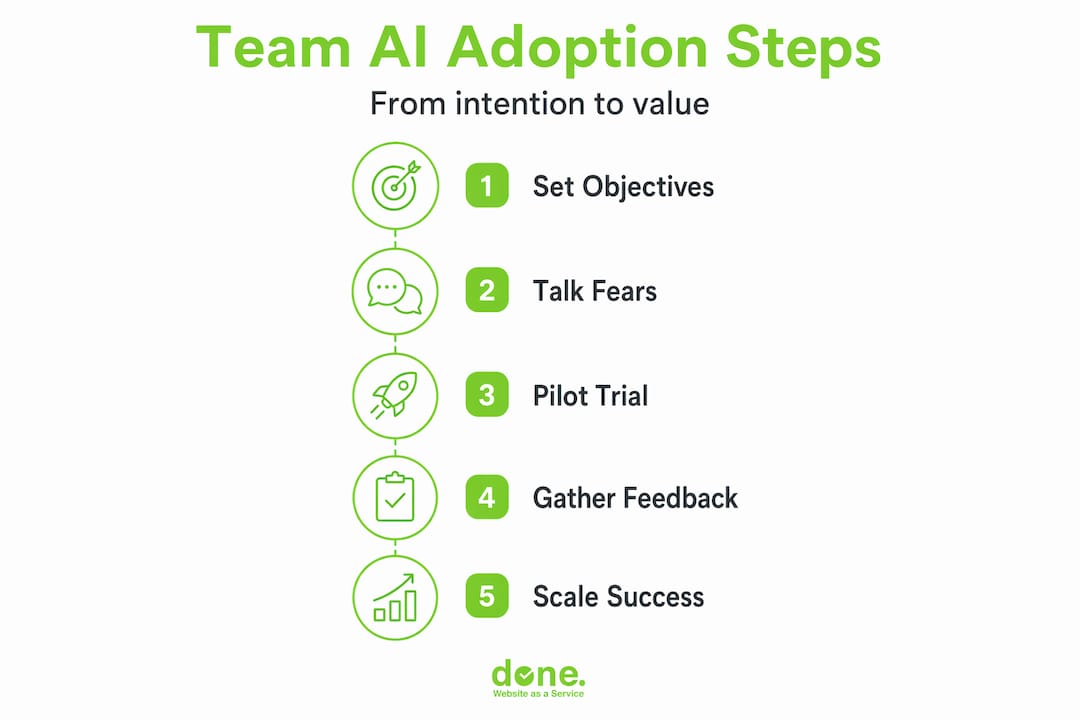
Prepare for the fact that adoption is never finished. Teams change, tools evolve, and the workflows that worked last year may not be optimal this year. AI adoption fails when treated as a one-off deployment rather than continuous habit formation. Build a quarterly review of your AI use into your planning cycle.
Pro Tip: Ask team members to keep a simple weekly log of tasks where they tried AI and what happened. Even two or three lines per person per week gives you far better adoption insight than any platform dashboard.
My honest view on what actually works
I have worked with enough SMB teams across Luxembourg and the wider European market to say this plainly: the organisations that succeed with AI are not the ones that found the best tool. They are the ones whose leaders decided the culture work was worth doing first.
The teams I have seen fail at AI adoption almost always share one characteristic. The decision to adopt came from the top, was communicated as a fait accompli, and the expectation was that training would sort out the rest. It never does. People need time to grieve their old workflows, test the new ones, and build genuine confidence. That takes weeks, sometimes months, and it requires a leader who stays involved well beyond the launch announcement.
What surprises people most is how much team composition matters. Small, isolated teams, even highly skilled ones, consistently underperform larger, more connected groups when it comes to AI outcomes. The cross-pollination of ideas, the diversity of use cases, the peer accountability: these things drive adoption in ways that individual enthusiasm simply cannot replicate. If you lead a small team, invest time in connecting people with colleagues in other departments who are also exploring AI. The informal knowledge transfer is worth more than a formal training session.
In the Luxembourg SMB context specifically, I have found that localised and pragmatic approaches work best. Generic global frameworks rarely account for the specific mix of languages, regulatory requirements, and cautious-but-curious attitude that many local business owners bring. Your AI strategy for your SME needs to reflect the reality of your team and your market, not a Silicon Valley playbook.
One more thing I would add: the leaders who see real ROI from AI are the ones who stay curious alongside their teams. If you are not personally experimenting with the tools you ask your people to use, you will not understand the friction they face. That gap in empathy is where many well-intentioned AI rollouts quietly die.
— Thomas
How Done can support your team AI strategy
If you have read this far and recognise some of these patterns in your own team, you are already ahead of most. Knowing the obstacles is half the battle. Acting on them with the right support is the other half.

Done works with small and medium-sized businesses in Luxembourg and across Europe to design and implement AI adoption programmes that are grounded in your real team context, not generic templates. From initial readiness assessments through to AI consulting for SMBs and full workflow integration, we handle the complexity so your team can focus on building confidence and delivering results.
Our approach follows the same principles outlined in this guide. We start with your people, map your processes, then select and implement tools that fit. You can explore our European AI strategy guide for SMEs to get a clearer picture of what a structured, GDPR-compliant AI adoption plan looks like in practice. If you are ready to move beyond the planning stage, we are ready to help.
FAQ
Why do most teams struggle with AI adoption?
54% of C-suite leaders report internal friction as a significant barrier. Most teams struggle because AI is introduced as a technology project rather than a change management process, leaving people unprepared and resistant.
How long does team AI adoption typically take?
There is no fixed timeline, but 90-day structured fluency plans with accountability checkpoints are widely recognised as the most effective approach for building lasting habits and moving beyond the pilot phase.
What is the biggest mistake SMB leaders make with AI rollouts?
Deploying tools without involving the team in the decision or redesigning workflows first. This creates confusion about ownership and often leads to shadow AI use, where employees use tools without disclosing it to management.
How do you measure whether AI adoption is working?
Move beyond login stats and track time saved on repetitive tasks, error rate reductions, and whether team members are voluntarily sharing AI use cases. These are the indicators that reflect genuine behaviour change.
How important is team size for AI adoption outcomes?
Team size matters more than most leaders expect. Teams of more than ten members use AI 74% of the time compared to 54% in smaller groups, with cognitive diversity and internal connectedness amplifying those results further.