

The role of digital communication in business growth
June 24, 2026
Ecommerce growth strategies for SMBs: 2026 guide
June 26, 2026
TL;DR:
- Partnering with an agency offers quicker startup times, cost savings, and access to multi-disciplinary expertise. Building an in-house team takes months and incurs higher costs, while agencies deliver results in weeks. Ensuring clear governance, data ownership, and open communication is essential for long-term digital growth.
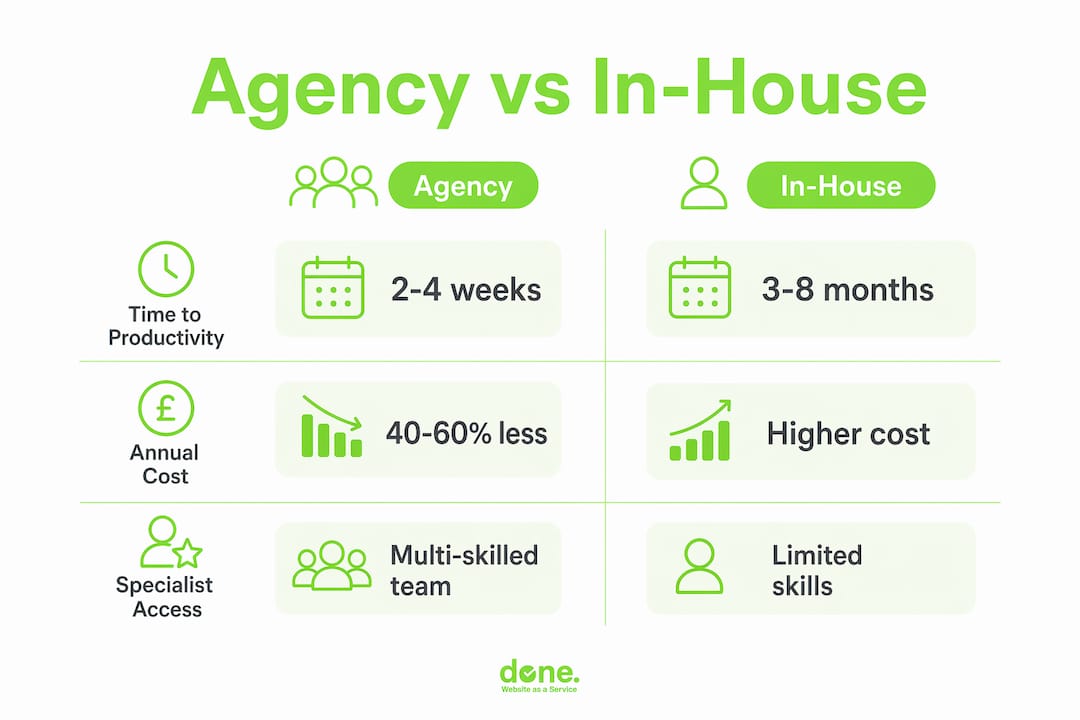
An agency partner is a specialist firm you contract to deliver digital, marketing, or technology services on your behalf, typically under a defined scope and Service Level Agreement (SLA). For small and medium-sized businesses evaluating digital transformation, the question of why choose an agency partner comes down to three practical realities: speed, cost, and access to expertise you cannot easily hire. Building an in-house team takes months and carries significant overhead. An agency can start delivering in 2–4 weeks, covering SEO, paid media, web development, and AI implementation from day one. For Luxembourg SMBs weighing their options, understanding what a digital agency actually does is the right starting point.
What are the key advantages of partnering with an agency?
The most direct advantage of hiring an agency is speed to productivity. 64% of companies spend more than four months filling technical roles. That delay costs you campaigns not run, websites not launched, and revenue not generated.
Cost is the second major factor. Full-service marketing agencies typically cost 40–60% less annually than building a comparable in-house team, once you account for salaries, benefits, training, and tooling. That figure surprises most business owners, who assume in-house is cheaper because the monthly retainer feels more visible than the hidden costs of recruiting, onboarding, and management overhead.
The third advantage is multi-specialist access. A single agency retainer can give you a web developer, an SEO specialist, a paid media manager, and a content strategist working in parallel. Hiring all four internally would require four separate recruitment processes, four salaries, and four sets of tools. Agencies absorb those costs and spread them across their client base.
Flexibility and tooling
Agencies also bring access to professional tooling that most SMBs would not purchase independently. Platforms like SEMrush, HubSpot, and Ahrefs carry significant annual licence fees. Agencies use these tools across multiple clients, so you benefit from the capability without paying the full cost. You also gain the expertise to interpret the data, not just access to the dashboard.

Flexibility is a genuine structural advantage. You can scale an agency engagement up during a product launch and reduce it during quieter periods. Ending or adjusting a contract is far simpler than making an employee redundant. For SMBs with variable growth cycles, that adaptability has real financial value.
Pro Tip: Before signing any agency contract, ask specifically which tools will be used on your account and whether you will retain access to the data and accounts if the engagement ends. This single question separates genuine partners from vendors.
| Factor | Agency | In-house team |
|---|---|---|
| Time to productivity | 2–4 weeks | 3–8 months |
| Annual cost | 40–60% lower | Higher once overhead included |
| Specialist coverage | Multi-disciplinary from day one | Requires multiple hires |
| Tool access | Included in retainer | Separate licence costs |
| Flexibility | Adjust or exit contract | Redundancy process required |
What are the common challenges when working with an agency?
Agency partnerships carry real risks, and choosing an agency partner is more about managing risk during change than simply buying services. Business owners who treat agencies as pure suppliers, rather than partners, tend to encounter the most problems.
The most common challenge is brand intimacy. An external team will never know your customers, your culture, or your product history as well as your own people do. This gap matters most in content creation, customer communications, and brand positioning. The solution is not to avoid agencies but to invest time upfront in proper onboarding. Share your brand guidelines, customer personas, past campaign data, and competitive context before work begins.
Knowledge transfer is a related issue. When an agency manages your SEO or paid media accounts, institutional knowledge about what has worked accumulates on their side. If the engagement ends without a structured handover, you lose that knowledge. Require regular documentation and insist that all accounts, logins, and campaign data remain in your ownership throughout.
Governance and clear metrics
Outsourcing digital transformation shifts execution risk but requires governance and clear metrics to avoid adoption issues. Without a named internal owner and a regular review cadence, agency work can drift from your actual business objectives.
Common pitfalls to avoid:
- Vague scopes. Define deliverables, timelines, and success metrics before signing. “Improve our digital presence” is not a scope.
- No internal champion. Appoint one person internally who owns the agency relationship and attends every review meeting.
- Deliverable focus over outcome focus. Measuring whether a report was delivered is not the same as measuring whether it drove results.
- Infrequent communication. Weekly or fortnightly check-ins prevent small misalignments from becoming expensive problems.
Pro Tip: Set up a shared project management space from day one. Tools like Notion or Basecamp give both sides visibility on tasks, deadlines, and decisions. Agencies that resist this level of transparency are worth questioning.
How to choose the right agency partner for your SMB
Choosing the right agency starts before you contact any agency at all. Early internal alignment on outcomes, budget constraints, and agency roles is critical to avoid late-stage miscommunication. If your leadership team disagrees on what success looks like, no agency can resolve that for you.
Once you have internal clarity, evaluate agencies on these criteria:
- Specialisation match. An agency that excels at e-commerce SEO may not be the right fit for a B2B lead generation brief. Ask for case studies from businesses in your sector or with comparable objectives.
- Transparency in reporting. Ask to see a sample report. If it is full of vanity metrics and light on revenue impact, that tells you something important about how they measure success.
- Culture fit. You will work closely with this team for months or years. A mismatch in communication style or working pace creates friction that erodes results.
- Data and tool ownership. Real agency partners explicitly address data ownership, tool portability, and integration with your existing infrastructure. Any agency that hedges on this question is a vendor, not a partner.
- Pricing model clarity. Understand exactly what is included in the retainer and what triggers additional fees. Hidden costs are the most common source of agency relationship breakdowns.
Questions worth asking directly during the selection process:
- What does success look like for this engagement in 90 days, six months, and one year?
- Who will be our day-to-day contact, and what is their seniority level?
- How do you handle scope changes or new priorities mid-engagement?
- What happens to our accounts and data if we end the contract?
The answers reveal more about an agency’s operational maturity than any credentials document. An agency that answers these questions clearly and without hesitation has done this before. One that deflects or over-promises has not.
How do agency partnerships support long-term growth?
The value of an agency partnership extends well beyond the initial project. Partner ecosystems can represent 40% or more of revenue for companies pursuing partner-led growth strategies. That figure reflects how deeply embedded good agency relationships become in a business’s commercial infrastructure.
A mature agency relationship evolves as your business does. In year one, the focus might be on building a website and establishing SEO foundations. By year two, the same agency can be running paid media campaigns, managing your lead generation workflows, and advising on AI tool adoption. That continuity has compounding value. The agency already knows your brand, your data, and your customers.
Agencies also keep pace with channel evolution in ways that internal teams struggle to match. The paid media landscape on platforms like Google Ads and Meta changes constantly. SEO algorithm updates from Google require ongoing technical and content adaptation. An agency with a broad client base sees these changes across multiple industries simultaneously, which sharpens their response time.
Maintaining ownership as you scale
One principle that protects your long-term interests is data sovereignty. As your agency builds out your marketing stack, including your CRM, analytics, email platform, and ad accounts, every account must be registered in your business name. This is not a minor administrative detail. It determines whether you retain full operational capability if you ever change agencies or bring work in-house.
The same logic applies to AI tools. If your agency implements a marketing automation system or a customer communication tool, you need to understand how it works, where the data lives, and whether it is GDPR-compliant. For Luxembourg businesses in particular, data residency and compliance are non-negotiable considerations. An agency that cannot answer these questions clearly is not equipped to support your digital transformation responsibly.
Agencies that support long-term growth share several characteristics:
- They document their work thoroughly and transfer knowledge proactively.
- They adapt their service mix as your business priorities shift.
- They introduce you to new tools and channels with honest assessments of ROI, not just enthusiasm.
- They flag problems early rather than waiting for a quarterly review to surface issues.
The digital marketing advantages available to Luxembourg SMBs are most fully realised when the agency relationship is built on this kind of operational trust.
Key takeaways
Choosing the right agency partner delivers faster results, lower costs, and specialist expertise that in-house teams take months to build.
| Point | Details |
|---|---|
| Speed to productivity | Agencies deliver in 2–4 weeks versus 3–8 months for an in-house hire. |
| Cost efficiency | Agency partnerships cost 40–60% less annually than comparable in-house teams. |
| Governance is non-negotiable | Appoint an internal owner and define KPIs before work begins to avoid scope drift. |
| Data ownership matters | Insist all accounts, tools, and data remain in your name throughout the engagement. |
| Long-term value compounds | A mature agency relationship adapts with your business and accelerates growth over time. |
What I have learned from watching SMBs choose agencies
The most common mistake I see business owners make is selecting an agency based on the quality of the pitch rather than the quality of the questions the agency asks. A good agency asks hard questions before it proposes anything. It wants to understand your margins, your sales cycle, your existing tech stack, and your internal capacity. An agency that skips straight to a proposal is selling, not partnering.
The second pattern I have noticed is that business owners underestimate how much internal effort a good agency relationship requires. You cannot hand over your digital marketing and expect results without ongoing input. The businesses that get the most from agency partnerships are the ones that show up to every review meeting, provide feedback quickly, and treat the agency team as an extension of their own.
There is also a misconception that agencies are only worth hiring when you have a large budget. We have seen this with clients at Done who started with a focused web development brief and a modest monthly retainer. Because the scope was clear and the governance was tight, the results justified expanding the engagement within six months. Starting small with clear objectives is a perfectly sound approach.
The uncomfortable truth is that most agency relationship failures are not the agency’s fault. They result from unclear briefs, internal disagreements that spill into the agency relationship, or a failure to define KPIs and appoint an executive-level transformation owner before work begins. Fix those things internally first, and the agency becomes far more effective.
— Thomas
How Done supports SMB digital growth in Luxembourg
Done is a Luxembourg-based digital and AI agency with over 350 completed projects for SMBs across multiple sectors. We specialise in web development, digital marketing, and AI implementation, with a particular focus on GDPR-compliant solutions for businesses in data-sensitive industries including legal, finance, and healthcare.
Our engagements are structured to reduce ramp-up time and give you clear ownership of every account, tool, and data set from day one. Whether you need a custom web development solution built for long-term performance or a full digital marketing programme, we work with transparent pricing, no setup fees, and a continuous improvement methodology. If you are evaluating agency partners for your next growth phase, explore what web investment delivers and speak with our team about your specific objectives.
FAQ
What is an agency partner?
An agency partner is a specialist firm contracted to deliver digital, marketing, or technology services under a defined scope and SLA. Unlike a freelancer, an agency provides multi-disciplinary teams and takes accountability for outcomes, not just deliverables.
How much does hiring an agency cost compared to in-house?
Full-service marketing agencies typically cost 40–60% less annually than building a comparable in-house team, once recruiting, onboarding, benefits, and tooling are factored in.
How long does it take an agency to get started?
Agencies can typically begin delivering work within 2–4 weeks. In-house hires, by contrast, often take 3–8 months to reach full productivity, particularly for technical roles.
What should I ask an agency before signing a contract?
Ask who owns the accounts and data, how success is measured, who your day-to-day contact will be, and what happens to your assets if the engagement ends. Clear answers to these questions indicate a genuine partner rather than a vendor.
How do I know if an agency partnership is working?
Define KPIs before work begins and review them at least monthly. Without clear governance and an internal owner managing the relationship, scope creep and disconnection from business objectives are the most common outcomes.