

How to boost website conversions: a practical SMB guide
June 23, 2026
Why choose an agency partner for SMB growth
June 25, 2026
TL;DR:
- Digital communication enables instant, flexible, and documented collaboration, boosting productivity for SMBs. However, poorly managed tools can lead to confusion, passive consumption, and disengagement, harming morale. SMBs should focus on well-integrated tools, active participation, clear norms, and outcome-based measurement to strengthen communication and engagement.
Digital communication is the exchange of information through electronic platforms in real time, and it is now the primary way businesses engage with customers, partners, and teams. Tools like Slack, Microsoft Teams, Zoom, and HubSpot have replaced the memo and the meeting room as the default channels for decisions, updates, and collaboration. For business owners and communication professionals, understanding how these tools work together, and where they fall short, is the difference between a team that moves fast and one that drowns in noise. This article covers the evidence, the pitfalls, and the practical steps to get it right.
How does digital communication impact business engagement and collaboration?
Digital communication reshapes how teams work together by removing the friction of geography and time zones. A sales team in Luxembourg can align with a developer in Lisbon before 9am, without a single email thread going cold overnight. That speed has a direct effect on productivity, decision quality, and staff satisfaction.

The evidence is clear. Structured virtual communication tools improve user satisfaction significantly, with a standardised mean difference of 0.76 across a meta-analysis of 54 studies from 19 countries. That figure comes from healthcare settings, but the principle applies directly to any environment where people need timely, reliable information to make decisions. When communication is structured and purposeful, outcomes improve.
The benefits for SMBs are concrete:
- Speed of decision-making. Real-time messaging tools like Slack and Microsoft Teams cut the lag between question and answer from hours to minutes.
- Flexibility for distributed teams. Video conferencing via Zoom or Google Meet lets remote staff participate fully, reducing the isolation that comes with hybrid working.
- Documented communication trails. Email and project management tools like Asana or Notion create records that protect businesses during disputes and support onboarding.
- Broader reach. Social media platforms extend communication beyond the internal team to customers, prospects, and partners at low cost.
“The most effective digital communication strategies unify multiple tools into a coherent ecosystem rather than adopting isolated channels.” — Real Business
Inclusivity is another measurable gain. Distributed teams that rely on asynchronous tools like Loom or Notion can include staff across time zones without forcing anyone into unsociable hours. That matters for SMBs competing for talent across Luxembourg and the wider European market.
Pro Tip: Set a clear response-time expectation for each channel. Slack for same-day replies, email for 24-hour turnaround, and project tools for task-specific updates. This alone reduces the anxiety of always-on communication.
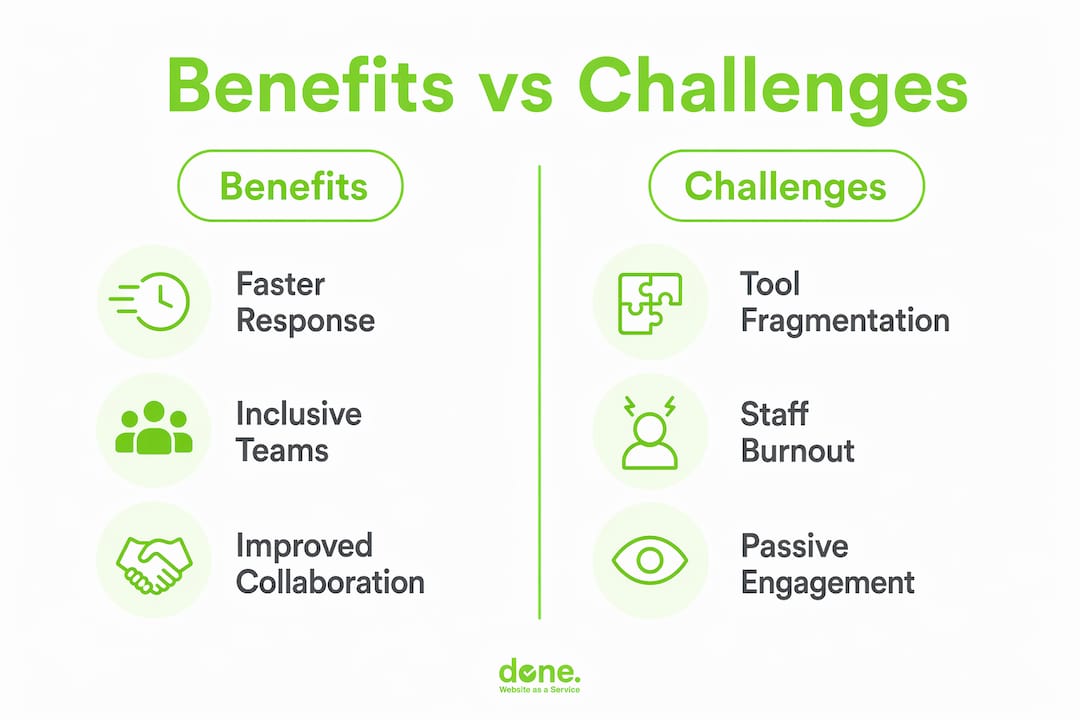
The importance of digital communication goes beyond convenience. It directly affects how quickly a business can respond to market changes, how well it retains staff, and how consistently it delivers on client expectations.
What challenges does digital communication present, and how can businesses address them?
Digital communication carries real risks that business owners often underestimate. The most common mistake is assuming that more tools means better communication. It does not.
Research on social media and mental health is instructive here. Passive social media consumption is linked to loneliness with an effect size of d=0.52, while active, intentional communication shows a protective effect of d=0.16. That distinction matters for businesses. Staff who scroll through company updates without engaging are not communicating. They are consuming. The difference affects morale, retention, and team cohesion.
A separate body of research reinforces this point. Digital platforms tend to prioritise rational information exchange over emotional depth, reducing the quality of relationships unless communication is deliberately designed to promote connection. For SMBs, this means a weekly all-hands on Zoom is not a substitute for genuine dialogue. It is a broadcast with a camera on.
Businesses can address these challenges through four practical steps:
- Audit your current channels. List every tool your team uses and identify which ones overlap or create confusion. Most SMBs find they have at least two tools doing the same job.
- Set communication norms. Define which channel is used for which purpose. Urgent operational issues go to Slack. Client updates go to email. Strategy discussions happen in scheduled video calls.
- Encourage active participation. Replace broadcast-style updates with formats that require a response, such as polls, short video replies via Loom, or structured check-ins.
- Address GDPR obligations early. Data privacy compliance is central to digital communication tool adoption, particularly in sectors like legal, finance, and healthcare. Choosing tools with EU data residency and clear processing agreements protects your business and builds client trust.
“Active user engagement in digital communication can counteract psychological harms associated with passive content consumption.” — Applied Research in Quality of Life
Pro Tip: Run a quarterly communication audit with your team. Ask two questions: which tools do you actually use, and which ones create stress? The answers will tell you more than any usage dashboard.
The impact of digital communication on staff wellbeing is real and measurable. Businesses that ignore it pay the price in turnover and disengagement.
Which digital communication tools and strategies work best for SMBs?
The right tool depends on the job, not the trend. SMBs that chase every new platform end up with fragmented communication and confused teams. The goal is a small, well-integrated set of tools that everyone actually uses.
Here is a practical comparison of the core categories:
| Tool category | Examples | Best used for |
|---|---|---|
| Gmail, Outlook | Client communication, formal records, external updates | |
| Instant messaging | Slack, Microsoft Teams | Internal queries, quick decisions, team channels |
| Video conferencing | Zoom, Google Meet | Client meetings, team calls, training sessions |
| CRM platforms | Salesforce, HubSpot | Customer communication, pipeline tracking, follow-ups |
| Project management | Asana, Notion, Trello | Task assignment, documentation, version control |
Effective digital communication requires a joined-up approach that avoids silos and enables consistent messaging across channels. A CRM like HubSpot, for example, connects email campaigns, contact records, and sales activity in one place. That removes the problem of a salesperson not knowing what marketing already sent to a prospect.
File organisation is a frequently overlooked part of digital communication strategy. Strict version control and permission management prevent data silos and maintain a single source of truth across teams. Without it, staff waste time searching for the right document or, worse, acting on outdated information.
Key practices for SMBs building a communication strategy:
- Choose tools with strong integration capabilities. Slack connects to Google Drive, Asana, and HubSpot. That matters.
- Standardise file naming conventions and folder structures from day one.
- Assign clear ownership for each communication channel so nothing falls through the gaps.
- Train staff on why each tool is used, not just how to use it.
Staff burnout and poor adoption are common outcomes when training focuses only on features rather than purpose. Teams that understand the reasoning behind a tool adopt it faster and use it more consistently.
Pro Tip: Designate one person as your communication continuity contact. This is not an IT role. It is someone who understands both the business goals and the tools, and who can coach colleagues when adoption stalls. In our experience with clients, this single step reduces tool abandonment significantly.
For SMBs looking to build a lead generation workflow around their communication tools, the integration between CRM, email, and social media is where the real gains appear.
How can businesses measure the effectiveness of their digital communication?
Measuring communication quality is harder than measuring communication volume. Most businesses track the wrong things: email open rates, message counts, meeting hours. These metrics tell you how much communication is happening, not whether it is working.
Measuring communication by content type and cognitive context produces better results than measuring duration of use alone. A 10-minute video call that resolves a client issue is worth more than three hours of back-and-forth email. The shift from time-based to outcome-based measurement is the single most useful change most SMBs can make.
Practical KPIs worth tracking:
- Engagement rate on internal updates. Are staff reading and responding to company communications, or ignoring them?
- Client response time. How quickly does your team reply to client queries across all channels?
- Collaboration output. Are projects completing on time? Are decisions being made, or deferred?
- Staff satisfaction scores. A quarterly pulse survey with three questions takes 10 minutes and surfaces communication problems before they become retention problems.
- Channel adoption rate. What percentage of your team actively uses each tool each week?
Feedback loops are as important as the metrics themselves. Schedule a monthly review of your communication data with team leads. Identify which channels are underperforming and why. Use that information to adjust protocols, not just to report numbers.
AI tools are beginning to change how businesses analyse communication quality. Platforms like HubSpot now include AI-driven insights that flag low-engagement email sequences or identify the best time to contact a specific client. For SMBs, these features reduce the manual effort of communication analysis and surface patterns that would otherwise go unnoticed.
Clear messaging and platform fit determine whether digital tools improve communication or simply amplify existing problems. A poorly written email sent to 500 contacts via Mailchimp does more damage than a well-written one sent to 50. The tool does not fix the message.
Key takeaways
Effective digital communication in business requires clear intent, the right tools, and consistent measurement, not just more channels.
| Point | Details |
|---|---|
| Structure improves outcomes | Structured communication tools produce measurably higher satisfaction and better collaboration results. |
| Active engagement protects wellbeing | Passive consumption of digital content harms morale; intentional, two-way communication has a protective effect. |
| Integration beats volume | A small set of well-connected tools outperforms a large collection of isolated platforms every time. |
| Measure quality, not quantity | Track engagement, response time, and collaboration output rather than message counts or meeting hours. |
| Training drives adoption | Staff who understand why a tool is used adopt it faster and sustain that adoption longer than those trained only on features. |
What I have learned from watching SMBs get digital communication wrong
Most businesses I work with do not have a tool problem. They have a clarity problem. They have adopted Slack, Teams, Zoom, and three other platforms, and nobody is quite sure which one to use for what. The result is that important decisions get buried in chat threads, clients receive inconsistent updates, and staff feel permanently on call without ever feeling informed.
The businesses that get digital communication right share one habit: they treat communication as a deliberate practice, not a byproduct of having the right software. They define what good looks like, they train for it, and they measure it. That sounds obvious, but in our experience with clients across Luxembourg, it is rare.
The psychological dimension is also underestimated. Research confirms that passive consumption of digital content increases loneliness and disengagement. I have seen this play out in teams where the internal newsletter goes out every week and nobody reads it, while the same team struggles with low morale. The newsletter is not communication. It is broadcasting. Real communication requires a response.
My honest advice: before you add another tool, audit what you already have. Map which channels your team actually uses, identify where decisions get stuck, and fix the process before you fix the platform. A well-run weekly video call on Zoom will do more for your team’s cohesion than a new AI-powered messaging app that nobody has time to learn.
The role of social media communication in external engagement is real, but it only works when the internal communication foundation is solid. Build that first.
— Thomas
How Done supports businesses with digital communication
Done works with SMBs across Luxembourg to build digital communication strategies that are grounded in business goals, not just tool adoption. Whether you need a website that functions as a genuine communication hub, a CRM integration that connects your sales and marketing channels, or an AI-powered customer communication tool, Done brings the technical expertise and the strategic clarity to make it work.

Done’s approach starts with an audit of your current digital presence and communication workflows, identifying gaps and quick wins before recommending any new investment. With over 350 completed projects and deep experience in web development for business growth, Done builds solutions that are GDPR-compliant, fully integrated, and designed to grow with your business. If you want to improve how your business communicates, get in touch with the Done team for a no-obligation consultation.
FAQ
What is digital communication in a business context?
Digital communication is the exchange of information through electronic platforms such as email, instant messaging, video conferencing, and CRM systems. It covers both internal team communication and external engagement with clients and partners.
Why is digital communication important for SMBs?
Digital communication gives SMBs the speed, flexibility, and reach to compete with larger organisations. It enables real-time collaboration across locations and creates documented records that support accountability and client service.
What are the main challenges of digital communication?
The main challenges are tool fragmentation, passive consumption replacing genuine engagement, and staff burnout from always-on expectations. Research shows that passive digital communication is linked to loneliness, while active and structured communication produces better outcomes.
Which digital communication tools should SMBs prioritise?
SMBs benefit most from a small, integrated set of tools: a messaging platform such as Slack or Microsoft Teams, a video conferencing tool such as Zoom, a CRM such as HubSpot or Salesforce, and a project management tool such as Asana or Notion. Integration between these tools matters more than the individual features of any one platform.
How do you measure the effectiveness of digital communication?
Measure engagement rate, client response time, collaboration output, and staff satisfaction rather than message volume or meeting hours. Quality and cognitive context predict collaboration success more reliably than time spent communicating.