

How to optimise digital campaigns for better ROI
June 17, 2026
Why invest in inbound marketing: a 2026 guide for SMBs
June 19, 2026
TL;DR:
- User experience design creates useful, engaging digital products by focusing on all user interactions, not just visuals. Applying core principles like user-centricity, consistency, and emotional engagement enhances product loyalty, business outcomes, and SEO performance. The cyclical Design Thinking process guides iterative problem-solving rooted in real user needs for continuous improvement.
User experience design is the discipline of creating digital products that are useful, usable, and emotionally engaging for the people who interact with them. Known in the industry as UX design, it covers every touchpoint a user encounters, from the first click on a homepage to the final confirmation email after a purchase. Don Norman, who coined the term “user experience” at Apple in the 1990s, defined it as encompassing all aspects of the end-user’s interaction with a company, its services, and its products. The Stanford d.school later formalised this thinking into the Design Thinking model, a five-step framework that has become the standard method for solving user problems. Understanding what is user experience design means recognising that it is not about making things look attractive. It is about making them work for real people.
What does user experience design actually cover?
User experience design covers far more than visual screens and button colours. UX spans all touchpoints, including onboarding emails, error messages, loading states, and customer support interactions. Every moment a person interacts with your product is a UX moment, whether or not a designer consciously shaped it.
The practical consequence of this is significant. A beautifully designed homepage means very little if the checkout process is confusing or the password reset email never arrives. UX design is the practice of auditing and improving every one of those moments so that users can achieve their goals with as little friction as possible.
User experience vs user interface: what is the difference?
The distinction between user experience and user interface (UI) design is one of the most misunderstood points in the field. UI design refers specifically to the visual and interactive elements on a screen: typography, colour palettes, buttons, and layout grids. UX design is the broader discipline that determines why those elements exist and whether they serve the user’s actual needs.
Think of it this way. UI design is the instrument panel of a car. UX design is the entire experience of owning, driving, and servicing that car. You need both, but they are not the same thing. A product can have a polished UI and still deliver a poor user experience if the underlying logic is flawed.
Why UX design matters for business outcomes
Good UX design directly improves customer satisfaction, retention, and competitive advantage. Users who find a product easy and enjoyable to use return more often and recommend it to others. That is not a soft benefit. It is a measurable driver of revenue.
We have seen this with clients at Done. Businesses that invest in structured UX improvements consistently report lower bounce rates, higher conversion rates, and fewer support requests. The UX impact on SEO is equally real: search engines now factor in behavioural signals like dwell time and page interaction when ranking websites.
Design differs from art in one critical way: it exists to solve a problem elegantly, with the user’s needs at the centre. That distinction keeps UX design grounded in outcomes rather than aesthetics.
What are the core UX design principles in 2026?
Seven fundamental UX principles guide effective design decisions in 2026: user-centricity, consistency, hierarchy, context, user control, accessibility, and usability. These principles are not arbitrary preferences. They are rooted in cognitive psychology and decades of usability research, making them evidence-based rules rather than opinions.

Each principle addresses a specific type of friction. Cognitive friction occurs when an interface is too complex to understand. Visual friction occurs when layout and hierarchy are unclear. Motor friction occurs when interactive elements are too small or poorly placed. Emotional friction occurs when a product feels cold, untrustworthy, or frustrating. Good UX design reduces all four.
Here is how each principle applies in practice:
- User-centricity. Every design decision starts with a validated understanding of who the user is and what they need. Teams that follow user-centred principles ship better products faster because they avoid solving the wrong problems.
- Consistency. Buttons, labels, and navigation patterns should behave the same way throughout a product. Inconsistency forces users to relearn the interface at every step.
- Hierarchy. Visual and informational hierarchy guides users toward the most important content first. A well-structured page tells the user where to look without requiring effort.
- Context. Design must account for where and how users interact with a product. A mobile user standing in a queue has different needs than a desktop user at a desk.
- User control. Users should always feel they can undo an action, go back, or exit a process. Removing control creates anxiety and abandonment.
- Accessibility. Accessibility is a legal requirement in many countries and a fundamental ethical obligation. Universal design considers users with visual, motor, cognitive, and auditory differences.
- Usability. A product is usable when a new user can complete a core task without instruction. If you need to explain how something works, the design has not done its job.
These principles are also adapting to new contexts. In 2026, voice interfaces, AI assistants, and multimodal products require designers to apply hierarchy and context in ways that go beyond the traditional screen. The principles remain constant; the surfaces they apply to keep expanding.
Pro Tip: Before making any design decision, ask which of these seven principles it serves. If you cannot answer that question, the decision is likely driven by preference rather than user need. Run a quick usability test with five real users to validate your assumptions before committing to a direction.
How does the design thinking model structure the UX process?
The five-step Design Thinking model is the standard framework the industry uses to solve user problems: empathise, define, ideate, prototype, and test. Its power lies in being cyclical rather than linear. You do not complete it once and move on. You return to earlier stages whenever testing reveals a gap between your assumptions and reality.
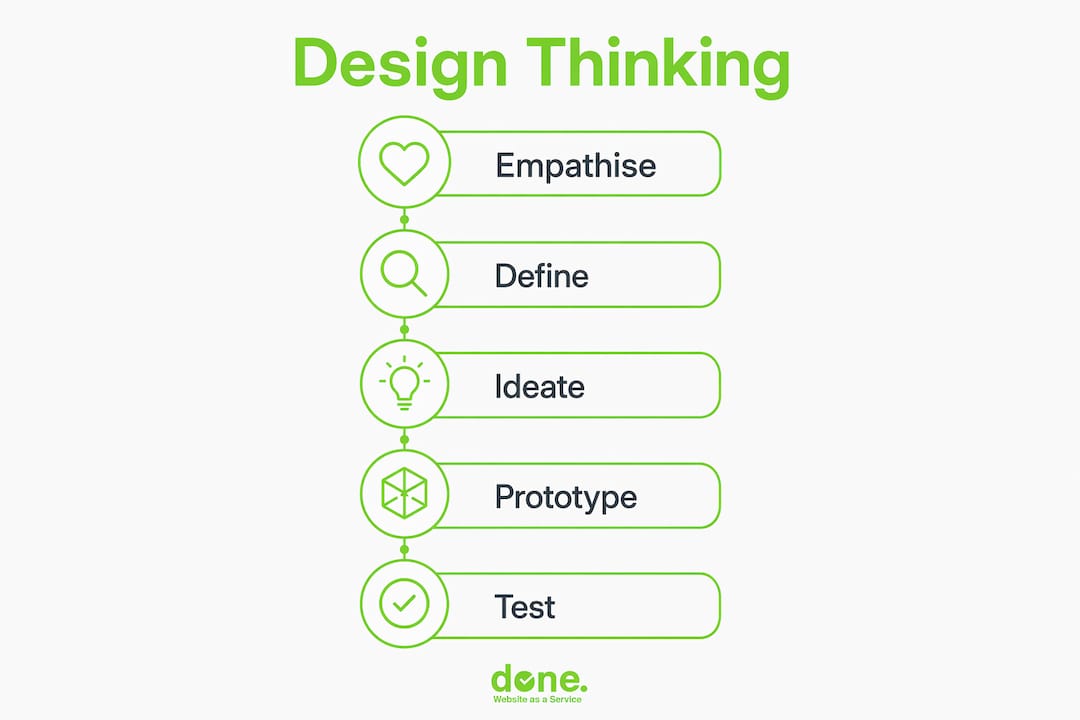
The model was popularised by the Stanford d.school and IDEO, and it has been adopted by product teams at companies ranging from IBM to small digital agencies. Its central premise is that good solutions come from a deep understanding of real user problems, not from clever ideas generated in isolation.
| Step | What You Do | What You Produce |
|---|---|---|
| Empathise | Conduct user interviews, observations, and surveys | User insights and behavioural patterns |
| Define | Synthesise research into a clear problem statement | A focused design brief or “How Might We” question |
| Ideate | Generate a wide range of possible solutions | Sketches, concepts, and feature ideas |
| Prototype | Build low-fidelity representations of the best ideas | Wireframes, mockups, or clickable prototypes |
| Test | Observe real users interacting with the prototype | Validated insights and a list of improvements |
The cyclical nature of Design Thinking is what separates it from traditional waterfall development. A team might prototype and test three times before arriving at a solution that genuinely works. That iteration is not a sign of failure. It is the process working as intended.
One practical point worth noting: the empathise stage is the one most frequently skipped by time-pressured teams. Jumping straight to ideation feels productive, but it almost always results in solutions built on assumptions rather than evidence. The define stage is equally critical. A vague problem statement produces vague solutions.
Pro Tip: During the test stage, resist the urge to explain or defend your design to users. Watch what they do, not what they say they would do. Behavioural observation reveals problems that self-reported feedback consistently misses.
What role does emotional design play in user experience?
Emotional design is the practice of shaping how users feel when they interact with a product, not just whether they can complete a task. Don Norman identifies three levels of emotional design: visceral, behavioural, and reflective. Each operates at a different depth of engagement.
- Visceral design is the immediate, instinctive reaction to a product’s appearance. A clean, well-proportioned interface creates a positive first impression before the user has done anything. A cluttered or dated design triggers doubt.
- Behavioural design is the satisfaction of using something that works well. This is the level most product teams focus on: does the button do what it should, does the form submit correctly, does the flow make sense?
- Reflective design is the deepest level. It concerns how a product fits into a user’s identity and self-image. Products like Apple’s hardware or Notion’s workspace design succeed at this level because users feel the product says something about who they are.
“Most product teams focus only on the behavioural level, missing opportunities for deeper connection.” — UX Design Principles, Figr
The business implication of this is direct. A product that only functions correctly will retain users until a functionally equivalent competitor appears. A product that also engages users at the visceral and reflective levels creates loyalty that is far harder to displace. Successful products engage users at all three levels to create genuine affinity and identification.
Balancing usability and emotional appeal is not a contradiction. The most effective UX work addresses both simultaneously. A well-structured checkout flow can also feel reassuring and trustworthy. A well-written error message can feel human rather than mechanical. These are not separate concerns. They are the same design decision viewed from two angles.
How can you apply UX principles to improve website usability?
Applying UX design principles to a real website requires moving from theory to specific, testable decisions. The following areas produce the most consistent improvements for business websites and digital products.
- Responsive design and context awareness. Responsive design is not simply about making a layout fluid across screen sizes. It means understanding what a mobile user actually needs in their context and prioritising that content. A restaurant website visited on a mobile device should surface the phone number and opening hours immediately, not a full-width hero image.
- Content hierarchy and navigation. Users scan before they read. Structure your pages so that the most important information is visually prominent and the navigation reflects how users think about your content, not how your organisation is structured internally. Practical guidance on improving website navigation can make a significant difference to how long visitors stay and what they do next.
- Accessibility as a baseline, not an afterthought. Accessible design benefits all users, not only those with disabilities. Sufficient colour contrast, keyboard navigability, and descriptive alt text improve the experience for everyone. In many European countries, accessibility compliance is also a legal requirement for certain categories of website.
- Reducing cognitive load. Every unnecessary element on a page competes for the user’s attention. Remove options that do not serve the user’s primary goal. Simplify forms to ask only for information you genuinely need. Use plain language rather than industry jargon.
- Testing with real users. The most common UX mistake is assuming that internal team reviews are sufficient. Five usability tests with real users will reveal more genuine problems than a month of internal critique. Tools like Maze, Hotjar, and UserTesting make this accessible even for small teams.
UX principles serve as a decision-making lens that ensures every design choice is justified by serving the user rather than by opinion or internal preference. When a team applies this lens consistently, the quality of decisions improves and the time spent on subjective debates decreases. For SMEs in particular, this discipline produces measurable returns without requiring a large design team.
For a practical view of how UX shapes website performance in the current environment, the Done article on UX and web design in 2026 covers the specific practices that are producing results for businesses right now.
Key takeaways
Effective user experience design combines evidence-based principles, structured frameworks like Design Thinking, and emotional engagement across all three of Don Norman’s levels to produce products that retain users and drive business outcomes.
| Point | Details |
|---|---|
| UX covers all touchpoints | Design every interaction, including emails and error states, not just visual screens. |
| Seven core principles guide decisions | Apply user-centricity, consistency, hierarchy, context, control, accessibility, and usability to every design choice. |
| Design Thinking is cyclical | Use the five-step model iteratively; return to earlier stages whenever testing reveals new user needs. |
| Emotional design builds loyalty | Address visceral, behavioural, and reflective levels to create products users identify with, not just use. |
| Accessibility is non-negotiable | Accessible design improves usability for all users and meets legal requirements across Europe. |
UX design in practice: what i have learned working with smbs
After working with over 350 clients at Done, I have come to one firm conclusion: most businesses underinvest in UX at the start and overspend fixing problems at the end. The pattern is consistent. A business launches a website built around what the team likes rather than what users need. Six months later, the conversion rate is poor, the bounce rate is high, and the instinct is to redesign the entire site. In most cases, the problem was not the visual design. It was the absence of structured user research at the beginning.
The second thing I have observed is that emotional design is almost always the missing layer. Teams focus on making things work correctly, which is necessary but not sufficient. The businesses whose websites genuinely perform well have invested in the tone of their copy, the quality of their imagery, and the feeling of trust that the overall experience creates. These are not decorative choices. They are the difference between a user who converts and one who leaves.
The third observation concerns AI and new interfaces. In 2026, more of our clients are asking how UX principles apply to chatbots, voice assistants, and AI-powered tools. The honest answer is that the principles do not change. User-centricity, clarity, and emotional engagement matter just as much in a conversational interface as they do on a webpage. What changes is the surface and the interaction model. The discipline remains the same.
My practical advice for any business owner reading this: start with five user interviews before you redesign anything. You will learn more in two hours of listening than in two weeks of internal discussion. UX design is not a luxury for large companies. For SMEs competing on digital channels, it is one of the highest-return investments available. If you want to understand why UX design matters for SME success, the evidence is clear and consistent.
— Thomas
How Done helps businesses build better digital experiences
Done is a Luxembourg-based digital agency with over a decade of experience building websites and digital products for SMBs across Europe. Our approach combines structured UX research, Growth Driven Design methodology, and continuous improvement to deliver websites that work for real users, not just internal stakeholders.
Whether you are building a new website from scratch or improving an existing one, our team applies the UX principles and Design Thinking frameworks covered in this article to every project. We also offer web development services that integrate UX best practices from the first wireframe to the final launch. If you want a website that converts visitors into customers and keeps them coming back, we would be glad to show you how we approach it. Contact Done to start the conversation.
FAQ
What is UX design in simple terms?
UX design is the practice of making digital products easy, useful, and satisfying to use. It covers every interaction a user has with a product, from first visit to final action.
How does UX design differ from UI design?
UI design focuses on the visual elements on a screen, such as buttons, colours, and typography. UX design is the broader discipline that determines whether the entire product experience serves the user’s needs effectively.
What are the five steps of design thinking?
The five steps are empathise, define, ideate, prototype, and test. The model is cyclical, meaning teams return to earlier stages as new user insights emerge during testing.
Why is emotional design important in UX?
Don Norman’s three levels of emotional design, visceral, behavioural, and reflective, show that products engaging users only at the functional level are vulnerable to competitors. Emotional engagement at all three levels creates loyalty that functionality alone cannot produce.
How does UX design affect SEO and business performance?
Good UX design reduces bounce rates, increases dwell time, and improves conversion rates. Search engines factor in these behavioural signals when ranking pages, making UX a direct contributor to organic search performance.