

Why choose e-commerce solutions for your SMB in 2026
June 16, 2026
What is user experience design? a 2026 guide
June 18, 2026
TL;DR:
- Effective digital campaign optimization relies on accurate conversion tracking, consolidated campaign structures, and disciplined landing page testing to improve return on investment. Implementing proper measurement, pooling data for sufficient conversions, and setting revenue-linked goals help campaigns perform reliably and sustainably. Patience with data validation and focusing on the right KPIs ensure long-term success for SMEs managing multichannel digital advertising efforts.
Digital campaign optimisation is the process of aligning your measurement setup, audience targeting, bidding strategy, and creative testing with clear performance goals to increase engagement and return on investment. Done right, it transforms scattered ad spend into a predictable growth engine. This guide covers the practical workflow behind how to optimise digital campaigns in 2026, including Meta Pixel and Conversions API configuration, Google Smart Bidding, landing page testing protocols, and campaign structuring for maximum ROI. Each section addresses a specific failure point we see repeatedly with Luxembourg SMEs, and gives you the fix.
How do you set up accurate conversion tracking?
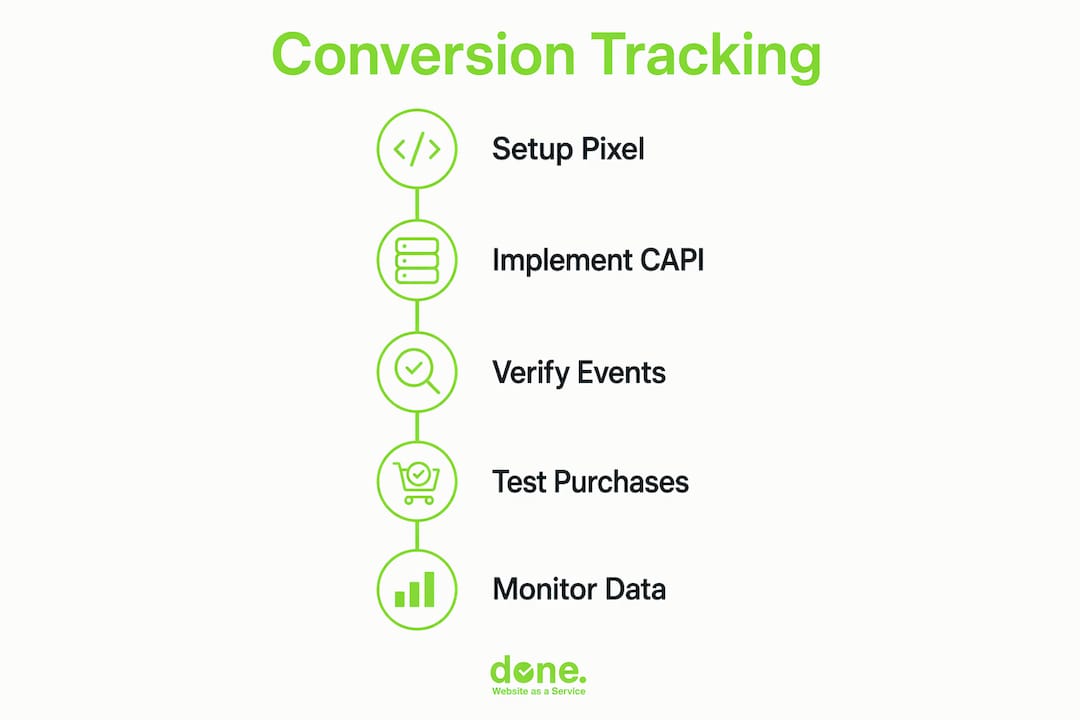
Accurate conversion tracking is the foundation of every optimisation decision you make. Without it, your bidding algorithms learn from bad data, your attribution reports mislead you, and your budget flows to the wrong campaigns. The industry term for this discipline is conversion measurement, and it covers everything from pixel configuration to server-side event validation.
The most common setup combines Meta Pixel with the Meta Conversions API (CAPI). The Pixel fires from the browser; CAPI fires from your server. Together, they capture events that browser-side tracking alone misses, particularly on iOS devices where cookie restrictions have significantly reduced Pixel reliability.
The critical technical detail is deduplication. Meta deduplicates conversions within 48 hours when both the Pixel and CAPI send the same event_id for a single real outcome. That means you must pass a stable, unique identifier, such as an order ID, through both payloads. Without it, Meta counts the same purchase twice, inflating your conversion numbers and corrupting the signals your campaigns learn from.
Here is what a correct setup requires:
- Stable
event_idmapping: Use the same unique identifier (order ID, lead ID) in both the Pixel payload and the CAPI payload for every event. - User data parameters: Pass hashed customer data including email, phone, and the
_fbcclick ID parameter. The_fbcvalue enables click-based attribution, which is essential for accurate last-click and data-driven models. - Event Match Quality (EMQ) score: Check this in Meta Events Manager. A score above 6.0 is the target. A low EMQ means Meta cannot reliably match your events to real people, which weakens attribution and reduces the value of your conversion data.
- Deduplication validation: In Events Manager, filter by event type and check the deduplication status column. Any event showing “not deduplicated” signals a missing or mismatched
event_id.
Misconfigured event tracking inflates conversion counts and misleads Smart Bidding algorithms. This is not a minor technical issue. It directly causes your campaigns to over-spend on audiences that are not actually converting.
Pro Tip: Before launching any new campaign, run a test purchase or lead submission and verify the event appears once, not twice, in Events Manager. This five-minute check prevents weeks of corrupted data.
What bidding and budget strategies boost campaign reach in 2026?
Smart Bidding is Google’s umbrella term for automated bid strategies that use machine learning to set bids at auction time. The strategies include Target CPA, Target ROAS, Maximise Conversions, and Maximise Conversion Value. Each one requires sufficient conversion data to function correctly.
The most important number to know is 30. Campaigns need at least 30 conversions in a 30-day period for Smart Bidding to exit the learning phase and perform reliably. Below that threshold, the algorithm is essentially guessing. This is why splitting your budget across too many small campaigns is one of the most damaging structural mistakes you can make.
Google’s 2026 updates introduced several features worth building into your workflow:
- Smart Bidding Exploration: This feature allows the algorithm to test less obvious search queries that it predicts will convert. Smart Bidding Exploration delivers on average 27% more unique converting users for Search campaigns. That is a meaningful reach increase without changing your targeting parameters.
- Campaign total budgets: Instead of setting daily budgets, you allocate a total budget for a defined campaign period. This reduces the need for manual adjustments during high-demand periods and lets the algorithm pace spend more efficiently.
- Demand-led pacing: Google’s system now identifies periods of elevated consumer intent and shifts spend toward those windows automatically. You benefit from peak demand without manually monitoring and adjusting bids.
- Portfolio bid strategies: Grouping multiple campaigns under a single portfolio strategy pools conversion data across them. This helps smaller campaigns exit the learning phase faster by drawing on shared signals.
- Dayparting as a supplement: Use bid adjustments by hour or day to reinforce the algorithm’s pacing decisions, particularly if your business has clear offline conversion patterns, such as phone calls that only happen during business hours.
“Consolidating campaigns to achieve data sufficiency is not about simplifying your account structure for convenience. It is about giving the algorithm enough signal to make decisions that actually reflect your customers’ behaviour.”
The practical implication for Luxembourg SMEs is straightforward. If you are running five separate campaigns each generating six conversions per month, none of them will perform well on Smart Bidding. Consolidate to two or three campaigns, pool the data, and let the algorithm work with a meaningful sample. You can always expand the structure once performance is stable.
How can you systematically test landing pages to improve conversions?
Landing page optimisation, known in the industry as Conversion Rate Optimisation (CRO), is the discipline of testing page elements to increase the percentage of visitors who complete a desired action. It compounds your campaign results because every improvement applies to all the traffic you are already paying for.
The most common mistake is stopping a test too early. A/B tests should run for at least two weeks and accumulate a minimum of 100 conversion events per variant before you draw conclusions. Checking results daily inflates false positive rates by approximately 22%. That means you will regularly declare a winner that is not actually better, then implement a change that hurts performance.
Here is a disciplined testing framework:
- Test one element at a time. Changing the headline, CTA button colour, and form length simultaneously makes it impossible to know which change drove the result.
- Prioritise high-impact elements first. CTA copy, form field count, and the primary headline have the largest effect on conversion rates. Test these before testing font size or image placement.
- Never change a variant mid-test. Editing a page while a test is running contaminates the data. If you spot an error, end the test, fix it, and restart.
- Segment your results. A change that improves conversions on desktop may reduce them on mobile. Always check results by device type before rolling out a winner.
The table below shows which elements to test first, based on their typical impact on conversion rate:
| Page Element | Typical Impact | Test Priority |
|---|---|---|
| CTA copy and placement | High | First |
| Form field count | High | First |
| Primary headline | High | First |
| Hero image or video | Medium | Second |
| Social proof placement | Medium | Second |
| Page layout and structure | Low to medium | Third |
| Colour scheme | Low | Last |
Landing page tests that are stopped early or run on insufficient traffic produce misleading results that can actively damage performance. The discipline here is patience. A properly run test takes three to four weeks for most SME campaigns. That timeline feels slow, but the conclusions are reliable.
Pro Tip: If your campaign sends traffic to a page built on a slow CMS, fix page load speed before running any CRO tests. A page that loads in over three seconds will suppress conversions regardless of what copy or layout you test.
What are the best practices for structuring performance campaigns?
Campaign structure determines how well your budget allocates itself and how effectively your bidding algorithm learns. The right structure aligns each campaign with a single, clear business objective, whether that is lowest CPA, highest ROAS, or maximum conversion volume.

Adobe recommends keeping fewer than six placements per campaign package and grouping placements with similar expected performance together. This approach improves algorithmic learning because the algorithm compares like with like. When you mix high-performing and low-performing placements in the same package, the budget does not shift efficiently to the best spots.
The comparison below illustrates the difference between a poorly structured and a well-structured campaign approach:
| Structural Choice | Poor Practice | Best Practice |
|---|---|---|
| Number of campaigns | Many small, fragmented campaigns | Fewer consolidated campaigns with pooled data |
| Placement grouping | Mixed performance placements together | Group by similar expected performance |
| Budget allocation | Fixed daily budgets per campaign | Flexible total budgets with demand-led pacing |
| Conversion events | Default platform events only | Custom success events tied to business goals |
| Optimisation goal | Click volume or impressions | CPA, ROAS, or revenue-linked KPI |
Custom success events deserve particular attention. The default conversion events in Google Ads or Meta, such as “page view” or “add to cart,” are useful signals, but they are not your business objective. Setting up custom events that map directly to revenue, such as a completed purchase above a minimum order value or a qualified lead form submission, gives the algorithm a more accurate target. Grouping placements with similar performance improves ROAS and CPA optimisation by making budget shifts more predictable and effective.
For Luxembourg SMEs running campaigns across French, German, and English audiences, this structural discipline also applies to language segmentation. Keep language variants in separate ad sets or campaigns so that performance data does not blend across audiences with different conversion rates.
How do analytics and attribution models shape optimisation decisions?
Attribution is the process of assigning credit for a conversion to one or more touchpoints in the customer journey. The model you choose determines which campaigns, channels, and keywords appear to be working, and therefore where you shift your budget and focus.
Attribution model choice critically impacts which campaigns receive credit for conversions, directly shaping your optimisation and budget decisions. A last-click model gives all credit to the final touchpoint before conversion. A data-driven model distributes credit based on the actual contribution of each touchpoint. These two models can produce completely different budget recommendations from the same underlying data.
The practical guidance is to build a layered metrics hierarchy:
- Top of funnel: Impressions, reach, click-through rate. These indicate whether your creative and targeting are working.
- Mid funnel: Cost per click, landing page conversion rate, time on page. These show whether your traffic is qualified and your pages are effective.
- Bottom of funnel: Cost per acquisition, ROAS, customer lifetime value. These are the metrics that connect directly to profit.
“Optimising for clicks alone is the equivalent of measuring a sales team by the number of calls they make rather than the deals they close. The metric is real, but it is not the right one.”
A high-performing optimisation workflow connects top-funnel engagement metrics through this hierarchy to pipeline and profitability measures. This protects you from the common trap of declaring a campaign successful because it generated cheap clicks, when those clicks never converted into revenue.
HubSpot’s 2026 guidance confirms that true campaign optimisation uses shared KPIs and unified attribution across all channels to enable a genuine test-and-learn approach. For SMEs managing campaigns across Google, Meta, and LinkedIn simultaneously, this means agreeing on one attribution model and one set of KPIs before the campaigns launch, not after the results come in. You can explore performance marketing on social media to see how iterative testing and shared KPIs apply specifically to social platforms.
Key takeaways
Effective digital campaign optimisation requires accurate conversion tracking, data-sufficient campaign structures, disciplined landing page testing, and revenue-linked KPIs working together as a single system.
| Point | Details |
|---|---|
| Validate conversion tracking first | Confirm Meta Pixel and CAPI send matching event_id values before spending budget. |
| Consolidate campaigns for Smart Bidding | Achieve 30+ conversions per 30 days per campaign to exit the learning phase reliably. |
| Test landing pages with discipline | Run A/B tests for at least two weeks with 100+ conversions per variant before acting. |
| Structure campaigns around business goals | Use custom success events and fewer placements to improve algorithmic budget allocation. |
| Choose attribution models deliberately | Align on revenue-linked KPIs across all channels before campaigns launch, not after. |
What i have learned from optimising campaigns for luxembourg smes
After working with over 350 clients since 2014, the pattern I see most often is this: businesses invest in campaign spend before they invest in measurement. They launch Meta campaigns, Google Search campaigns, and LinkedIn ads, then try to interpret the results using default attribution and unchecked pixel setups. The data looks plausible. The decisions based on it are not.
The most damaging version of this I have encountered was a client whose Meta CAPI setup was sending duplicate purchase events because the event_id was not stable. Their reported ROAS was nearly double the actual figure. They had been scaling a campaign that was, in reality, barely breaking even. Fixing the tracking did not feel like a win in the short term. It was, though.
The second pattern is impatience with testing. Clients see a landing page variant performing better after five days and want to call it. We push back every time. The false positive rate from early peeking is high enough that acting on early data is genuinely worse than not testing at all.
My honest recommendation: spend the first two weeks of any new campaign on measurement validation, not creative iteration. Get your digital marketing workflow right before you optimise anything else. The campaigns that perform consistently over six months are almost always the ones where the tracking was correct from day one.
The businesses that improve most are not the ones with the biggest budgets. They are the ones willing to be patient with data and honest about what the numbers are actually saying.
— Thomas
How Done helps smbs get campaign optimisation right
Done has been helping Luxembourg SMEs build and optimise digital campaigns since 2014, with over 350 completed projects across web development, digital marketing, and AI-powered solutions. We have seen every tracking misconfiguration, every premature test conclusion, and every campaign structure that looked logical but starved the algorithm of data. Our approach starts with a measurement audit before any campaign spend increases. From there, we build the campaign structure, bidding strategy, and testing workflow around your actual business goals, not platform defaults. If you want a digital marketing strategy built on accurate data and clear ROI targets, or need support with your lead generation workflow, we are ready to help.
FAQ
What is the minimum data needed for smart bidding to work?
Google Smart Bidding requires at least 30 conversions in a 30-day period per campaign to exit the learning phase and bid reliably. Below this threshold, performance is inconsistent.
How do meta pixel and conversions API work together?
Meta Pixel fires from the browser and CAPI fires from your server. Both must send the same event_id so Meta can deduplicate the event and count it once rather than twice.
How long should a landing page a/b test run?
A/B tests should run for a minimum of two full business cycles, typically two weeks, and accumulate at least 100 conversion events per variant before you draw conclusions.
What attribution model should i use for google ads?
Data-driven attribution is the recommended model for most campaigns in 2026, as it distributes credit based on actual touchpoint contribution rather than assigning all credit to the last click.
Why should i use custom conversion events instead of default ones?
Default platform events like “page view” do not reflect your business objective. Custom events tied to revenue actions, such as completed purchases or qualified lead submissions, give Smart Bidding a more accurate target and improve campaign performance over time.