

What is user experience design? a 2026 guide
June 18, 2026
What is mobile-first design? A practical guide for 2026
June 20, 2026
TL;DR:
- Inbound marketing attracts high-intent prospects through valuable content, reducing costs compared to outbound methods. It builds a long-term, sustainable acquisition system that generates leads and trust over time, especially when combined with short-term outbound strategies. Measuring success requires focusing on content-driven pipeline value and conversion metrics rather than vanity traffic figures.
Inbound marketing is defined as the practice of attracting customers through valuable, relevant content rather than interruptive advertising. Where outbound methods buy attention through cold calls, display ads, and paid placements, inbound earns it. Companies that primarily use inbound marketing achieve 61% lower cost per lead compared to outbound-centric firms. That single figure explains why so many SMBs are shifting budget away from paid channels and asking the same question: why invest in inbound marketing at all? The answer is that it builds a self-reinforcing acquisition system. Platforms like HubSpot, tools like Leadfeeder, and AI-assisted content workflows make that system accessible even for businesses with lean teams and modest budgets.
Why invest in inbound marketing over outbound methods?
Inbound marketing attracts prospects who are already looking for what you sell. Outbound marketing interrupts people who may not be. That distinction matters enormously for conversion rates and cost.

When a prospect finds your article through a Google search, reads your case study, or downloads your guide, they arrive with intent. They have self-selected. Outbound campaigns, by contrast, cast wide nets and rely on volume to compensate for low relevance. The result is higher spend per qualified lead and a sales team chasing contacts who were never warm to begin with.
The mechanism is straightforward. Content built around the questions your buyers actually ask draws them to your website at the moment they are evaluating solutions. SEO-optimised blog posts, comparison pages, and how-to guides each serve as permanent entry points into your pipeline. Unlike a paid ad that stops delivering the moment your budget runs out, inbound content keeps generating leads for years after publication.
This does not mean outbound has no place. For businesses that need pipeline immediately, a short-term paid campaign can fill the gap while inbound content matures. The most effective approach combines both: outbound for speed, inbound for sustainability. Done has seen this hybrid model work well for Luxembourg SMBs that need quick wins without abandoning long-term growth.
- Inbound attracts high-intent prospects who are actively researching solutions, not passively scrolling.
- Outbound generates immediate reach but at a higher cost per qualified lead and with no residual value.
- Combining both produces short-term pipeline and a compounding long-term asset base.
- Content assets accumulate value over time, reducing the effective cost per lead with every passing month.
Pro Tip: If you are new to inbound, start with three to five high-quality articles targeting the specific questions your best customers asked before they bought from you. Those topics are your fastest route to qualified organic traffic.
What are the main benefits of inbound marketing?
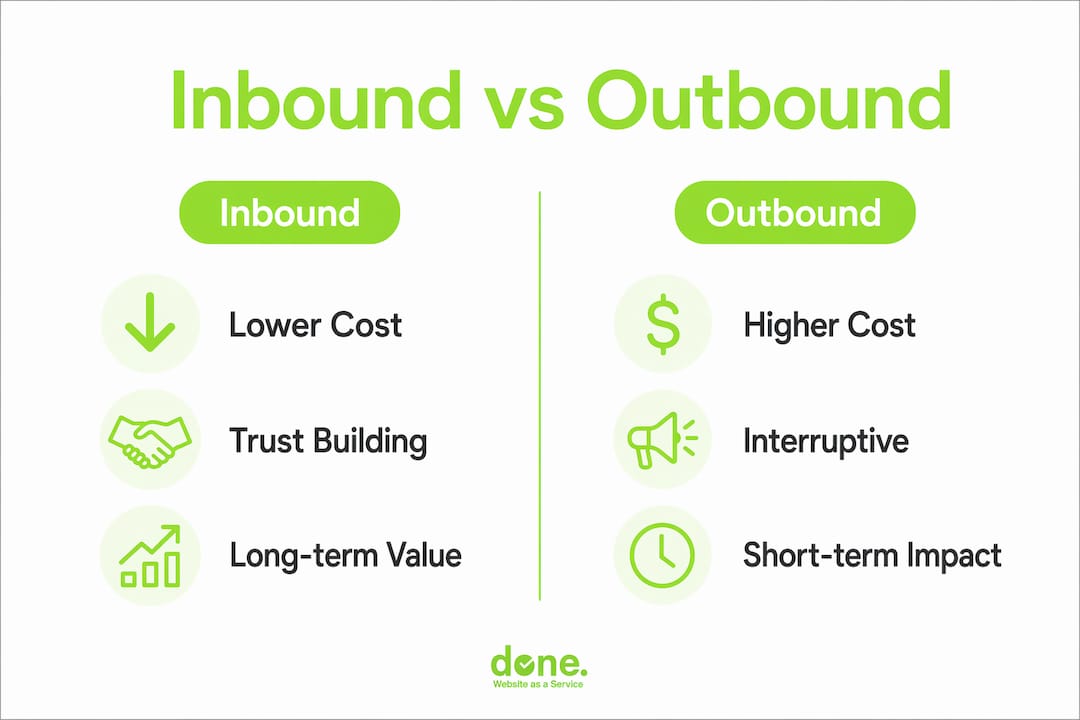
The benefits of inbound marketing go well beyond cost savings. They include brand authority, lead quality, and a compounding return on content investment that paid media simply cannot replicate.
Cost reduction and budget efficiency
Inbound marketing requires upfront resource investment but delivers sustained returns that reduce dependency on paid media over time. A business that publishes 50 well-researched articles over 18 months builds a library of assets that each generate traffic independently. The cost per lead from that library falls month by month as the fixed production cost is spread across an ever-growing volume of organic visitors. Paid ads offer no such dynamic.
Trust and authority over time
Inbound marketing builds trust and authority through consistent, valuable content. Buyers who have read three of your articles before they contact you already trust your expertise. That trust shortens the sales cycle and reduces the amount of convincing your sales team needs to do. For professional services firms in Luxembourg, where reputation drives referrals, this effect is particularly pronounced.
Evergreen content as a long-term asset
Content, once created, continues to generate leads for years, amortising production costs to near zero over time. A well-written guide published today may still rank on Google in 2029. No paid campaign offers that kind of longevity. This is the compounding return that makes inbound marketing a genuine investment rather than a recurring expense.
Inbound vs outbound: a direct comparison
| Factor | Inbound marketing | Outbound marketing |
|---|---|---|
| Cost per lead | Lower over time | Higher, ongoing |
| Lead quality | High intent, self-selected | Variable, often cold |
| Asset longevity | Content persists for years | Stops when budget stops |
| Trust building | Gradual, content-driven | Limited, interruptive |
| Scalability | Scales with content volume | Scales with spend |
| Measurement | Traffic, MQLs, pipeline | Impressions, clicks, CPL |
Pro Tip: Treat your content library as a balance sheet asset. Track how many leads each article generates per quarter. The ones with the highest lead-to-traffic ratio deserve updates and internal links, not retirement.
What inbound marketing strategies actually drive pipeline?
The core inbound tactics are content marketing, search engine optimisation (SEO), social media, and email nurturing. Each plays a distinct role, and they work best when connected to each other and to your sales process.
Content marketing and SEO
Content marketing means creating articles, guides, videos, and tools that answer the questions your buyers are asking. SEO ensures those assets are discoverable. Together, they form the foundation of any inbound programme. For Luxembourg SMBs, this often means writing in multiple languages and targeting local search intent alongside broader European queries. Done’s experience across 350+ client projects confirms that localised, specific content consistently outperforms generic material.
Ranking on the first page of Google for relevant queries is the single most reliable source of organic traffic for SMBs. Each position gained on a high-volume search term compounds over time as click-through rates improve and domain authority grows.
Social media as a distribution channel
Social media does not generate leads on its own for most B2B businesses. Its role in inbound is distribution: getting your content in front of people who would not find it through search alone. LinkedIn, in particular, works well for B2B audiences in Luxembourg. The benefits of social media for business extend beyond reach to include social proof, community building, and direct engagement with prospects before they enter your pipeline.
Email nurturing and lead scoring
Email remains the highest-ROI channel for converting inbound leads into customers. Once a prospect has downloaded a guide or subscribed to your newsletter, a structured email sequence can move them from awareness to consideration without any sales intervention. Behavioural data, such as visits to your pricing page or repeated downloads, signals high intent. Successful inbound strategies use this data to trigger targeted sales outreach at exactly the right moment.
Aligning inbound with your sales team
- Define your MQL criteria. Agree with your sales team on what actions constitute a marketing-qualified lead (MQL). Page visits, content downloads, and email engagement are all valid signals.
- Connect your CRM to your content platform. Tools like HubSpot allow behavioural data to flow directly into sales workflows, so sales development representatives (SDRs) see which leads are most active.
- Create sales enablement content. Case studies, comparison guides, and ROI calculators help sales close deals that inbound marketing opened.
- Measure MQL-to-SQL conversion. Track how many marketing-qualified leads become sales-qualified leads (SQLs). This ratio tells you whether your content is attracting the right audience.
- Use AI to prioritise outreach. AI tools can score leads based on engagement patterns and surface the highest-priority contacts for your SDRs each morning. Platforms like Slayy.ai blend inbound engagement signals with outbound prospecting to improve conversion velocity.
- Review and iterate monthly. Inbound is not a set-and-forget system. Monthly reviews of content performance and pipeline contribution keep the programme aligned with sales targets.
How do you measure inbound marketing ROI?
Inbound marketing ROI is measured by tracking the revenue generated from inbound-sourced leads against the total cost of producing and distributing content. The challenge is that most businesses measure the wrong things.
Moving beyond vanity metrics
Traffic and social media followers are easy to count but rarely correlate with revenue. The metrics that matter are MQL-to-SQL conversion rate, content-influenced pipeline value, and customer acquisition cost (CAC) from inbound channels. Measuring success requires focusing on MQL-to-SQL conversion and content-influenced revenue, not just traffic or social engagement. A blog post that generates 500 visits but zero leads is not an asset. A post that generates 50 visits and three MQLs is.
Typical timelines for measurable impact
85% of companies using inbound marketing report a measurable increase in website traffic within 7 months. That means you should not expect overnight results, but you should expect clear signals within two quarters if your content is well-targeted. Revenue impact typically follows traffic growth by 3–6 months as leads mature through the pipeline.
Inbound marketing as infrastructure, not a campaign
Inbound marketing must be engineered as an infrastructure designed for trust accumulation rather than isolated campaigns. This is the most important conceptual shift for SMB owners to make. A campaign has a start date and an end date. Infrastructure compounds. Every article you publish, every email sequence you build, and every lead magnet you create adds a permanent layer to your acquisition system.
Key performance indicators to track:
- Organic traffic growth month on month, segmented by landing page
- MQL volume and quality from inbound channels versus paid
- Content-influenced pipeline showing which deals touched inbound assets before closing
- Customer acquisition cost from inbound versus outbound, tracked quarterly
- Time to first conversion from first content interaction to MQL status
Pro Tip: The most common measurement mistake is attributing a lead only to the last touchpoint. Use multi-touch attribution in HubSpot or your CRM to see which content pieces contributed to each closed deal. This reveals which topics deserve more investment.
Inbound marketing programmes that feed engagement data to sales teams improve lead prioritisation and conversion velocity dramatically. The data loop between marketing and sales is where most of the ROI lives. Without it, you are leaving significant value on the table.
Key takeaways
Inbound marketing delivers lower acquisition costs, higher-quality leads, and compounding content returns that paid advertising cannot match.
| Point | Details |
|---|---|
| Cost per lead advantage | Inbound marketing produces 61% lower cost per lead than outbound-centric approaches. |
| Content as a long-term asset | Well-produced content continues generating leads for years, reducing effective cost over time. |
| Sales alignment is critical | Feeding behavioural engagement data to sales teams improves lead prioritisation and conversion rates. |
| Measure revenue, not traffic | Track MQL-to-SQL conversion and content-influenced pipeline, not just page views or social metrics. |
| Results take time | 85% of inbound users see measurable traffic growth within 7 months; revenue impact follows shortly after. |
Why I think most SMBs underestimate inbound marketing
After working with SMBs across Luxembourg for over a decade, I have noticed a consistent pattern. Business owners understand the logic of inbound marketing immediately. They agree that earning trust through helpful content makes sense. Then they ask for results in 60 days and abandon the programme when the pipeline is not full by month three.
The problem is not the strategy. The problem is the expectation. Inbound marketing is not a paid campaign with a predictable cost-per-click. It is closer to building a sales team: the upfront investment is real, the ramp-up takes time, and the compounding returns only become visible once the system has enough content and enough data to work properly.
What I have seen work consistently is a hybrid approach. Use paid search or LinkedIn ads to generate immediate leads while your inbound content matures. Do not pit the two against each other. The businesses that grow fastest treat inbound as the foundation and outbound as the accelerant.
The other mistake I see regularly is treating content as a marketing task rather than a sales asset. The best-performing content we have helped clients produce answers the exact questions their sales team hears on discovery calls. When marketing and sales share the same content brief, the results are measurably better. You can explore practical inbound examples for SMBs to see what this looks like in practice.
One more observation: businesses that invest in a well-built website as the foundation of their inbound programme consistently outperform those that treat the website as an afterthought. Content needs a fast, credible, conversion-optimised home. Without that, even excellent articles fail to convert visitors into leads. The infrastructure matters as much as the content itself.
— Thomas
How Done supports your inbound marketing investment
Done is a Luxembourg-based digital and AI agency with over 350 completed projects for SMBs across Europe. We build the technical and strategic foundations that make inbound marketing work: fast, conversion-ready websites, SEO-driven content programmes, and marketing automation workflows that connect your content to your sales pipeline.
If you are ready to move beyond paid ads and build a sustainable acquisition system, we can help you design and implement an inbound programme tailored to your market, your team size, and your growth targets. Our approach combines web development for business growth with content strategy and marketing automation, so every element of your inbound system works together from day one. Get in touch with the Done team to discuss where to start.
FAQ
What is inbound marketing in simple terms?
Inbound marketing is the practice of attracting customers by publishing helpful, relevant content rather than interrupting them with ads. Prospects find you through search engines, social media, or referrals, and arrive already interested in what you offer.
How long does inbound marketing take to show results?
Most businesses see measurable traffic growth within 7 months of starting a consistent inbound programme. Revenue impact typically follows 3–6 months after that, as leads mature through the sales pipeline.
Is inbound marketing cheaper than outbound?
Companies that prioritise inbound marketing achieve 61% lower cost per lead compared to outbound-focused firms. The cost advantage grows over time as content assets accumulate and organic traffic increases without additional spend.
Does inbound marketing work for B2B businesses?
Inbound marketing works particularly well for B2B, where buyers research extensively before contacting a supplier. Content that answers technical or strategic questions attracts high-intent prospects and shortens the sales cycle by building trust before the first conversation.
How do I measure whether my inbound marketing is working?
Track MQL-to-SQL conversion rates, content-influenced pipeline value, and customer acquisition cost from inbound channels. Avoid relying solely on traffic or social metrics, which do not reliably predict revenue outcomes.