

SEO best practices for SMBs: 2026 guide
June 10, 2026
What is branding strategy? A practical guide for SMBs
June 12, 2026
TL;DR:
- E-commerce optimisation is a continuous process that improves site speed, user experience, and conversion rates to increase revenue. Prioritizing mobile, checkout flow, and product pages delivers the highest ROI by reducing friction and abandonment. Integrating SEO and CRO strategies ensures sustained growth, with ongoing testing and iteration being essential for long-term success.
E-commerce optimisation is defined as the ongoing, systematic process of improving every element of an online store to increase conversion rates, revenue, and customer satisfaction. It covers three interconnected disciplines: search engine optimisation (SEO), user experience (UX), and conversion rate optimisation (CRO). Stores that apply this approach consistently can achieve conversion rates above 4.5%, compared to the industry average of 1 to 3%. That gap represents a 50 to 350% revenue increase from the same volume of traffic. For e-commerce professionals and SMB owners, understanding what drives that gap is the most practical place to start.
What is e-commerce optimisation and why does it matter?
E-commerce optimisation is not a one-time project. It is a continuous discipline applied across product pages, checkout flows, site speed, mobile experience, and search visibility. The goal is to remove every obstacle between a visitor and a completed purchase.
The business case is straightforward. Doubling your conversion rate produces equivalent revenue to doubling your traffic, but at a fraction of the cost. You do not need more advertising spend. You need a store that converts the visitors you already have.
This matters especially for small and medium-sized businesses operating with limited marketing budgets. Investing in optimisation delivers compounding returns: each improvement builds on the last, and the gains accumulate over time rather than resetting with each campaign.
The standard industry term for the conversion-focused strand of this work is Conversion Rate Optimisation, or CRO. You will encounter this term frequently alongside SEO and UX in any serious discussion of e-commerce best practices. All three must work together. Treating them as separate workstreams is one of the most common and costly mistakes we see with clients.
Which areas of your store should you optimise first?
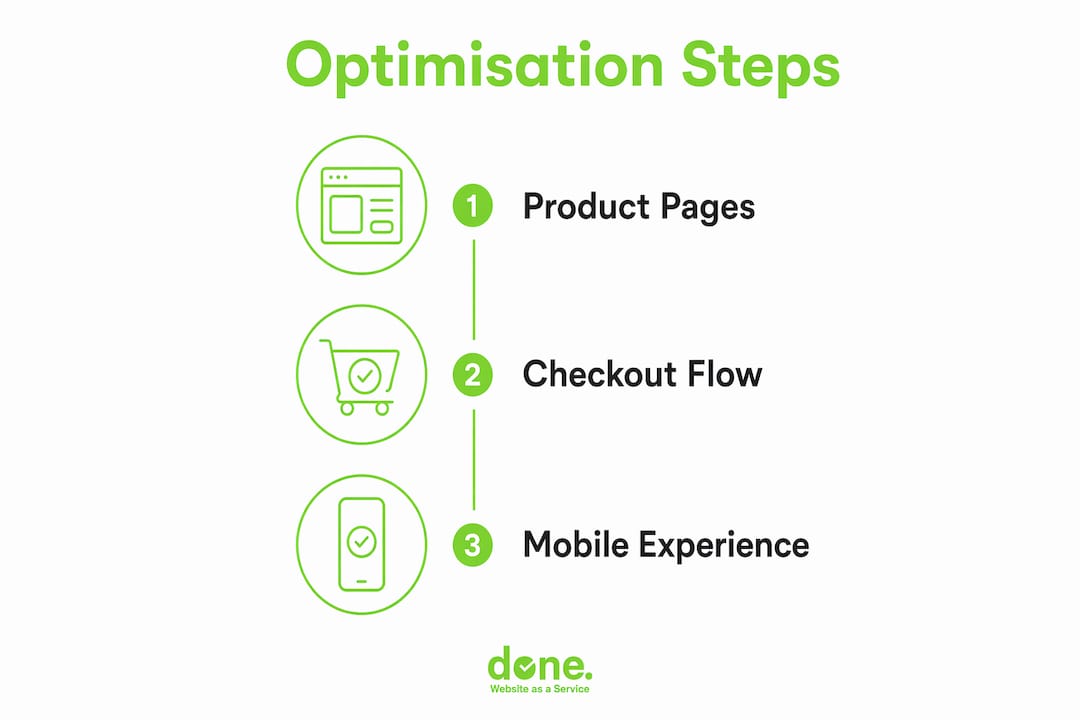
Not all optimisation efforts deliver equal returns. Product pages, checkout flows, and mobile experience account for the majority of conversion lift opportunities in most stores. Prioritising these three areas before anything else is the most efficient use of your time and budget.
Product pages
Your product page is where purchase decisions are made. Weak images, vague descriptions, missing social proof, and slow load times all erode confidence at the critical moment. A page that loads in under one second converts roughly three times better than one that takes five seconds. That is not a marginal gain. It is the difference between a viable store and one that bleeds revenue quietly.

Visitors who use your site search function convert at three to five times the rate of those who browse without it. This means a well-implemented search feature on your product catalogue is not a nice-to-have. It is a direct revenue lever.
Checkout flows
Cart abandonment sits at approximately 70% across e-commerce. Most of that abandonment is caused by friction: too many form fields, hidden shipping costs revealed at the final step, no guest checkout option, and a lack of visible security signals. Removing unnecessary fields and displaying shipping costs upfront are two changes that consistently reduce abandonment without requiring any design overhaul.
Offering guest checkout is equally important. Forcing account creation before purchase introduces a barrier that many shoppers will not cross. Simplifying checkout steps and removing that requirement can produce measurable conversion gains within days of implementation.
Mobile experience
Mobile accounts for over 70% of e-commerce visits, yet mobile converts at roughly half the rate of desktop. That gap is not caused by user preference. It is caused by stores that were designed for desktop and never properly adapted for smaller screens. In seven and eight-figure stores, mobile and checkout improvements account for 73% of total conversion lift potential. The implication is clear: if your mobile experience is poor, you are leaving the majority of your revenue opportunity on the table.
The table below illustrates the typical conversion impact of addressing each area:
| Store area | Typical pre-optimisation rate | Typical post-optimisation rate |
|---|---|---|
| Product pages (desktop) | 2.0% | 3.5 to 4.5% |
| Checkout flow | 1.5% | 3.0 to 4.0% |
| Mobile experience | 1.0% | 2.0 to 3.5% |
| Site search users | 2.5% | 7.5 to 12.5% |
Pro Tip: Fix friction before you fix aesthetics. A cleaner font or a new colour scheme will not recover abandoned carts. Removing a mandatory account creation step will.
How do you balance CRO and SEO for sustained growth?
CRO and SEO are often managed by different teams with different objectives. CRO focuses on converting existing visitors. SEO focuses on attracting new ones. Treating them as competing priorities is a mistake that limits both.
The role of SEO in e-commerce is to bring qualified traffic to your store. CRO’s role is to convert that traffic into revenue. Neither discipline works at full effectiveness without the other. A store with excellent SEO but a poor checkout experience acquires visitors it cannot convert. A store with excellent CRO but weak SEO converts well but reaches too few people.
The practical solution is to build an integrated optimisation approach where improvements serve both objectives simultaneously. Several tactics do exactly that:
- Page speed improvements reduce bounce rates (a CRO benefit) and improve Core Web Vitals scores (an SEO ranking factor). Both gains come from the same technical work.
- Content optimisation on product pages improves keyword relevance for search engines while also giving shoppers the information they need to make a purchase decision.
- Mobile responsiveness is a direct Google ranking signal and simultaneously the single largest conversion opportunity in most stores. Addressing it serves both disciplines at once.
- Internal linking and site navigation help search engines crawl and index your catalogue while also reducing the number of clicks a shopper needs to find what they want.
- Structured data and schema markup improve how your products appear in search results, increasing click-through rates before a visitor even reaches your store.
The risk of focusing exclusively on SEO is that you drive traffic to a store that does not convert, wasting your acquisition investment. The risk of focusing exclusively on CRO is that you optimise a store that too few people visit. A holistic optimisation approach that combines UX, SEO, and security improvements together consistently outperforms siloed strategies. We have seen this pattern repeatedly with clients who came to us having invested heavily in one area while neglecting the other.
What techniques and tools drive effective optimisation?
Effective e-commerce optimisation follows a four-phase lifecycle. Understanding each phase prevents the most common and expensive mistakes.
-
Audit. Start by mapping your current performance using Google Analytics 4, Google Search Console, and a heatmap tool such as Hotjar. Identify where visitors drop off, which pages have the highest exit rates, and where mobile users struggle. This phase produces your list of hypotheses ranked by potential revenue impact.
-
Hypothesis building. Each hypothesis should follow a clear structure: “If we change X, we expect Y to improve because Z.” Vague hypotheses produce uninterpretable results. Specific ones, grounded in your audit data, give you something you can act on regardless of the outcome.
-
Testing. A/B testing is the standard method for validating hypotheses. Tools such as Optimizely, VWO, and Google Optimize (or its successors) allow you to run controlled experiments on live traffic. The critical constraint here is sample size. Each test variant needs a minimum of 350 to 400 conversions before you can draw statistically valid conclusions. Running tests on low-traffic pages or ending them early produces false positives that can lead to changes that actively harm revenue.
-
Iteration. A winning test result is not the end of the process. It is the start of the next cycle. Implement the winning variant, update your baseline metrics, and return to the audit phase with new data. This is what makes optimisation a continuous discipline rather than a one-time project.
For mobile-specific improvements, the priorities are responsive design, compressed images, and reduced JavaScript execution time. Tools such as Google PageSpeed Insights and GTmetrix give you a precise breakdown of what is slowing your pages down and in what order to address the issues. For responsive web design, the goal is not simply that your site displays on a phone. It is that every interaction, from browsing to checkout, works as well on a 375px screen as it does on a 1440px monitor.
On the checkout side, the most impactful technical changes are reducing the number of form fields to the absolute minimum, enabling autofill, offering multiple payment methods including digital wallets, and displaying trust signals such as SSL certificates and recognised payment logos prominently throughout the process.
Pro Tip: Do not run A/B tests on pages that receive fewer than 1,000 visits per month. You will not reach statistical significance in a reasonable timeframe, and the results will mislead you. Fix your highest-traffic friction points first using direct evidence from heatmaps and session recordings.
What are the most common e-commerce optimisation mistakes?
Most optimisation failures are not caused by bad ideas. They are caused by good ideas applied in the wrong order, without sufficient data, or in isolation from the rest of the store.
-
Ignoring mobile. With over 70% of traffic arriving on mobile devices, a store that has not been properly optimised for small screens is failing the majority of its visitors before they even reach a product page. Mobile UX improvements are not optional. They are the highest-priority item on any optimisation list.
-
Running underpowered A/B tests. Testing with fewer than 350 to 400 conversions per variant produces results that cannot be trusted. Many businesses make permanent changes to their stores based on tests that were statistically meaningless. The result is a store that has been changed based on noise rather than signal.
-
Prioritising aesthetics over friction. A new hero image or a redesigned homepage banner will not move your conversion rate. Removing a mandatory registration step, displaying shipping costs earlier, or fixing a broken mobile menu will. Cosmetic changes feel productive but rarely address the actual reasons visitors leave without buying.
-
Operating in silos. SEO, UX, and CRO must be treated as one system. Stores that run SEO campaigns without considering the landing page experience, or that redesign their UX without checking the impact on search rankings, consistently underperform stores that treat these disciplines as interconnected.
-
Treating optimisation as a project with an end date. A store that was well-optimised in 2024 is not necessarily well-optimised in 2026. Customer behaviour changes, competitors improve, and platform updates alter the technical environment. Optimisation is a monthly commitment, not a quarterly project.
-
Underestimating checkout friction. Checkout friction is the primary cause of conversion loss in most stores. Addressing it before investing in personalisation, loyalty programmes, or advanced analytics delivers a far higher return on investment.
Key takeaways
E-commerce optimisation delivers its greatest returns when mobile experience, checkout friction, and SEO are treated as one integrated system rather than separate workstreams.
| Point | Details |
|---|---|
| Define the scope correctly | Optimisation covers SEO, UX, and CRO together. Siloed efforts consistently underperform. |
| Prioritise mobile and checkout | Over 70% of traffic is mobile; 70% of carts are abandoned. These two areas drive the most revenue recovery. |
| Use the four-phase lifecycle | Audit, hypothesise, test with sufficient data, then iterate. Skipping any phase produces unreliable results. |
| Respect A/B test sample sizes | Each variant needs 350 to 400 conversions minimum before results can be trusted. |
| Commit to continuous improvement | Optimisation is a monthly discipline. Stores that treat it as a one-time project lose ground steadily. |
What I have actually seen work in practice
After working with SMB clients across Luxembourg and broader Europe on their e-commerce stores, the pattern I see most often is this: businesses invest in traffic acquisition before their store is ready to convert that traffic. They run Google Ads or social campaigns, see mediocre results, and conclude that digital marketing does not work for them. In most cases, the marketing was fine. The store was the problem.
The clients who see the most consistent improvement are those who start with an honest audit. Not a redesign. Not a new platform. An audit. Where are visitors leaving? What does the mobile experience actually look like on a mid-range Android device? How many steps does it take to complete a purchase? Those questions, answered with real data from Google Analytics 4 and Hotjar session recordings, consistently reveal two or three changes that account for the majority of the conversion gap.
I would also push back on the instinct to test everything. A/B testing is a powerful tool, but it requires traffic volume and patience that most SMBs do not have in the early stages of optimisation. In our experience, fixing obvious friction points, particularly on mobile and at checkout, produces faster and more reliable gains than running experiments on button colours or headline copy. Save the testing for decisions where the right answer is genuinely unclear.
The businesses that treat optimisation as a permanent part of how they run their store, rather than a project they complete once, are the ones that compound their gains over time. That is not a complicated insight. But it is one that most stores still do not act on.
— Thomas
How Done can help you optimise your e-commerce store
If you recognise any of the patterns described in this article, whether it is a mobile experience that does not convert, a checkout flow with too many steps, or an SEO strategy that is disconnected from your UX, Done has the expertise to address them systematically.

Done is a Luxembourg-based digital agency with over 350 completed projects across web development, SEO, and UX design for SMBs. We apply the same four-phase optimisation lifecycle described in this article to every e-commerce engagement: audit, hypothesise, test, and iterate. Our e-commerce development services cover everything from mobile-first responsive builds to checkout architecture and analytics integration. If you want to understand what is holding your store back before committing to a full project, start with a conversation. We will tell you what we find, not what you want to hear.
FAQ
What is e-commerce optimisation in simple terms?
E-commerce optimisation is the process of systematically improving your online store to increase the percentage of visitors who complete a purchase. It covers site speed, mobile experience, product pages, checkout flow, and search visibility.
What is a good conversion rate for an e-commerce store?
The industry average sits between 1 and 3%. Stores that apply data-driven optimisation consistently can reach 4.5% or higher, which represents a significant revenue increase from the same traffic volume.
How long does it take to see results from optimisation?
Quick wins from checkout and mobile fixes can appear within weeks. Statistically valid A/B test results require enough traffic to reach 350 to 400 conversions per variant, which may take one to three months depending on your store’s volume.
Should I focus on SEO or CRO first?
Address the most critical friction points in your store first, particularly mobile experience and checkout flow, before scaling traffic acquisition. Once your store converts reliably, SEO investment produces a far better return.
What tools do I need to start optimising my store?
Google Analytics 4 and Google Search Console cover traffic and search performance. Hotjar provides heatmaps and session recordings to identify UX friction. For testing, tools such as Optimizely or VWO allow you to run controlled experiments once your traffic volume supports it.