

What is e-commerce optimisation? A 2026 guide
June 11, 2026
Top 4 web-design.lu alternatives agencies 2026
June 13, 2026
TL;DR:
- A branding strategy is a long-term plan that shapes a business’s identity, customer perception, and market position through purpose, messaging, and visuals. Its effective operationalization across all touchpoints builds trust, loyalty, and differentiation, especially for SMBs competing against larger firms. Without clear structure and consistent application, even well-designed strategies often fail to produce lasting impact or customer loyalty.
A branding strategy is the long-term plan a business uses to define its identity, shape customer perception, and build a competitive position in the market. According to Salesforce, it covers purpose, messaging, visuals, and consistency across every customer touchpoint, and it is distinct from short-term marketing campaigns. Where marketing asks “how do we sell this?”, branding strategy asks “who are we, and why should anyone care?” For business owners and marketers, getting this distinction right is the difference between building a brand people trust and simply running promotions that fade the moment the budget stops.
What is branding strategy and why does it matter?
A branding strategy is the foundational blueprint that guides every decision about how your business presents itself to the world. HubSpot describes it as a plan that turns every customer interaction into an opportunity to earn trust, loyalty, and relevance. That framing is worth sitting with. It means your hiring process, your invoice template, your social media tone, and your website design are all expressions of the same underlying strategy.

The importance of branding goes well beyond logos and colour palettes. A clear strategy gives your team a shared reference point for decisions, reduces inconsistency across channels, and signals to customers that you are a business worth trusting. Without it, even well-funded marketing campaigns produce mixed results because the underlying message keeps shifting.
For SMBs in Luxembourg and across Europe, the stakes are particularly high. You are competing against larger players with bigger budgets, so differentiation through a clear, consistent brand identity is one of the few advantages you can build without outspending the competition. Branding for SME growth is not a luxury reserved for large corporations. It is a practical tool for any business that wants to grow sustainably.
What are the essential components of a branding strategy?
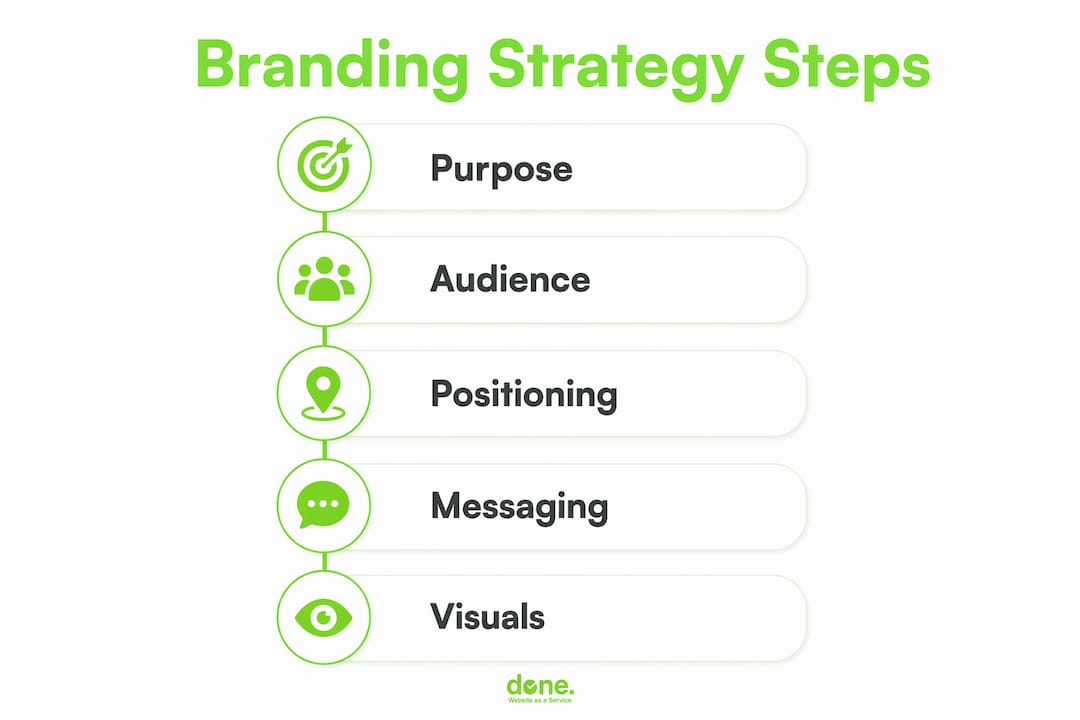
A complete branding strategy is built from several interconnected elements. Salesforce identifies purpose, audience, positioning, messaging, values, consistency, loyalty, and employee involvement as the core components. Each one plays a specific role, and neglecting any of them creates gaps that customers will notice even if they cannot name what feels off.
Here is what each component means in practice:
- Brand purpose. The reason your business exists beyond making money. A genuine purpose gives customers and employees something to connect with emotionally. Patagonia’s commitment to environmental responsibility is a purpose that shapes every product decision, not just the marketing copy.
- Audience definition. Who you are speaking to, in specific terms. Not “SMBs” but “finance directors at Luxembourg accounting firms with 10 to 50 staff.” The more precise your audience definition, the more relevant your messaging becomes.
- Brand positioning. Where you sit relative to competitors in the minds of your customers. Positioning answers the question: why choose us over the alternatives? It must be both true and distinctive.
- Messaging architecture. The hierarchy of messages you communicate, from your core brand promise down to the specific language used in product descriptions. This includes tone of voice, which determines whether your brand sounds formal, conversational, technical, or warm.
- Visual identity. Colours, typography, imagery style, and logo usage. These are the tangible expressions of your strategy, not the strategy itself. A common mistake is treating visual identity as the whole of branding.
- Employee advocacy. Your team is your brand in action. Internal alignment means staff understand the brand values and reflect them in every customer interaction, from a support email to a sales call.
- Customer loyalty mechanisms. The deliberate ways you reward, retain, and deepen relationships with existing customers. Loyalty is not an accident. It is the result of consistent, positive experiences over time.
Pro Tip: If you are building a branding strategy from scratch, prioritise purpose, audience, and positioning first. These three elements inform everything else. Visual identity and messaging can be refined over time, but a weak foundation in purpose or positioning will undermine every other investment you make.
The importance of branding compounds over time. Each consistent interaction adds to the brand’s credibility, and that credibility is what converts first-time buyers into repeat customers.
How does branding strategy differ from marketing strategy and brand identity?
These three terms are frequently used interchangeably, which causes real confusion when businesses try to plan. Monday.com’s branding guide draws a clear line: brand strategy sets your values, personality, and promise; marketing strategy focuses on campaigns and conversions; brand identity is the visual and verbal expression of the brand strategy.
Think of it this way. Brand strategy is the architecture. Brand identity is the exterior of the building. Marketing strategy is how you attract people to walk through the door. All three are connected, but they operate on different timescales and serve different purposes.
| Concept | Timescale | Primary focus | Output |
|---|---|---|---|
| Brand strategy | 5 to 10 years | Purpose, values, positioning | Strategic direction |
| Marketing strategy | 6 to 18 months | Campaigns, leads, revenue | Campaigns and content |
| Brand identity | Ongoing | Visual and verbal expression | Logo, tone, design system |
The practical value of understanding these distinctions is significant. When a business owner says “our branding isn’t working,” they often mean their marketing is underperforming. But the root cause may be a brand strategy that has never been clearly defined. Fixing the advertising without fixing the strategy is like repainting a building with a cracked foundation.
Brand strategy also has a longer shelf life than most business owners expect. A well-constructed strategy should hold for five to ten years, with periodic reviews rather than complete overhauls. Marketing strategies, by contrast, should be reviewed annually or even quarterly as market conditions shift.
Why does branding strategy matter for customer loyalty and trust?
Consistent brand presentation across all channels differentiates a business and drives customer engagement. That consistency is the engine of trust, and trust is the precondition for loyalty. Customers do not become loyal to brands they find unpredictable or confusing.
Research published in MDPI’s sustainability journal found that brand image and brand love act as mediators between brand strategy elements and customer loyalty, with a strong connection between loyalty and willingness to pay a premium. This matters because it means loyalty is not just about repeat purchases. It is about customers who will pay more, recommend you to others, and forgive the occasional mistake.
“Brand strategy turns every interaction into an opportunity to earn trust, loyalty, and relevance.” — HubSpot
The emotional dimension of branding is often underestimated by SMB owners who focus on functional benefits. Customers choose brands they feel good about, not just brands that perform well. Apple’s loyalty is not built on technical specifications alone. It is built on a consistent emotional experience that starts with the product packaging and extends through every customer service interaction.
For local businesses, this emotional connection is even more accessible. A Luxembourg-based accountancy firm that consistently communicates its values through its website, its proposals, and its client communications builds a brand that feels trustworthy long before a prospect picks up the phone.
Pro Tip: The most common trust-killer in SMB branding is inconsistency between the website and the actual customer experience. If your website promises a premium, personal service but your onboarding process is chaotic and impersonal, customers notice. Audit every touchpoint against your brand promise at least once a year.
Web design plays a direct role in building that trust online. A website that reflects your brand values clearly and consistently is one of the highest-return branding investments a small business can make.
How to create an effective branding strategy
Creating a branding strategy is a structured process, not a creative brainstorm. Here is a practical sequence that works for most SMBs.
-
Conduct a brand discovery audit. Before defining where you want to go, understand where you are. Review your current messaging, visual assets, customer feedback, and competitor positioning. Identify what is working, what is inconsistent, and what is missing. A free marketing audit can help surface gaps you may not have noticed internally.
-
Define your core brand elements. Write down your brand purpose in one sentence. Define your audience in specific terms. State your positioning clearly: what you do, for whom, and why you are different. These three elements are the foundation everything else builds on.
-
Write practical brand guidelines. Effective brand guidelines answer real questions your team has every day. They include approved logo usage, colour codes, typography, tone of voice examples, and messaging templates. Guidelines that sit in a PDF nobody reads are not guidelines. They are decoration. Make them accessible, searchable, and genuinely useful.
-
Assign ownership and integrate into workflows. Monday.com’s research confirms that strategy must move from abstract ideas to clear actions embedded in hiring, product development, culture, and customer communication. Assign a named person or team responsible for brand consistency. Include brand review steps in your content approval process, your hiring criteria, and your product launch checklist.
-
Build a step-by-step website branding process. Your website is the most visible expression of your brand strategy. It should reflect your positioning, speak in your brand voice, and present your visual identity consistently. Treat it as a living asset that evolves as your strategy matures, not a one-time project.
-
Review and evolve the strategy. Set a formal review at least every 18 months. Look at customer feedback, market shifts, and internal changes. Brand strategy should be stable but not rigid. If your audience has shifted or a competitor has moved into your positioning territory, your strategy needs to respond.
The digital strategy guide for SMEs published by Done covers how brand purpose and positioning translate into digital execution, which is where most SMBs need the most practical support.
Key takeaways
A branding strategy is the long-term plan that defines purpose, positioning, and consistent presentation, and without it, marketing spend produces diminishing returns.
| Point | Details |
|---|---|
| Definition is foundational | Brand strategy sets purpose, values, and positioning before any marketing or design work begins. |
| Components work together | Purpose, audience, messaging, visual identity, and employee alignment must all point in the same direction. |
| Distinct from marketing | Brand strategy operates over 5 to 10 years; marketing strategy operates over months and serves the brand. |
| Trust drives loyalty | Consistent brand experience builds the emotional connection that turns customers into advocates willing to pay a premium. |
| Operationalise or fail | Strategy embedded in workflows, guidelines, and team ownership produces results; strategy left in a document does not. |
Why most branding strategies fail before they start
In our experience working with SMBs across Luxembourg and Europe, the most common failure is not a bad strategy. It is a strategy that never gets operationalised. A business owner spends time and money on a brand workshop, receives a polished document with a purpose statement and colour palette, and then files it away. Six months later, the sales team is using one tone, the website has a different one, and the brand feels fragmented to anyone paying attention.
The second most common failure is confusing brand identity with brand strategy. I have seen businesses invest heavily in a new logo and website redesign while the underlying positioning remains unclear. The result looks better but performs no differently, because the visual refresh was not grounded in a strategic decision about who the brand is for and why it matters.
What actually works is treating brand strategy as an operational document, not a creative one. The businesses I have seen build genuine loyalty are the ones that translate their brand values into specific behaviours. Not “we are customer-focused” but “we respond to every client query within four hours and we follow up proactively when a project milestone is reached.” That specificity is what makes a brand feel real to customers.
For SMBs in particular, a clear branding strategy is a competitive advantage that does not require a large budget. It requires clarity, consistency, and the discipline to apply it across every touchpoint. The businesses that get this right build reputations that outlast any individual campaign.
— Thomas
How Done supports your digital branding
Done is a Luxembourg-based digital agency with over 350 completed projects for SMBs across multiple sectors. We work with business owners and marketing teams to translate brand strategy into digital reality, from web development and design to SEO and inbound marketing. Our approach starts with understanding your positioning and audience before touching a single pixel.
If you are building or refining your brand strategy and want it to translate into a website and digital presence that actually reflects your values, Done’s digital branding services are built for exactly that. We bring the strategic clarity and the technical execution together, so your brand works consistently across every channel your customers use.
FAQ
What is branding strategy in simple terms?
A branding strategy is the long-term plan that defines how a business presents itself, what it stands for, and how it builds trust with customers. It covers purpose, messaging, visual identity, and consistency across all touchpoints.
How is branding strategy different from marketing strategy?
Brand strategy sets the long-term direction, values, and positioning of a business, typically over five to ten years. Marketing strategy focuses on campaigns, conversions, and revenue over shorter timeframes, and it serves the brand strategy rather than replacing it.
What are the key components of a branding strategy?
The core components include brand purpose, audience definition, positioning, messaging architecture, visual identity, employee alignment, and customer loyalty mechanisms. Salesforce identifies all of these as necessary for a complete strategy.
How long does it take to build a branding strategy?
A focused brand discovery and strategy development process typically takes four to eight weeks for an SMB. The strategy itself should then be reviewed every 12 to 18 months to reflect market changes and business growth.
Why does consistent branding improve customer loyalty?
Research published by MDPI found that brand image and brand love act as mediators between brand strategy and loyalty, with loyal customers showing a greater willingness to pay a premium. Consistency builds the trust that underpins that emotional connection.