

GDPR AI compliance: a practical guide for European SMEs
May 17, 2026
On-premise AI for SMBs: a practical 2026 guide
May 19, 2026
TL;DR:
- Many European SMEs mistakenly believe AI requires handing data to cloud providers, risking compliance issues. Running AI models locally on controlled hardware ensures data stays within EU borders, simplifying GDPR and EU AI Act obligations. Implementing a secure, compliant local AI infrastructure is achievable within days using containerisation and open-source tools, provided proper governance is maintained.
Many European SMEs believe AI means handing data to a cloud provider and hoping for the best. It does not have to. Local AI infrastructure, where AI models run on hardware you own and control, gives your business the processing power of modern AI without sending sensitive data beyond your walls. For SMEs operating under GDPR, this distinction is not merely technical; it is the difference between a manageable compliance posture and a regulatory headache. This guide covers what local AI is, how it supports GDPR and EU AI Act obligations, how it compares to cloud alternatives, and how to get started without needing a large IT team.
Table of Contents
- What is local AI infrastructure and why it matters for SMEs
- How local AI infrastructure simplifies GDPR compliance for European SMEs
- Local AI’s role in meeting EU AI Act high-risk system obligations
- Local AI infrastructure versus cloud AI: which fits your SME best?
- Getting started with local AI infrastructure: practical setup for SMEs
- Why local AI infrastructure is about infrastructure engineering, not just running models
- How Done.lu supports European SMEs with local AI and digital infrastructure solutions
- Frequently asked questions
Key Takeaways
| Point | Details |
|---|---|
| Local AI boosts data control | Running AI locally keeps personal data within your infrastructure, simplifying GDPR compliance. |
| Avoid cross-border complexities | Self-hosting eliminates international transfer rules, cutting legal overhead for European SMEs. |
| Compliance requires full-stack governance | You must secure all connected tools and manage logs to truly meet GDPR and AI Act standards. |
| Cost-effective and scalable | Local AI can be affordable with modest hardware and grow with your company’s needs. |
| Expert guidance eases adoption | Working with experienced consultants helps design compliant, resilient local AI infrastructure. |
What is local AI infrastructure and why it matters for SMEs
Local AI infrastructure means running AI models directly on hardware that you own or control, whether that is a capable workstation, an on-premise server, or a small cluster of machines inside your office or data centre. The AI inference, meaning the process of the model generating outputs, happens entirely within your environment. No data leaves your building, and no third party processes your inputs.
This matters enormously for SMEs handling sensitive information, whether that is client records, financial data, or healthcare information. AI strategies for SMEs are increasingly pointing toward local deployment as the practical choice for data-conscious businesses, and for good reason.
Here is what a typical local AI setup looks like in practice:
- Self-hosted inference: The AI model runs on your own machine, processing requests locally without contacting external servers.
- OpenAI-compatible API: Tools like LocalAI run on your machine with an API matching the OpenAI standard, meaning your existing applications can connect without rewriting code.
- Flexible hardware: GPU acceleration speeds things up, but many models run adequately on a modern CPU with 16GB or more of RAM, keeping entry costs low.
- Multiple deployment scales: From a single developer workstation running a small language model to a rack-mounted server handling dozens of simultaneous requests, local AI scales to your needs.
- No vendor dependency: You choose the model, the update schedule, and the access rules. No subscription price hikes, no terms-of-service changes affecting your operations overnight.
For SMEs, the appeal is straightforward. You get the AI benefits for SME growth that larger enterprises enjoy, whilst keeping the compliance controls your sector demands. Local machine learning systems are no longer the exclusive territory of enterprise IT teams with dedicated budgets. Modern tooling has made them genuinely accessible.
Now that we have introduced local AI, let us explore the GDPR and compliance benefits it offers specifically for European businesses.
How local AI infrastructure simplifies GDPR compliance for European SMEs
GDPR places strict rules on where personal data can travel. Sending personal data to a cloud AI provider based outside the European Economic Area (EEA), or even to a European provider whose sub-processors operate elsewhere, triggers a cascade of legal obligations: Standard Contractual Clauses, Transfer Impact Assessments, Data Processing Agreements, and ongoing monitoring obligations.
Most mainstream cloud AI APIs involve these cross-border transfers by default. Your query, which may contain personal details, travels to data centres that may be physically located in the United States or elsewhere. Self-hosted inference on EU infrastructure removes cross-border transfer requirements entirely, eliminating whole categories of GDPR administrative work for SMEs.
“When your AI processes data exclusively on hardware you control within the EU, you are not a data exporter under GDPR. That single fact removes the need for transfer mechanisms, external DPA negotiations, and the associated audit burden.”
The practical compliance benefits of local AI include:
- No cross-border transfer obligations: Data never leaves EU-controlled infrastructure, so the complex international transfer rules simply do not apply.
- No external Data Processing Agreements: If no third party touches your data, you do not need to negotiate or maintain DPA contracts with AI providers.
- Reduced audit surface: Fewer external processors mean fewer data flows to document in your Records of Processing Activities (RoPA).
- Internal access controls: You set who can query the AI, what data it can see, and how requests are logged.
- Network-level security: A reverse proxy with HTTPS encryption and IP whitelisting ensures that even within your local network, only authorised requests reach the inference engine.
Our AI and GDPR guide for Europe covers the full compliance picture, but the core point is this: local deployment removes the most operationally burdensome parts of AI-related GDPR compliance. It does not eliminate all obligations, since you still need to document your processing activities and apply appropriate security measures, but it shrinks the problem considerably. Organisations that want to stay compliant whilst boosting productivity find that local AI gives them both.
With GDPR advantages clear, we should understand how local AI supports high-risk AI rules under the EU AI Act.
Local AI’s role in meeting EU AI Act high-risk system obligations
The EU AI Act, which entered force in 2024 and is rolling out requirements through 2027 and 2028, classifies certain AI applications as high-risk. These include AI used in recruitment, credit scoring, medical diagnosis, educational assessment, and several other areas that directly affect people’s lives and rights. If your SME operates in any of these domains, the obligations are significant.
The EU AI Act high-risk AI requirements cover risk management, data governance, technical documentation, human oversight, and logging standards before any deployment. For a standalone high-risk AI system, compliance is mandatory by December 2027. For AI embedded within regulated products, the deadline follows in 2028.
Local AI infrastructure helps you meet these obligations in a structured way. Here is how to approach it:
- Document your risk management process: Identify what risks the AI introduces, how you mitigate them, and who is responsible. Local infrastructure makes it easier to demonstrate control since you hold the system.
- Establish data governance records: Know exactly what data trains or informs your model, where it is stored, and how it is protected. On-premise AI tools make this audit trail far more straightforward than tracing data flows through cloud APIs.
- Maintain technical documentation: Keep records of the model version, configuration, and any fine-tuning applied. This is essential for demonstrating that your system meets the Act’s transparency requirements.
- Implement human oversight mechanisms: Design workflows where human review is built into consequential decisions. Local AI makes it easier to add these checkpoints without depending on a third party’s interface.
- Establish logging and monitoring: Every inference request and response must be loggable for audit and incident response. Local infrastructure means you control the logging configuration entirely.
| EU AI Act obligation | What it requires | How local AI helps |
|---|---|---|
| Risk management | Documented risk identification and mitigation | Full system control enables thorough documentation |
| Data governance | Records of training and input data | No external data flows to trace or negotiate |
| Technical documentation | Model version, config, and update records | You manage the model directly |
| Human oversight | Review mechanisms for consequential decisions | Workflow design is yours to configure |
| Logging and audit trails | Retained logs for regulatory inspection | Local logs under your own retention policy |
Pro Tip: Design your log retention and monitoring architecture before your first deployment. Retrofitting logging infrastructure into a production AI system is far more disruptive and costly than building it from day one. Set your retention periods, define your alert thresholds, and test your log recovery process during the initial setup phase.
An AI strategy roadmap for SMEs that incorporates these governance elements from the outset will save you considerable effort and expense as compliance deadlines approach.
Understanding compliance requirements, let us now compare local AI to cloud AI, highlighting practical pros and cons relevant for SMEs.
Local AI infrastructure versus cloud AI: which fits your SME best?
This is the question most SMEs face when they first consider AI adoption. Cloud AI services offer fast deployment and no upfront hardware costs. Local AI offers control, data residency, and long-term cost predictability. Neither option is universally better; the right choice depends on your data sensitivity, regulatory context, and internal capacity.

Sovereign and self-hosted AI reduces reliance on complex third-party transfer mechanisms and moves compliance responsibility to your own internal controls, unlike external cloud APIs where you are dependent on the provider’s compliance posture.
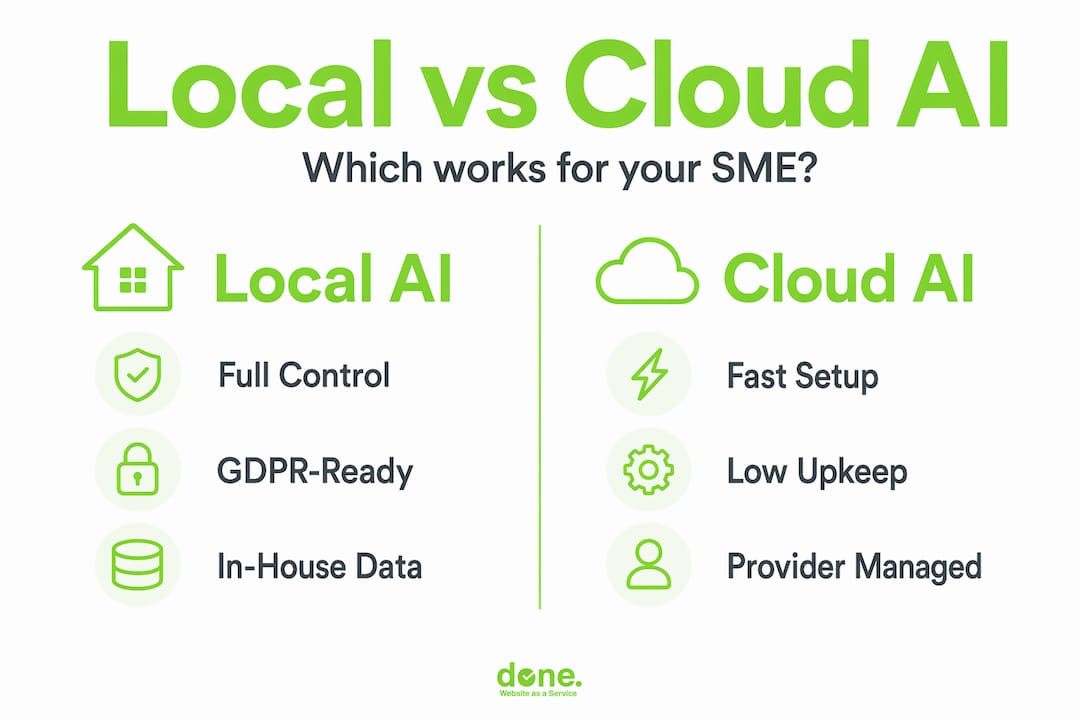
| Factor | Local AI | Cloud AI |
|---|---|---|
| Data residency | Fully within your control | Depends on provider and sub-processors |
| GDPR transfer rules | No international transfer issues | May require SCCs or TIAs |
| Upfront cost | Hardware investment required | Low upfront, usage-based billing |
| Ongoing cost | Electricity and maintenance | Scales with usage volume |
| Latency | Very low for local requests | Depends on internet connection |
| Vendor dependency | None | High |
| Compliance complexity | Managed internally | Shared with provider |
| Scalability | Limited by hardware | Scales instantly |
Pro Tip: When calculating the cost of cloud AI, include the hidden compliance overhead. Negotiating DPAs, conducting Transfer Impact Assessments, and maintaining audit documentation for external processors takes real staff time. That time has a cost. For many European SMEs, the total cost of cloud AI compliance exceeds the cost of modest local hardware within the first year.
When deciding between local and cloud AI, consider these factors:
- Data sensitivity: Does your AI process personal, financial, medical, or legally privileged information? If yes, local AI significantly reduces your exposure.
- Regulatory sector: Are you in finance, healthcare, legal, or accounting? Local AI is almost certainly the safer default.
- Request volume: Very high volumes may require significant hardware investment for local AI to remain performant.
- Team capacity: Local AI requires someone to manage the infrastructure. If your team has no technical capacity, factor in consulting or training costs.
- Integration requirements: OpenAI-compatible APIs on local systems mean most existing tools integrate without significant rework.
The practical steps for AI adoption and thoughtful AI change management are equally important in making either option succeed. Technology without process rarely delivers results.
Having weighed pros and cons, let us examine practical steps SMEs can take to start deploying local AI infrastructure today.
Getting started with local AI infrastructure: practical setup for SMEs
The good news is that you do not need a data centre to run local AI. A minimal viable stack with Docker, one workstation with optional GPU, and open-source tools like Ollama and Open WebUI can have you running AI locally within a day or two. Here is a realistic hardware baseline:
- RAM: 16GB minimum; 32GB for running larger models comfortably
- GPU (optional): A mid-tier card such as an RTX 3060 with 12GB VRAM handles most small to medium models efficiently; CPU-only operation is viable for lighter workloads
- Storage: At least 50GB free for model files and logs; NVMe storage reduces load times considerably
- Operating system: Linux is preferred for stability and Docker support, but Windows with WSL2 works well for smaller setups
Follow these steps to stand up a basic local AI environment:
- Install Docker and Docker Compose on your chosen machine. These tools package the AI software and its dependencies into isolated containers, simplifying deployment and updates.
- Deploy Ollama using Docker. Ollama manages model downloads, storage, and serving. Pull your first model, such as Llama 3 or Mistral, with a single command.
- Launch Open WebUI as your chat interface. Open WebUI connects to Ollama via its local API, providing a browser-based interface your team can use without any technical knowledge.
- Configure a reverse proxy such as Nginx or Caddy in front of both services. Apply HTTPS certificates, restrict access to internal IP ranges, and optionally add VPN-only access for an additional layer of security.
- Set up log collection and retention. Route container logs to a centralised log manager, set retention policies aligned with your GDPR obligations, and define alert rules for unusual request patterns.
Pro Tip: Never expose the default inference port (typically 11434 for Ollama) to external networks. Even on a trusted internal network, use IP whitelisting or VPN-gated access. Misconfigured AI inference endpoints are an increasingly common source of data leakage in SME environments.
Key operational tips once your stack is running:
- Review model licences before deploying in production. Some open-weight models have commercial use restrictions.
- Update models periodically to benefit from improved performance and reduced hallucination rates.
- Test your AI responses against known inputs before connecting it to live business workflows.
- Document your infrastructure configuration as part of your AI Act technical documentation obligation.
AI consulting for SMB operations can help you move from this baseline setup to a production-grade deployment confidently, and workflow automation for SMEs can connect your local AI to document processing, customer communication, and internal knowledge tools that make the investment tangible.
With setup guidance covered, let us offer a unique perspective on what often gets overlooked in local AI adoption.
Why local AI infrastructure is about infrastructure engineering, not just running models
Here is the uncomfortable truth we encounter repeatedly when working with SMEs on their first local AI deployments: they focus entirely on the model and forget everything around it. They install Ollama, pull a model, test a few prompts, and declare success. Then six months later, a compliance audit reveals that their document summarisation tool was quietly sending files to an external cloud OCR service, or that their RAG pipeline (Retrieval-Augmented Generation, a method of feeding documents to AI models) was logging queries to an analytics platform hosted in the United States.
The model is not the risk. Compliance failures often stem from adjacent tooling silently calling cloud services or external APIs, not from the local AI inference engine itself.
True local AI infrastructure engineering means treating every component in your data pipeline with the same scrutiny you apply to the inference engine. That includes your vector database, your document parser, your embedding generator, your monitoring stack, and your user authentication layer. Each of these components can, if not carefully selected and configured, route data outside your controlled environment.
This requires a governance mindset, not just a technical one. You need an inventory of every tool your AI system touches, a network policy that blocks unexpected outbound calls, and a regular review process as your integrations evolve. AI change management is not a soft skill here; it is a compliance mechanism.
We also observe that SMEs underestimate how quickly an AI stack grows. What starts as one model for summarisation becomes three models serving different teams, each with its own integrations and data flows. Design your architecture as enterprise infrastructure from day one, with proper network segmentation, documented data flows, and defined ownership. The SMEs who do this early avoid expensive remediation work later. Those who do not end up rebuilding their stack just as they are ready to scale.
How Done.lu supports European SMEs with local AI and digital infrastructure solutions
Building local AI infrastructure correctly takes more than following a tutorial. It takes experience with GDPR-specific architecture decisions, knowledge of which open-source tools are genuinely compliant, and the ability to connect AI capabilities to real business workflows that your team will actually use.

At Done.lu, we specialise in exactly this. Our AI strategy consulting service guides European SMEs from initial audit through to production-grade local AI deployment, covering compliance planning, infrastructure design, model selection, and team training. We have worked across legal, finance, healthcare, and professional services sectors, where data sovereignty is non-negotiable. Our AI consulting services are built around your scale and sector, and our workflow automation solutions connect your local AI to the processes where it adds the most measurable value. If you are ready to move beyond theory and build something that works, we are ready to help.
Frequently asked questions
What is local AI infrastructure?
Local AI infrastructure means running AI models on servers or machines you control entirely, keeping data in-house and not sending it to cloud providers. LocalAI runs AI locally with data never leaving your machine, supporting privacy-first usage.
How does local AI help with GDPR compliance?
By processing data entirely within EU-controlled infrastructure, local AI avoids cross-border transfers that trigger complex GDPR rules, reducing legal burdens for SMEs. Self-hosted AI on EU hardware eliminates international transfer obligations since data does not leave the EEA.
Can small businesses afford local AI infrastructure?
Yes, a modest setup with one or a few machines and an optional mid-tier GPU can effectively run local AI systems at a fraction of ongoing cloud API costs. A basic self-hosted AI stack costs approximately €50 per month in running costs, considerably less than cloud API subscriptions at equivalent usage volumes.
Does local AI cover all compliance requirements?
Local AI addresses GDPR and EU AI Act obligations around data residency and control, but full compliance also requires securing adjacent tools and maintaining clear governance and logs. Compliance failures often arise from tooling around AI inference silently calling external services, not from the local AI itself.
How quickly can SMEs implement local AI infrastructure?
With containerised tools and clear documentation, SMEs can set up basic local AI environments in a matter of days, depending on resources and existing technical capacity. Docker-based installations allow getting started quickly, though complexity grows as integrations and governance requirements are added.