

Social media management for Luxembourg SMBs: a 2026 guide
April 11, 2026
Top 6 website builders for startups 2026
April 13, 2026
TL;DR:
- European SMEs have a significant productivity opportunity through AI adoption, but current rates are low.
- Affordable, user-friendly AI tools can improve efficiency and customer experience while meeting EU compliance standards.
- Starting with low-risk use cases and leveraging regulatory sandboxes helps SMEs build trust, achieve ROI, and stay competitive.
European SMEs are sitting on one of the most significant productivity opportunities of the decade, yet AI adoption rates across the continent remain stubbornly low, hovering between 8% and 20% for smaller businesses compared to 30–55% for large enterprises. That gap translates directly into lost efficiency, slower growth, and competitive disadvantage. The good news is that AI is no longer the exclusive domain of corporations with vast technology budgets. Practical, affordable, and GDPR-compliant AI tools are available right now for businesses of every size. This guide will demystify AI for SME owners, compare your options, walk you through compliance requirements under the EU AI Act and GDPR, and give you a clear action plan to move forward with confidence.
Table of Contents
- Understanding AI in companies: What every SME owner needs to know
- Key benefits of AI for SMEs: From productivity to new opportunities
- Navigating the EU AI Act: Compliance essentials for SMEs
- GDPR and AI: Safeguarding data and building customer trust
- From pilot to profit: A practical roadmap for SME AI adoption
- What most SME owners miss: The real advantage of compliant AI adoption
- How to move forward: Get expert support for AI success
- Frequently asked questions
Key Takeaways
| Point | Details |
|---|---|
| SMEs lag in AI adoption | Most European SMEs use little or no AI, missing out on strong productivity advantages. |
| Fast, measurable ROI | Adopting AI tools can deliver 15-50% productivity gains and fast returns, often inside a year. |
| Compliance is crucial | GDPR and the EU AI Act require SMEs to manage risks, document use, and protect personal data. |
| Start with low-risk use cases | Chatbots, AI marketing, and analytics offer practical, compliant ways to pilot AI safely. |
| Regulatory readiness builds trust | Early compliance can give SMEs a long-term advantage and greater customer confidence. |
Understanding AI in companies: What every SME owner needs to know
AI, or artificial intelligence, is a broad term that covers any software capable of performing tasks that would normally require human judgement. For SMEs, this is not about robots or self-driving vehicles. It is about practical tools: software that drafts your marketing emails, analyses your sales data, answers customer queries at midnight, or flags unusual invoices before they become problems. Understanding this distinction is the first step toward making AI work for your business.
The productivity gap between SMEs and large firms is real and growing. Large enterprises invest heavily in AI infrastructure and talent, compounding their advantages year after year. SMEs that delay adoption risk falling further behind, not just in efficiency but in the quality of customer experience they can deliver.
Several misconceptions hold SME owners back from taking action. The most common ones include:
- “AI is too expensive for my business.” Many AI tools operate on subscription models starting at a few dozen euros per month, with no large upfront investment required.
- “We don’t have the technical expertise.” Modern AI platforms are designed for non-technical users, with intuitive interfaces and vendor support included.
- “AI will create compliance nightmares.” With the right guidance, AI adoption can be structured to meet both GDPR and EU AI Act requirements from day one.
- “AI is only useful for big data.” Even small datasets, such as a year’s worth of customer enquiries, can yield actionable insights with the right tools.
| Metric | SMEs (current) | Large enterprises | Potential SME gain |
|---|---|---|---|
| AI adoption rate | 8–20% | 30–55% | Significant upside |
| Productivity improvement | Baseline | 15–50% above baseline | Achievable within 12 months |
| Operational efficiency gain | Baseline | 30–50% improvement | Realistic with targeted tools |
For a broader strategic view, the AI business guide for SMEs offers a practical starting point, and European SME AI strategies outlines how businesses across the continent are structuring their approach.
“SMEs that adopt AI in targeted, well-scoped ways consistently report productivity gains of 15–50% and achieve return on investment within 12 months.”
Pro Tip: Resist the urge to transform everything at once. Pick one repetitive, time-consuming process, automate it, measure the result, and then expand. Small wins build the confidence and internal knowledge needed for larger projects.
Key benefits of AI for SMEs: From productivity to new opportunities
With the basics and misconceptions cleared up, it is time to see what concrete benefits AI can bring to your business and how SMEs are already making measurable gains.
The numbers speak clearly. Two-thirds of surveyed enterprises in EMEA report productivity gains from AI adoption, with operational improvements in the range of 30–50% across key business functions. For SMEs specifically, productivity gains of 15–50% are achievable, and 41% of adopters report seeing a positive ROI within 12 months. These are not projections. They are outcomes from businesses that started exactly where you are now.
66% of EMEA enterprises report measurable productivity gains after implementing AI tools, with operational improvements averaging 30–50% across marketing, customer service, and back-office functions.

Here is what the choice looks like in practice:
| Business area | Doing nothing | Adopting AI |
|---|---|---|
| Marketing | Manual campaign creation, slow iteration | Automated content, personalised targeting, faster testing |
| Operations | Repetitive admin, human error risk | Streamlined workflows, reduced errors, faster processing |
| Customer service | Limited hours, slow response times | 24/7 automated responses, faster resolution, higher satisfaction |
| Compliance | Manual document review, risk of oversight | Automated flagging, audit trails, consistent documentation |
For SMEs looking to get started, the most effective first steps tend to follow a clear pattern:
- Identify your highest-frequency tasks. Look for processes your team repeats daily or weekly. These are your best candidates for automation.
- Choose a single use case. Start with one tool solving one problem, such as an AI chatbot for customer enquiries or an automated email sequence for lead nurturing.
- Measure the baseline first. Before deploying any tool, record how long the task currently takes and what it costs. This gives you a real ROI figure to work with.
- Run a short pilot. Most AI platforms offer trial periods. Use them to validate results before committing to a subscription.
- Scale what works. Once you have proven value in one area, apply the same methodology to the next process on your list.
If you want to see how AI is reshaping marketing specifically, AI in digital marketing for SMEs covers the practical applications in detail. For a curated selection of tools, the guide to best AI tools for SMEs is a useful reference.
Pro Tip: Routine, high-frequency tasks deliver the fastest ROI. Think invoice processing, appointment scheduling, or first-line customer support. These are low-risk, high-volume activities where AI pays for itself quickly.
Navigating the EU AI Act: Compliance essentials for SMEs
While the benefits are clear, successful AI adoption in European SMEs depends on understanding the regulatory landscape. The EU AI Act, which came into force in 2024, introduces a structured framework for AI use across the continent, and SMEs are not exempt.
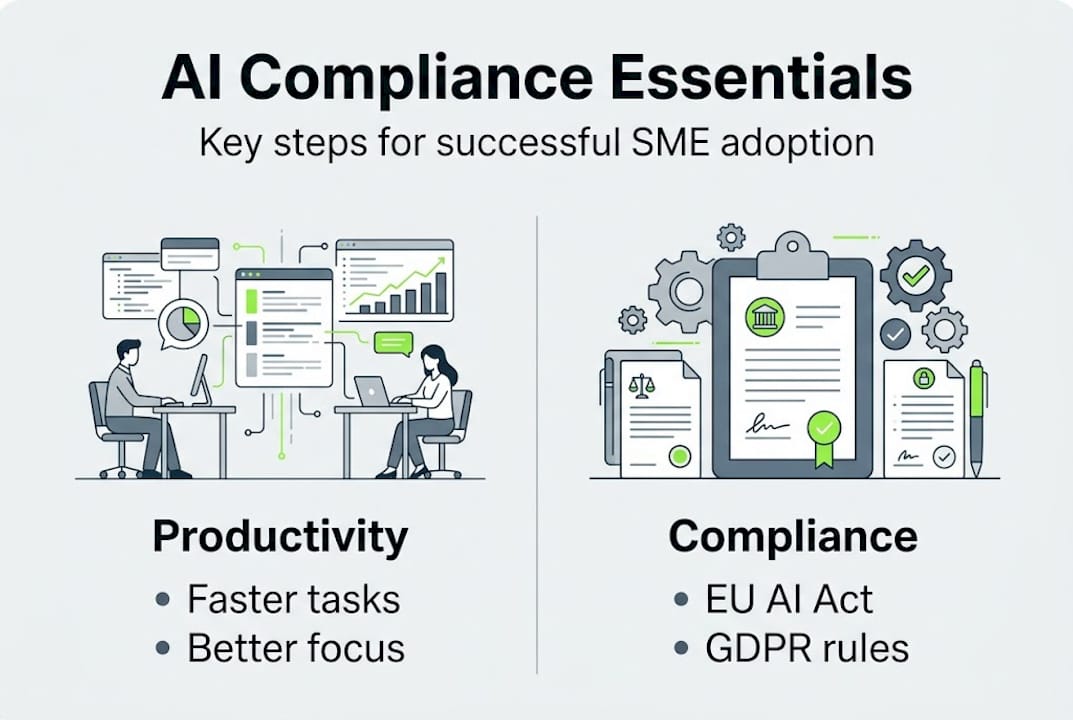
The Act classifies AI systems into four risk categories: unacceptable risk (banned outright), high risk (strict requirements), limited risk (transparency obligations), and minimal risk (largely unregulated). The reassuring reality is that most SME AI uses fall into the minimal or limited risk categories, meaning the compliance burden is manageable.
Key obligations for SMEs under the EU AI Act include:
- AI literacy (Article 4, effective February 2025): You must ensure that staff who use or oversee AI tools have a sufficient level of understanding of how those tools work and their limitations.
- Transparency requirements: For limited-risk AI systems, such as chatbots, users must be informed they are interacting with an AI.
- High-risk AI documentation (deadline August 2026): If you deploy AI in areas such as recruitment, credit scoring, or access to essential services, you must maintain risk management documentation and conduct conformity assessments.
- Regulatory sandbox access: SMEs receive priority access to EU regulatory sandboxes, which are controlled testing environments where you can trial AI solutions under regulatory supervision before full deployment.
“Fines under the EU AI Act are capped at €35 million or 7% of global turnover for the most serious violations, and €15 million or 3% for other infringements. SMEs benefit from proportionate enforcement and priority sandbox access, making early compliance a practical and strategic investment.”
For guidance on integrating these requirements with your existing data protection obligations, GDPR and AI for business is a useful resource, and the guide on using AI tools compliantly covers practical implementation steps.
Pro Tip: Before rolling out any AI tool company-wide, test it in a regulatory sandbox if one is available in your sector or country. This reduces both technical and compliance risk before you commit resources at scale.
GDPR and AI: Safeguarding data and building customer trust
Now that you have seen the essentials of AI legislation, it is worth focusing on data protection specifically, and how you can make GDPR and AI work together rather than against each other.
GDPR does not prohibit AI. What it does is set clear rules for how personal data must be handled, and those rules apply equally when AI is involved in the processing. GDPR requires a lawful basis for any processing of personal data, data minimisation, and a Data Protection Impact Assessment (DPIA) for high-risk AI activities. These are not optional extras. They are legal requirements that carry real consequences if ignored.
The core GDPR principles every SME should apply to AI include:
- Lawful basis: Identify and document your legal ground for processing personal data through AI tools, whether that is consent, legitimate interest, or contractual necessity.
- Data minimisation: Only feed AI systems the personal data they genuinely need to perform their function. Avoid sharing full customer records when a subset will do.
- Purpose limitation: Do not use data collected for one purpose to train or feed an AI system intended for a different function without a fresh legal basis.
- DPIA for high-risk processing: If your AI tool makes automated decisions that significantly affect individuals, a formal impact assessment is required before you begin.
- Vendor auditing: Before signing any contract with an AI provider, review their data processing agreements, sub-processor lists, and data residency policies.
The overlap between GDPR and the EU AI Act is significant. Both frameworks require transparency about automated processing, mechanisms to minimise bias, and clear accountability structures. Meeting one set of requirements often advances your compliance with the other.
For practical guidance on applying these principles to your marketing activities, AI marketing GDPR strategies and marketing automation for GDPR offer sector-specific advice.
Pro Tip: Before connecting any AI tool to your customer database, map exactly which fields of personal data will be shared and why. Document this decision. If you cannot justify each data point, do not include it.
Building a reputation for responsible data use is not just a compliance exercise. It is a commercial advantage. Customers in Europe are increasingly aware of their data rights, and businesses that handle data transparently earn measurably higher levels of trust and loyalty.
From pilot to profit: A practical roadmap for SME AI adoption
With a solid understanding of AI, compliance basics, and the benefits, here is how to build a pragmatic adoption roadmap that moves you from exploration to embedded business value.
The evidence is consistent: SMEs that start with low-risk use cases such as chatbots, AI-driven analytics, and process automation achieve efficiency gains of 15–50% and scale successfully from there. The key is a structured approach rather than ad hoc experimentation.
- Assess your needs and readiness. Audit your current processes to identify where time is lost, errors occur, or customer experience falls short. Map these against available AI solutions.
- Classify your AI use cases by risk. Before selecting any tool, determine whether it falls into minimal, limited, or high-risk categories under the EU AI Act. This shapes your compliance obligations from the outset.
- Select and pilot a low-risk tool. Start with a chatbot for customer queries, an AI writing assistant for marketing content, or an automated reporting tool. Run a 30 to 60 day pilot with clear success metrics.
- Document compliance from day one. Record your lawful basis under GDPR, your AI literacy training for staff, and any vendor due diligence. This documentation is both a legal requirement and a practical asset.
- Review, refine, and scale. After the pilot, measure outcomes against your baseline. If the results justify it, expand the tool’s scope or introduce a second use case using the same methodology.
- Invest in ongoing skills development. AI tools evolve rapidly. Build a habit of regular team training and stay informed about regulatory updates, particularly ahead of the August 2026 high-risk AI deadline.
For businesses that want expert guidance through this process, AI consulting for SMEs provides structured support from initial audit through to full implementation.
Pro Tip: Create a simple one-page compliance and ethics checklist for every AI tool you consider adopting. Include questions about data residency, sub-processors, transparency features, and bias testing. This takes 30 minutes and can save months of remediation work later.
What most SME owners miss: The real advantage of compliant AI adoption
Most conversations about AI regulation focus on burden: the paperwork, the deadlines, the risk of fines. That framing misses something important. For SMEs, regulatory compliance is not just a cost of doing business with AI. It is a genuine competitive advantage, if you approach it correctly.
Large enterprises face the same regulatory requirements, but they carry the weight of legacy systems, complex procurement processes, and slow internal decision-making. SMEs are structurally more agile. You can audit your AI tools, update your data practices, and retrain your team in weeks, not quarters. That speed is valuable.
SMEs that engage with regulatory sandboxes and invest in AI literacy early are consistently better positioned to build customer trust, attract privacy-conscious clients, and avoid the reputational damage that follows a compliance failure. The businesses that treat the EU AI Act as a checklist to be minimised will find themselves reactive and exposed. Those that treat it as a framework for building trustworthy AI will find it opens doors.
The same discipline that makes a business GDPR-compliant, clear data governance, documented processes, staff training, also makes its AI adoption more robust and its outcomes more reliable. Compliance and performance are not in tension. They reinforce each other.
For SMEs ready to move beyond reactive compliance and build a proactive AI strategy, AI success strategies outlines how to turn regulatory rigour into a market differentiator. The investment in skills and structure pays dividends well beyond avoiding fines.
How to move forward: Get expert support for AI success
Adopting AI in a way that is both effective and compliant is entirely achievable for SMEs, but it is considerably easier with the right partner alongside you.
At Done.lu, we work with small and medium-sized businesses across Luxembourg and Europe to design and implement AI solutions that are practical, proportionate, and built for compliance from the ground up. Whether you need help selecting the right tools, structuring your GDPR documentation, training your team, or deploying a private on-premise AI for a data-sensitive environment, our expert AI consulting service covers every stage of the journey. We also provide guidance on top AI tools for SMEs to help you invest wisely. Visit Done.lu to explore our services or get in touch for a no-obligation consultation. Your AI adoption journey can start today, and it does not have to be complicated.
Frequently asked questions
What is the biggest barrier for SMEs adopting AI in Europe?
The primary barrier is a combination of skills gaps and compliance uncertainty. 55% of SMEs lag larger firms in AI capability, and many owners feel unsure about navigating the EU AI Act and GDPR simultaneously. Structured guidance and phased adoption significantly reduce both obstacles.
How quickly can a typical SME see ROI from AI?
Many European SMEs see positive ROI within 12 months of adoption, with productivity gains of 15–50% reported across EMEA. Starting with high-frequency, low-complexity tasks accelerates the timeline considerably.
What are low-risk AI use cases for compliance-focused SMEs?
Most SME AI applications fall into the minimal or limited risk categories under the EU AI Act, including chatbots, marketing automation, and data analytics tools. Provided transparency obligations and data minimisation are followed, these are straightforward to deploy compliantly.
How do the EU AI Act and GDPR overlap for SMEs?
Both frameworks require transparency in automated processing, data minimisation, and clear accountability. GDPR adds lawful basis requirements and data subject rights on top of the AI Act’s risk management obligations, so a joined-up compliance approach is the most efficient path.
Where can SMEs test AI solutions and get compliance support?
EU regulatory sandboxes offer SMEs priority access and reduced fees to trial AI solutions in a supervised environment before full commercial deployment, making them an excellent starting point for compliance-conscious businesses.