
How to launch your e-commerce site: A step-by-step guide
March 31, 2026
Branding in the digital age: the SME growth driver
April 2, 2026AI is not the exclusive preserve of large corporations with deep pockets and dedicated data science teams. European SMEs are proving this point decisively, with AI adoption positively affecting SME revenue growth by more than 30% when implemented thoughtfully. Yet many business owners remain uncertain about where to begin, what AI actually involves in practice, and how to avoid costly mistakes. This guide cuts through the noise. You will find clear definitions, honest statistics, common pitfalls to sidestep, and a practical roadmap for adopting AI in a way that suits the real-world constraints of a small or medium-sized enterprise operating in Europe.
Table of Contents
- What are artificial intelligence contents for SMEs?
- How AI is transforming SME productivity and growth
- Common pitfalls and why most AI projects fail for SMEs
- Best practices for successful SME AI adoption
- Integrating AI into wider digital transformation
- Why starting small and focused beats grand AI ambitions
- Unlock more SME growth with tailored AI strategies
- Frequently asked questions
Key Takeaways
| Point | Details |
|---|---|
| Clear SME AI contents | AI contents include more than just tools—they cover data, procedures, and outputs shaped for SME operations. |
| Measurable performance gains | AI in SMEs leads to significant productivity and revenue improvements, especially when combined with IoT and BDA. |
| Strategy reduces failure | Success comes from starting small, focusing on data quality, and ensuring digital integration. |
| Integration is key | AI yields the greatest impact when embedded in wider digital transformation efforts, not as a standalone fix. |
What are artificial intelligence contents for SMEs?
When people talk about AI for business, they often picture futuristic robots or complex algorithms beyond their reach. In practice, AI for European SMEs is far more grounded. The term “artificial intelligence contents” refers to the full set of elements that make an AI system work: the data you feed it, the algorithms that process that data, the training materials used to teach the system, the operating procedures your team follows, and the outputs and reports the system generates.
This is an important distinction. Simply subscribing to an AI tool is not the same as having AI contents working for your business. A tool without quality data, clear objectives, and defined workflows will produce little of value. The contents are what give the tool its intelligence and relevance to your specific context.
Another critical insight is that AI rarely delivers its best results in isolation. Synergies with IoT and BDA (Internet of Things and Big Data Analytics) significantly amplify the benefits AI brings to SMEs. When your AI system can draw on real-time sensor data or rich customer datasets, its outputs become far more accurate and actionable.
Here is a quick comparison of common misconceptions versus reality:
| Misconception | Reality |
|---|---|
| AI is a plug-and-play solution | AI requires quality data and clear goals |
| Only large firms can afford AI | Cloud-based AI tools are accessible and affordable |
| AI replaces your team | AI augments your team’s capabilities |
| One AI tool solves everything | AI works best as part of a broader digital strategy |
The core components of AI contents for SMEs include:
- Data inputs: Customer records, sales figures, operational logs
- Algorithms: The rules and models that process your data
- Training materials: Examples and feedback that improve accuracy over time
- Operating procedures: How your team interacts with and acts on AI outputs
- Outputs and reporting: Dashboards, alerts, recommendations, and automated actions
Understanding these elements helps you ask the right questions before investing in any AI solution.
How AI is transforming SME productivity and growth
The evidence for AI’s impact on SME performance is growing steadily. AI adoption increases labour productivity by 4% in European firms, according to recent European Investment Bank research. That figure may sound modest, but across a team of twenty people, a 4% productivity gain is equivalent to gaining almost a full additional working day per week without hiring anyone new.

The revenue picture is even more striking. AI adoption results in over 30% revenue growth for SMEs, particularly when combined with IoT and Big Data Analytics. Start-ups and scale-ups tend to outpace more traditional firms in capturing these gains, largely because they are more willing to redesign processes around AI rather than simply bolting it onto existing workflows.
| Metric | Impact for SMEs |
|---|---|
| Labour productivity | +4% on average |
| Revenue growth (with IoT/BDA) | +30% or more |
| Customer response time | Significantly reduced via automation |
| Reporting accuracy | Improved through automated data processing |
Here are four concrete examples of AI contents delivering real operational value for SMEs right now:
- Customer service chatbots: Handle routine enquiries around the clock, freeing your team for complex issues
- Automated reporting: Generate weekly performance summaries without manual data gathering
- Predictive analytics: Forecast demand or identify at-risk customers before problems escalate
- Marketing personalisation: Tailor email campaigns and digital adverts based on individual behaviour patterns
Exploring the best AI tools for SMEs available in 2026 will help you match these use cases to practical, affordable solutions. The digital marketing AI benefits for European SMEs are particularly well-documented, making marketing automation one of the most accessible entry points for businesses new to AI.
Common pitfalls and why most AI projects fail for SMEs
The statistics on AI adoption are encouraging, but they come with an important caveat. 85 to 95% of AI pilots in Europe fail, largely due to poor data quality, lack of integration planning, weak key performance indicators (KPIs), and insufficient skills within the organisation. This is not a reason to avoid AI. It is a reason to approach it carefully.
The situation is particularly stark in Germany. 94% of German Mittelstand firms remain without any meaningful AI implementation, suggesting that hesitation and poor preparation are widespread even among well-resourced businesses.
“The gap between AI ambition and AI execution in European SMEs is not a technology problem. It is a data, skills, and strategy problem.”
The most common causes of AI project failure include:
- Poor or insufficient data: AI cannot learn from incomplete, inconsistent, or outdated records
- No integration planning: AI tools that cannot connect with your existing systems create silos rather than solutions
- Unclear goals: Launching AI without defined KPIs makes it impossible to measure success
- Lack of relevant skills: Teams without basic AI literacy struggle to act on outputs effectively
- Weak leadership buy-in: Without senior commitment, AI projects stall when they encounter early friction
Getting AI consulting for SMEs early in the process helps avoid these traps. Working with specialists who understand both the technology and the operational realities of smaller businesses makes a measurable difference. You can also explore AI tools for SME marketing as a lower-risk starting point.
Pro Tip: Before launching any AI project, conduct a simple data audit. List your key data sources, check for completeness and consistency, and identify gaps. If your data is not reliable, your AI outputs will not be either. Fix the data first.
Best practices for successful SME AI adoption
Knowing what can go wrong is only half the picture. The other half is knowing what works. Successful AI adoption in SMEs follows a recognisable pattern, and it is one you can replicate regardless of your sector or size.
Here is a proven step-by-step sequence:
- Assess your needs: Identify one or two specific business problems where AI could add clear value
- Audit your data: Confirm you have sufficient, reliable data to support the use case you have chosen
- Upskill your team: Invest in basic AI literacy training so your people can work confidently with new tools
- Choose a focused pilot: Start with a single, well-scoped project rather than a broad transformation initiative
- Track KPIs from day one: Define success metrics before you begin, and review them regularly
- Iterate and expand: Use lessons from your pilot to refine the approach before scaling
The easiest wins tend to come from automating repetitive tasks: scheduling, reporting, customer enquiry handling, and lead qualification. These are low-risk, high-visibility improvements that build confidence and momentum across your team.
Combining AI with IoT and BDA delivers outsized growth for innovative SMEs, so keep integration in mind even at the pilot stage. Staying informed about AI marketing trends 2026 will help you identify where to focus next. Understanding marketing automation with AI is also a practical next step for SMEs looking to generate more leads without increasing headcount.
Pro Tip: Before building any custom AI solution, explore existing cloud-based AI services from providers such as Microsoft, Google, or specialist SME platforms. These are often affordable, GDPR-compliant, and ready to deploy within days rather than months.
Integrating AI into wider digital transformation
AI delivers its greatest value not as a standalone tool but as a connected component within a broader digital ecosystem. When AI integrates with your workflow management tools, customer relationship management (CRM) platform, and analytics dashboards, the results compound over time.
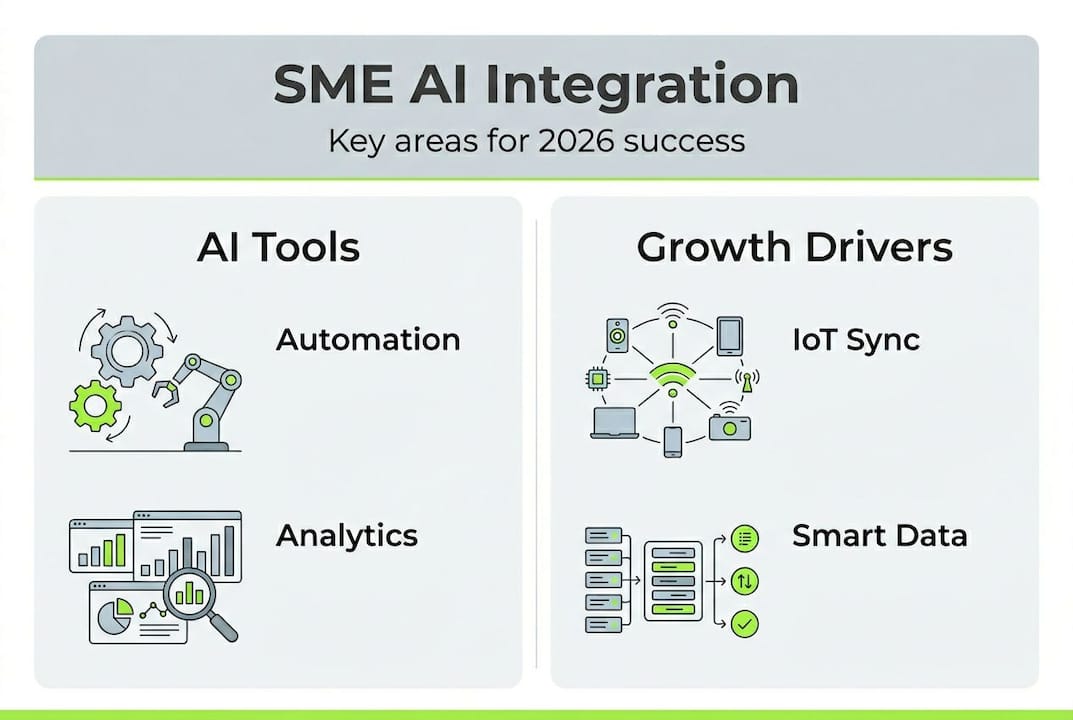
Synergies with digital tools and automation multiply SME results, which is why integration planning is so important from the outset. Think of AI as the intelligence layer sitting on top of your existing digital infrastructure, making every other system smarter and more responsive.
Practical integration examples for SMEs include:
- CRM with predictive analytics: Identify which leads are most likely to convert and prioritise sales outreach accordingly
- AI-driven marketing automation: Trigger personalised email sequences based on customer behaviour without manual intervention
- Smart resource scheduling: Use AI to optimise staff rotas, delivery routes, or production schedules based on demand forecasts
- Document processing: Automate invoice handling, contract review, or compliance checks using AI-powered document tools
- Customer communication tools: Deploy AI assistants that handle routine queries across email, chat, and social channels simultaneously
The concept of “digital transformation maturity” is useful here. SMEs at an early stage of digital maturity will benefit most from foundational integrations, such as connecting their CRM to a basic analytics platform. More digitally mature businesses can layer in advanced AI capabilities, such as real-time personalisation or predictive maintenance. Reviewing the SME digital marketing advantages available through integrated digital strategies will help you map out a realistic progression path.
Why starting small and focused beats grand AI ambitions
There is a pattern we see repeatedly when working with European SMEs on AI adoption. Businesses that set out to “transform everything at once” almost always struggle, while those that pick one clear problem and solve it well build genuine momentum.
The fear of missing out on AI is real and understandable. But chasing a sweeping digital transformation without the data, skills, or processes to support it leads to wasted investment and demoralised teams. A single well-executed AI pilot, such as automating lead qualification or deploying a customer service assistant, creates tangible results that justify the next step.
Sustainable digital change for SMEs is a series of practical improvements, not a single dramatic leap. Each successful pilot builds organisational confidence, improves data quality, and develops internal skills. Over time, these incremental gains compound into a genuinely competitive advantage. If you are ready to explore realistic AI consulting approaches that match your actual resources and ambitions, the path forward is clearer than you might think.
Unlock more SME growth with tailored AI strategies
Understanding AI contents and adoption best practices is a strong foundation, but putting it into practice is where many SMEs need support. Professional guidance significantly increases the likelihood of a successful outcome, particularly when navigating data readiness, tool selection, and GDPR compliance.
At Done.lu, we work with small and medium-sized businesses across Europe to design and implement AI strategies that fit their real-world constraints. Whether you are exploring AI consulting for digital transformation, looking for reliable AI tool recommendations for SMEs, or considering how web development for SME growth can support your digital ambitions, we offer transparent, practical guidance with no setup fees and a continuous improvement approach.
Frequently asked questions
Which AI contents are most useful for European SMEs?
Customer service bots, automated reporting tools, predictive analytics, and marketing automation are among the highest-impact AI contents for SME operations, delivering measurable gains in efficiency and customer engagement.
How much can AI increase productivity for SMEs?
AI adoption increases labour productivity by approximately 4% in European firms, and revenue growth of over 30% is achievable when AI is combined with complementary digital tools.
What is the biggest risk for SMEs starting with AI?
The biggest risk is launching without proper data preparation or integration planning, which is why 85 to 95% of AI pilots fail across Europe, making readiness assessment essential before committing resources.
How should SMEs get started with AI content?
Begin by identifying a specific business problem, audit your existing data for quality and completeness, upskill your team, and launch a focused pilot project before expanding to wider use cases.