

AI implementation in Luxembourg: a practical guide for SMBs
May 16, 2026
Local AI infrastructure: a practical guide for SMEs
May 18, 2026
TL;DR:
- Running AI tools in your business without a clear GDPR compliance plan exposes you to liability under European law. GDPR applies throughout the AI lifecycle, requiring documentation, transparency, data minimization, and human oversight at each stage, not just at deployment. Additionally, responsible AI use mandates thorough DPIAs, verified vendor agreements, and careful handling of automated decision-making, especially under Article 22.
Running AI tools in your business without a clear compliance plan is not a grey area under European law — it is a liability. GDPR AI compliance applies the moment personal data enters an AI system, whether you are using a customer service chatbot, a recruitment screening tool, or a cloud-based analytics platform. Many European SMEs either assume AI sits outside GDPR’s scope or believe the compliance burden is too heavy to manage without a dedicated legal team. Neither assumption is correct. This guide breaks down exactly what GDPR requires of AI systems, at every stage, in plain terms you can act on.
Table of Contents
- How GDPR applies throughout the AI lifecycle
- Automated decision-making and human oversight under GDPR Article 22
- Performing and maintaining data protection impact assessments (DPIAs) for AI
- Managing third-party AI tools: data processing agreements and risk controls
- AI model anonymity, lawful basis, and the EDPB’s Opinion 28/2024
- Why most GDPR AI compliance efforts miss the mark and how SMEs can do better
- Practical GDPR AI compliance support for European SMEs
- Frequently asked questions
Key Takeaways
| Point | Details |
|---|---|
| GDPR applies to AI lifecycle | GDPR governs all stages of AI use: data collection, training, deployment, and automated decisions. |
| Meaningful human oversight required | Automated decisions impacting individuals’ rights must have mechanisms for real human review. |
| DPIAs must be proactive and ongoing | Conduct impact assessments before AI deployment and update them regularly as risks change. |
| Verify AI vendor compliance | Use AI tools only with verified data processing agreements and clear roles under GDPR. |
| AI model anonymity requires proof | Cannot assume models trained on personal data are anonymous; evidence-based risk assessments are required. |
How GDPR applies throughout the AI lifecycle
The most important thing to understand about GDPR and AI is that the regulation does not treat an AI system as a single activity. GDPR applies across the AI lifecycle including data collection, training, deployment, and profiling, with separate lawful bases needed for each step. That means you cannot identify a single legal justification at the start and consider the job done.
Think about a customer churn prediction model. Collecting the training data is one processing activity. Training the model is another. Running it against live customer profiles is a third. Each of these phases carries its own GDPR obligations, and you need to document them separately. This is where many SMEs trip up early, particularly those relying on AI adoption guidance that focuses on capabilities without addressing compliance at each stage.
Here is what GDPR requires across the full AI lifecycle:
- Lawful basis documentation: Identify and record whether you rely on consent, contractual necessity, or legitimate interest for each processing stage, not just for the system overall.
- Privacy notices: Update your privacy information to describe AI-specific processing in plain language. Vague references to “data analysis” are insufficient.
- Records of Processing Activities (RoPA): Your Article 30 records must reflect AI processing, including data sources, recipients, retention periods, and international transfers.
- Data minimisation: Only collect and retain the personal data genuinely necessary for each AI function. AI systems have a tendency to benefit from larger datasets, but GDPR does not make exceptions for model performance.
- Purpose limitation: Data collected for one purpose, say, a customer support interaction, cannot simply be redirected to train a model for a different function without a fresh legal basis.
Reviewing your AI and GDPR obligations at the design stage, before deployment, is far more practical than unpicking compliance gaps after a system is live.
Pro Tip: Map each stage of your AI system to a distinct entry in your Records of Processing Activities. If you cannot articulate the lawful basis for a specific stage, that is a signal to pause before proceeding.
Automated decision-making and human oversight under GDPR Article 22
Article 22 is the part of GDPR that most directly governs AI decision-making, and it is frequently misunderstood. Article 22 grants data subjects the right not to be subject to automated decisions with legal or similarly significant effects without safeguards like human intervention and contestability.
The trigger for Article 22 is specific. It applies when three conditions are met: the decision is based solely on automated processing, it produces a legal effect (such as a loan refusal) or a similarly significant effect (such as being rejected from a job application), and there is no meaningful human involvement. All three conditions must be present. If a human genuinely reviews and can override the AI’s recommendation, Article 22 may not apply in the same way, but that human review must be substantive.
Common scenarios where Article 22 applies in SME contexts:
- Automated credit or loan assessments where an AI system approves or declines applications without human review.
- Recruitment screening tools that filter out candidates entirely based on algorithmic scoring, with no human seeing rejected profiles.
- Insurance eligibility decisions generated automatically without a case officer reviewing the individual’s circumstances.
- Dynamic pricing systems that determine individual contract terms based on profiling, with no human sign-off.
- Employee performance management tools that trigger disciplinary outcomes based solely on automated monitoring data.
If your AI system falls within Article 22, three exceptions exist. You must document which applies: contractual necessity (the decision is required to enter into or perform a contract), legal authorisation (EU or member state law explicitly permits it), or explicit consent (freely given, specific, and informed). Whichever exception you rely on, you must still implement appropriate safeguards.
Human intervention under Article 22 does not mean a human glances at the AI’s output and clicks approve. The reviewing person must have genuine authority to override the decision, access to the information on which it was based, and the time to consider it properly. Anything less does not satisfy the requirement.
Pro Tip: Document the human review process in writing. Describe who reviews which decisions, what information they can access, how they record their reasoning, and what the override mechanism is. This documentation protects you if a regulator asks whether your human oversight is genuine.
Understanding these obligations connects directly to wider AI productivity and compliance considerations that SMEs face when embedding AI into daily operations.
Performing and maintaining data protection impact assessments (DPIAs) for AI
A Data Protection Impact Assessment, or DPIA, is a structured process for identifying and managing privacy risks before a high-risk processing activity goes live. For AI systems, a DPIA is not optional where the processing is likely to pose a high risk to individuals’ rights and freedoms. AI processing often requires a DPIA because it poses high risk to rights and freedoms, and DPIAs must be done before deployment and updated when risks change.
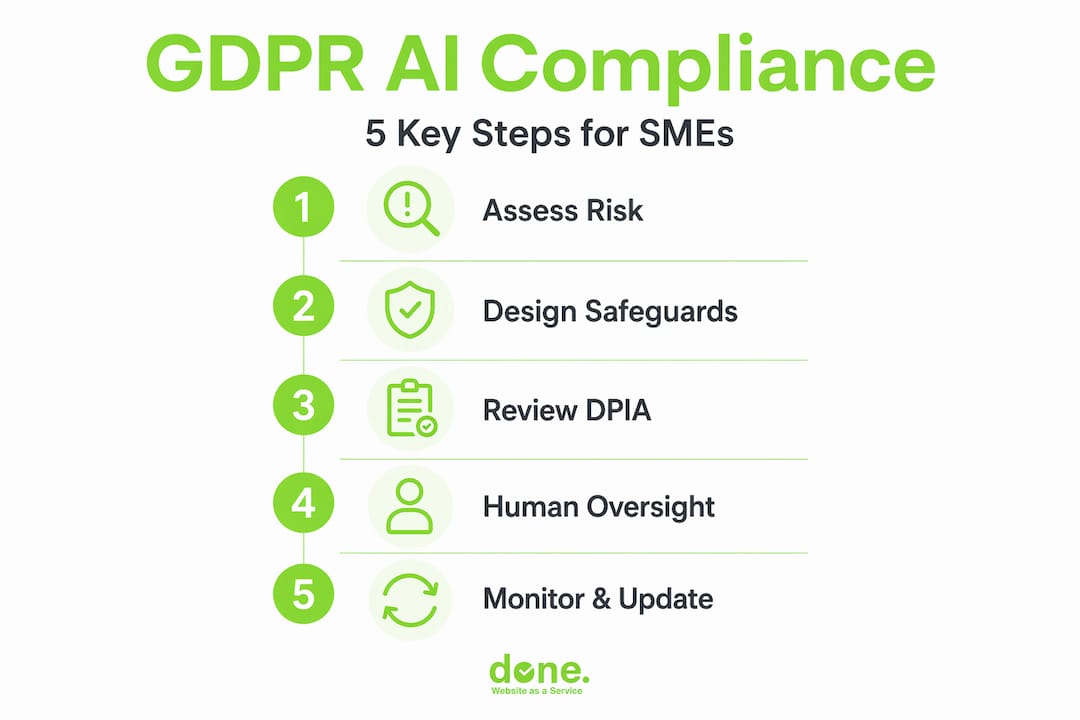
What counts as high risk in the AI context? Any AI system that involves automated decision-making at scale, processes special categories of data (health, biometric, financial), involves profiling, or uses new technologies where the privacy implications are not yet well understood will typically trigger the obligation.
Key areas your AI DPIA must address:
- Discrimination and bias risks: Does the model produce systematically different outcomes for protected groups? How was training data sourced, and does it reflect historical biases?
- Transparency and explainability: Can you explain to an individual, in plain language, how the AI reached a decision affecting them?
- Data provenance: Where did the training data originate? Was it collected lawfully, and can you demonstrate that?
- Unexpected behaviour: What happens if the model produces outputs outside its intended parameters? Is there a monitoring and response plan?
- Data retention and deletion: Can you delete an individual’s data from the system if they exercise their right to erasure?
The DPIA is not a one-time document. It is a living record, and you should revisit it whenever the model is retrained, when input data categories change, or when the regulatory environment shifts. Your Data Protection Officer (DPO) should be involved from the outset, not brought in at the end to sign off on a completed document. If, after conducting a DPIA, you cannot mitigate the identified risks sufficiently, you are required to consult your national supervisory authority before proceeding.
It is also worth noting that the EU AI Act introduces a parallel requirement, the Fundamental Rights Impact Assessment (FRIA), for high-risk AI systems. Whilst the FRIA and DPIA are distinct documents, they share significant overlap. Planning both together from the start is more efficient than treating them as separate exercises. Your AI security posture and your DPIA documentation will often draw on the same underlying risk analysis.
Pro Tip: Schedule DPIA reviews into your AI system’s maintenance calendar. A quarterly or bi-annual review, tied to your model’s retraining cycle, ensures the document reflects the system’s actual current behaviour rather than what it did at launch.
Managing third-party AI tools: data processing agreements and risk controls
When your team uses an external AI tool, whether it is a document summarisation service, a customer communication assistant, or a marketing automation platform, GDPR still applies to every piece of personal data that enters it. Using external AI tools that process personal data requires a GDPR-compliant Data Processing Agreement (DPA). Without it, processing is non-compliant under Article 28.

The challenge for SMEs is that many popular AI tools are operated by large international technology companies. The default terms of service offered by these providers are often written for their own interests, not yours. You, as the data controller, remain responsible for how personal data is processed, regardless of where that processing physically occurs.
Before allowing any third-party AI tool to process personal data in your organisation, confirm the following:
- Article 28 DPA in place: Does the provider offer a formal Data Processing Agreement that meets GDPR requirements? If they offer only general terms of service, that is a red flag.
- Data location and transfers: Where is data processed and stored? If it is outside the EEA, are Standard Contractual Clauses (SCCs) or another transfer mechanism in place?
- Sub-processor transparency: Does the provider publish a list of sub-processors and notify you of changes?
- Data retention policies: What does the provider do with your data after processing? Does prompt data get used to train their models? This matters significantly for AI tools.
- Security certifications: Does the provider hold ISO 27001 or equivalent certifications that you can review?
Beyond verifying individual tools, you should maintain an internal AI usage policy. This policy should specify which tools are approved for use, what categories of personal data may be entered into them, and what training employees must complete before using AI tools with customer or employee data. Without such a policy, individual employees may use free public AI tools with no DPA at all, creating violations your organisation is accountable for.
Pro Tip: Never enter special category data (health records, financial details, HR data) into any AI tool until you have reviewed and signed a compliant DPA with the provider. The risk-to-reward ratio simply does not favour convenience over compliance in these cases. Review your secure AI deployment practices before onboarding any new tool.
AI model anonymity, lawful basis, and the EDPB’s Opinion 28/2024
One of the most consequential recent developments in AI data protection is the European Data Protection Board’s Opinion 28/2024. It directly addresses a widespread assumption in the AI industry: that once a model has been trained, the personal data used to train it is no longer present, and the model is therefore anonymous.
The EDPB’s Opinion 28/2024 rejects automatic claims of AI model anonymity when trained on personal data, requiring evidence-based risk assessments and distinct lawful bases for training versus deployment. In other words, you cannot simply assert that your model is anonymous. You must demonstrate it, through documented testing and risk assessment.
This has practical implications for SMEs both building and deploying AI. Extracting personal data from a model, whether through direct prompting or more sophisticated extraction attacks, is a known risk. Supervisory authorities now expect organisations to test for this risk and document their findings.
The Opinion also reinforces that the legal basis used for training data does not automatically extend to deployment. These are treated as two distinct processing activities:
| Aspect | AI training phase | AI deployment phase |
|---|---|---|
| Processing purpose | Building model capabilities | Generating outputs from live data |
| Lawful basis required | Separate basis for training data use | New basis for inference and output generation |
| Data subject rights | Apply to training data sources | Apply to individuals affected by outputs |
| Transparency obligations | Data sources and training purposes | Decision logic and output consequences |
| Risk assessment | Bias, provenance, data leakage | Profiling, Article 22, downstream harm |
When deploying a third-party AI model, you also carry due diligence responsibilities. You need to verify, as far as possible, that the model was trained lawfully and that the provider can evidence this. Relying solely on a vendor’s assurance, without documentation, exposes you to regulatory risk if that training turns out to have been non-compliant.
Your AI and GDPR compliance approach should treat training and deployment as distinct projects with separate governance requirements, not as a single implementation.
Why most GDPR AI compliance efforts miss the mark and how SMEs can do better
After working with European SMEs on AI adoption and compliance, we have seen the same mistakes appear repeatedly. They are not born from carelessness. They come from a reasonable but flawed instinct: deal with the technology first and sort out the paperwork afterwards.
The first problem is timing. DPIAs and human oversight safeguards are often retrofitted post-deployment rather than integrated early, which creates serious compliance gaps. A DPIA conducted after a system has gone live is not a DPIA. It is a documentation exercise. The whole point of the assessment is to identify risks before they become operational realities. By the time a system is live, the decisions that could have reduced risk, choosing a different data source, adding a review layer, limiting output scope, have already been made.
The second problem is the nature of human oversight. Many businesses tick the Article 22 compliance box by designating a person to “review” AI decisions, but meaningful human review must be real and authoritative, not a rubber stamp. If the reviewing person has thirty seconds per decision, no access to the underlying data, and no record of their reasoning, that is not oversight. It is theatre. Building genuine oversight means investing in the process, the training, and the tools that make review substantive.
The third problem is vendor trust. Many teams rely on vendor claims of anonymity without documented, evidence-based assessments, which undermines compliance with EDPB Opinion 28. We see this constantly. A vendor provides a one-page document stating their AI model is “fully anonymised and GDPR-compliant.” The SME accepts this at face value, adds it to their compliance folder, and considers the matter closed. It is not closed. You need your own documented assessment, not just the vendor’s word.
What actually works is conducting a processing-path workshop before any AI project begins. Gather your relevant stakeholders, map every processing activity from data source to output, identify the lawful basis for each, flag the Article 22 and DPIA triggers, and assign ownership for each governance action. This takes a few hours. It saves months of remediation later. Managing AI compliance pitfalls in practice requires treating privacy as a design constraint from day one, not a layer to be added at the end.
Privacy and compliance integrated into AI procurement and design also means better AI. Systems built with clear data minimisation, purpose limitation, and transparency requirements tend to be more maintainable, more explainable, and more trusted by the people using them. That is not a compliance benefit. That is a business benefit.
Practical GDPR AI compliance support for European SMEs
Now you have the roadmap and know the pitfalls to avoid, expert support can make compliance genuinely manageable rather than a source of ongoing uncertainty.
At Done.lu, we work with European SMEs to implement AI solutions that are built for GDPR compliance from the ground up, not bolted on after the fact. We help you map your AI processing paths, identify lawful bases for each stage, conduct DPIAs, and design human-in-the-loop safeguards that meet Article 22 requirements in practice.

Our team handles vendor due diligence for third-party AI tools, reviews Data Processing Agreements, and helps you build an internal AI usage policy your teams will actually follow. We also provide GDPR-compliant automation for SMEs operating in data-sensitive sectors, including legal, finance, accounting, and healthcare. Whether you are evaluating your first AI tool or expanding an existing AI programme, we provide the practical, hands-on guidance that integrates data protection into your AI initiatives from day one.
Frequently asked questions
When does GDPR Article 22 apply to AI systems?
It applies when an AI system makes automated decisions with legal or similarly significant effects on individuals without meaningful human involvement. Article 22 applies if a decision is based solely on automated processing producing legal or significant effects, covering scenarios such as loan refusals, recruitment filtering, or insurance decisions.
Do I need a DPIA for all AI implementations?
Not for every AI use, but any AI processing that is likely to pose high risks to individuals’ rights requires one. AI processing often triggers DPIA obligations due to potential high risks, particularly where automated decisions or large-scale sensitive data processing are involved.
Can I rely on vendor claims that their AI model is anonymous?
No. You must conduct your own evidence-based assessment confirming there is a negligible risk of personal data being extracted or inferred from the model. Anonymity of AI models trained on personal data cannot be assumed without rigorous testing and documentation, per EDPB Opinion 28/2024.
What if employees use public AI tools without compliance checks?
Your organisation remains accountable for any personal data processed by employees using external tools, regardless of whether those tools were officially approved. Allowing employees to use external AI tools without policies or DPAs violates GDPR accountability principles, and enforcement risk falls on you as the data controller.
How often should I review my AI-related DPIA?
Review it whenever the AI system changes, is retrained, or the risk environment evolves. DPIAs must be living documents reviewed on model retraining, input changes, or legal updates, rather than filed once and forgotten.