

How to choose website as a service for Luxembourg SMBs
July 29, 2026
Why choose digital transformation: a practical guide for SMEs
July 31, 2026
TL;DR:
- Integrated marketing connects multiple channels into a unified customer experience, enhancing brand recognition and conversion efficiency.
- Most SMEs benefit from starting with aligned owned, earned, and paid channels, supported by consistent messaging and tracking.
Integrated marketing matters because it turns disconnected channels into a single, consistent customer experience, which directly improves conversion efficiency and builds brand equity over time. 84% of surveyed companies already use or plan to use an integrated marketing communications (IMC) approach, and the academic evidence is clear that IMC acts as a measurable capability that lifts both market presence and growth for SMEs. In Central Europe, where GDPR compliance and multilingual audiences add real complexity, a joined-up approach is not a luxury — it is the practical baseline for any campaign that needs to perform.
The short version:
- Brand consistency: every channel reinforces the same message, so audiences recognise and trust you faster.
- Campaign efficiency: aligned channels reduce duplicated spend and wasted ad budget when your website or sales process cannot fulfil the interest an ad creates.
- Clearer measurement: a single customer journey across touchpoints makes attribution far more tractable than siloed reporting ever can.
Table of Contents
- What is integrated marketing, and how does it differ from siloed marketing?
- What are the concrete benefits of integrated marketing for your business?
- Which channels and components should you integrate first?
- How do you build an integrated marketing plan step by step?
- How do you measure integrated marketing success?
- What are the most common pitfalls, and how do you fix them?
- What do Central European SMEs need to consider specifically?
- What timeline and budget should you expect as an SME?
- How Done implements integrated marketing for SMEs
- Key takeaways
- The case for starting small and staying joined up
- How Done can help you get started
- Further reading and sources used
What is integrated marketing, and how does it differ from siloed marketing?
Integrated marketing communications (IMC) is the practice of coordinating every channel, message, and creative asset so that a customer receives a coherent experience at every touchpoint, from the first social post to the final invoice. The Medill IMC programme at Northwestern University defines it as a strategic process that aligns all forms of communication and messaging to work together rather than independently.
Siloed marketing is the opposite: separate teams managing separate budgets, producing separate creative, with no shared brief. The result is a prospect who sees a promotional offer on LinkedIn, clicks through to a website that mentions something different, and receives a follow-up email with a third message entirely. Each channel may perform adequately on its own metrics, yet the cumulative effect is confusion rather than conversion.
A simple illustration: a Central European B2B company runs a trade-fair campaign in Vienna. The stand, the paid search ads, the landing page, and the follow-up email sequence all carry the same headline offer, the same visual identity, and the same UTM tracking. That is integrated marketing. The same company running the stand with one agency, the ads with another, and the email with an internal team that never saw the brief — that is siloed marketing.
The four C’s framework gives a practical checklist for evaluating any campaign:
- Coherence: do individual messages make sense together as a whole?
- Consistency: is the tone, visual identity, and core offer the same across channels?
- Continuity: does the message build over time rather than reset with each new campaign?
- Customer-centricity: is the sequence designed around how the customer actually moves, not around internal team structures?
What are the concrete benefits of integrated marketing for your business?
The commercial case for integration is well-supported. Research on SMEs shows that IMC dimensions correlate strongly with improved market and customer-related performance, making it a genuine capability investment rather than a cosmetic exercise.
Here are the core benefits, each tied to a practical business outcome:
- Brand consistency: repeated, aligned touchpoints build stronger brand recall. For SMEs competing against larger players, this compounds over time into a recognition advantage that paid media alone cannot buy.
- Improved conversion efficiency: when your ad creative and your website headline match, the prospect does not need to re-evaluate. We have seen this with clients where simply aligning the campaign offer with the landing page headline produced a measurable lift in form completions without any increase in ad spend.
- Reduced waste: if advertising drives interest that the website or sales process cannot fulfil, the entire campaign investment is wasted. Integration closes that gap.
- Broader audience reach: coordinated owned, earned, and paid channels extend reach without proportionally increasing budget, because each channel reinforces the others.
- Higher customer lifetime value: consistent, personalised communication builds trust and loyalty. Customers who receive relevant, coherent messages across channels disengage less and buy more often.
Pro Tip: Brand consistency across channels does more than look professional. Research on brand consistency and business growth shows it directly supports revenue growth by reducing the cognitive effort a buyer needs to trust you.
Which channels and components should you integrate first?
Integration does not mean using every channel simultaneously. For most SMEs, the practical starting point is a small set of well-connected assets rather than an ambitious multi-channel architecture built all at once.

Owned channels form the foundation: your website, email list, blog, and social media profiles. These are the assets you control entirely, so aligning them costs effort rather than budget. Your website is the hub; everything else should point back to it with a consistent message. A practical website creation checklist helps confirm that your owned asset is actually ready to receive campaign traffic before you spend on paid channels.
Earned channels include PR coverage, organic search rankings, reviews, and word-of-mouth referrals. These take longer to build but carry high credibility. Integrating them means ensuring your PR messaging and your SEO content share the same positioning, so a journalist’s mention and a Google search result tell the same story.
Paid channels — search ads, social ads, display, and sponsored content — amplify the message. They work best when the creative brief is drawn from the same document as the organic content strategy, not written separately by a media agency with no visibility of the brand guidelines.
Offline materials (events, print, direct mail, trade fairs) still matter in Central Europe, particularly in B2B sectors. The integration point here is simple: the same offer, the same visual, the same URL or QR code that feeds into the same tracking setup.
Supporting technology is what makes orchestration practical:
- A CMS that lets marketing update landing pages without a developer
- A CRM that captures lead source data from every channel
- A marketing automation platform that triggers follow-up sequences based on channel behaviour
- An analytics layer (Google Analytics 4 or equivalent) with consistent UTM tagging across all channels
- A shared content calendar and creative guidelines document accessible to every team or agency involved
For most SMEs, integrating the website, email, and one paid channel with a shared brief and consistent UTM tracking is enough to see a meaningful improvement. Add channels only when the core loop is working.
How do you build an integrated marketing plan step by step?
A phased approach prevents the most common failure mode: trying to integrate everything at once and ending up with a half-finished system that nobody trusts.
- Audit your current state (Week 1). List every active channel, who owns it, what message it carries, and whether it links back to a tracked landing page. Note where messages conflict or where there is no tracking at all.
- Define your core message and audience (Week 2–3). Write a single positioning statement: who you help, what problem you solve, and what makes you different. Every channel brief derives from this document.
- Build your channel plan (Week 3–4). Select three to five channels based on where your audience actually spends time. For most Central European B2B SMEs, this means website, LinkedIn, email, and either search ads or a trade-fair presence.
- Write a shared creative brief (Month 1). One document, shared with every team or agency involved. It covers the headline offer, key messages, visual guidelines, and the call to action. No channel goes live without it.
- Set up your tech and tracking (Month 1). Implement consistent UTM parameters, connect your CRM to your analytics, and configure your marketing workflow so leads are attributed to the correct source from day one.
- Run a pilot campaign (Month 2–3). Choose one campaign with a clear objective, a defined audience, and a short timeline. Measure it rigorously. This is your proof of concept.
- Review, iterate, and scale (Quarter 2 onwards). Use the pilot data to refine your channel mix, messaging, and automation sequences before committing larger budgets.
Pro Tip: The single most effective coordination trick we have seen with clients is a weekly 30-minute cross-channel sync. One person from each channel (or agency) reviews what went live that week and what is planned for the next. It catches message conflicts before they reach the audience, not after.
How do you measure integrated marketing success?
Measurement is where many SMEs either over-engineer (building a 40-metric dashboard nobody reads) or under-invest (tracking only last-click conversions and missing most of the story). The practical answer sits between those extremes.

Primary KPIs to track:
| Campaign stage | KPI | What movement tells you |
|---|---|---|
| Awareness | Reach and impressions | Whether your message is getting in front of the right audience |
| Engagement | Click-through rate, time on page | Whether the message is resonating once seen |
| Conversion | Conversion rate, cost per acquisition (CPA) | Whether the integrated journey is closing leads efficiently |
| Retention | Customer lifetime value (LTV), repeat purchase rate | Whether consistent post-sale communication is building loyalty |
Attribution basics for small teams: last-click attribution is the default in most analytics tools and is easy to read, but it systematically undervalues the channels that create awareness early in the journey. A simple improvement is to look at assisted conversions in Google Analytics 4, which shows you which channels appeared in the path before the final click. For most SMEs, this is enough to make better budget decisions without building a full multi-touch attribution model.
Pro Tip: Pick one metric to own in your first integrated campaign. For most SMEs, that is cost per qualified lead by channel. It is concrete, comparable across channels, and directly tied to revenue. Avoid optimising for reach or impressions alone in the early stages — they are easy to inflate and hard to connect to commercial outcomes.
What are the most common pitfalls, and how do you fix them?
Most integrated marketing projects do not fail because the strategy is wrong. They fail because of execution problems that were predictable from the start.
- Organisational silos: marketing, sales, and product teams each run their own communications with no shared brief. Fix: appoint one person as the integration owner, even if part-time. Their job is to ensure every channel team has seen the same positioning document before anything goes live.
- Inconsistent creative: the ad says one thing, the website says another. This is the single fastest way to destroy conversion efficiency. Fix: a shared creative brief and a mandatory review step before any new asset is published.
- Poor data hygiene: leads arrive in the CRM with no source attribution, or with inconsistent naming conventions that make reporting meaningless. Fix: agree on UTM naming conventions before the first campaign launches and enforce them with a simple shared spreadsheet.
- Wrong KPIs: measuring vanity metrics (total impressions, social followers) rather than commercial outcomes. Fix: tie every KPI to a business objective at the outset. If you cannot explain how a metric connects to revenue, drop it.
- Tech fragmentation: four different tools that do not talk to each other, producing four different versions of the truth. Fix: organisational coordination and data sharing are the most cited barriers to IMC adoption. Start with the minimum viable stack and integrate tools only when the manual process is genuinely breaking down.
Red flags that a campaign is failing early: conflicting headlines across channels, leads arriving with no source data, team members who cannot state the campaign’s core offer from memory, and a CPA that is rising week on week without a clear explanation.
What do Central European SMEs need to consider specifically?
Central Europe adds three layers of complexity that generic integrated marketing guides tend to ignore: GDPR, multilingual audiences, and vendor choices that affect data sovereignty.
GDPR compliance checklist for marketers:
- Obtain and log explicit consent before adding anyone to an email sequence or retargeting list.
- Confirm that every marketing tool you use (email platform, CRM, analytics) processes data on EU-based servers or under a valid data transfer mechanism.
- Document your data processors and review their Data Processing Agreements annually.
- Ensure your consent management platform (CMP) is correctly configured and that consent signals flow through to your ad platforms.
This is general guidance, not legal advice. Confirm your specific setup with a qualified data protection professional or your company’s Data Protection Officer.
Multilingual marketing in practice: Central Europe is not a single-language market. A campaign running across Luxembourg, Austria, the Czech Republic, and Poland needs at minimum German, French, Czech, and Polish variants. The practical approach is to translate the core creative brief first, then localise each channel asset from that brief rather than translating finished ads. Localisation means adapting cultural references and idioms, not just swapping words. A content marketing strategy built around a shared content calendar makes this manageable for a small team.
Vendor and hosting choices: for businesses in regulated sectors (legal, finance, healthcare), choosing tools that offer EU-based data hosting is not optional. Prioritise vendors with ISO 27001 certification and clear GDPR data processing agreements. Where possible, prefer tools with a local support presence in Central Europe.
Localisation checklist for multilingual campaigns:
- Core positioning statement translated and approved by a native speaker before any channel brief is written.
- Visual assets reviewed for cultural appropriateness in each target market.
- Landing pages in each language with matching URLs and hreflang tags.
- Consent flows tested in each language to confirm they display correctly.
- Analytics configured to segment traffic and conversions by language and market.
What timeline and budget should you expect as an SME?
Setting realistic expectations prevents the most common disappointment: a business that invests in integration, sees no results in the first six weeks, and concludes that it does not work.
| Phase | Timeline | Resource focus | Expected outcome |
|---|---|---|---|
| Audit and strategy | Weeks 1–4 | Internal time, possibly one external workshop | Clear positioning, channel plan, shared brief |
| Pilot campaign | Months 2–3 | Creative production, basic tech setup, small paid budget | First integrated data set, baseline CPA |
| Optimisation | Months 3–6 | Iteration on creative and channel mix, automation setup | Improved CPA, cleaner attribution |
| Scale | Months 6– | Increased budget, additional channels, team training | Compounding brand recognition, lower cost per lead |
Budget bands are better described in terms of resource focus than fixed currency amounts, because the ratio of internal time to external spend varies enormously by team size. A low-resource approach (one marketing manager, minimal external spend) concentrates on owned channels and email automation. A medium-resource approach adds a paid search or social budget and an external creative resource. A high-resource approach brings in a specialist agency for channel orchestration, automation build, and multilingual creative production.
The highest-return first investment for most SMEs is aligning the website with the campaign creative. Transforming your website to match campaign messaging costs less than most paid media budgets and immediately improves the conversion rate of every channel that points to it.
How Done implements integrated marketing for SMEs
Done has been working with SMEs across Luxembourg and Central Europe since 2014, with over 350 completed projects spanning web development, digital marketing, and AI-assisted automation. The pattern we see most often is a business that has invested in individual channels — a website, some ads, and an email tool — but has never connected them with a shared brief, consistent tracking, or a single view of the customer journey.
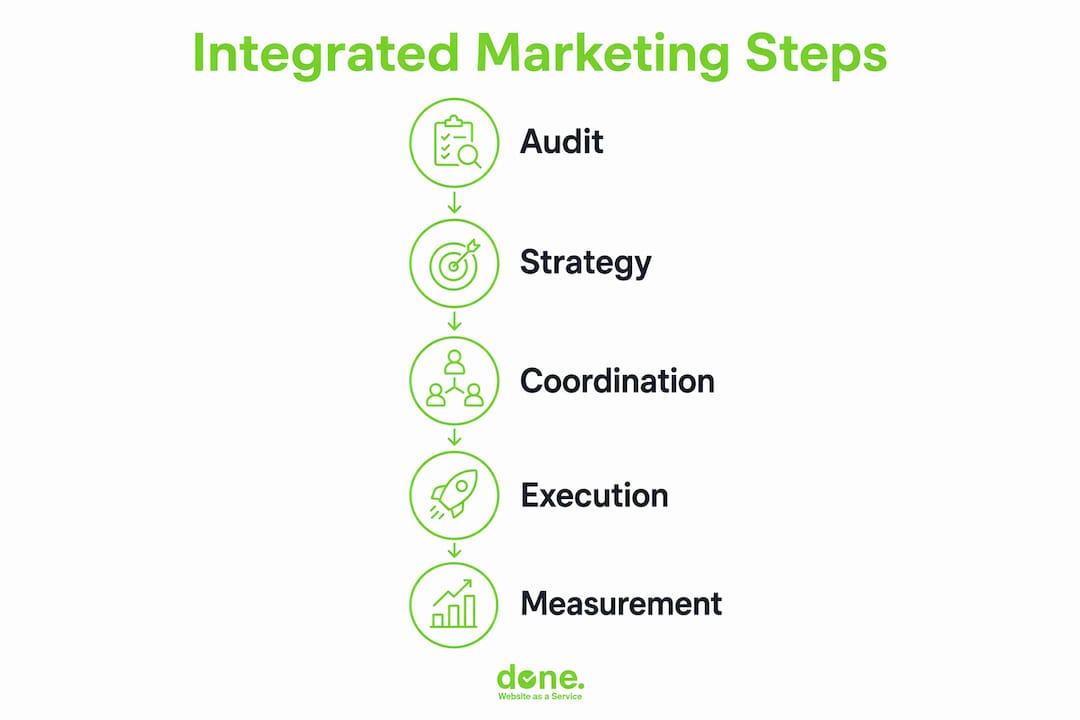
Our typical SME engagement follows five stages:
- Audit: we map every active channel, review the current messaging for consistency, and identify the biggest gaps between what the ad promises and what the website delivers.
- Messaging and positioning: we work with the client to produce a single positioning document that every channel brief derives from.
- Channel orchestration: we align the website, email automation, and paid channels around the same offer and tracking setup, using GDPR-compliant tools with EU-based data hosting.
- Measurement setup: we configure analytics and CRM attribution so the client has a clear view of cost per lead by channel from day one.
- Iterated scaling: we review performance monthly and adjust the channel mix and creative before recommending any budget increase.
What we deliver on a typical project:
- Website alignment with campaign creative and conversion path optimisation
- Marketing automation sequences triggered by channel behaviour
- UTM and CRM attribution setup
- Monthly reporting with commercial KPIs (not vanity metrics)
- GDPR-compliant consent and data processing configuration
- Multilingual asset production for Central European markets where required
Pro Tip: Start with the website and one automation. In our experience, the fastest path to a measurable integrated result is checking that your main campaign creative and your website headline say the same thing, then connecting a simple email follow-up to the form submission. That single loop, done well, outperforms a complex multi-channel setup done poorly.
Key takeaways
Integrated marketing works because aligned channels compound: each touchpoint reinforces the last, reducing the cost of conversion while building brand equity that paid media alone cannot replicate.
| Point | Details |
|---|---|
| Start with alignment, not scale | Match your campaign creative to your website headline before adding new channels or increasing budget. |
| Use the four C’s as your checklist | Coherence, consistency, continuity, and customer-centricity are the practical tests for any integrated campaign. |
| Track cost per qualified lead first | It is the most direct commercial KPI for an SME pilot and connects clearly to revenue without requiring complex attribution. |
| GDPR and language come before launch | In Central Europe, consent logging and multilingual localisation must be configured before any campaign goes live, not retrofitted afterwards. |
| Done offers a structured SME approach | Done’s audit-to-scale methodology connects web, automation, and paid channels with GDPR-compliant tracking from day one. |
The case for starting small and staying joined up
Most businesses I work with already have the ingredients for integrated marketing: a website, an email tool, and at least one paid channel. What they are missing is the connective tissue — a shared brief, consistent tracking, and someone whose job it is to check that the message is the same everywhere.
The temptation is to wait until you have a bigger budget or a larger team before attempting integration. That logic is backwards. A small, well-connected campaign with three aligned channels will consistently outperform a large, fragmented one with six disconnected ones. The omnichannel evidence is consistent on this point: consistency of experience matters more than volume of channels.
My practical recommendation is this: before your next campaign launches, check that the headline on your main landing page matches the headline in your ad. If it does not, fix that first. Everything else follows from that single discipline.
How Done can help you get started
Done is the practical alternative to running your marketing channels in isolation. Rather than managing a website agency, an ads agency, and an automation consultant separately, Done brings web development, marketing automation, and GDPR-compliant AI tools under one roof for SMEs in Luxembourg and Central Europe.
A first engagement typically starts with a short audit: we review your current channel setup, identify the biggest gaps between your campaign messaging and your owned assets, and produce a prioritised action plan with clear KPIs. There are no setup fees and no long-term subscription required to begin. For businesses in regulated sectors, we configure all tools with EU-based data hosting and full GDPR documentation from the outset.
If you are ready to connect your channels and measure what actually drives leads, get in touch with Done for a discovery conversation. We will tell you honestly what is worth fixing first.
Further reading and sources used
- What is integrated marketing communications? (Medill IMC, Northwestern University) — the authoritative academic definition of IMC and its strategic foundations.
- How integration is reshaping the future of marketing (Medill Spiegel) — explains how repeated, aligned touchpoints build brand equity across channels.
- From outreach to outcome: exploring the impact of IMC on SMEs (2024) — peer-reviewed study showing IMC’s measurable impact on SME market and customer performance.
- The integrated marketing communication (INDECS 2024 paper) — survey data showing that 84% of companies use or plan to use an integrated approach.
- Integrated marketing communications (Smart Insights) — practical overview of the four C’s framework for evaluating IMC quality.
- The ultimate guide to integrated marketing for SMBs (Pipedrive) — practitioner guide covering channel prioritisation, personalisation, and ecosystem-first approaches for small businesses.
- Why integrated marketing communications is essential for small businesses — explains the cost of misalignment between advertising and website or sales processes.
- Market orientation, IMC and SME performance (Butkouskaya et al., 2024) — academic analysis of organisational coordination and data sharing as the primary barriers to IMC adoption.
- Optimisation potential in SME marketing communication: Czech-German comparison — regional research on how Central European SMEs prioritise communication channels and where efficiency gains are available.