

2026 Lithuania Website Costs: When SMBs Should Pick Agency, WaaS, or DIY
September 12, 2026
What €150–€25,000 Buys: Workflow Automation Costs for Lithuanian SMEs
September 14, 2026
Most Lithuanian small businesses pay between €500 and €8,000 to launch an online shop, with a typical mid-range agency project landing around €2,000 to €5,000. The right route for most SMBs is a WooCommerce build on a standard agency package, unless you need multilingual B2B pricing or ERP integration, which pushes you into custom territory above €10,000. Whatever you spend upfront, budget separately for hosting, transaction fees, and at least one to three months of marketing on top.
TL;DR:
- Most Lithuanian small businesses spend between €2,000 and €5,000 on a standard WooCommerce online shop build, unless they require custom features like ERP integration or multilingual B2B pricing.
- Additional costs such as hosting, transaction fees, and marketing often surpass the initial build price within the first three years, significantly impacting long-term profitability.
- Integrations like courier services or ERP systems can add days or weeks to project timelines and increase the overall budget by thousands of euros.
- Freelancers are suitable for simple, low-cost projects under €1,500, while agencies are recommended for scopes involving multiple integrations or complex B2B features.
- To compare quotes effectively, owners should provide clear briefs specifying product count, integrations, languages, and timeline, requesting itemized prices for better scope management.
Table of Contents
- How much does e. parduotuvės kūrimo kaina really cost by tier?
- What actually drives up the price of an online shop?
- Three sample budgets for Lithuanian online shops
- What will your online shop really cost over three years?
- How do you brief an agency to get a comparable quote?
- What patterns actually show up in Lithuanian e-commerce projects?
- Freelancer or agency: which one actually saves you money?
- How does scope change your delivery timeline?
- What does ongoing support actually cost after launch?
- Our take: the number that matters isn’t the one everyone asks about
- How Done can help you plan an online shop that pays for itself
- Sources
- FAQ
How much does e. parduotuvės kūrimo kaina really cost by tier?
E. parduotuvės kūrimo kaina splits into three clear tiers, and knowing which one fits your business saves you from either overpaying for features you won’t use or underbuying and having to rebuild within a year.
Starter builds (€500–€2,000) typically use a pre-made Shopify theme or a basic WooCommerce install with minimal customisation. You get a working catalogue, one payment method, and maybe 20 to 50 products loaded. Fine for testing an idea, but expect to do your own product photography and copywriting.
Standard agency packages (€2,000–€8,000) cover custom design work, proper product data entry, one or two payment integrations, and basic SEO setup. This is where most established Lithuanian retailers land. A WooCommerce build in this bracket typically runs €2,000 to €5,000, while Shopify equivalents cost less upfront (often €500 to €3,000) but carry ongoing platform fees of €32 to €384 a month.
Custom builds (€10,000+) happen when you need ERP synchronisation, B2B pricing tiers, multi-warehouse stock logic, or bespoke checkout flows that no off-the-shelf plugin handles well. We’ve seen this with clients running wholesale alongside retail. It’s not a decision to take lightly, and it rarely pays off for a shop selling under a few hundred SKUs.
A few things push a project between tiers fast:
- Adding a courier integration (Omniva, LP Express) beyond the standard plugin
- Requiring Lithuanian, English, and Russian content from day one
- Needing a loyalty or subscription mechanism at launch
- Wanting a custom checkout instead of the platform default
Local survey data shows median project costs often sitting around €1,000, with common ranges between €500 and €2,800 for straightforward builds. That figure covers the build only, not what comes after.
What actually drives up the price of an online shop?
Platform choice sets your cost floor, but it’s the line items stacked on top that determine your final invoice. Understanding each one lets you cut what you don’t need and get quotes that are actually comparable.
Platform licensing and hosting. WooCommerce is free to install but needs paid hosting (typically €10 to €30 a month) and you own the maintenance burden. Shopify bundles hosting into its subscription, which is convenient but adds up: WooCommerce and PrestaShop tend to carry lower three-year costs than Shopify for comparable feature sets, mainly because Shopify’s monthly fee compounds over time.
Design and UX work. A templated design costs little; a fully custom homepage, category pages, and checkout flow can add €1,000 to €3,000 depending on complexity.
Product photography and data entry. Budget roughly €5 to €15 per product for basic photo editing and copywriting automation at catalog scale if you’re outsourcing it, more for lifestyle shoots. This scales fast for catalogues over 200 SKUs.

Integrations. ERP or accounting connections (common with Lithuanian accounting software) typically add €500 to €2,000 per integration depending on complexity.
Payments and couriers. Local gateways like Paysera and Montonio are the standard choice, and integration costs range from a few hundred euros to over €1,000 for custom setups.
Pro Tip: Ask your agency for a per-integration price breakdown before signing anything. Bundled quotes hide which features you’re actually paying for, and that makes it impossible to trim scope later.
Three sample budgets for Lithuanian online shops
Real numbers help more than ranges. Here are three scenarios that reflect what we typically see in the Lithuanian market.
-
Minimal launch (boutique, 50–100 products). WooCommerce theme and setup: €1,200. Payment gateway (Paysera): €300. Hosting for year one: €150. Product photography (DIY with basic editing): €400. First-year total: roughly €2,050, plus your own time.
-
Growth-ready shop (200–500 products, courier and accounting integration). Agency design and build: €4,500. Courier plugin (Omniva/LP Express): €600. Accounting software integration: €900. Professional product photography: €1,500. Initial marketing push: €1,200. First-year total: around €8,700.
-
Custom B2B/enterprise (1,000+ SKUs, ERP sync, tiered pricing). Custom development: €14,000. ERP integration and price list logic: €3,500. Multilingual content (Lithuanian, English, Russian): €2,000. Extended testing and launch support: €1,500. Total before year-one marketing: around €21,000.
These mirror patterns from real Lithuanian projects, where initial technical builds around €2,800 often reach €6,330 in first-year total spend once photography, copy, and integrations are added. The build quote is rarely the whole story.
What will your online shop really cost over three years?
The build price is the smallest number you’ll deal with over time. Recurring costs, not the launch invoice, decide whether your e-shop is profitable by year two.
Budget for these every year, without exception:
- Hosting or platform subscription (€120–€4,600 depending on platform)
- Plugin and extension licence renewals
- Payment transaction fees (typically 1% to 3% per transaction)
- Security certificates and GDPR compliance updates
- Ongoing maintenance and bug fixes
A worked example: a WooCommerce shop might cost €2,400 total over three years including hosting and plugin renewals, while a comparable Shopify setup can reach €18,864 over the same period once monthly platform fees are compounded. That gap is the single biggest reason SaaS platforms suit fast launches better than long-term cost control.
The number that matters: transaction fees scale with revenue, so the platform that looks cheapest at launch isn’t always cheapest at €50,000 in annual turnover.
How do you brief an agency to get a comparable quote?
Vague briefs produce vague quotes, and vague quotes are impossible to compare. Before you contact anyone, write down these fields.
Must-have brief details:
- Exact product count and expected SKU growth over 12 months
- Expected monthly order volume
- Required payment methods and courier integrations
- Languages needed at launch (and later)
- Whether you need B2B features (tiered pricing, quote requests, net terms)
Questions to ask every agency:
- What happens after launch? Is support included, and for how long?
- Who owns the code and the customer data if we part ways?
- What’s the response time (SLA) on critical fixes versus minor ones?
- How many hours of CMS training are included for our team?
Watch for contracts with no phased delivery. A project split into discovery, design, build, and launch milestones, each with its own payment, gives you leverage if something’s not working. A single lump-sum invoice gives you none.
Pro Tip: Ask for a fixed price on the “must-have” scope and a separate estimate for “nice-to-have” extras. This stops feature creep from quietly doubling your final bill.
What patterns actually show up in Lithuanian e-commerce projects?
Most Lithuanian SMBs we’ve spoken with default to WooCommerce when they have any in-house technical support, and Shopify when they want to launch fast with zero maintenance overhead. Both are reasonable choices; the mistake is picking based on brand recognition rather than who’s maintaining the site in year two.
A typical timeline runs four stages: discovery and scoping (one to two weeks), design and build (two to six weeks depending on integrations), launch and testing (one week), then a few weeks of post-launch optimisation.
The build survives the first six months on catalogue quality and payment reliability. It survives the following two years on how well someone keeps optimising it, not on how it looked at launch.
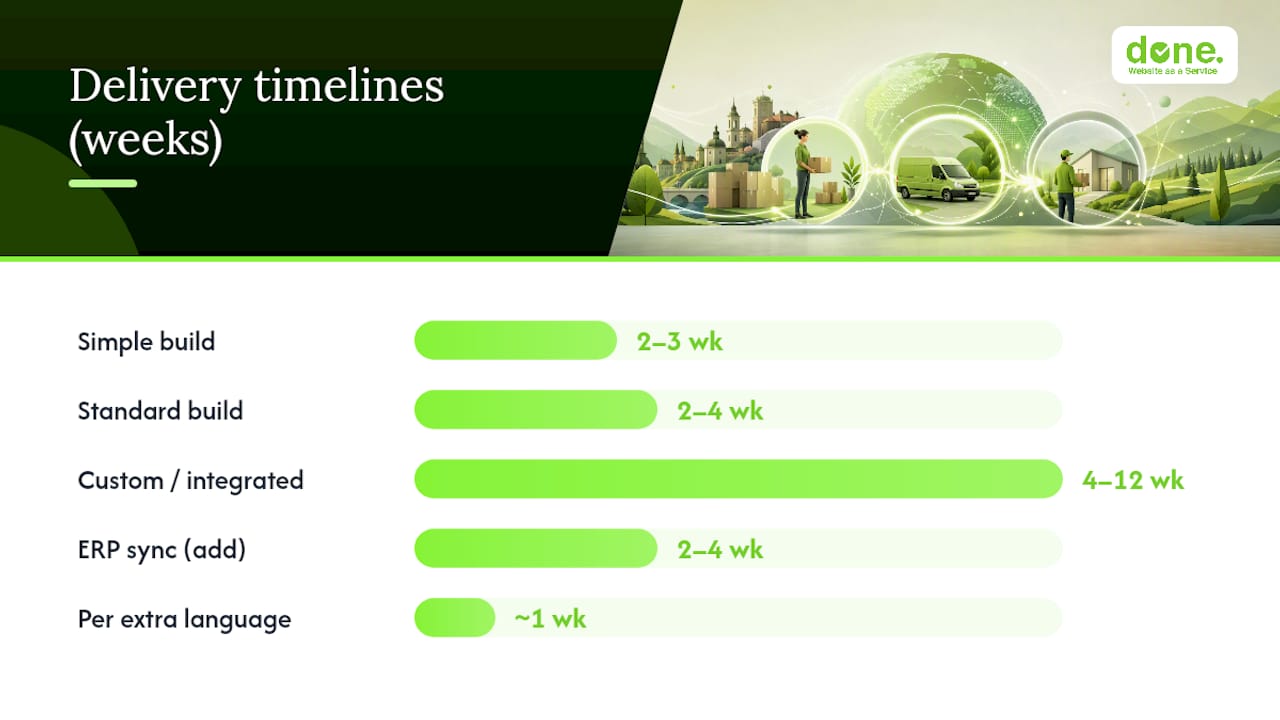
Timelines shift fast once integrations enter the picture: simple builds typically take two to three weeks, while custom or heavily integrated projects run four to twelve weeks.
Freelancer or agency: which one actually saves you money?
The trade-off shows up later, not at signing.
A freelancer typically handles the build alone, which means slower turnaround when you need three things fixed at once, and no backup if they become unavailable mid-project. Agencies spread the work across a designer, developer, and project manager, which costs more per hour but compresses the timeline and reduces the risk of a stalled project.
Where freelancers genuinely win: small, well-defined builds with a clear brief and no integrations. If you know exactly what you want and can describe it in a page, a freelancer can deliver it cheaper and often just as well.
Where agencies earn their premium: anything involving multiple integrations, GDPR-sensitive data handling, or B2B features. These projects need coordinated testing across payment, courier, and accounting systems simultaneously, and a solo freelancer juggling that alone is where projects quietly slip by weeks.
Post-launch support is the real differentiator most owners miss. A freelancer’s availability after delivery is often informal, dependent on their current workload elsewhere. An agency generally has a support structure and a named point of contact, even if that costs more monthly.
Our take, based on what we’ve seen across dozens of Lithuanian and Luxembourg projects: freelancers suit a €500 to €1,500 starter build. Anything above €2,000 in scope, or anything touching payment integrations and customer data, benefits from an agency’s structured process, even at a higher price point.
How does scope change your delivery timeline?
A standard e-shop build takes two to four weeks from kickoff to launch when the scope is fixed and the brief is clear. Every variable you add extends that window, sometimes disproportionately to the actual work involved.
Product catalogue size barely moves the timeline if data is supplied in a clean spreadsheet. It moves considerably if photography and copywriting happen during the build, because that work runs in parallel with development but still gates the launch date.
Integrations are the biggest timeline risk. A single courier plugin adds days. An ERP sync with a Lithuanian accounting platform can add two to four weeks, mostly spent on testing edge cases (stock going negative, price list conflicts, tax rate mismatches) rather than the integration code itself.
Multilingual content adds roughly a week per additional language if translation is handled externally, longer if it’s done in-house alongside other tasks.
The realistic range across the market: two to three weeks for simple builds, four to twelve weeks for custom or heavily integrated projects. Anyone quoting a five-figure custom build in under three weeks is either underscoping the testing phase or overselling the timeline. Ask specifically what’s included in “testing” before you accept a fast delivery date; skipped testing shows up as bugs in your first month of live sales, which costs you far more than the extra week would have.
What does ongoing support actually cost after launch?
Launch day is not the finish line, and most first-time e-shop owners underestimate what comes next. Post-launch support typically falls into a monthly retainer, ranging from roughly €100 for basic monitoring and small fixes to €500 or more for active optimisation, content updates, and priority bug response.
What that retainer should cover, at minimum: security updates, plugin compatibility checks, backup verification, and a guaranteed response time for anything that breaks checkout or payments. Without this, a single broken plugin update can take your shop offline for days while you scramble to find someone available to fix it.
Beyond basic maintenance, ongoing optimisation work (testing checkout flows, improving page speed, refining product pages) is what actually moves revenue after the first few months. This is separate from maintenance and usually billed separately, either as a retainer or project-by-project.
A rough rule that holds across most projects we’ve reviewed: budget 10% to 15% of your initial build cost annually for maintenance and support, and treat any agency that offers “free lifetime support” with scepticism. Someone is paying for that time somewhere, usually through inflated hourly rates on any future change request.
Our take: the number that matters isn’t the one everyone asks about
Most guides to e. parduotuvės kūrimo kaina fixate on the build price, and that’s the wrong obsession. The build is a one-time cost. What determines whether your shop is still profitable in year two is the recurring line: hosting, transaction fees, and whether you budgeted for marketing at all.
Conventional advice treats platform choice as the biggest decision. In our experience, it’s the third biggest, behind having clean product data ready before the build starts and having a realistic post-launch budget set aside. We’ve seen well-built shops fail commercially because the owner spent everything on development and had nothing left for the first three months of driving traffic to it.
If you take one thing from this: get three quotes using the exact same brief (product count, integrations, languages, timeline), and ask each agency to itemise the price. The variance you see tells you more about what you’re actually buying than any single number in this guide.
— Thomas
How Done can help you plan an online shop that pays for itself
There are other routes to launching an online shop in Lithuania: a freelancer for a simple catalogue, a DIY Shopify setup, or a large agency retainer. Some agencies take an approach as a website-as-a-service partner: offering a fully responsive e-shop built and maintained under one monthly subscription, sometimes with no setup fees and no long contract if your needs change.
That model matters most for SMBs who don’t want to choose between “cheap now” and “expensive later.” Done’s web development work covers WooCommerce and custom builds alike, and because we handle marketing automation and GDPR-aware AI tools under the same roof, your product content, customer service, and SEO don’t end up scattered across three different vendors. If B2B pricing tiers or ERP sync are part of your plan, our custom development approach is built for exactly that complexity.
The next step is straightforward: request a tailored estimate based on your product count, integrations, and timeline, and we’ll tell you honestly which tier fits your business, not the one that’s easiest to sell you.
Sources
FAQ
How much does a basic online shop cost in Lithuania?
A basic starter build typically costs between €500 and €2,000, covering a template design, one payment method, and a limited product catalogue.
Is WooCommerce or Shopify cheaper long-term?
WooCommerce and PrestaShop generally carry lower three-year costs than Shopify, since Shopify’s platform fees compound monthly while self-hosted platforms mainly cost hosting and occasional plugin renewals.
How long does it take to build an online shop?
Standard builds take two to four weeks, while custom projects with ERP or multiple integrations can run four to twelve weeks.
Should I hire a freelancer or an agency?
Freelancers suit simple builds under €1,500 with no integrations; agencies are worth the premium once payment, courier, or ERP integrations enter the scope, largely due to coordinated testing and structured post-launch support.
What ongoing costs should I budget after launch?
Budget for hosting or platform subscription fees, transaction fees on payments, plugin renewals, and roughly 10% to 15% of your build cost annually for maintenance and support.
Does Done offer online shop development in this price range?
Yes. Done’s e-commerce development work covers both WooCommerce and custom builds, delivered under a website-as-a-service subscription with no setup fees.