

Pilot in 4 to 8 Weeks: Private LLM for Luxembourg SMEs, RAG First
September 15, 2026
Prepare for EHDS 2031: Two AI Deployment Paths for EU Patient Data
September 17, 2026Skaidri agentūros kainodara means three things in practice: the invoice separates media spend from management fees, the pricing follows one clearly named model, and the monthly range sits within published market benchmarks rather than a vague “it depends” quote. If a proposal fails any of these three, treat it as a red flag, not a negotiating detail. The rest of this guide breaks down the models, the actual monthly numbers, what should be included, and the checklist worth insisting on before you sign anything.
TL;DR:
- Agencies that combine media spend and management fees in one line impede transparency, making it difficult to judge whether costs are fair and justified.
- Small agencies typically charge between €300 and €900 monthly for single services, while large full-service firms start from €3,000, with costs rising sharply for multi-channel packages.
- The most common and reliable pricing models are fixed monthly fees, hourly rates, or hybrid arrangements, with percentage-of-spend models often creating incentives to increase ad budgets.
- A standard monthly retainer generally covers campaign optimization, reporting, and basic creative work, but excludes video production, website changes, technical fixes, and third-party tools unless specified.
- Prioritize proposals that clearly separate media spend from management fees, include specific KPIs, ownership rights, reporting frequency, and exit clauses to avoid hidden costs and contractual surprises.
Table of Contents
- Kiek kainuoja agentūros paslaugos: rinkos kainų diapazonai
- Which pricing model actually fits your business?
- What’s included in the monthly fee, and what costs extra?
- How to compare proposals: the checklist that protects you
- How Done approaches pricing on client proposals
- What should you actually check before comparing proposals?
- What contract terms change your total cost?
- Three pricing scenarios, worked through
- What matters more than the number on the quote
- Want a proposal you can actually compare?
- Sources
- FAQ
Kiek kainuoja agentūros paslaugos: rinkos kainų diapazonai
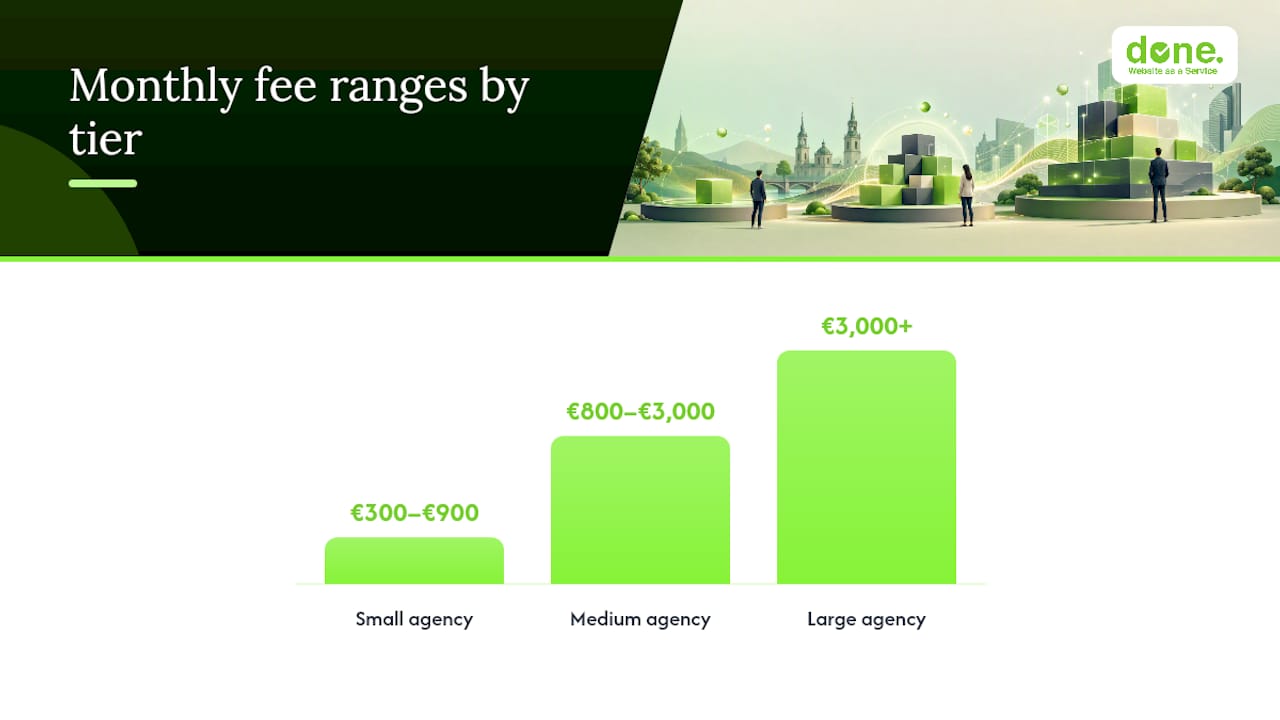
Agency pricing in Lithuania splits roughly into three tiers, and each one behaves differently.
Mažos agentūros ir laisvai samdomi specialistai dažniausiai taiko valandinį mokestį arba mėnesinius mokesčius, kurie prasideda nuo pagrindinių paslaugų lygio. Ranges for social media management commonly run €350 to €900 per month, and PPC management at this tier tends to sit at €300 to €800 monthly, usually for a single channel and a modest media budget.
Vidutinio dydžio agentūros dažnai imasi platesnio spektro paslaugų ir taiko atitinkamus mokesčius. Jų kainos už PPC valdymą ir SEO gali ženkliai skirtis, o kai kurios naudoja procentinį mokestį nuo reklamos išlaidų, kuris priklauso nuo platformos ir kūrybinio darbo apimties.
Large, full-service agencies quote from €3,000 upward for comprehensive packages covering strategy, multiple channels, and dedicated account teams. Project fees and creative production costs rise sharply here, since you’re paying for senior strategists and in-house production, not just a media buyer.
A useful worked example: a starter PPC configuration might budget around €600 per month in media spend to generate roughly 30 enquiries, assuming a cost per enquiry near €20. Add a management fee on top, and the total monthly cost depends entirely on which pricing model the agency applies to that management portion.
Quick reference by tier:
- Small agency: €300 to €900/month per service, or €40 to €120/hour
- Medium agency: €800 to €3,000/month per service, sometimes 7 to 25% of ad spend
- Large agency: €3,000+/month for bundled, multi-channel packages
If you want a deeper look at how media budgets scale specifically for Google Ads, our Google Ads pricing guide for Lithuanian SMEs breaks that down further.
Which pricing model actually fits your business?
Five models dominate the Lithuanian market, and each shifts risk differently between you and the agency.
- Valandinis mokestis: mokate už dirbtas valandas, dažnai priklausomai nuo paslaugos sudėtingumo.
- Mėnesinis fiksuotas mokestis: stabilus biudžetas, tačiau reikia aiškiai žinoti, kas įtraukiama.
- Procentas nuo reklamos biudžeto: dažnai priklauso nuo biudžeto dydžio ir gali skatinti didinti išlaidas vietoje efektyvumo.
- Project fee. A fixed price for a defined deliverable, such as a new website or a campaign launch. Works well when scope is genuinely fixed.
- Hybrid. A smaller base fee plus a performance component. This tends to align incentives better than pure percentage models while keeping your budget somewhat predictable.
Hidden costs usually creep in through vague “optimisation” line items or undefined “extra hours” clauses. Ask for the exact hourly rate that applies beyond the agreed scope.
Pro Tip: Ask any agency to name their model in one sentence. If they can’t, or if they blend two models without separating the numbers, you’re looking at a proposal designed to obscure cost, not clarify it.
What’s included in the monthly fee, and what costs extra?
A standard monthly retainer usually covers campaign optimisation, reporting, a set number of strategy meetings, and basic creative adjustments (copy tweaks, minor image edits). That’s the baseline you should expect for any fee above roughly €300 a month.
What it typically does not cover:
- Video production or professional photography
- New landing page builds or website changes
- Technical fixes (tracking setup, tag configuration, site speed issues)
- Analytics or CRM setup beyond basic reporting
- Third-party tool licences (heat mapping, A/B testing software, premium reporting dashboards)
None of these extras are unreasonable to charge for. The problem is when they appear on the invoice without being flagged in advance. Ask suppliers for a line-item proposal that names each deliverable, its cost, and whether it recurs monthly or is one-off. A one-page breakdown takes an agency ten minutes to produce and tells you more than any sales call. If landing page performance is part of the conversation, our conversion optimisation guide covers where that spend tends to pay off.
How to compare proposals: the checklist that protects you
Before signing anything, insist on answers to these contract points. Vague answers here matter more than the headline price.
- Ad account ownership. The account should be registered in your business’s name, not the agency’s. If they resist, they may be reselling access through their own account, which limits your control if you switch suppliers.
- Reporting cadence and KPI definitions. Get it in writing: what’s reported, how often, and what counts as success. “Engagement” means nothing without a number attached.
- Media versus management split. The invoice should show media spend and management fee as two separate lines, always.
- Data access and exit terms. Can you export your data on day one of leaving? Is there a transition period, and does it cost extra?
- Overtime and extra-hours policy. What happens the moment you exceed the agreed scope, and at what rate?
The single most revealing test isn’t a long price list. It’s three short questions: who pays the media directly, who legally owns the account, and what exactly gets measured after three months. Agencies that hesitate on any of these are usually hiding a margin somewhere.
Pro Tip: If an agency refuses to separate media spend from management fees, it often means they’re buying media through a resold account and adding an invisible commission. Insist media is billed directly to you, with the agency invoicing management separately.
How Done approaches pricing on client proposals
We’ve built over 350 client projects since 2014, and the pricing complaint we hear most often isn’t about the number. It’s about not knowing what the number buys.
Our approach on every proposal:
- No setup fees hidden in month one
- Media spend and management fee always shown as separate lines
- Proposals built around growth-driven design principles, meaning scope adjusts as results come in rather than locking you into a rigid package for twelve months
- GDPR-compliant handling on any AI or automation component, which matters if you’re in finance, legal, or healthcare
A short sample proposal, at a high level, typically shows: a fixed monthly management fee, an agreed media budget range with your name on the ad account, a reporting cadence (usually monthly), and named KPIs tied to your actual business goals rather than vanity metrics like impressions.
What should you actually check before comparing proposals?
Reporting frequency is the first thing to pin down. Monthly reporting is standard; anything less frequent makes it hard to catch problems early, and anything promised as “real time” often means a dashboard nobody explains to you.
Deliverables need to be named, not implied. “Social media management” could mean three posts a week or daily content plus community replies. Get the exact scope in writing before comparing two quotes side by side, because two agencies quoting €800/month might be offering completely different amounts of work.
KPIs should be specific and tied to your business, not generic platform metrics. A proposal that promises “increased visibility” without defining what that means in numbers isn’t offering a guarantee, it’s offering a hope.
Ownership, as covered above, extends beyond ad accounts. Ask who owns the creative assets, the website code if one is built, and any customer data collected through forms or automation tools.
Notice periods matter more than most business owners realise upfront. A 30-day notice period is standard and fair. Anything requiring 90 days or more should come with a clear justification, usually tied to a long-term campaign that genuinely needs time to show results.
Guarantees are rare and should be treated with suspicion when offered without qualification. No honest agency guarantees a specific number of leads or a fixed return on ad spend, because too many variables sit outside their control. What a credible agency can guarantee is transparency: clear reporting, defined KPIs, and no surprise line items.
What contract terms change your total cost?
Minimum commitment periods are the clause most business owners skip past, and the one that costs them the most later. A three-month minimum is reasonable for testing a channel. Twelve-month minimums are common for SEO, since results take longer to show, but they should come with a clear review point at month three or four to assess early signals.
Cancellation policies vary widely. Some agencies require 30 days’ written notice; others quietly extend to 60 or 90 days inside the fine print. Read this clause specifically, not just the headline retainer amount, because an unfavourable notice period effectively locks in extra months of fees even after you’ve decided to leave.
Fee adjustment clauses deserve equal attention. Many contracts include a right to raise fees annually, sometimes tied to inflation, sometimes left open to the agency’s discretion. Ask for a percentage cap in writing rather than accepting an undefined “subject to review” line.
Media spend increases are a separate issue from management fee increases, and contracts should treat them separately. If your campaigns scale and media spend doubles, a percentage-of-spend management fee doubles with it automatically, which is worth modelling out before you sign, not after your second invoice arrives. As one Lithuanian business analysis puts it, the real comparison isn’t the lowest monthly fee but the full investment across media, creative, and internal time required to manage the relationship.
Three pricing scenarios, worked through
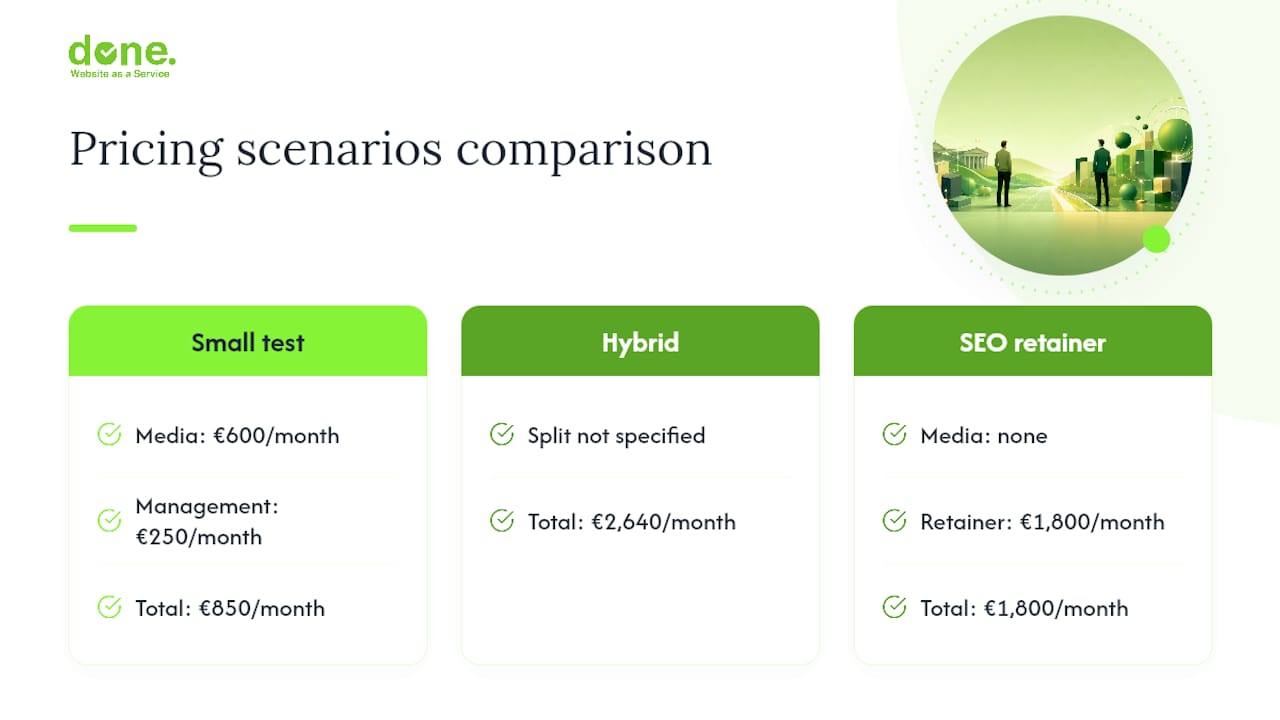
Scenario one: a small retailer testing PPC. Media budget of €600/month, management on a flat retainer of €250/month. Total monthly cost: €850. This suits a business testing whether paid search converts before committing to a bigger spend.
Total: €2,640/month. Here the hybrid structure keeps the agency motivated to manage spend efficiently rather than just letting it climb.
Scenario three: an established company running SEO and content. No media spend involved since SEO doesn’t buy ad placements directly. A flat retainer of €1,800/month covering technical audits, content production, and monthly reporting. Total: €1,800/month, with the understanding that meaningful ranking movement typically takes four to six months to show.
In every scenario, the total cost only makes sense once media and management are shown as separate figures. A quote that bundles “€1,000 all-in” without that breakdown makes it impossible to judge whether you’re paying a fair management fee or an inflated one disguised inside the media number.
What matters more than the number on the quote
Most guidance on agency pricing focuses on finding the cheapest option, and that’s the wrong starting point. The proposals we’ve seen cause the most regret aren’t the expensive ones. They’re the cheap ones with no line-item breakdown, because the missing detail always resurfaces later as a surprise invoice.
The conventional advice to “get three quotes and compare” falls short because it assumes the quotes are comparable. They rarely are, unless every agency states its model, separates media from management, and names its KPIs the same way. Without that, you’re comparing three different products wearing the same price tag.
If there’s one thing worth prioritising first, it’s this: ask for the media versus management split before asking about the total price. Everything else on the checklist, ad account ownership, reporting cadence, notice periods, becomes far easier to evaluate once that single number is transparent. A hybrid model with a modest fixed fee tends to serve growing businesses better than a pure percentage cut, simply because it doesn’t reward the agency for spending more of your money.
— Thomas
Want a proposal you can actually compare?
Done is a Luxembourg agency built on the same principle covered throughout this guide: media spend and management fees stay on separate lines, always, and nothing hidden appears after month one. Our proposals are built around growth-driven design, which means your scope adjusts as results come in instead of locking you into a rigid annual package.
If you’re weighing up a new website, an e-commerce platform, or a digital marketing engagement and want a proposal with every line item named, our web development services page is the right starting point. For agencies specifically looking to cut delivery hours without cutting quality, it’s worth also checking how AI tools are reshaping agency workflows, since that efficiency is often what makes transparent, fixed pricing possible in the first place. Get in touch and ask for a fixed-scope starter proposal. You’ll see the media and management split before you commit to anything.
Sources
FAQ
What is a fair monthly retainer for a small business?
Small agencies typically charge €300 to €900 per month for a single service such as social media or PPC, depending on scope and ad spend involved.
Is percentage-of-ad-spend pricing better than a flat retainer?
Not universally. Percentage models scale naturally as your budget grows but can incentivise higher media spend rather than better performance, whereas hybrid models tend to balance incentives more fairly.
Should media spend and management fees always be separate?
Yes. Any agency unwilling to separate these two figures on the invoice is a clear transparency red flag worth questioning before signing.
How long should a minimum contract commitment be?
Three months is reasonable for testing a channel like PPC; twelve months is common for SEO, but insist on a review checkpoint at month three or four.
Does Done offer transparent, line-item pricing proposals?
Yes. Done separates media spend from management fees on every proposal and avoids hidden setup fees, building scope around growth-driven design principles.