

Ecommerce growth strategies for SMBs: 2026 guide
June 26, 2026
Inbound marketing process: a practical guide for SMBs
June 28, 2026
TL;DR:
- Validating product demand through marketplaces and search data prevents costly mistakes before building a store.
- Most small e-commerce businesses get legal setup, platform choice, and operations right to protect revenue and ensure compliance.
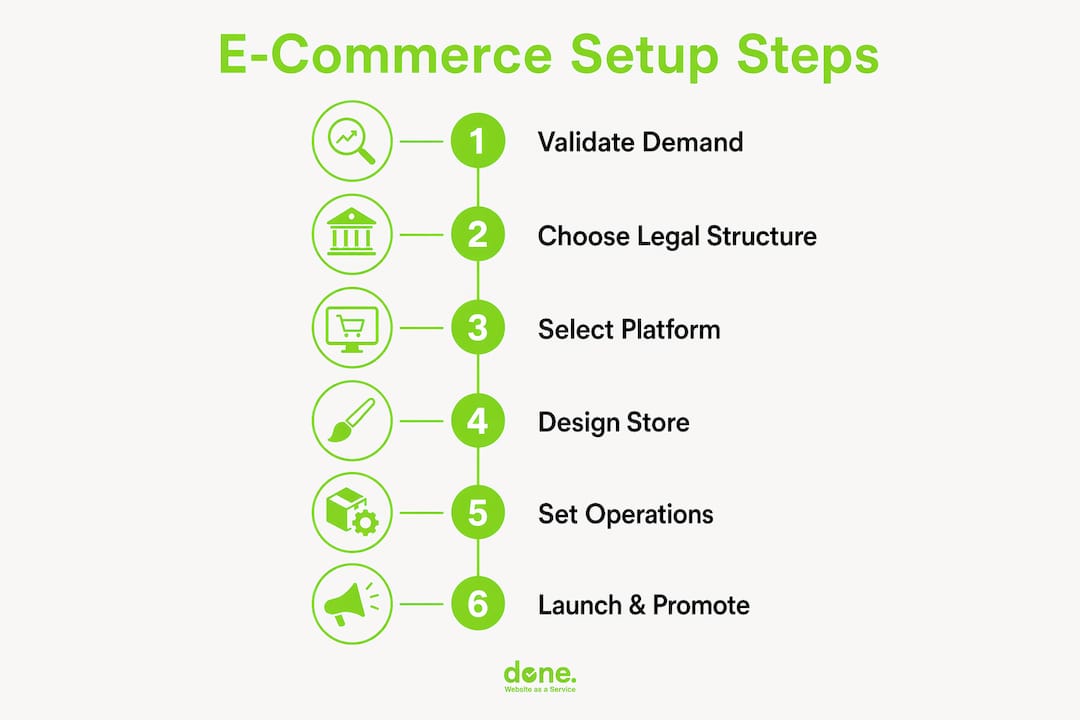
A step by step e-commerce setup is the process of building a legally compliant, commercially viable online store from scratch, covering everything from product validation to your first sale. Global e-commerce sales are forecast to reach $6.88 trillion in 2026, which means the market opportunity is real, but so is the competition. Getting the sequence right matters more than moving fast. Founders who skip legal setup, rush platform selection, or launch without validating demand pay for those shortcuts later, in lost orders, compliance fines, and wasted ad spend. This guide gives you the correct order of operations, with no filler.
How to validate your product niche before you build anything
Niche validation is the single step most founders skip, and it is the one that costs them the most. Building a store around a product nobody wants is an expensive lesson. Spend two weeks on validation before you spend a penny on development.
Start with search data. Google Trends, keyword research tools, and marketplace bestseller lists tell you whether people are actively looking for what you plan to sell. Pair that with competitor analysis: if established sellers exist, demand is confirmed. If nobody is selling it, ask whether that is an opportunity or a warning sign.
Sourcing models differ significantly in risk and reward:
- Dropshipping carries margins of 10–20% with minimal upfront investment. That low barrier attracts heavy competition, so differentiation through branding or niche focus is critical.
- Private label requires upfront investment of $2,000–$10,000 but yields margins of 40–65%. You own the brand and control quality, which builds long-term value.
- Handmade or artisan products offer strong margins and brand story potential, but production capacity limits growth.
Choose your sourcing model based on your available capital and how quickly you need cash flow. Dropshipping suits founders testing multiple niches with limited funds. Private label suits founders with a clear product vision and six months of runway.
Pro Tip: Validate demand on marketplaces like Amazon or TikTok Shop before building your own store. Marketplace sales confirm real purchase intent, generate early cash flow, and reduce the traffic acquisition cost you will face on a standalone site.

A written business plan is not just for investors. It forces you to align your product strategy, target customer, pricing model, and marketing approach before you commit resources. Founders who skip this step routinely discover mid-build that their margins do not support their planned ad spend.
What legal structure does an e-commerce business need?
Legal setup is not optional, and the sequence matters. Getting this wrong does not just create paperwork problems. It can result in payment processor shutdowns and personal liability for business debts.
For most small e-commerce businesses, an LLC (Limited Liability Company) or its local equivalent is the right structure. An LLC with an EIN and a dedicated business bank account protects your personal assets and keeps tax obligations manageable. In Luxembourg and across the EU, the equivalent structure is typically a SARL (Société à Responsabilité Limitée), which provides the same core protections.
The minimum legal setup checklist before you process a single payment:
- Register your business entity with the relevant national authority
- Obtain your tax identification number (EIN in the US, numéro de TVA in Luxembourg)
- Open a dedicated business bank account, separate from personal finances
- Register for VAT if your turnover exceeds the local threshold
- Obtain any sector-specific licences or permits your product category requires
Ignoring finance separation is one of the most common and costly mistakes in early e-commerce. Payment processors shut down accounts when they detect mixed personal and business finances, which can freeze your revenue mid-launch.
GDPR compliance is a non-negotiable addition for any business selling to EU customers. Your store needs a privacy policy, a cookie consent mechanism, and clear data retention practices before you go live. These are not bureaucratic formalities. Regulators in Luxembourg and across the EU actively enforce them.
Which e-commerce platform is right for your business?
Platform choice is one of the highest-stakes decisions in your setup. The wrong choice does not just slow you down at launch. A poor platform decision increases five-year total cost of ownership by 45% or more and delays your time to market significantly.
The three main platform categories each suit a different business profile:
| Platform type | Best for | Launch speed | Cost profile |
|---|---|---|---|
| SaaS (e.g. Shopify) | Brands under $10M revenue | Fast (weeks) | Predictable monthly fee |
| Open source (e.g. WooCommerce) | Technical teams wanting control | Moderate | Low licence, higher dev cost |
| Enterprise platforms | High-volume, complex operations | Slow (months) | High implementation cost |
SaaS platforms launch 86% faster and cost 88% less to implement than fully custom builds. That gap is significant for any founder who needs to reach market quickly. Most successful brands under $10 million in revenue start on SaaS platforms and migrate only when complexity demands it.
The fundamental tradeoff is ease of use versus technical control. SaaS platforms handle hosting, security patches, and payment compliance for you. Open source platforms give you full code access but require a developer to maintain them. For most SMB owners, the time cost of managing a self-hosted platform outweighs the flexibility it offers.
Once you have chosen a platform, the essential technical setup covers four areas: a custom domain, SSL security, at least two payment gateways (card and a local alternative), and a mobile-responsive theme. Explore platform options for SMBs to compare what each category delivers in practice before committing.
Pro Tip: Test your store on a 3G mobile connection before launch. Mobile accounts for the majority of e-commerce traffic, and a slow mobile experience will cost you sales regardless of how good your desktop version looks.
How does store design affect your conversion rate?
Store design is not about aesthetics. It is about trust. A visitor who does not trust your store within the first few seconds will leave without buying, and no amount of ad spend will fix that.
Conversion rates average 2–3% across e-commerce stores, but top-performing stores reach 4–5%. The gap between average and excellent is almost entirely explained by trust signals, page speed, and checkout friction. Every second of page load delay reduces conversions by 7%. That is a measurable, avoidable revenue loss.
The pages that determine whether visitors buy:
- Homepage: Communicates your value proposition within three seconds. Avoid carousels, which consistently underperform static hero images in conversion tests.
- Product pages: High-quality images from multiple angles, clear pricing, honest delivery timelines, and genuine customer reviews. Missing any one of these reduces purchase confidence.
- Checkout: Every additional step costs you customers. Guest checkout, multiple payment options, and a visible security badge are non-negotiable.
Your brand identity underpins all of this. A consistent name, logo, colour palette, and tone of voice across every page signals professionalism. Inconsistency, even small inconsistencies, reads as untrustworthy to first-time buyers. Well-executed e-commerce branding strategies measurably increase sales by building the kind of recognition that turns first-time buyers into repeat customers.
Conversion rate optimisation acts as a multiplier on all your traffic. Doubling your conversion rate from 2% to 4% doubles your revenue without increasing your marketing budget. Fix the store before you scale the ads.
What operations do you need in place before launch?
Operational readiness is what separates a store that can fulfil orders from one that creates customer service problems on day one. Get these foundations in place before you take your first payment.
Logistics and fulfilment:
- Define your shipping zones and carriers before launch. Customers expect delivery timelines at checkout, not after purchase.
- Decide between in-house fulfilment, a third-party logistics provider (3PL), or dropshipping. Each has different cost structures and lead times.
- Build a returns policy that is clear, fair, and easy to find. A generous returns policy increases purchase confidence and reduces disputes.
Payment processing:
- Use a payment gateway that supports your target markets and currencies. For EU businesses, this means supporting SEPA payments alongside card processing.
- Verify that your gateway is PCI-DSS compliant. This is a security standard for card data handling, and non-compliance creates liability.
- Display accepted payment methods visibly on product pages and at checkout. Hidden payment options cause cart abandonment.
Tax and invoicing:
- Understand your VAT obligations across the markets you sell into. EU VAT rules for cross-border digital and physical goods changed significantly with the OSS (One Stop Shop) scheme.
- Issue compliant invoices automatically. Most SaaS platforms support this natively or through an app.
Cart abandonment averages above 70% across e-commerce. Clarity on shipping costs, delivery times, and payment options at the product page stage, not just at checkout, reduces that figure meaningfully.
How do you launch and drive your first sales?
Launch is not the end of your setup. It is the beginning of your customer acquisition work. A store with no traffic generates no revenue, regardless of how well it is built.
Pre-launch checklist:
- Test every page on mobile and desktop
- Place a test order through each payment method
- Confirm all automated emails (order confirmation, shipping notification) are working
- Verify your analytics tracking is live and recording sessions
- Check that your privacy policy, cookie notice, and terms of service are published
Marketing channels for early traffic:
- SEO: Write product descriptions and category pages around the terms your customers actually search. An e-commerce SEO strategy built on keyword intent drives compounding organic traffic over time.
- Paid social: Meta and TikTok ads work well for visually driven products. Start with a small daily budget and test two or three creative variants before scaling.
- Email marketing: Build your list from day one. Even a small list of 500 engaged subscribers outperforms a large list of disengaged contacts.
- Influencer partnerships: Micro-influencers (10,000–50,000 followers) in your niche typically deliver better ROI than large accounts, at a fraction of the cost.
Measure what matters from week one. Track conversion rate, average order value, customer acquisition cost, and return rate. These four metrics tell you whether your business model is working. Use the step-by-step launch guide to structure your go-live sequence and avoid the most common pre-launch oversights.
Key takeaways
A successful e-commerce setup requires validated demand, correct legal structure, the right platform for your revenue stage, and conversion-focused design before you invest in traffic.
| Point | Details |
|---|---|
| Validate before you build | Confirm product demand on marketplaces before investing in a standalone store. |
| Legal structure protects revenue | An LLC or SARL with a separate business account prevents payment processor shutdowns. |
| Platform choice affects total cost | The wrong platform increases five-year ownership costs by 45% and delays launch. |
| Design drives conversion | Top stores convert at 4–5%; every second of load delay cuts conversions by 7%. |
| Operations must be ready at launch | Shipping clarity, compliant payments, and automated invoicing must work before day one. |
What most e-commerce guides get wrong
After working with clients across Luxembourg and Europe on web and e-commerce projects, one pattern stands out clearly: most founders treat the website as the product. They spend months perfecting the design and almost no time validating whether anyone wants what they are selling.
The website is a delivery mechanism. It delivers your value proposition to a customer who has already decided they want something like what you offer. If the product-market fit is not there, no amount of design polish will save you.
The second mistake I see consistently is launching with the intention of fixing operations later. Fulfilment problems, unclear returns policies, and broken checkout flows do not just cost you individual sales. They generate negative reviews that follow your brand for years. Get the operations right before you go live, even if it means delaying launch by two weeks.
The third thing I would push back on is the instinct to spend on ads before the store converts. If your conversion rate is 1%, doubling your ad budget doubles your losses. Fix the store first. A 1% improvement in conversion rate is worth more than a 50% increase in traffic budget, and it costs far less.
The founders who succeed are not the ones who launch fastest. They are the ones who launch with a validated product, a compliant business, a store that converts, and operations that can actually fulfil what they sell. Speed matters, but sequence matters more.
— Thomas
How Done supports your e-commerce launch
Building an e-commerce store that actually generates revenue requires more than a template and a payment gateway. Done works with SMBs across Luxembourg and Europe to build fast, conversion-focused online stores backed by professional web development that handles the technical and compliance complexity for you.
From platform selection and store build to SEO, digital marketing, and GDPR-compliant setup, Done manages the full process so you can focus on your product and customers. With over 150 completed projects and a transparent, no-setup-fee model, Done gives you a clear path from idea to live store, without the guesswork that costs most founders time and money. Explore e-commerce development to see what a professionally built store looks like in practice.
FAQ
What is the first step in setting up an e-commerce store?
Validate your product demand before building anything. Use marketplace data, search trends, and competitor analysis to confirm that real buyers exist for what you plan to sell.
How long does an e-commerce setup take?
A SaaS-based store can launch in two to four weeks once your legal structure, product sourcing, and branding are in place. Custom builds take longer, typically two to four months.
Do I need an LLC to sell online?
An LLC or its local equivalent (such as a SARL in Luxembourg) is strongly recommended. It separates personal and business finances, which protects your assets and prevents payment processor shutdowns.
Which platform is best for a small e-commerce business?
Most brands under $10 million in revenue start on SaaS platforms, which launch faster and cost significantly less to implement than custom or enterprise alternatives.
How do I get my first sales after launch?
Start with SEO-optimised product pages, a small paid social campaign, and an email list built during pre-launch. Marketplace validation before launch also generates early cash flow and real customer data.