

Step-by-step website branding for business growth
April 8, 2026
Proven inbound marketing examples for SMB growth
April 10, 2026
TL;DR:
- AI adoption among European SMEs is low, with only 19.95% currently implementing it despite high interest.
- Main barriers include skills shortages, costs, lack of clear strategies, and regulatory concerns.
- Starting small with targeted pilots and leveraging government support can boost successful AI integration.
AI is reshaping the way businesses operate, yet a striking gap exists between the enthusiasm surrounding it and the reality of adoption among small and medium-sized enterprises (SMEs) in Europe. EU SME adoption sits at just 19.95% in 2025, compared to 55% for large enterprises, which means most business owners are watching from the sidelines while competitors begin to gain ground. The barriers are real: skills shortages, budget constraints, and uncertainty about where to begin. But the opportunity is equally real. This guide cuts through the noise and gives you a clear, practical path to understanding and implementing AI in your business, whether you are based in Luxembourg, across Europe, or somewhere in between.
Table of Contents
- AI adoption in SMEs: Current state and barriers
- Core uses of AI in business: Real-life applications
- How to overcome common pitfalls and barriers
- Planning your AI journey: Step-by-step guidance for SMEs
- What many SMEs miss when taking on AI
- Ready to transform your business with AI?
- Frequently asked questions
Key Takeaways
| Point | Details |
|---|---|
| AI adoption is rising | More SMEs in Luxembourg and Europe are starting to use AI, but barriers remain. |
| Practical AI uses | AI helps small businesses in areas like marketing, automation, and customer service. |
| Overcoming barriers | Skills training, financial support, and starting small make AI adoption feasible for SMEs. |
| Strategic AI planning | A clear step-by-step approach maximises the benefits of AI for your business. |
AI adoption in SMEs: Current state and barriers
With the groundwork laid, let’s look at the statistics and obstacles shaping the present state of AI adoption in small and medium businesses.
The numbers tell a nuanced story. EU SME adoption rates stand at 19.95% overall in 2025, with small businesses at 17% and medium-sized businesses at 30%. Large enterprises, by contrast, reach 55%. Luxembourg performs better than most, with an adoption rate of 33.61%, placing it above the EU average. That is encouraging, but it also means two thirds of Luxembourg SMEs have yet to integrate AI into their operations in any meaningful way.
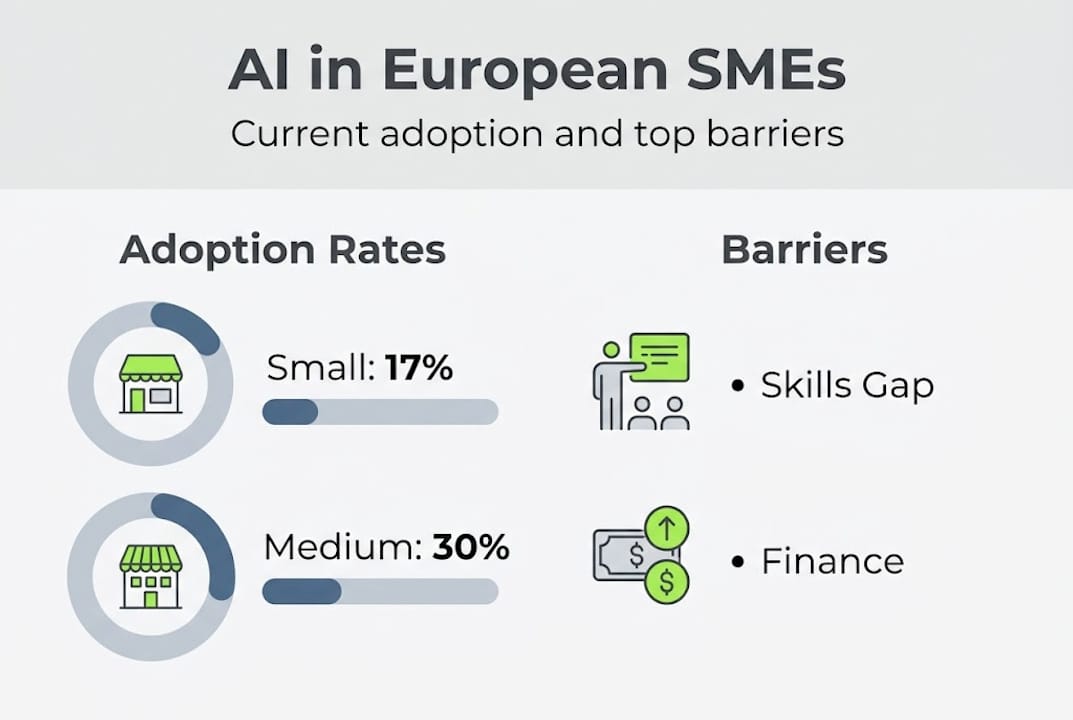
| Business size | EU AI adoption rate (2025) |
|---|---|
| Small businesses | 17% |
| Medium-sized businesses | 30% |
| Large enterprises | 55% |
| Luxembourg (all sizes) | 33.61% |
The contrast becomes even sharper when you consider sentiment. 82% of SME owners see AI as essential to their future competitiveness, yet 43% report they are simply not ready to implement it. That is a significant disconnect between belief and action.
So what is holding businesses back? The top barriers identified by the OECD include:
- Skills shortages: Many SMEs lack staff with the technical knowledge to evaluate, implement, or manage AI tools.
- Financial constraints: Initial investment costs, even for cloud-based tools, can feel prohibitive without a clear return on investment (ROI) in sight.
- Lack of internal readiness: Processes, data quality, and organisational culture may not yet support AI adoption.
- Uncertainty about regulation: GDPR compliance and data sovereignty concerns create hesitation, particularly in sectors like legal, finance, and healthcare.
- Absence of a clear strategy: Many owners want to adopt AI but do not know where to start or which tools are appropriate for their sector.
The good news is that the landscape is shifting. Government AI initiatives such as the Digital Europe Programme (DEP) and the Luxembourg AI Factory are actively working to close the gap. These programmes offer funding, training, and advisory support specifically designed for SMEs. They lower the financial and technical barriers, making it more feasible for smaller businesses to take their first steps with confidence.
The takeaway here is straightforward. The adoption gap is not evidence that AI is unsuitable for SMEs. It reflects the absence of accessible, practical guidance and targeted support. That is precisely what this guide aims to address.
Core uses of AI in business: Real-life applications
Understanding the adoption gap, it is important to see where AI is already making a real difference for SMEs.
AI adoption by SMEs spans digital marketing, automation, customer service, and process optimisation, each offering measurable benefits without requiring a large technical team. The applications are more accessible than most business owners expect.

Here is a comparison of two of the most popular starting points for SMEs:
| AI application | Best for | Typical investment | Time to value |
|---|---|---|---|
| Customer service chatbot | Reducing support workload | Low to medium | 2 to 6 weeks |
| Email marketing automation | Lead nurturing and retention | Low | 1 to 4 weeks |
| AI content generation | Marketing and communications | Low | Immediate |
| Predictive inventory tools | Retail and e-commerce | Medium | 4 to 8 weeks |
| Document processing AI | Legal, finance, admin | Medium to high | 4 to 12 weeks |
A Luxembourg-based accounting firm, for example, might begin with AI-assisted document processing to reduce the time spent on invoice handling. A retail business might deploy a chatbot to handle frequently asked questions outside of business hours. Both scenarios involve relatively low risk and deliver measurable time savings quickly.
If you are exploring AI tools for SMEs for the first time, a structured approach helps. Here is a practical sequence to follow:
- Identify a repetitive, time-consuming task in your business that does not require complex human judgement.
- Research AI tools that address that specific task, focusing on those with a free trial or low entry cost.
- Run a short pilot over four to six weeks, measuring time saved or errors reduced.
- Evaluate the results against your original goals before committing to a full rollout.
- Train your team on the tool and gather their feedback to refine how it is used.
- Scale gradually, adding further AI capabilities only once the first tool is embedded in your workflow.
Real-world tried-and-tested AI solutions consistently show that the businesses seeing the fastest returns are those that start narrow and specific, not those that attempt a sweeping transformation all at once. There are compelling success stories in Luxembourg across sectors from professional services to hospitality that demonstrate this approach in practice.
Pro Tip: Choose your first AI pilot based on the problem that costs your team the most time each week. Solving one real pain point quickly builds internal confidence and creates momentum for broader adoption.
How to overcome common pitfalls and barriers
While opportunities are everywhere, the road to effective AI adoption comes with familiar challenges.
The most common reason SMEs stall is not a lack of ambition. It is a lack of a structured plan for dealing with the obstacles that arise. Addressing these proactively makes the difference between a successful pilot and an abandoned project.
Here are the most effective ways to tackle the main barriers:
- Invest in skills before tools. Before purchasing any AI software, identify the knowledge gaps in your team. Short online courses, vendor-led training sessions, and workshops offered through boosting marketing with AI programmes can rapidly build internal competence.
- Tap into financial support. The DEP and Luxembourg AI Factory offer grants, subsidised consultancy, and co-investment schemes for SMEs. Exploring these options before budgeting for AI tools can significantly reduce your upfront costs.
- Build a culture of experimentation. Teams that fear failure will avoid AI. Leaders who frame pilots as learning exercises, not high-stakes bets, create the psychological safety needed for genuine innovation.
- Partner with specialists. Working with an experienced AI consulting partner means you avoid common implementation mistakes and benefit from proven frameworks rather than starting from scratch.
- Prioritise data quality. AI tools are only as good as the data they work with. Before deploying any solution, audit your existing data for accuracy, completeness, and GDPR compliance.
“SMEs that approach AI adoption incrementally, focusing on clearly defined business problems and measurable outcomes, are significantly more likely to report positive returns and sustained engagement with AI tools.” — OECD, AI Adoption by Small and Medium-Sized Enterprises, 2025
Pro Tip: Resist the temptation to solve everything at once. Pick one core business problem, whether that is slow customer response times or manual data entry, and focus your first AI effort entirely on that. Narrowing your scope dramatically increases your chances of a successful outcome.
Building momentum through early wins is the most reliable strategy. Each successful pilot builds trust within your team and gives you the evidence needed to justify further investment to stakeholders or board members.
Planning your AI journey: Step-by-step guidance for SMEs
With the challenges and solutions clear, it is time to turn ambition into action with a guided roadmap.
A structured approach to AI adoption prevents the two most common failure modes: moving too fast without clear goals, or moving so slowly that momentum is lost. The following steps give you a repeatable framework you can apply regardless of your sector or size.
- Audit your current processes. Map out your key business operations and identify where time is lost, errors occur, or bottlenecks slow growth. This audit becomes the foundation of your AI strategy.
- Define specific business goals. Vague ambitions like “use AI more” lead nowhere. Set concrete targets such as reducing customer response time by 40%, cutting invoice processing time in half, or increasing email open rates by 20%.
- Research available tools and partners. Match your goals to specific AI solutions. Use stepwise AI strategy guides and consult with specialists who understand your sector and the regulatory environment in Luxembourg and Europe.
- Run a time-limited pilot. Select one tool, one team, and one process. Set a clear evaluation period of four to eight weeks and define how you will measure success before you begin.
- Evaluate and document outcomes. At the end of the pilot, review what worked, what did not, and what you would do differently. Document this clearly so the learning is retained regardless of staff changes.
- Scale what works. Once a pilot delivers results, expand it to other teams or processes. Introduce additional AI tools only after the first is fully embedded.
- Leverage national and EU support programmes. Government programmes such as DEP and Luxembourg AI Factory can provide both funding and expert guidance at each stage of your journey.
Use this checklist to assess your readiness before you begin:
- Clear understanding of your top three operational pain points
- Basic data hygiene in place (accurate, organised, GDPR-compliant records)
- At least one internal champion who will lead the AI pilot
- A defined budget, even a modest one, for tools and training
- Leadership commitment to supporting experimentation
- A shortlist of two or three AI tools relevant to your first use case
- A plan for measuring success with specific, quantifiable metrics
This roadmap is not theoretical. It reflects the approach that consistently delivers results for SMEs across Luxembourg and Europe, combining realistic expectations with disciplined execution.
What many SMEs miss when taking on AI
After the strategic roadmap, it is worth pausing to challenge a few common assumptions about what AI actually means for SMEs.
The most persistent misconception is that AI adoption is binary: either you transform your entire business or you are left behind. This framing causes paralysis. It leads business owners to delay action because they believe they need a large budget, a dedicated data science team, or a complete overhaul of their systems before they can start.
The reality is quite different. The businesses achieving real business impact from AI right now are often those that started with something modest, an automated email sequence, a simple chatbot, or a tool that extracts data from PDFs. These are not glamorous applications. But they free up hours each week, reduce errors, and build the internal confidence needed to go further.
Another overlooked factor is the human side of AI adoption. Technology does not transform a business. People do. The SMEs that succeed are those where leadership actively involves the team, explains the purpose of each tool, and creates space for questions and adjustment. Resistance to AI is almost always rooted in fear of job loss or uncertainty about change. Address that directly and openly.
Finally, expecting overnight transformation is a reliable path to disappointment. AI is a long-term capability, not a quick fix. Incremental progress, compounded over months and years, is where the genuine advantage lies. Start small, learn fast, and build steadily. That is the approach that actually works.
Ready to transform your business with AI?
Now that you are equipped with practical insights, consider how targeted expert support can accelerate your AI journey.
Navigating AI adoption alone is possible, but it takes significantly longer and carries more risk than working with a partner who has done it before. At Done.lu, we specialise in helping SMEs across Luxembourg and Europe move from curiosity to confident implementation. Whether you need AI consulting for your business, guidance on selecting the right AI tools for your SME, or a complete digital transformation strategy, we bring the experience and practical frameworks to make it happen. Our approach is human-first: we empower your team with technology rather than replacing them. Explore our full range of web and AI solutions and take the first step towards a smarter, more efficient business today.
Frequently asked questions
Why should SMEs in Luxembourg consider AI adoption now?
Luxembourg’s AI adoption rate of 33.61% already exceeds the EU average, and government programmes are actively supporting SMEs to go further, making now an ideal moment to act before the competitive gap widens.
What is the main barrier preventing SMEs from using AI?
Skills shortages and finance are consistently identified as the top obstacles, though both can be addressed through targeted training, partnerships, and available government support schemes.
Are there government programmes to support AI for small businesses in Europe?
Yes, initiatives such as the Digital Europe Programme (DEP) and the Luxembourg AI Factory provide funding and advisory support specifically designed to help SMEs adopt AI effectively and sustainably.
What kinds of business tasks can AI help SMEs automate?
AI can handle a wide range of tasks including marketing, customer service, and process optimisation, as well as invoice processing, inventory management, and document handling across many sectors.