

Role of SEO in ecommerce success: a 2026 guide
March 17, 2026
Why invest in SEO: a guide for Luxembourg SMEs in 2026
March 19, 2026
Many Luxembourg SMEs dismiss SEO as too slow or suited only for large corporations. Yet Zoot’s €1.5M sales growth from organic traffic proves otherwise. When implemented strategically, SEO transforms small and medium businesses into market leaders by delivering qualified prospects, sustainable revenue streams, and measurable ROI. This guide reveals actionable methodologies tailored for Luxembourg and European SMEs to harness SEO’s full potential in 2026, from local optimisation to budget allocation and performance tracking.
Table of Contents
- The Role Of SEO In Driving Business Growth For SMEs
- Core SEO Methodologies Tailored For Luxembourg And European SMEs
- Balancing SEO With Paid Marketing And Preparing For New Search Trends
- Measuring SEO Success And Budgeting For Sustained Growth
- Discover Expert Web Development And Digital Marketing Services
- Frequently Asked Questions About The Role Of SEO In Business Growth
Key takeaways
| Point | Details |
|---|---|
| SEO boosts organic traffic and sales | Strategic SEO implementation drives qualified visitors and revenue growth for Luxembourg SMEs. |
| Prioritise local and long-tail keywords | Focus on multilingual, location-specific terms with manageable competition for European markets. |
| Comprehensive audits are essential | Regular technical reviews covering speed, mobile responsiveness, and schema markup ensure optimal performance. |
| Budget 5-10% of revenue for SEO | Allocate resources to content creation, local optimisation, and ongoing monitoring for sustained growth. |
| Track local metrics for ROI | Monitor Google Business Profile insights and organic conversions to measure campaign effectiveness. |
The role of SEO in driving business growth for SMEs
Organic search visibility forms the foundation of sustainable digital growth for small and medium businesses. When prospects search for products or services you offer, appearing prominently in results delivers qualified traffic without ongoing advertising costs. Unlike paid campaigns that stop generating leads the moment budgets dry up, SEO compounds over time.
Three factors determine SEO success: content quality, keyword optimisation, and authoritative backlinks. Content must answer specific questions your prospects ask whilst incorporating terms they actually search. Keywords should match user intent precisely, whether informational, navigational, or transactional. Backlinks from reputable industry sources signal credibility to search engines.
The evidence speaks clearly. Zoot’s €1.5M sales growth from organic traffic demonstrates how focused SEO campaigns transform revenue. Other SMBs report six-figure monthly revenues directly attributed to organic search. Meta-analysis confirms SEO significantly boosts organic rankings and traffic across industries.
Consider the economics. Paid advertising demands continuous investment to maintain visibility. SEO requires upfront effort but delivers compounding returns. A well-optimised article attracting 500 monthly visitors costs nothing after publication, yet paid ads require ongoing spend for equivalent traffic. This makes SEO particularly valuable for SMEs operating on limited marketing budgets.
For ecommerce businesses, SEO proves especially powerful. Product pages optimised for buyer-intent keywords capture prospects actively ready to purchase. Category pages targeting broader terms build topical authority whilst individual product listings convert searchers into customers. The role of SEO in ecommerce success extends beyond traffic to encompass user experience, conversion optimisation, and customer lifetime value.
Pro Tip: Start with low-competition, high-intent keywords where you can rank quickly and demonstrate ROI before tackling broader terms.
Core SEO methodologies tailored for Luxembourg and European SMEs
Successful SEO for Luxembourg SMEs requires methodologies adapted to multilingual markets, local competition, and European search behaviour. These five approaches form the foundation:
-
Conduct comprehensive technical audits: Review site speed, mobile responsiveness, crawlability, indexation status, and schema markup implementation. Tools like Google Search Console reveal indexing issues whilst PageSpeed Insights identifies performance bottlenecks. Fix broken links, optimise images, and ensure HTTPS security across all pages.
-
Optimise Google Business Profile completely: Your GBP listing dramatically influences local visibility. SMBs using Google Business Profile see significantly higher engagement than competitors without optimised profiles. Add accurate business hours, high-quality photos, service descriptions, and respond promptly to reviews. Regular posts about offers or updates keep your profile active.
-
Target multilingual long-tail keywords: Luxembourg’s trilingual environment demands keywords in French, German, and English. Research terms with 100-1000 monthly searches and keyword difficulty below 30. “Comptable Luxembourg Kirchberg” performs better than generic “accountant” for local firms. Long-tail phrases attract qualified prospects closer to conversion.
-
Build content pillars and clusters: Create comprehensive pillar pages covering broad topics, then develop cluster content addressing specific subtopics. Each cluster article links back to the pillar, establishing topical authority. A digital marketing pillar might spawn clusters on SEO, social media, email marketing, and PPC.
-
Monitor performance and adapt continuously: Track rankings, organic traffic, conversion rates, and local metrics weekly. Google Analytics reveals which pages drive conversions whilst Search Console shows keyword opportunities. Adjust strategy based on data rather than assumptions.
Pro Tip: For Google My Business local SEO, prioritise review generation and regular photo updates as these signals strongly influence local pack rankings.
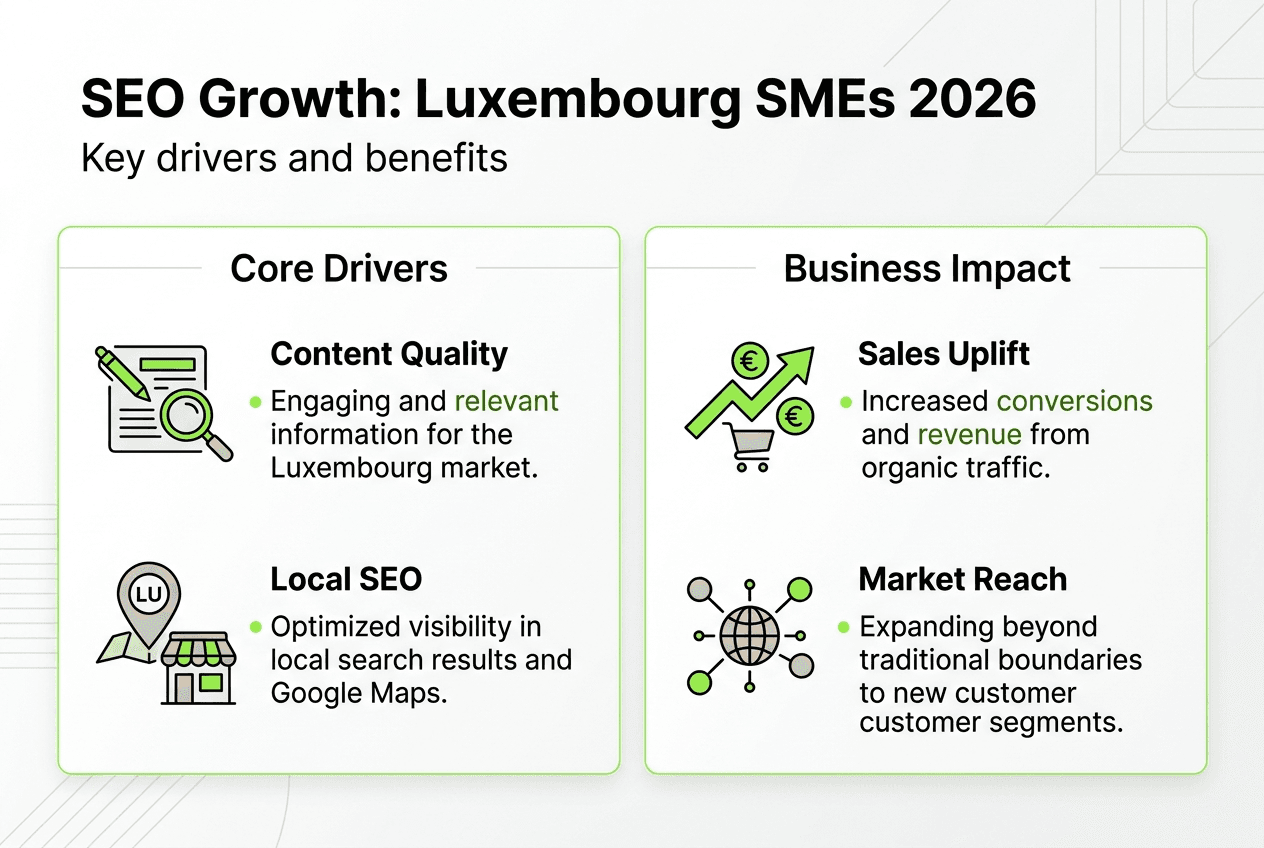
Implementing these methodologies systematically positions Luxembourg SMEs to compete effectively in European markets. The key lies in consistent execution rather than sporadic efforts. Optimising your Google My Business listing alone can double local enquiries within months.
Balancing SEO with paid marketing and preparing for new search trends
SEO and PPC serve different strategic purposes. SEO provides long-term compounding ROI whilst PPC delivers immediate visibility at ongoing cost. Smart SMEs integrate both channels for maximum impact.
SEO builds momentum gradually. Expect three to six months before seeing significant organic traffic increases. Rankings improve as search engines recognise your authority and content quality. Once established, organic positions generate traffic indefinitely without per-click costs.
PPC offers instant visibility but requires continuous investment. Pause campaigns and traffic stops immediately. Cost per click in competitive Luxembourg markets often exceeds €5 for commercial keywords. Monthly PPC budgets quickly surpass SEO investments without building lasting assets.
Integrated campaigns maximise both channels:
- Use PPC data to identify high-converting keywords for SEO targeting
- Retarget organic visitors who didn’t convert with display ads
- Run PPC campaigns for seasonal promotions whilst SEO handles evergreen traffic
- Test messaging in paid ads before committing to long-form SEO content
Local SEO via Google Business Profile yields 50% higher engagement for Luxembourg SMEs compared to generic organic listings. However, results require patience. Expect four to nine months for local SEO efforts to fully materialise. This timeline reflects Google’s verification processes, review accumulation, and citation building across directories.
Emerging search trends demand strategic adaptation:
| Trend | Impact | Action Required |
|---|---|---|
| Zero-click searches | Users get answers without visiting sites | Optimise for featured snippets and knowledge panels |
| Authority emphasis | Google prioritises established experts | Build thought leadership through original research |
| Location relevance | Hyper-local results dominate | Create neighbourhood-specific content and citations |
| Voice search growth | Conversational queries increase | Target question-based long-tail keywords |
Tracking SEO ROI requires connecting organic traffic to revenue. Google Analytics reveals which pages drive conversions whilst attribution modelling shows SEO’s role in customer journeys. For digital marketing strategy in Luxembourg SMEs, local metrics prove especially valuable: Google Business Profile insights, direction requests, phone calls, and review sentiment.
Pro Tip: Set up conversion tracking for micro-actions like newsletter signups and resource downloads, not just final sales, to capture SEO’s full funnel impact.
Measuring SEO success and budgeting for sustained growth
Effective SEO demands appropriate resource allocation and rigorous performance measurement. SMEs should allocate 5-10% of revenue to SEO, focusing primarily on content creation and local optimisation. This translates to monthly budgets between $500 and $2000 for most small businesses, depending on market competitiveness and growth objectives.
Budget distribution for optimal results:
- 40% content creation: High-quality articles, landing pages, and multimedia addressing customer questions
- 25% technical optimisation: Site speed improvements, mobile responsiveness, schema implementation
- 20% link building: Outreach, digital PR, partnership development for authoritative backlinks
- 15% local SEO: Google Business Profile management, citation building, review generation
Monthly costs vary by service model. DIY approaches minimise expenses but demand significant time investment and expertise. Freelance SEO specialists charge €50-150 hourly in Luxembourg markets. Agency retainers provide comprehensive services but start around €1500 monthly. Choose based on internal capabilities and growth urgency.
Tracking these metrics reveals SEO performance:
| Metric | Measurement Method | Target Benchmark |
|---|---|---|
| Organic traffic | Google Analytics sessions from organic search | 20% monthly growth |
| Keyword rankings | Position tracking tools for target terms | Top 10 for priority keywords |
| Conversion rate | Goals completed divided by organic sessions | 2-5% depending on industry |
| Local visibility | Google Business Profile impressions and actions | 30% quarterly increase |
| Backlink growth | Referring domains from authority sites | 5-10 new links monthly |
Google Analytics provides foundational insights. Create custom dashboards tracking organic traffic, top landing pages, conversion paths, and assisted conversions. Segment by device, location, and traffic source to identify optimisation opportunities. Tracking ROI through Google Analytics with emphasis on local metrics proves vital for Luxembourg SMEs competing in multilingual markets.
Google Business Profile Insights reveal local engagement: search queries triggering your profile, customer actions like calls and direction requests, photo views, and competitor comparisons. Monitor these weekly to gauge local SEO effectiveness.
Regular performance reviews enable strategic adjustments. Monthly analysis identifies trending keywords, declining rankings, and content gaps. Quarterly reviews assess broader strategy alignment with business objectives. Annual audits evaluate competitive positioning and market opportunities.
Pro Tip: Calculate customer lifetime value and attribute it to organic channels to demonstrate SEO’s true revenue impact beyond initial conversions.
Successful SEO requires patience and consistency. Results compound over time as authority builds, content libraries expand, and technical foundations strengthen. SMEs committing to systematic optimisation for 12-18 months typically see transformative growth in organic visibility and revenue. The digital marketing advantages for Luxembourg SMEs extend beyond immediate metrics to encompass brand authority, market positioning, and sustainable competitive advantage.
Discover expert web development and digital marketing services
Transforming SEO strategy into measurable growth requires both technical expertise and strategic execution. Your website’s architecture, speed, and user experience directly influence search rankings and conversion rates. Investing in professional web development creates the foundation for effective SEO whilst delivering superior customer experiences.
Strategic investment in web development pays dividends through improved organic visibility, faster page loads, mobile responsiveness, and conversion optimisation. These technical elements work synergistically with content and local SEO to drive qualified traffic and revenue.
Done Web Agency Luxembourg specialises in tailored digital marketing strategies for Luxembourg SMEs, combining technical excellence with strategic insight. Our comprehensive approach integrates web development, SEO, content marketing, and analytics to deliver sustainable growth for businesses across Luxembourg and Europe.
Frequently asked questions about the role of SEO in business growth
How long before SEO results appear for my SME?
Expect three to six months for initial ranking improvements and traffic increases. Competitive keywords may require nine to twelve months. Local SEO through Google Business Profile shows results faster, typically within four to nine months, especially when combined with active review generation and regular profile updates.
What is the most effective local SEO tactic in Luxembourg?
Optimising your Google My Business profile delivers the strongest local visibility impact. Complete every profile section, add high-quality photos weekly, respond to all reviews promptly, and post regular updates about services or offers. This combination significantly boosts local pack rankings and customer engagement.
How much should small businesses budget for SEO in 2026?
Allocate 5-10% of total revenue to SEO activities, translating to €500-2000 monthly for most SMEs. Prioritise content creation, technical optimisation, and local SEO. Businesses in competitive sectors or pursuing aggressive growth should target the higher end. Start conservatively and scale investment as ROI becomes evident.
Can SEO replace paid advertising completely?
SEO provides sustainable long-term traffic but shouldn’t completely replace paid advertising. Integrate both channels strategically: use SEO for evergreen content and brand building whilst deploying PPC for immediate visibility, seasonal promotions, and retargeting. This balanced approach maximises reach whilst controlling costs.
Should I use multilingual SEO for European markets?
Absolutely. Luxembourg’s trilingual environment demands content in French, German, and English. Create separate pages for each language rather than relying on automatic translation. Research keywords natively in each language as direct translations often miss actual search terms. Multilingual SEO dramatically expands your addressable market across Europe.