

Why use SEO for SMEs: a practical growth guide
July 4, 2026
How to improve user experience on your SMB website
July 6, 2026
TL;DR:
- Search engine marketing provides ecommerce stores immediate traffic and sales by targeting high-intent buyers. It complements SEO by generating short-term revenue while building organic traffic over time. Implementing a strategic, data-driven SEM approach ensures measurable results and sustainable long-term growth.
Search engine marketing (SEM) is the fastest way for an ecommerce business to put its products in front of buyers who are ready to purchase right now. Unlike SEO, which builds visibility over months, SEM drives traffic the same day a campaign goes live. That speed matters enormously when you are launching a new product, running a seasonal promotion, or entering a competitive market where organic rankings are months away. This guide explains why use SEM for ecommerce is one of the most practical questions a store owner can ask, and gives you the answers grounded in how paid search actually works.
Why use SEM for ecommerce: the case for paid search
SEM, formally known as paid search advertising, is the practice of bidding on keywords so your ads appear at the top of search engine results pages. The industry term covers pay-per-click (PPC) campaigns, Google Shopping Ads, and display retargeting, all managed through platforms such as Google Ads. For ecommerce businesses, the core advantage is simple: you reach buyers at the exact moment they are searching for what you sell.
SEM delivers measurable, targeted marketing that increases web traffic and sales in a short time frame. That measurability is what separates it from almost every other channel. You know exactly how much you spent, how many clicks you received, and how many of those clicks converted into orders.
The contrast with SEO is stark. SEO takes 6–12 months to yield sustainable organic traffic. A new ecommerce store cannot wait that long to generate revenue. SEM fills that gap immediately, giving you cash flow while your organic presence matures.
For ecommerce owners who are sceptical of marketing spend, SEM is also the most auditable channel available. Every pound spent is traceable to a keyword, an ad, and a conversion. That accountability makes it far easier to justify budget to stakeholders than brand advertising or social media spend.
How does SEM drive immediate traffic and sales?
SEM’s speed advantage comes from its auction-based model. You set a budget, choose your keywords, write your ads, and your listings appear within hours. There is no waiting for a search engine to crawl and index your pages. You buy your position directly.

70% of search clicks go to the first five organic results, but ecommerce brands use SEM to capture high-intent traffic during peak buying seasons when organic rankings cannot respond quickly. A retailer running a Black Friday promotion cannot wait for SEO to surface new pages. SEM puts those offers at the top of results on the day they go live.
The mechanism that makes SEM particularly powerful for ecommerce is Google Shopping Ads. These ads display a product image, price, and customer reviews directly in the search results. Shopping Ads pre-qualify buyers before they even click, because the shopper already sees the price and product image. That pre-qualification reduces wasted clicks and increases conversion rates compared to standard text ads.
Brands that skip SEM during new product launches often lose the conversion window entirely. Missing short-term visibility during launches costs ecommerce businesses sales they cannot recover through organic search alone. The buyer who searches on launch day and finds a competitor’s ad is unlikely to return weeks later when your organic ranking finally appears.
- Same-day launch: SEM campaigns go live within hours, not months.
- High-intent targeting: Ads appear for buyers actively searching for your product category.
- Shopping Ads: Product image, price, and reviews are visible before the click, filtering out low-intent traffic.
- Seasonal agility: You can increase budget during peak periods and reduce it in quiet months, something SEO cannot do.
- Measurable ROI: Every click, cost, and conversion is tracked and reportable.
Pro Tip: Set up conversion tracking before you spend a single penny on SEM. Without it, you are flying blind. Google Ads conversion tracking takes under an hour to configure and tells you exactly which keywords are generating orders.
Should you use SEM and SEO together for ecommerce?
The SEO versus SEM debate is a false dichotomy. Successful ecommerce brands combine both: SEM rents traffic now while SEO owns traffic later. Treating them as competing priorities is one of the most expensive mistakes an ecommerce marketer can make.
SEM gives you immediate revenue and data. SEO gives you compounding, lower-cost traffic over time. The two channels reinforce each other when managed together. SEM data tells you which keywords convert at the highest rate. You then build SEO content around those proven terms, knowing they drive purchases rather than just page views. This approach to ecommerce growth strategies is far more efficient than guessing which topics to write about.
The risk of ignoring SEO while relying on SEM is real. Overreliance on SEM risks a margin crisis when cost-per-click (CPC) prices rise, which they do in competitive categories. If paid search is your only source of traffic and CPCs double, your margins collapse overnight. SEO acts as a buffer. Organic traffic costs nothing per click once rankings are established.
The table below shows how SEM and SEO serve different but complementary roles in an ecommerce marketing plan.
| Dimension | SEM | SEO |
|---|---|---|
| Time to first traffic | Same day | 6–12 months |
| Cost model | Pay per click | Time and content investment |
| Traffic ownership | Rented (stops when budget stops) | Owned (persists after investment) |
| Best use case | Product launches, seasonal peaks, new stores | Brand authority, long-term category dominance |
| Data output | Keyword conversion data, ad copy performance | Organic ranking data, content engagement |
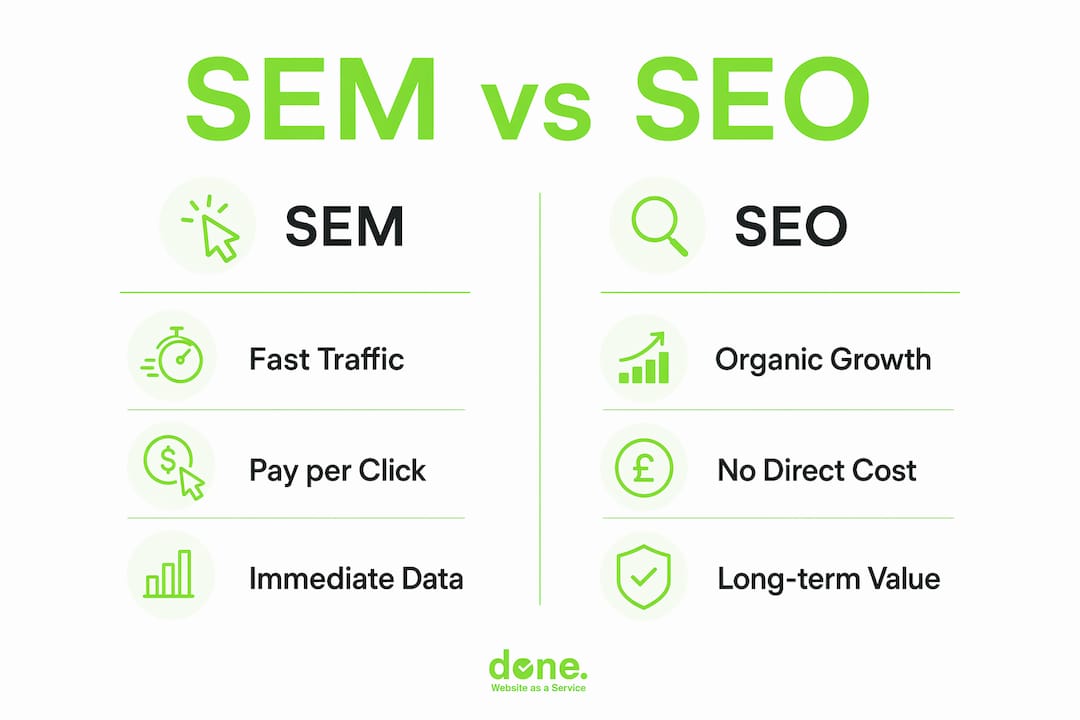
SEO best practices for ecommerce, including technical SEO for SMBs, take time to implement correctly. SEM bridges the revenue gap while that work takes effect. The two channels are not rivals. They are phases of the same growth plan.
Pro Tip: Run SEM for at least three months before drawing conclusions about which keywords to target with SEO. The conversion data from paid campaigns is far more reliable than keyword volume estimates from planning tools.
Key SEM strategies for ecommerce that actually work
Effective SEM for ecommerce is not simply a matter of setting a budget and choosing broad keywords. The campaigns that generate strong ROI follow a specific set of practices that most store owners overlook when starting out.
-
Target high-intent, specific keywords. Broad keywords like “shoes” attract browsers. Specific keywords like “women’s waterproof walking boots size 7” attract buyers. Long-tail keywords cost less per click and convert at higher rates because the searcher knows exactly what they want.
-
Build Shopping Ad feeds carefully. Google Shopping Ads pull data from your product feed. Accurate titles, high-quality images, correct pricing, and genuine customer reviews all affect how often your ads appear and how well they convert. A poorly structured feed wastes budget on irrelevant impressions.
-
Match landing pages to ad intent. Failing SEM campaigns often result from poor landing pages rather than weak ads. If your ad promotes a specific product, the landing page must show that product immediately, with a clear price and a prominent buy button. Sending paid traffic to a homepage is one of the most common and costly errors in ecommerce SEM.
-
Set up negative keywords from day one. Negative keywords prevent your ads from appearing for irrelevant searches. An outdoor clothing retailer, for example, should exclude terms like “free” or “DIY” to avoid paying for clicks that will never convert.
-
Review and adjust weekly, not monthly. SEM campaigns require active management. Keyword performance shifts, competitor bids change, and seasonal demand fluctuates. Weekly reviews catch wasted spend before it accumulates into a significant budget loss.
-
Use audience segmentation. Retargeting past visitors with specific ads, and creating separate campaigns for new versus returning customers, significantly improves conversion rates. A visitor who added a product to their basket but did not purchase responds differently to an ad than a first-time visitor.
Pro Tip: Start with a tightly controlled campaign covering your ten best-selling products. Master those before expanding. Spreading budget across hundreds of products too early dilutes performance and makes it impossible to identify what is working.
How ecommerce businesses can use SEM as a research tool
SEM is not only an advertising channel. Used carefully, it functions as a real-time research tool that informs your entire marketing operation. This is one of the most underused advantages of paid search for ecommerce businesses.
SEM acts as a research tool, allowing you to test ad copy and keywords that then inform your organic SEO content strategy. When you run two versions of an ad with different headlines, the one that generates more clicks tells you which message resonates with buyers. That insight is far more reliable than any focus group or survey.
The research applications of SEM extend well beyond ad copy testing:
- Keyword validation: Run ads on keywords you are considering for SEO. If they convert, invest in organic content for those terms. If they do not, you have saved months of SEO effort on the wrong topics.
- Product demand testing: Launch a new product with a small SEM budget before committing to large inventory orders. If the ads generate clicks and conversions, demand is real. If they do not, you have learned cheaply.
- Price sensitivity testing: Run identical ads with different price points to understand where buyer resistance begins.
- Seasonal demand mapping: SEM data shows you exactly when demand for specific products peaks, allowing you to plan inventory and promotions with precision.
- Competitor gap identification: Search impression share data reveals where competitors are outbidding you, which often signals high-value keyword opportunities worth pursuing organically.
Integrating SEM into Revenue Operations transforms it from a tactical expense into a tool for modelling pipeline growth and guiding resource allocation. Ecommerce businesses that treat SEM data as a source of market intelligence make better decisions across product development, content marketing, and inventory planning. The role of SEO in ecommerce becomes clearer when SEM has already validated which search terms drive real purchases.
Key takeaways
SEM is the most direct route to immediate, measurable ecommerce sales, and its value compounds when integrated with SEO, audience data, and ongoing campaign refinement.
| Point | Details |
|---|---|
| SEM delivers same-day traffic | Campaigns go live within hours, making it the fastest channel for new stores and product launches. |
| Shopping Ads pre-qualify buyers | Displaying price, image, and reviews before the click reduces wasted spend and improves conversion rates. |
| SEM and SEO are complementary | SEM rents traffic now while SEO builds owned traffic over time; both are needed for balanced growth. |
| SEM data informs SEO strategy | Conversion data from paid campaigns identifies which keywords and messages to prioritise in organic content. |
| Overreliance on SEM is a margin risk | Rising CPC costs without an organic buffer can erode profitability; integrate both channels from the start. |
SEM works fast, but it needs a plan
I have worked with ecommerce businesses across Luxembourg and Europe for over a decade, and the pattern I see most often is this: a store owner launches SEM, gets excited by the traffic, and then quietly panics six months later when the ad costs have eaten into margins without a corresponding lift in organic sales.
The problem is not SEM itself. SEM works. The problem is treating it as a permanent solution rather than a phase in a longer plan. Paid search is expensive in competitive categories, and CPC costs in ecommerce have risen consistently year on year. A business that builds its entire customer acquisition model on paid search is one algorithm change or competitor bidding war away from a serious revenue problem.
What I recommend to every ecommerce client is a parallel track from day one. Use SEM to generate revenue and data immediately. Use that data to build an SEO content plan that targets the keywords you have already proven convert. Set a target, for example, to reduce your paid traffic dependency by a defined percentage each year as organic rankings grow. This is not theory. We have seen this with clients who started with 100% paid traffic and, after two years of parallel investment, had a meaningful share of their revenue coming from organic search at near-zero marginal cost.
The other thing I would say plainly: SEM without good landing pages is money in a bin. The ad is only half the job. If the page a buyer lands on is slow, confusing, or missing a clear purchase path, no amount of keyword targeting will save the campaign. Fix the ecommerce site fundamentals before you scale ad spend.
SEM is a powerful tool. Use it with a plan, measure everything, and build organic capacity alongside it. That combination is what produces durable ecommerce growth.
— Thomas
How Done supports ecommerce businesses with SEM
Done works with ecommerce businesses across Luxembourg and Europe to build digital marketing campaigns that combine paid search with organic growth from the start. The approach is practical: we audit your current visibility, identify the highest-value keyword opportunities, and build SEM campaigns that generate measurable returns while your SEO foundation develops in parallel.

Done’s team has delivered over 350 digital projects, including ecommerce builds and full-funnel marketing programmes for SMBs in competitive sectors. If you want SEM campaigns that are tracked, managed, and connected to your broader growth plan, talk to Done about what that looks like for your store.
FAQ
What is SEM in ecommerce?
SEM in ecommerce is the practice of running paid search ads, such as Google Shopping Ads and PPC campaigns, to place products at the top of search results for buyers actively searching to purchase. It is the standard industry term for paid search advertising within a search engine environment.
How quickly does SEM generate traffic for an online store?
SEM campaigns can go live and drive traffic on the same day they are launched, making it the fastest available channel for ecommerce visibility compared to SEO, which takes 6–12 months to produce sustainable organic results.
Is SEM better than SEO for ecommerce?
Neither channel is superior in isolation. SEM delivers immediate, paid traffic while SEO builds owned, compounding traffic over time. The most effective ecommerce marketing strategy combines both, using SEM data to inform SEO content priorities.
What causes SEM campaigns to fail for ecommerce stores?
Failing SEM campaigns most commonly result from poor keyword targeting, weak landing pages that do not match the ad’s promise, or the absence of conversion tracking. Launching ads without these foundations in place wastes budget without generating sales.
How much should an ecommerce business spend on SEM?
There is no universal figure, as the right budget depends on your product margins, average order value, and competitive intensity in your category. Start with a tightly controlled campaign on your best-selling products, measure cost per acquisition against margin, and scale only what is profitable.