
Top website redesign tips for SME success in Luxembourg 2026
March 14, 2026
Why Social Media Management Matters for E-Commerce
March 16, 2026
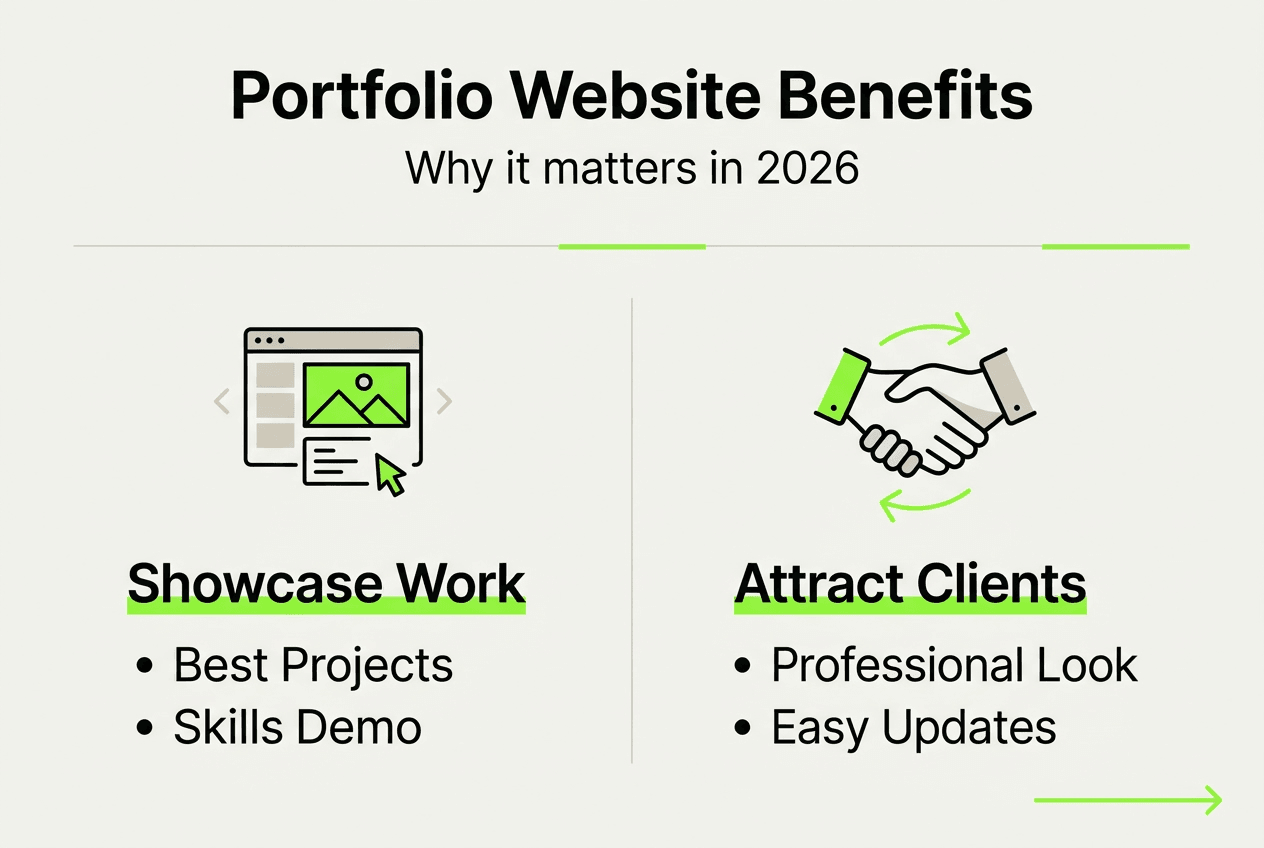
Many business owners mistakenly believe portfolio websites are reserved for photographers, graphic designers, and artists. This misconception costs Luxembourg SMEs valuable opportunities to showcase their expertise and attract clients. A portfolio website serves any business seeking to demonstrate capabilities through tangible results. Whether you manage marketing campaigns, develop software solutions, or provide consulting services, a focused portfolio site establishes credibility and converts visitors into clients. This guide explores what portfolio websites truly are, how they benefit your business, and practical steps to create one that drives growth.
Table of Contents
- What Is A Portfolio Website And Who Needs One?
- Design Principles For A Portfolio Website That Converts
- Choosing The Right Platform: A Comparison Of Top Portfolio Website Builders
- Practical Tips To Leverage Your Portfolio Website For Business Growth
- Boost Your Business With Professional Web Development
- Frequently Asked Questions
Key takeaways
| Point | Details |
|---|---|
| Portfolio websites showcase work | These sites highlight your best projects and skills to attract potential clients and establish authority. |
| SMEs gain competitive advantage | Marketing managers and business owners use portfolios to demonstrate results and differentiate from competitors. |
| Design simplicity converts visitors | Clear navigation, focused content, and professional presentation reduce bounce rates and encourage enquiries. |
| Government support reduces costs | Luxembourg’s SME Package Digital may offset development expenses. |
| Regular updates maintain relevance | Refreshing content with recent projects keeps your site aligned with business goals and market demands. |
What is a portfolio website and who needs one?
A portfolio website is a digital platform designed to showcase your best work and demonstrate professional capabilities. Unlike comprehensive company websites that cover every service detail, portfolio sites focus exclusively on results you’ve achieved for clients. This targeted approach lets potential customers quickly assess whether your expertise matches their needs.
The misconception that portfolios belong only to creative professionals limits business growth. Marketing managers benefit enormously from displaying successful campaigns with measurable outcomes. Software development firms showcase applications they’ve built. Consulting agencies present case studies demonstrating problem-solving abilities. Any business that produces tangible deliverables gains credibility through a well-structured portfolio.
Luxembourg SMEs face intense competition in digital spaces. Your portfolio website serves as proof of competence when prospects research potential partners. Rather than asking customers to imagine what you might deliver, you show exactly what you’ve accomplished. This transparency builds trust faster than promotional copy ever could.
Building a portfolio website represents a focused project with a clear goal: presenting your strongest work. The site should answer three questions immediately: what you do, who you’ve helped, and why prospects should contact you. Everything else is secondary.
Consider these business types that benefit from portfolio websites:
- Marketing agencies displaying campaign results and client growth metrics
- Web development firms showcasing responsive sites and technical solutions
- Consulting businesses presenting case studies with measurable improvements
- Event management companies featuring successful corporate functions
- Architecture and engineering firms displaying completed projects
Your portfolio establishes professionalism in ways that LinkedIn profiles and social media cannot match. You control the narrative, presentation quality, and visitor experience entirely. This ownership matters when prospects make purchasing decisions worth thousands of euros.
Understanding web development fundamentals helps you make informed decisions about your portfolio site. Whether you build it yourself or hire professionals, knowing basic principles ensures your investment delivers returns. The goal remains constant: convert visitors into paying clients through compelling evidence of your capabilities.
Design principles for a portfolio website that converts
Effective portfolio design borrows wisdom from art galleries. These spaces understand that presentation quality directly impacts how viewers perceive value. Your website should apply the same principles: clarity, intention, and focus above all else.

Art galleries present work with careful attention to lighting, spacing, and flow. They remove distractions so visitors concentrate on the art itself. Your portfolio website requires identical discipline. Every element should either showcase your work or guide visitors toward contact.
Simplicity outperforms complexity in portfolio contexts. Visitors arrive with specific questions: can you solve my problem? Have you delivered similar results before? Complicated navigation, animated backgrounds, or unusual fonts obstruct these answers. Potential clients leave if they cannot quickly find what they need.
Consider these design priorities:
- Clear navigation structure: Visitors should reach any portfolio item within two clicks from the homepage.
- High-quality imagery: Professional photographs or screenshots demonstrate attention to detail and quality standards.
- Consistent visual language: Fonts, colours, and spacing should reinforce your brand identity without overwhelming content.
- Fast loading times: Every second of delay increases bounce rates, particularly on mobile devices.
- Accessible contact options: Make it effortless for prospects to reach you when they’re ready.
Your colour palette and typography choices communicate professionalism before visitors read a single word. Conservative industries like finance or legal services benefit from restrained palettes and classic fonts. Creative agencies can experiment more freely, but readability always takes priority over artistic expression.
Pro Tip: Test your portfolio website on actual potential clients before launch. Watch them navigate without guidance. If they struggle to find key information or understand your value proposition, redesign those elements immediately.
Mobile responsiveness is non-negotiable in 2026. Over 60% of business research happens on smartphones and tablets. Your portfolio must function flawlessly across all screen sizes. Images should resize appropriately, text must remain readable, and contact forms need to work perfectly on touchscreens.
Exploring custom web design benefits reveals how tailored solutions outperform generic templates for Luxembourg businesses. Custom designs let you optimise every pixel for conversion while maintaining brand consistency. The investment pays dividends when your portfolio generates qualified leads consistently.
Choosing the right platform: a comparison of top portfolio website builders
Selecting the appropriate platform determines how easily you’ll maintain and update your portfolio. Each builder offers distinct advantages depending on your technical skills, budget, and customisation needs. Squarespace has proved to be the best portfolio website builder for most users seeking balance between design quality and ease of use.
| Platform | Starting Price | Best For | Key Limitation |
|---|---|---|---|
| Squarespace | €12/month | Design-focused portfolios with minimal technical knowledge | Limited third-party integrations |
| Wix | €14/month | Beginners wanting drag-and-drop simplicity | Can feel restrictive as needs grow |
| WordPress | €4/month (hosting) | Maximum flexibility and customisation control | Steeper learning curve, requires maintenance |
| Format | €8/month | Photographers and visual artists exclusively | Not ideal for service businesses |
| Adobe Portfolio | Included with Creative Cloud | Creatives already using Adobe tools | Basic features, limited SEO options |
Squarespace excels at delivering professional aesthetics without coding knowledge. Its templates suit marketing agencies, consultants, and service providers perfectly. The platform handles hosting, security, and updates automatically, letting you focus on content rather than technical maintenance.
Wix offers maximum flexibility for non-technical users through its visual editor. You can position elements precisely anywhere on the page. However, this freedom sometimes leads to inconsistent designs if you lack design experience. The platform works well for small businesses testing portfolio concepts before committing to custom development.
WordPress powers over 40% of all websites globally for good reason. The platform offers unlimited customisation through thousands of plugins and themes. You control every aspect of functionality and design. This power comes with responsibility: you’ll manage updates, security, and performance optimisation yourself or hire developers.
Pro Tip: Start with a simpler platform like Squarespace to validate your portfolio concept. Once you’ve proven it generates leads, consider migrating to WordPress for advanced features and integrations.
Consider these factors when choosing:
- Technical comfort level: Can you troubleshoot basic issues independently?
- Budget constraints: What ongoing costs can you sustain monthly?
- Customisation requirements: Do you need specific features or integrations?
- Growth trajectory: Will your needs expand significantly over the next two years?
- Time availability: How much effort can you dedicate to maintenance?
Understanding why invest in web development helps contextualise platform decisions. Sometimes paying professionals to build a custom solution costs less long-term than struggling with DIY platforms. Calculate the value of your time honestly when comparing options.
Practical tips to leverage your portfolio website for business growth
Creating the portfolio represents only the first step. Maximising its business impact requires ongoing optimisation and strategic integration with your broader marketing efforts. These practical approaches transform your portfolio from a static showcase into an active lead generation tool.
Search engine optimisation determines whether prospects discover your portfolio organically. Each project page should target specific keywords potential clients search. For example, a marketing agency might optimise individual case studies for “B2B lead generation Luxembourg” or “social media management financial services”. This specificity attracts highly qualified visitors already seeking your exact capabilities.
Implement these growth strategies:
- Add detailed case studies: Move beyond pretty screenshots to explain the problem, your solution, and measurable results achieved.
- Include client testimonials: Third-party validation carries more weight than self-promotion ever could.
- Optimise for local search: Luxembourg businesses should emphasise location throughout content and metadata.
- Create compelling calls-to-action: Every portfolio piece should guide visitors toward the next step, whether that’s scheduling a consultation or requesting a quote.
- Track visitor behaviour: Use analytics to identify which projects attract most attention and generate enquiries.
- Refresh content quarterly: Add recent projects and remove outdated work to maintain relevance.
Pro Tip: Create a separate landing page for each service you offer, linking to relevant portfolio examples. This structure improves SEO while helping visitors find exactly what they need quickly.
Luxembourg’s government recognises the importance of digital presence for SME competitiveness. The SME Package Digital offers potential financial support for website development costs. This programme can offset a significant portion of your investment, making professional portfolio development more accessible. Research eligibility requirements and application processes to maximise available support.
Integrating your portfolio with digital marketing strategies amplifies its impact. Share portfolio pieces across social media platforms, include them in email campaigns, and reference them during sales conversations. Each channel drives traffic back to your website where visitors can explore your full capabilities.
Consider partnering with established web agencies if building and maintaining a portfolio feels overwhelming. Professional developers understand conversion optimisation, technical SEO, and user experience principles that dramatically improve results. The investment typically pays for itself within months through increased lead quality and quantity.
Regular updates keep your portfolio aligned with evolving business goals. As you expand service offerings or enter new markets, your portfolio should reflect these changes immediately. Stale content signals to prospects that you’re not actively engaged in your field, undermining the credibility you’re trying to establish.
Boost your business with professional web development
Your portfolio website represents a critical investment in business growth and client acquisition. While DIY platforms offer accessibility, professional web development ensures your site achieves maximum impact from launch. Done specialises in creating tailored digital solutions for Luxembourg SMEs and marketing managers seeking competitive advantages.
Our team understands the unique challenges facing businesses in Luxembourg’s multilingual, competitive market. We’ve delivered over 150 successful projects, each designed to generate leads and support business objectives. From initial strategy through ongoing optimisation, we ensure your portfolio works as hard as you do. Explore why investing in web development delivers measurable returns, and discover how custom web development benefits provide long-term value that templates cannot match.
Frequently asked questions
What is the difference between a portfolio website and a company website?
A portfolio website focuses exclusively on showcasing selected works and demonstrable results, whilst a company website covers comprehensive business information including services, team details, and corporate background. Portfolio sites prioritise visual presentation of past projects to attract clients through proven capabilities. Company websites serve broader purposes including customer education, brand building, and providing complete service catalogues.
How much does it typically cost to build a portfolio website in Luxembourg?
Costs vary dramatically based on platform choice and customisation level. Basic DIY solutions using Squarespace or Wix start around €150 annually including domain and hosting. Professional custom development typically ranges from €2,000 to €8,000 depending on complexity and features required. The SME Package Digital offered by Luxembourg’s government may offset a significant portion of development costs, making professional solutions more accessible. Consider exploring various development options to find the best fit for your budget and requirements.
What features should my portfolio website have to attract clients?
Your portfolio must include clear, intuitive navigation that lets visitors find relevant work samples within seconds. High-quality images or videos showcasing your best projects form the foundation, supported by brief descriptions explaining the challenge and solution. Visitors come to see work, not navigation gimmicks or quirky fonts that distract from your capabilities. Mobile responsiveness and fast loading times are essential, as prospects increasingly research on smartphones. Include prominent contact information and compelling calls-to-action on every page to capture leads when interest peaks.
How often should I update my portfolio website?
Add new projects immediately upon completion whilst they’re fresh and relevant. This demonstrates ongoing activity and current capabilities to potential clients. Conduct comprehensive reviews quarterly to remove outdated work that no longer represents your best efforts or current service focus. Annual design refreshes keep your site aligned with contemporary web standards and evolving brand identity. Regular updates signal professionalism and active engagement in your field, building confidence with prospects researching potential partners.