

AI adoption for SMEs: Practical steps to boost efficiency
May 5, 2026
How to implement GDPR-compliant automation for SMEs
May 10, 2026
TL;DR:
- Manual document workflows drain European SMEs of time, money, and regulatory compliance, often due to ineffective AI tools. Effective document processing AI must interpret tables, ensure data faithfulness, and provide detailed audit trails to meet strict EU regulations. Selecting and implementing AI solutions with robust features and traceability significantly reduces errors, enhances compliance, and improves operational scalability.
Manual document workflows are quietly draining European SMEs of time, money, and regulatory standing. Whether you are processing invoices, HR forms, contracts, or compliance submissions, the assumption that any AI tool will simply “sort it out” is one of the costliest misconceptions a business owner can hold. The reality is that generic automation rarely meets the auditability standards that EU regulations demand, and a failed audit or data extraction error can carry consequences far beyond the inconvenience of rework. This guide cuts through the noise to show you exactly what document processing AI must do, how to evaluate it rigorously, and how to implement it in a way that genuinely protects and grows your business.
Table of Contents
- What is document processing AI and why does it matter?
- Key features and evaluation criteria for document processing AI
- How to select and implement document processing AI for your SME
- Common pitfalls and advanced tips for SME document AI adoption
- The overlooked truth: why traceability is your document AI’s superpower
- Ready to transform your documents? Explore AI solutions for SMEs
- Frequently asked questions
Key Takeaways
| Point | Details |
|---|---|
| Audit-ready extraction | Solutions must offer traceability so your business can prove compliance and swiftly handle audits. |
| Choose robust benchmarks | Evaluate document AI tools using tests that mimic real SME documents and measure data faithfulness. |
| Focus on traceability | High accuracy matters, but traceability protects you from regulatory risk and costly mistakes. |
| Test before adoption | Use anonymised sample documents to assess tool reliability before full-scale rollout. |
What is document processing AI and why does it matter?
Document processing AI is software that uses artificial intelligence to read, extract, and structure information from business documents. This goes well beyond scanning a page for text. A capable system interprets tables, identifies named fields such as invoice totals or contract dates, resolves ambiguous layouts, and outputs clean, structured data that your other business systems can actually use.
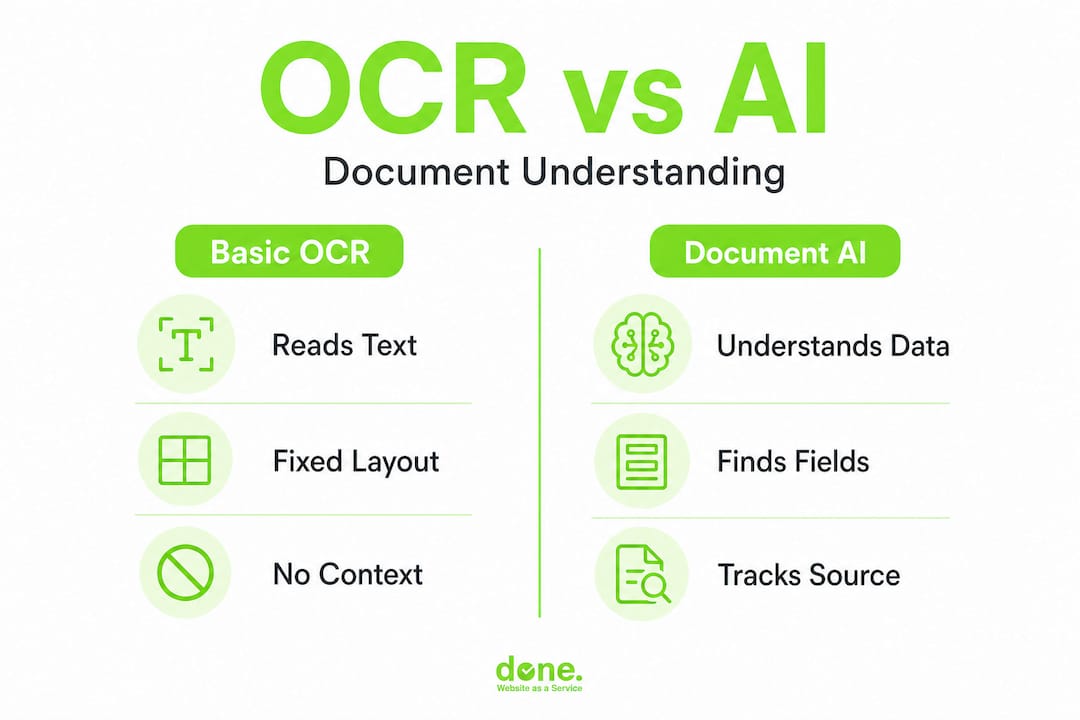
For European SMEs, this distinction matters enormously. Operating within frameworks such as GDPR, VAT directives, and sector-specific rules in finance, healthcare, and legal services means that your document workflows carry real regulatory weight. “Automation” in the broadest sense might mean a script that moves a PDF from one folder to another. Document processing AI, done properly, means a system that extracts the right data, from the right place, with a traceable record of how it got there.
The four core business problems that document processing AI addresses are:
- Time costs: Manual data entry from invoices and contracts is slow and scales poorly. A member of staff spending three hours per day on document processing is not available for higher-value work.
- Human error: Even diligent teams make transcription mistakes. A misplaced decimal on an invoice or a missed clause in a contract can create financial or legal exposure.
- Compliance and audit risk: Regulators expect you to know where your data came from and how it was handled. Without a clear extraction trail, you cannot demonstrate this.
- Scalability: As your document volumes grow, a manual or basic automated process does not scale gracefully. AI-based systems can handle dramatically higher volumes without proportional cost increases.
Understanding AI change management for SMEs is also essential here, because adopting document AI is as much an organisational challenge as a technical one. Teams need to trust the system and understand what it is doing.
“Benchmarks designed for document parsing (not just text similarity) highlight distinct failure modes like table/visual grounding and content faithfulness that directly affect whether extracted data is actionable for AI agents.” — ParseBench
This is a vital point. A system that performs well on a generic text similarity test may still fail when confronted with a real invoice containing merged table cells, multi-column layouts, or scanned images with variable quality. European SMEs need to measure AI performance against realistic document types, not idealistic test cases. The same rigour applies when considering AI in digital marketing, where output quality directly affects business outcomes.
Key features and evaluation criteria for document processing AI
Having laid the groundwork, it is crucial to understand which technical criteria and features distinguish genuinely robust document processing AI from surface-level automation. Not all tools are equal, and the feature gap between a basic optical character recognition (OCR) tool and a purpose-built document AI platform is significant.
Essential features to look for
When evaluating any document processing AI solution, prioritise these capabilities:
- Table and visual grounding: The system should accurately extract data from tables, including those with merged cells, irregular column widths, or embedded images. Many tools fail here on real-world documents.
- Content faithfulness: Extracted values must match the source document precisely. This prevents the AI from “hallucinating” plausible-sounding but incorrect figures, a particular risk with large language models used in document parsing.
- Audit traceability: Every extracted value should link back to the exact location in the source document where it was found. This is your compliance safety net.
- Semantic formatting: The output should preserve the meaning and structure of the original document, not just the raw text.
- GDPR-compatible data handling: The AI must process and store document data in a way that conforms to EU privacy law.
For AI tools for document reporting, these features are not optional extras. They are the baseline for any solution that will be used in a compliance context.
OCR vs document processing AI: a practical comparison
| Feature | Basic OCR | Document processing AI |
|---|---|---|
| Text extraction | Yes (printed text only) | Yes (printed, handwritten, structured) |
| Table extraction | Limited or none | Full, with cell-level traceability |
| Data structuring | No | Yes, fields mapped to schema |
| Error detection | No | Yes, confidence scoring |
| Audit trail | No | Yes, source-linked extractions |
| GDPR compliance tools | No | Yes (varies by vendor) |
| Handles poor scan quality | Poor | Significantly better |
| Integration with business systems | Manual | API-driven, automated |
The gap is stark. Basic OCR reads characters; document AI understands context. For best AI tools for SMEs, this context-awareness is what separates tools that add real value from those that create new problems.
For audit and compliance-heavy workflows, which are common for EU SMEs handling invoices, HR forms, and regulatory submissions, you should prefer traceability measurement over evaluations that only check for correct-looking output values. A figure that looks right is not the same as a figure you can prove is right.

Pro Tip: When requesting a demonstration from any document AI vendor, ask them to process one of your own document types, such as a real invoice format or a contract template, and show you how each extracted field is linked back to its source location. If they cannot demonstrate this clearly, the audit trail is likely weak.
How to select and implement document processing AI for your SME
Now that you know what makes a document AI platform enterprise-ready, here is how to evaluate and introduce one without disrupting your operations. A structured approach reduces risk and increases the probability of a successful rollout.
A step-by-step implementation framework
-
Define your document types and use cases. Start by cataloguing the documents your business processes most frequently: purchase invoices, supplier contracts, employee onboarding forms, compliance filings. Prioritise those with the highest volume or greatest compliance risk.
-
Assess your compliance requirements. Identify which regulations apply to your document types. Under GDPR, for example, any document containing personal data must be processed with documented lawful basis. Sector-specific rules in finance or healthcare add further obligations. Build these into your evaluation criteria from the start.
-
Shortlist tools based on your criteria. Use the feature checklist from the previous section to filter vendors. Eliminate any that cannot demonstrate audit traceability or that rely solely on basic OCR as their extraction engine.
-
Run benchmarks on real documents. Do not rely on vendor-supplied test results. Benchmarks like ParseBench emphasise omissions, hallucinations, and traceability to source locations for auditability. Test using anonymised versions of your actual documents to get a realistic picture of performance.
-
Pilot with a low-risk, high-volume document type. Choose a document category that is frequent but not business-critical for your pilot. Supplier invoices are often ideal: high volume, structured format, and easily cross-checked against your accounts payable records.
-
Review integration requirements. A document AI tool in isolation creates as many problems as it solves. It needs to feed data into your ERP, accounting software, CRM, or case management system. Confirm API availability and review what technical resource the integration will require.
-
Scale based on pilot outcomes. Use the pilot to identify failure modes and refine your extraction configuration before rolling out to higher-stakes document types.
Understanding how to start using AI tools in SMEs gives you a broader strategic context for this kind of phased adoption. It also connects to wider opportunities, such as AI-powered content generation, where the same discipline of piloting and benchmarking applies.
A recent industry estimate suggests that SMEs with structured document processing workflows reduce administrative overhead by 30 to 50 per cent compared to those relying on manual data entry. This is not a trivial gain. For a business with five to fifty employees, reclaiming even ten hours per week of staff time translates directly to capacity for growth.
Pro Tip: Always test your shortlisted AI solutions on real, anonymised company documents before signing any contract. Vendor demo documents are almost always chosen to showcase best-case performance. Your real documents, with their irregular layouts, mixed scan quality, and unique field structures, will reveal the true capability of the system.
Common pitfalls and advanced tips for SME document AI adoption
With an implementation plan in hand, it pays to be alert to pitfalls and pursue ongoing improvements. Most SMEs that struggle with document AI do not fail because the technology is wrong. They fail because of how the technology is chosen and managed.
The most common failure modes
- Relying on generic models. A large language model trained on internet text is not the same as a document AI system trained on structured business documents. Generic models often produce output that looks correct but lacks the field-level precision required for accounting, legal, or HR documents.
- Weak audit trails. If your system cannot tell you exactly which line of which page a value was extracted from, you have a compliance gap. This becomes critical the moment a regulator or auditor asks you to justify a figure.
- Skipping real-world testing. As noted above, vendor benchmarks are not a substitute for testing on your own documents. Real-world documents are messier, more varied, and more likely to expose extraction weaknesses.
- Ignoring EU data privacy rules. Many cloud-based AI tools route document data through servers outside the EU. This can create GDPR violations without any deliberate wrongdoing. Always verify where your document data is processed and stored.
- Focusing on best-case scenarios. Evaluate AI tools on your hardest documents, not your easiest. If the tool struggles with a poorly scanned form or a non-standard invoice layout, that is where errors will accumulate.
“Benchmarks designed for document parsing highlight distinct failure modes like table/visual grounding and content faithfulness that directly affect whether extracted data is actionable for AI agents.” — ParseBench
These failure modes are not theoretical. We see them regularly in businesses that have already invested in document automation and are now questioning why their error rates remain high or why they struggled during a recent audit.
Advanced tips for sustained success
Build a continuous feedback loop. Designate a member of your team to review AI-extracted data regularly, particularly for high-stakes document types. Feed corrections back into your system configuration or report them to your vendor. Over time, this improves extraction accuracy significantly.
Invest in staff upskilling. Your team should understand what the AI is doing well enough to spot obvious errors. This is not about replacing human judgement. It is about creating a productive partnership between your staff and the AI system. Reviewing a structured approach to digital document automation for SMEs can help you build this culture systematically.
Cross-check AI results for high-stakes documents. For contracts, tax filings, or regulatory submissions, maintain a human review step. AI handles the extraction; a human confirms the output before it is acted upon. This is not a sign that your AI is failing. It is sound risk management.
Align your document AI strategy with your broader AI roadmap. Document processing is often the starting point for a wider AI adoption journey. A clear AI strategy for SME efficiency ensures that your document AI investment connects to larger operational and commercial goals.
The overlooked truth: why traceability is your document AI’s superpower
Many SMEs approach document processing AI as a pure accuracy problem. They want the right values extracted, and they measure success by whether the output matches the source document. This framing is understandable but incomplete, and in a regulated European business environment, it can leave you genuinely exposed.
Consider what actually happens when something goes wrong. A supplier invoice is processed with an incorrect VAT amount. The error passes through your accounts payable, appears in your quarterly VAT return, and surfaces only when the tax authority queries a discrepancy six months later. In this scenario, accuracy alone does not save you. You need to be able to show exactly where the extracted figure came from, why the system produced it, and what steps were in place to detect errors. Without traceability, you are left explaining a process you cannot fully reconstruct.
Benchmarks like ParseBench emphasise omissions, hallucinations, and traceability to source locations precisely because these are the factors that determine whether an AI system is genuinely auditable or merely accurate in normal conditions. The distinction matters enormously when conditions are not normal.
The counterintuitive insight here is this: a document AI system with slightly lower raw accuracy but full traceability is far more valuable to a compliance-conscious SME than a system with marginally higher accuracy and no traceable output. With traceability, errors are detectable and correctable. Without it, errors are invisible until they become problems.
We advise clients to treat traceability as the first selection criterion, not an afterthought. Build for auditability first, then optimise for speed and volume. This is your insurance policy. It protects you not just during audits but in any dispute, contract review, or regulatory query where you need to demonstrate that your data is what you say it is.
An SME working with an AI consulting for SMEs partner can assess their current document workflows against this traceability standard and identify gaps before they become liabilities. That investment in review and planning pays dividends the first time a difficult question is asked by an auditor or a counterparty.
Ready to transform your documents? Explore AI solutions for SMEs
With the right knowledge, the final step is to put smart solutions into action. Document processing AI is not a distant aspiration for large enterprises. It is accessible, practical, and increasingly essential for European SMEs that want to stay competitive and compliant.

At Done.lu, we work with SMEs across Luxembourg and Europe to assess their document workflows, identify the right AI tools, and implement solutions that are GDPR-compliant, traceable, and genuinely suited to their operational needs. Whether you are just starting to explore your options or ready to move quickly, our team can guide you from initial audit through to full deployment and staff training. Explore our thinking on AI for SME growth, see how AI consulting for SMBs can reshape your operations, or browse our recommendations for top AI tools for SMEs to find your starting point.
Frequently asked questions
What is the difference between OCR and document processing AI?
OCR simply reads and transcribes text from a scanned image, while document processing AI extracts structured data, maps it to defined fields, tracks context, and provides audit traceability. As distinct failure modes like table grounding and content faithfulness show, OCR alone cannot deliver the reliability that compliance-heavy workflows require.
Why is traceability crucial for document processing in European SMEs?
Traceability links every extracted data value back to its source location in the original document, which is essential for audit trails and demonstrating regulatory compliance. For audit and compliance workflows, measuring traceability and grounding is far more reliable than evaluating only whether output values appear correct.
How can I test if a document AI solution is reliable?
Run benchmarks using real, anonymised business documents that represent your actual document mix, checking for faithfulness, traceability, and error rates under realistic conditions. Benchmarks emphasising omissions and traceability to source locations give you a far more honest picture than vendor-supplied test results.
What common mistakes should SMEs avoid with document processing AI?
The most damaging mistakes are relying on generic models that lack document-specific training, neglecting compliance features such as audit trails and GDPR-conformant data storage, and skipping real-world testing entirely. Distinct failure modes in document parsing, including table grounding and content faithfulness errors, are best discovered during structured pre-adoption benchmarking rather than after the system is live.