

Harnessing artificial intelligence in business for SME growth
April 30, 2026
How to onboard AI in your business for greater efficiency
May 1, 2026
TL;DR:
- Most Luxembourg SMEs overlook the essential process audit before adopting AI solutions.
- Government-funded programmes support SMEs in auditing, strategizing, and implementing automation at up to 50% subsidy.
- Focus on high-impact, multilingual workflows and treat automation as an ongoing improvement process.
Most Luxembourg SMEs could unlock significant operational gains through subsidised AI consulting, yet the majority overlook the single most important first step: a targeted process audit. The Fit 4 AI and Fit 4 Digital programmes from Luxinnovation provide up to 50% subsidy on AI consulting, covering audits, roadmaps, and the identification of operational inefficiencies. That is a genuinely accessible entry point, and yet uncertainty about where to start prevents many business owners from acting. This guide cuts through that confusion and gives you a clear, practical framework for automating your Luxembourg business with confidence.
Table of Contents
- The automation landscape in Luxembourg: Key drivers and challenges
- Fit 4 AI and local funding: How to leverage Luxembourg’s SME-focused schemes
- Selecting high-impact processes: Auditing before automating
- AI Factory and implementation: From assessment to real-world results
- What most SMEs misunderstand about AI automation in Luxembourg
- Take the next step: Partner solutions for automation and digital growth
- Frequently asked questions
Key Takeaways
| Point | Details |
|---|---|
| Subsidised AI audits | Luxinnovation funds up to 50% of AI audit costs for business automation in Luxembourg. |
| Start with process audit | Auditing your core operations helps reveal the areas with most automation potential and ROI. |
| Expert end-to-end support | Luxembourg AI Factory and partners guide you from assessment to compliant AI implementation. |
| Multilingual optimisation | Local automation solutions address Luxembourg’s unique multilingual business communication needs. |
| Continuous improvement | Automation is most effective when treated as an ongoing process, not a one-time project. |
The automation landscape in Luxembourg: Key drivers and challenges
Having set expectations, let’s look at the local landscape shaping the approach to automation in Luxembourg.
Luxembourg occupies a distinctive position in the European business ecosystem. It is a small, highly internationalised economy with a sophisticated financial services sector, a growing technology cluster, and a workforce that routinely operates across three or four languages. For SMEs, this creates both pressure and opportunity. The pressure comes from competing with larger, better-resourced organisations that have already invested in automation. The opportunity comes from a government that has made digital transformation a national priority and backed that commitment with real funding.
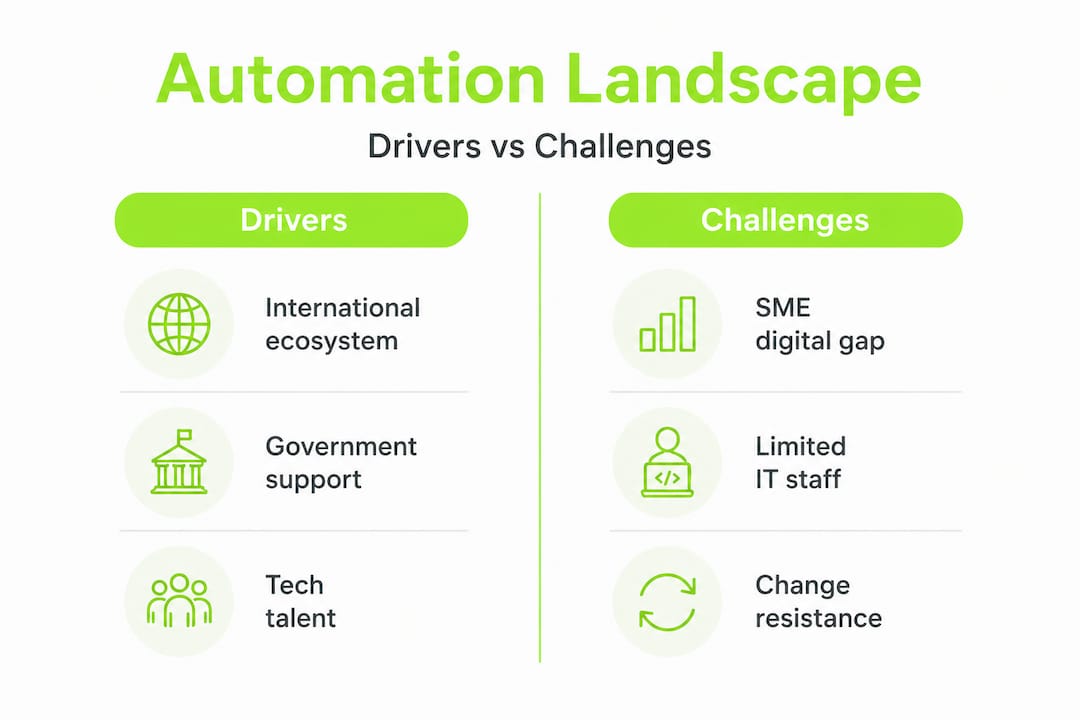
Despite these advantages, many SMEs face a persistent digitalisation gap. Common obstacles include limited internal IT expertise, uncertainty about which processes to automate first, and genuine concern about GDPR compliance when adopting cloud-based AI tools. Understanding the digital marketing benefits for SMEs is one area where this gap is felt acutely, because marketing automation often produces fast, measurable results that build internal confidence for broader AI adoption.
Luxembourg’s multilingual environment adds a layer of complexity that is often underestimated. A typical SME might handle invoices in French, client communications in German, and internal reports in English. Manual processing across these language combinations is time-consuming and error-prone. Automation tools that can handle multilingual document classification, translation support, and templated communications represent a high-value starting point for many local businesses.
Here are the key challenges and advantages that currently define the automation landscape for Luxembourg SMEs:
- Digitalisation gaps: Many SMEs rely on manual workflows for invoicing, email management, and reporting, creating bottlenecks that reduce overall productivity.
- Government support: Luxembourg’s national AI strategy is backed by programmes that directly fund SME transformation, reducing the financial risk of starting.
- Multilingual complexity: Operating in French, German, Luxembourgish, and English simultaneously creates unique automation opportunities in document and communication handling.
- Compliance concerns: GDPR and the EU AI Act create legitimate considerations around data handling, but also provide a structured framework for responsible AI adoption.
- Skills shortage: Finding in-house AI expertise remains difficult, making external consulting support both practical and cost-effective.
“The Chamber of Commerce has consistently emphasised that coordination across teams and sectors is essential for AI adoption to translate into genuine productivity gains, rather than fragmented, siloed efforts that deliver minimal return.”
Understanding the SEO strategies for Luxembourg businesses is also relevant here, because visibility and automation are increasingly interlinked. Businesses that automate their content production and digital marketing workflows gain a compounding advantage over those that continue to manage these processes manually.
Fit 4 AI and local funding: How to leverage Luxembourg’s SME-focused schemes
With the landscape in focus, here’s how to tap specific support available for Luxembourg SMEs.
The Fit 4 AI and Fit 4 Digital programmes represent the most accessible funding route for SMEs beginning their automation journey. Administered by Luxinnovation, these programmes grant 50% subsidy for AI audits, strategic roadmaps, and the identification of process inefficiencies. In practice, this means a business can engage a qualified AI consultant for a fraction of the standard cost, with the government co-financing the diagnostic work.
Understanding exactly how these programmes function is essential before you apply. The table below summarises the main support options available to Luxembourg SMEs:
| Programme | Support type | Subsidy level | Eligibility criteria |
|---|---|---|---|
| Fit 4 AI | AI audit and roadmap | Up to 50% | Luxembourg-based SME, commitment to digital innovation |
| Fit 4 Digital | Digital transformation consulting | Up to 50% | Luxembourg-based SME, no prior digital grant in 12 months |
| AI Factory | End-to-end implementation support | Variable | SME or startup, EU AI Act compliance required |
| Digital Chèque | Voucher for digital tools | Fixed amount | Micro-enterprise or SME, registered in Luxembourg |
Each programme has specific application windows and documentation requirements, so early engagement with Luxinnovation is strongly recommended. The process typically unfolds as follows:
- Initial enquiry: Contact Luxinnovation directly or work with an approved consulting partner to assess your eligibility. A brief description of your business, headcount, and sector is usually sufficient for an initial eligibility check.
- Pre-diagnostic session: Before a formal audit, most programmes require a short pre-diagnostic meeting. This session helps frame the scope of the audit and identifies the business areas most likely to benefit from automation.
- Formal audit: A qualified consultant conducts a structured review of your operations, documenting inefficiencies, mapping existing workflows, and identifying automation opportunities with the highest potential return on investment (ROI, meaning the financial gain relative to the cost of implementing a solution).
- Roadmap development: The consultant produces a prioritised roadmap, recommending specific tools, workflows, and implementation sequences. This document forms the basis of your funding application.
- Grant application and approval: With the roadmap in hand, you submit your grant application through Luxinnovation. Approved businesses receive co-financing for implementation costs based on the approved scope.
Working with an experienced digital consulting for growth partner at the pre-diagnostic stage significantly increases the quality of your roadmap and the strength of your funding application.
Pro Tip: Engage your consulting partner before contacting Luxinnovation. A well-prepared pre-diagnostic submission significantly shortens the time from enquiry to approved funding, because consultants who regularly work within these programmes understand exactly what auditors are looking for.
Selecting high-impact processes: Auditing before automating
Once you know what funding exists, it’s time to ensure effort is focused where it counts most.
The single most common mistake SMEs make when starting automation projects is selecting tools before completing a process audit. It is tempting to adopt a popular workflow automation platform or AI chatbot because a competitor is using one, without first establishing whether it solves an actual problem in your specific business context. A process audit changes this dynamic entirely. It replaces assumption with evidence, and ensures that the automation budget, subsidised or otherwise, is directed at processes that genuinely constrain your growth.

Prioritising a process audit via Fit 4 AI before committing to any tool or platform is strongly recommended across Luxembourg’s SME support ecosystem, specifically to target high-ROI areas such as multilingual document processing and email management.
The comparison table below illustrates the contrast between manual and automated workflows for three processes commonly identified as high-priority during SME audits:
| Process | Manual approach | Automated approach | Typical time saving |
|---|---|---|---|
| Multilingual invoice processing | Staff manually reads, translates, and enters data | AI extracts, classifies, and routes invoices by language | 60 to 80% reduction in processing time |
| Customer email triage | Staff reads and categorises each email | AI classifies by topic and urgency, assigns to correct team | 40 to 60% reduction in response time |
| Contract document review | Legal or admin staff reviews each document manually | AI flags key clauses, anomalies, and missing fields | 50 to 70% reduction in review time |
These figures are illustrative, but they reflect the order of magnitude of gains that businesses regularly achieve when automation is applied to the right processes. The key phrase is “the right processes.” Automating a process that is already efficient wastes money. Automating a bottleneck that affects ten people every day delivers immediate, visible returns.
When conducting or commissioning a process audit, focus on the following areas:
- Multilingual invoicing and accounts: Identify which languages your invoices arrive in, how many staff are involved in processing them, and what error rates currently exist.
- Email and enquiry management: Map how incoming communications are routed, how long responses take, and where bottlenecks occur during peak periods.
- Document generation and approval: Review how contracts, proposals, and compliance documents are created, reviewed, and signed off.
- Reporting and data aggregation: Identify which reports are generated manually, how long they take, and whether the data sources could be connected automatically.
- HR and onboarding workflows: Assess the volume of repetitive administrative tasks associated with hiring, onboarding, and staff record management.
Understanding how digital marketing drives higher leads is another area worth assessing during an audit, because marketing processes are frequently among the most labour-intensive and most amenable to automation. Similarly, digital marketing tips for startups highlight how even early-stage businesses can benefit from automated campaign management and lead nurturing workflows.
Pro Tip: Resist the urge to automate everything at once. Change fatigue, where staff become overwhelmed by simultaneous shifts in how they work, is a real risk that can undermine even a well-funded automation project. Introduce automation in phases, starting with one or two high-impact, low-disruption processes, and build from there once your team is comfortable.
AI Factory and implementation: From assessment to real-world results
With priorities set, here’s how implementation unfolds and the partners that smooth the path.
The Luxembourg AI Factory is a structured support ecosystem specifically designed to guide SMEs from initial AI maturity assessment through to live implementation and ongoing compliance. The AI Factory offers end-to-end support, covering maturity assessments, proof-of-concept (PoC) development, EU AI Act compliance, and access to funding, drawing on the collective expertise of LuxProvide, Luxinnovation, the University of Luxembourg (Uni.lu), and the Luxembourg Institute of Science and Technology (LIST).
This is a genuinely significant resource. Most SMEs approach AI implementation without a clear sense of where they currently stand in terms of AI readiness. The maturity assessment corrects this by evaluating your data infrastructure, team capabilities, existing technology stack, and governance frameworks. The output is a realistic picture of what you can implement now and what needs to be built first.
The implementation journey within the AI Factory framework typically follows these steps:
- AI maturity assessment: A structured evaluation of your current data practices, technology infrastructure, and team AI literacy. This assessment produces a score that indicates your readiness for different types of AI deployment.
- Use case identification: Based on the audit outcomes and maturity assessment, consultants identify two or three specific use cases where AI implementation is both feasible and likely to deliver measurable business value.
- Proof of concept (PoC): A small-scale, time-limited test of the selected AI application in your actual business environment. The PoC validates the technology and builds internal confidence before full deployment.
- EU AI Act compliance review: Before any AI system is deployed at scale, it must be assessed against the requirements of the EU AI Act. This regulation categorises AI applications by risk level and imposes corresponding compliance obligations. The AI Factory provides expert guidance on navigating this requirement.
- Full deployment and team training: Following a successful PoC and compliance clearance, the solution is deployed at scale. Team training is embedded in this phase to ensure adoption rates are high and the technology is used effectively.
“Luxembourg’s AI Factory model is particularly valuable because it connects SMEs to world-class research and infrastructure, specifically through LuxProvide’s high-performance computing resources and LIST’s applied research capabilities, reducing the gap between cutting-edge AI and everyday business application.”
Consider a practical example. A Luxembourg-based accountancy firm operating across French and German-language clients faced significant delays in processing multilingual client correspondence and generating quarterly reports. Following a Fit 4 AI audit, the firm identified document classification and email triage as its highest-ROI automation targets. A PoC using an AI document processing tool reduced document handling time by 65% within eight weeks. The firm then engaged its team in a structured training programme, ensuring all staff could interpret AI outputs and escalate edge cases appropriately.
Understanding how AI in digital marketing creates measurable uplift in campaign performance is increasingly relevant as implementation matures. Firms that automate operational processes first often find that marketing automation becomes the natural next phase, building on the data infrastructure and team confidence developed during earlier implementation. Ensuring AI GDPR compliance throughout this journey is non-negotiable, particularly for businesses handling client financial or personal data.
What most SMEs misunderstand about AI automation in Luxembourg
Having seen the practical framework, it is time to address a few stubborn misconceptions that regularly hold Luxembourg SMEs back from achieving the gains that automation genuinely offers.
The first and most persistent myth is that any automation is good automation. Business owners sometimes assume that because a process is repetitive, it is automatically a good candidate for AI. This is not accurate. A process that is performed infrequently, requires high levels of judgement, or involves sensitive human interaction may cost more to automate than it saves. The return on investment calculation must be done carefully, and the audit step exists precisely to prevent wasted effort and expenditure.
The second misconception concerns team coordination. Many SMEs treat automation as a technology decision rather than an organisational one. They select and implement a tool without adequately involving the teams who will use it. The result is low adoption, workarounds, and eventual abandonment of perfectly functional technology. As the Chamber of Commerce and Fedil have both highlighted, coordination across departments and sectors is essential for AI adoption to translate into genuine productivity improvement rather than fragmented, poorly integrated efforts that deliver minimal return and generate staff frustration.
The third misconception is treating automation as a one-time project rather than a continuous process. Businesses that automate a workflow and then leave it unchanged for two years often find that the initial gains erode as their operations evolve. Automation requires periodic review, adjustment, and expansion. The most effective approach frames automation as an ongoing improvement methodology, not a one-off implementation exercise.
We have seen this play out repeatedly across our work with Luxembourg SMEs. The businesses that achieve lasting results from AI consulting for operational growth are those that adopt a structured, iterative mindset: audit, implement, measure, adjust, and repeat. They treat each automation cycle as a source of new data that informs the next improvement.
The fourth, and perhaps most overlooked, misconception is that Luxembourg’s unique support infrastructure is primarily for large enterprises or technology companies. It is not. The Fit 4 AI and AI Factory frameworks were designed specifically with SMEs in mind. A ten-person professional services firm is as eligible as a fifty-person logistics company. The barrier is not eligibility; it is awareness and the confidence to take the first step.
Automation done well does not replace people. It removes the low-value, repetitive tasks that consume time and reduce job satisfaction, freeing your team to focus on the work that genuinely requires human judgement, creativity, and client relationship management. That is the right framing, and it is one that Luxembourg’s support ecosystem is built to help you realise.
Take the next step: Partner solutions for automation and digital growth
You have now got a clear roadmap for automating your Luxembourg business: understand the landscape, access the available funding, audit your processes before selecting tools, and implement with the right partners. The next step is getting the right support to put it into practice.
At Done.lu, we specialise in guiding Luxembourg SMEs through exactly this journey. From initial process audits and funding application support to AI tool selection, implementation, and team training, our approach is built on the same audit-first, human-centred principles outlined throughout this article. Our AI consulting for SMEs service is structured to help you identify the highest-ROI opportunities in your business and implement solutions that your team will actually use. Our digital consulting in Luxembourg offering covers the full spectrum from web presence to workflow automation. For those ready to explore specific tools, our curated guide to AI tools for business success provides a practical starting point. Contact us for a bespoke consultation and take the first concrete step towards a more efficient, competitive business.
Frequently asked questions
What qualifies an SME in Luxembourg to access Fit 4 AI subsidies?
An SME must be Luxembourg-based and demonstrate commitment to digital innovation, usually through a structured process audit. The Fit 4 AI programme covers up to 50% of eligible AI audit and roadmap costs for qualifying businesses.
Is AI automation compatible with multilingual requirements in Luxembourg businesses?
Yes, automation projects frequently target multilingual document and email processes specifically because these are among the most labour-intensive workflows in Luxembourg SMEs. Prioritising these areas during the Fit 4 AI audit phase consistently delivers the strongest early returns.
Who provides end-to-end AI support for SMEs in Luxembourg?
The Luxembourg AI Factory supports SMEs from maturity assessment through to EU AI Act compliance and funding access, working with LuxProvide, Luxinnovation, Uni.lu, and LIST as delivery partners.
What is the typical first step to start automating your business in Luxembourg?
The best first step is a structured process audit, which identifies the specific workflows that will deliver the highest return on automation investment before any tool selection or implementation begins.