

Predictive analytics SMB: a practical guide for 2026
May 20, 2026
Team AI adoption: a practical guide for SMBs
May 22, 2026
TL;DR:
- Most SMEs struggle with AI adoption due to unstructured upskilling and lack of readiness.
- A deliberate, role-specific training approach with champions and proper measurement boosts productivity gains.
Most SME leaders feel the pressure. AI tools are being adopted faster than any previous workplace technology, yet only 8% of European SMEs have truly embedded them, while those who get it right report 15 to 25% productivity gains within a year. The gap is not the technology. It is the readiness of the people using it. Upskilling AI tools without a structured approach leaves teams frustrated, budgets wasted, and leadership wondering why the ROI never materialised. This guide gives you a clear, practical path from assessment through execution to proving the business case.
Table of Contents
- Key takeaways
- What you need before starting an AI upskilling programme
- How to implement AI upskilling step by step
- Common pitfalls in AI upskilling and how to avoid them
- Measuring the ROI of AI upskilling
- Sustaining AI upskilling excellence over time
- My honest take on what actually works
- How Done can help you upskill with AI
- FAQ
Key takeaways
| Point | Details |
|---|---|
| Assess before you invest | Map your team’s current AI knowledge gaps before selecting any training solutions or tools. |
| Upskilling is business infrastructure | Treat AI competency development as a core operational need, not a one-off HR event. |
| Start with champions | Train one or two team members first to pilot tools and build peer learning before a wider rollout. |
| Measure what matters | Track task speed, output quality, and hours redirected, not just course completion rates. |
| Pace it realistically | A 10-person SME needs 20 to 40 hours of structured training over four to eight weeks to reach a useful level of AI proficiency. |
What you need before starting an AI upskilling programme
Many SMEs jump straight to purchasing licences or signing up for training platforms. The teams who get the best results start with a clear picture of where they actually stand.
Audit your current skills honestly. Ask each team member to rate their comfort with AI tools across a few specific areas: writing prompts, evaluating AI output, selecting the right tool for a task, and handling data responsibly. You do not need a formal psychometric test. A short survey or a 15-minute team conversation will surface the gaps you need to address. AI skill-building is not only technical. Most staff need proficiency in prompt engineering, workflow integration, and output evaluation, not software development.
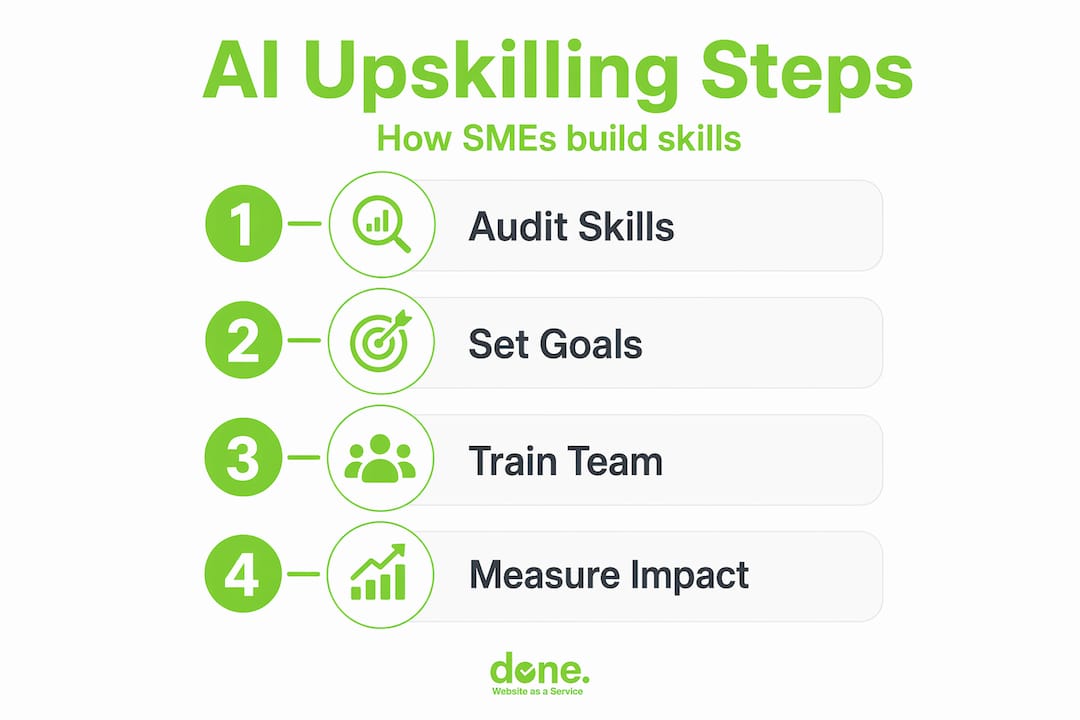
Set goals that tie to real business outcomes. Vague ambitions like “get the team using AI more” will not hold budget conversations or sustain momentum. Instead, define goals such as: reduce first-draft content time by 40%, automate three recurring administrative tasks by Q3, or have 80% of staff AI-proficient within 90 days. These specifics give you something to measure and give your team something to aim for.
Choose tools that match your actual work processes. Not every AI platform suits every SME. A legal or financial services firm in Luxembourg has different requirements from a marketing agency or a logistics company. Consider budget, GDPR compliance, and whether the tool integrates with what you already use.
Here is what to clarify before committing to any AI training solution:
- Which roles will benefit most immediately from AI assistance?
- What tasks currently consume the most time and could be partially automated?
- What is your realistic training budget? A complete upskilling programme for a 10-person SME typically costs between €1,400 and €4,600 and requires 20 to 40 hours over four to eight weeks.
- Who in the team already shows interest or aptitude for learning AI technologies?
- How will you handle data privacy and misuse guidelines from the start?
Pro Tip: NIST recommends a risk-based approach with Human-in-the-Loop principles embedded from the beginning of any AI training programme. Build incident management and misuse guidelines into your onboarding material, not as an afterthought.
Building internal AI champions at this stage matters enormously. Identify one or two employees who are curious, influential, and willing to be the first to test tools. They will become your knowledge hubs, your advocates, and your early-warning system for problems before a wider rollout.
How to implement AI upskilling step by step
Once you have done your assessment and defined your goals, the implementation itself should follow a deliberate sequence. Here is the process that works reliably for SMEs, drawn from experience across dozens of team upskilling projects.
-
Start with free AI literacy resources for all staff. Before anyone touches a paid tool, give the whole team a shared baseline. Resources from Google, Microsoft, and platforms such as Coursera or LinkedIn Learning provide solid introductions to AI concepts without cost. Two to three hours here prevents confusion later.
-
Allocate structured time weekly. The productivity paradox occurs when AI platforms are deployed faster than people can absorb them. Counter it by protecting three to five hours per person per week during the upskilling phase. Block this in calendars and treat it as non-negotiable.
-
Map training directly to real tasks. In-the-flow learning, where staff practise AI skills on their actual daily work, is consistently more effective than purely theoretical training. A sales executive should practise using AI to draft client proposals. A finance manager should test AI for report summarisation. The learning sticks because it is immediately useful.
-
Create role-specific learning paths. Not everyone needs the same programme. Marketers benefit most from AI content and campaign tools. Finance roles gain most from data summarisation and document processing. Sales teams benefit from CRM-linked AI assistants. Segmenting training by role improves both engagement and speed of adoption.
-
Give AI champions extended, advanced training. Your identified champions should go deeper. They need to understand tool configuration, data security basics, and how to train colleagues. This investment pays back when they become the internal resource your team turns to rather than getting stuck.
-
Build peer learning into the process. Weekly 20-minute team check-ins where someone shares what they tried with AI that week create a culture of knowledge-sharing. Assign small AI project tasks and ask teams to present what worked and what did not.
-
Publish a simple internal tool guide. A one-page reference showing which AI tool to use for which purpose removes daily friction. It does not need to be elaborate.
Pro Tip: When building your AI skill-building programme, aim for 80% of your staff reaching a working level of AI proficiency within 90 days. That threshold is where cumulative productivity gains become visible at team level.
Here is a simple reference framework for role-based tool allocation:
| Role | Primary AI use case | Example tool category |
|---|---|---|
| Marketing | Content drafting, campaign planning | AI writing and ideation tools |
| Sales | Proposal drafting, CRM summaries | Conversational AI assistants |
| Finance | Report summarisation, data extraction | Document processing AI |
| Operations | Workflow automation, scheduling | Process automation platforms |
| Leadership | Data analysis, strategic briefings | AI analytics and dashboards |
Common pitfalls in AI upskilling and how to avoid them
Even well-intentioned programmes stumble in predictable ways. Knowing where teams go wrong is half the battle.
-
Treating upskilling as a one-off event. AI tools update constantly. A training session from six months ago may already be partly outdated. 52% of tech professionals actively seek independent learning because formal programmes do not keep pace. Build quarterly refreshers and monthly update briefings into your plan from the start.
-
Measuring vanity metrics. Course completion rates feel reassuring but tell you almost nothing about real-world improvement. SMEs that track only completions consistently overestimate the impact of their AI training solutions and underdeliver on productivity gains. Measure task speed, output quality, and hours redirected to higher-value work instead.
-
Ignoring change resistance. Some team members will feel threatened by AI tools, worrying about job security or feeling inadequate. Dismissing these concerns accelerates resistance. Address it directly: be clear that the goal is to make their work easier, not to replace their role.
-
Setting expectations that are too high, too soon. AI does not transform a team overnight. ROI becomes measurable within three to six months, but full business impact typically takes six to twelve months to appear clearly. Leaders who expect dramatic results in the first month create pressure that derails the programme.
-
Skipping the human oversight layer. AI outputs require human review, especially in regulated sectors. Implementing Human-in-the-Loop accountability is not a bureaucratic formality. It is how you prevent costly errors and maintain compliance under GDPR and sector-specific regulations.
“Upskilling is fundamental business infrastructure, not an HR perk. It must be integrated into workflow and tracked for real outcomes — not left to individuals to figure out on their own.”
Managing these pitfalls requires someone accountable. Assign ownership of the upskilling programme to a specific manager or champion rather than leaving it to the HR department alone. AI competency development works best when it sits close to operational leadership.
Measuring the ROI of AI upskilling
This is the section most SME leaders skip, and it is exactly why so many programmes lose momentum after the first quarter. Measuring impact properly is what keeps leadership engaged and budget flowing.

The most reliable framework covers four pillars:
| Pillar | What to measure | How to track it |
|---|---|---|
| Adoption | Percentage of staff actively using AI tools weekly | Tool usage dashboards and manager check-ins |
| Capability | Self-assessed and observed skill improvement | Before/after skill assessments |
| Productivity | Task completion speed and output volume | Time tracking and output logs |
| Business impact | Revenue influence, cost reduction, error rates | Financial reports and operational KPIs |
Establish a baseline before you start. This sounds obvious, but most teams do not do it. Record how long key tasks currently take. Note error rates. Capture output volumes. Without this data, you cannot make a credible comparison three months later.
Run a controlled pilot first. Train one team or department before rolling out company-wide. Compare their productivity metrics against an untrained group doing similar work. This gives you causal attribution, the ability to say confidently that the training drove the improvement, rather than just claiming a coincidence.
Convert improvements into monetary values. Proving AI training ROI requires a CFO-grade scorecard linking learning outcomes to financial metrics. The formula is straightforward: total benefits minus total costs, divided by total costs. Benefits include time saved multiplied by hourly cost, error reduction savings, and faster output delivery. Be conservative in your estimates. Under-promising and over-delivering builds credibility.
Pro Tip: Measure too early and you will see noise, not signal. ROI becomes measurable at three to six months for productivity gains, and six to twelve months for full business impact. Schedule your first serious review at the 90-day mark, using the baselines you set at the start.
Do not wait for a perfect measurement system before starting. A simple spreadsheet tracking time spent on key tasks before and after upskilling will reveal meaningful patterns if you record it consistently.
Sustaining AI upskilling excellence over time
Getting through the initial rollout is one challenge. Keeping the momentum alive is another. Here is what teams who sustain strong AI competency development over the long term actually do differently.
-
Champion-led rollout as the foundation. Training one or two technically curious employees first allows them to pilot tools, identify workflow-specific adjustments, and share practical insights before a wider rollout. This reduces adoption risk and makes the programme feel credible to sceptical colleagues, because the advice comes from a peer rather than an external consultant.
-
Integrate AI skills into annual professional development. AI competency should sit alongside communication, leadership, and project management in your annual review process. When it appears in development plans and performance conversations, it signals that improving AI skills is a genuine career priority, not an optional extra.
-
Budget for continuity, not just launch. Allocate budget for monthly AI tool update briefings and quarterly skill refreshers. The cost is modest compared to the alternative, which is watching skills atrophy as tools evolve and teams revert to old habits.
-
Build a sharing culture deliberately. Celebrate when someone finds a clever way to use AI on a task. Share it in a team meeting. Document it in your internal tool guide. Small acts of recognition compound into a culture where continuous learning feels normal.
-
Respect local compliance requirements. For SMEs in Luxembourg and across Europe, GDPR is not a background consideration. Any AI tool handling client data, employee information, or financial records must comply with data sovereignty requirements. For data-sensitive sectors, private on-premise AI deployment removes the ambiguity entirely. The AI strategies for European SMEs guide covers this in detail.
-
Point your team to quality resources. Platforms such as Google’s AI Essentials, Microsoft’s AI Skills Initiative, and sector-specific courses from providers like General Assembly and Coursera provide consistent, updated AI learning content. Curating a short list of recommended resources for your team removes the friction of deciding where to start.
My honest take on what actually works
I have worked with SME teams at various stages of AI adoption, and the pattern that leads to failure is almost always the same. Leadership gets excited about a tool, rolls it out to everyone at once, measures nothing meaningful, and declares victory based on the number of people who completed a training module. Six months later, half the team has reverted to their old workflow and nobody can explain why the ROI did not materialise.
What actually works is far less dramatic. Start with one or two curious people. Give them real time to experiment. Have them share what they discover with the rest of the team in a low-pressure format. Then build the programme out from there, slowly and deliberately.
The productivity paradox is real. When you deploy AI tools faster than people can genuinely absorb them, you do not get a productivity boost. You get confusion, workarounds, and quiet abandonment of the tools. Pacing the rollout to match the team’s learning curve is not a weakness. It is the strategy.
I also think the measurement piece is underrated. Most SME leaders skip baseline tracking because it feels administrative. But without it, you are asking leadership to keep investing in something you cannot prove is working. Three hours spent setting up a simple tracking sheet before training starts will save you months of budget justification conversations later.
The businesses I have seen succeed at this treat AI upskilling as they would treat a compliance obligation or a quality standard. Not optional, not dependent on enthusiasm, but built into how the business operates and reviewed regularly. Start small, measure early, and iterate.
— Thomas
How Done can help you upskill with AI
Done works with SMEs across Luxembourg and Europe to make AI adoption practical and measurable, not just aspirational. Our AI consulting approach starts with an honest audit of your team’s current capabilities and your business processes, then builds a structured upskilling plan tailored to your sector and budget.
We help you select the right AI tools for your business, integrate them into your existing workflows, and train your team in a way that sticks. For businesses in regulated sectors, we also offer private on-premise AI deployment that keeps sensitive data within your control and fully compliant with GDPR requirements.
If you want to understand where your team stands today and what a realistic AI upskilling roadmap looks like for your SME, explore our AI strategy consulting services. No generic recommendations. No setup fees. Just a clear plan built around your actual operations.
FAQ
What is AI upskilling and why does it matter for SMEs?
AI upskilling means training your team to use artificial intelligence tools effectively in their daily work. For SMEs, it matters because adopters report 15 to 25% productivity gains within a year, while teams without structured training rarely see those returns.
How long does it take to upskill a small team in AI tools?
A 10-person SME typically needs 20 to 40 hours of structured training over four to eight weeks to reach a working level of AI proficiency, with measurable productivity ROI appearing at three to six months.
What is a champion-led AI upskilling approach?
A champion-led approach trains one or two team members first to pilot AI tools and share findings before a wider rollout. It reduces adoption risk and makes the programme more credible to sceptical colleagues.
How do you measure the ROI of AI training?
Track four pillars: adoption rate, capability improvement, productivity gains, and business impact. Use the formula: total benefits minus total costs, divided by total costs. Always set a baseline before training starts.
Which AI skills do SME employees actually need?
Most employees do not need coding or technical AI knowledge. The skills that unlock immediate value are prompt engineering, AI tool selection, output evaluation, data privacy awareness, and workflow integration.