

Grow your business with machine learning: An SME guide
April 28, 2026
Workflow automation: A practical efficiency guide for SMEs
April 29, 2026
TL;DR:
- Most SMEs hesitate to adopt AI due to poor data quality and unclear business goals.
- Effective AI strategies involve thorough data audits, phased roadmaps, and strong change management.
- Regulatory fears are often overstated; most SME AI use cases fall into low-risk categories with minimal compliance barriers.
Most small and medium-sized enterprises across Europe already sense that AI could help them operate more effectively, yet 94% of German SMEs have not meaningfully adopted AI, and the majority of those that do attempt implementation walk away with little to show for it. The idea that AI is reserved for large corporations with dedicated data science teams is a persistent myth, and an expensive one. This guide walks you through the real reasons AI projects stall, what structured AI strategy consulting actually involves, how to handle compliance without fear, and how to measure genuine returns from your investment.
Table of Contents
- Why SMEs struggle with AI adoption
- What effective AI strategy consulting looks like
- Navigating data, compliance, and regulation: What SMEs need to know
- How SMEs can measure real ROI from AI initiatives
- A consultant’s perspective: Why most AI projects stumble and how to actually move the needle
- Ready to make AI work for your SME?
- Frequently asked questions
Key Takeaways
| Point | Details |
|---|---|
| Data quality is critical | Most AI failures in SMEs stem from poor or incomplete data, so a thorough data audit is the essential first step. |
| Start with clear KPIs | Success is driven by clear goals and measurable outcomes integrated into daily business workflows. |
| Regulation rarely blocks progress | For most SMEs, European AI rules are manageable and not the barrier many fear. |
| Human oversight matters | Keeping people involved, especially in critical decisions, boosts trust and AI success. |
| Consulting accelerates value | The right guidance helps SMEs leapfrog common pitfalls and achieve sustainable digital gains. |
Why SMEs struggle with AI adoption
AI adoption challenges are rarely about the technology itself. The tools have become genuinely accessible over the past two years, with cloud-based platforms, pre-trained models, and low-code interfaces making experimentation easier than ever. Yet 85 to 95% of AI pilots still fail, and when you look closely at why, the same root causes appear time and again.
The most common blockers SMEs face include:
- Poor data quality. Many SMEs are sitting on data that is fragmented, inconsistently labelled, or stored across incompatible systems. An AI model is only as good as the information it learns from. If your customer records are duplicated, your sales figures are spread across five spreadsheets, and your inventory data is updated manually once a week, no AI tool will produce reliable outputs.
- No clear KPIs or business objectives. A surprising number of pilot projects are launched without defining what success actually looks like. Teams install a tool, experiment with it for a few months, and then cannot demonstrate whether it delivered value. Without measurable goals, projects drift and budgets get cut.
- Integration gaps. Even when a tool works well in isolation, connecting it to existing systems, whether that is a CRM, an ERP, or a legacy accounting platform, is where things break down. Integration requires technical planning, API (application programming interface) compatibility checks, and often custom development work that was never budgeted.
- Skills gaps. Staff may lack the foundational digital literacy to adopt new AI-assisted workflows. This is not a failure of intelligence; it is a training and communication challenge that requires deliberate management.
- Regulatory anxiety. Many business owners hold back because they are uncertain about GDPR (General Data Protection Regulation) compliance, data sovereignty, or the implications of the EU AI Act. This caution is understandable but often prevents action in areas where risk is actually very low.
- Employee resistance. People worry about their roles being automated. Without clear communication from leadership, rumour and anxiety can undermine adoption even when the technology is solid.
Understanding these AI adoption challenges is the first step toward addressing them. The role of an AI strategy consultant is to uncover which specific combination of these factors is holding your business back, and to design a practical path forward that accounts for your actual resources, systems, and people.
“The biggest mistake we see SMEs make is purchasing an AI tool before they understand the problem they are trying to solve. Technology is never the starting point. The business outcome is.”
Pro Tip: Before evaluating any AI product or platform, write down the single business problem you want it to solve, and how you will measure whether it is solved six months from now. If you cannot answer both parts clearly, you are not ready to buy.
What effective AI strategy consulting looks like
A qualified AI strategy consultant does not arrive with a preferred tool and work backwards to justify it. The process is rigorous, structured, and grounded in your specific business context. Here is how an effective engagement typically unfolds.
-
Discovery and audit. The consultant reviews your current data infrastructure, your existing software stack, your team’s skill levels, and your primary business goals. This is not a superficial review. It involves mapping data flows, identifying where information is created, stored, and used across the business, and assessing data quality in practical terms. A structured process that begins with a data audit is consistently associated with lower failure rates across AI deployments.
-
Business goal alignment. This is where the consultant translates business priorities into specific AI use cases. For example, a logistics firm wanting to reduce delivery exceptions might prioritise predictive scheduling tools. A professional services firm wanting to reduce time spent on routine document review might explore AI-assisted contract analysis. The use case must connect directly to a measurable business outcome.
-
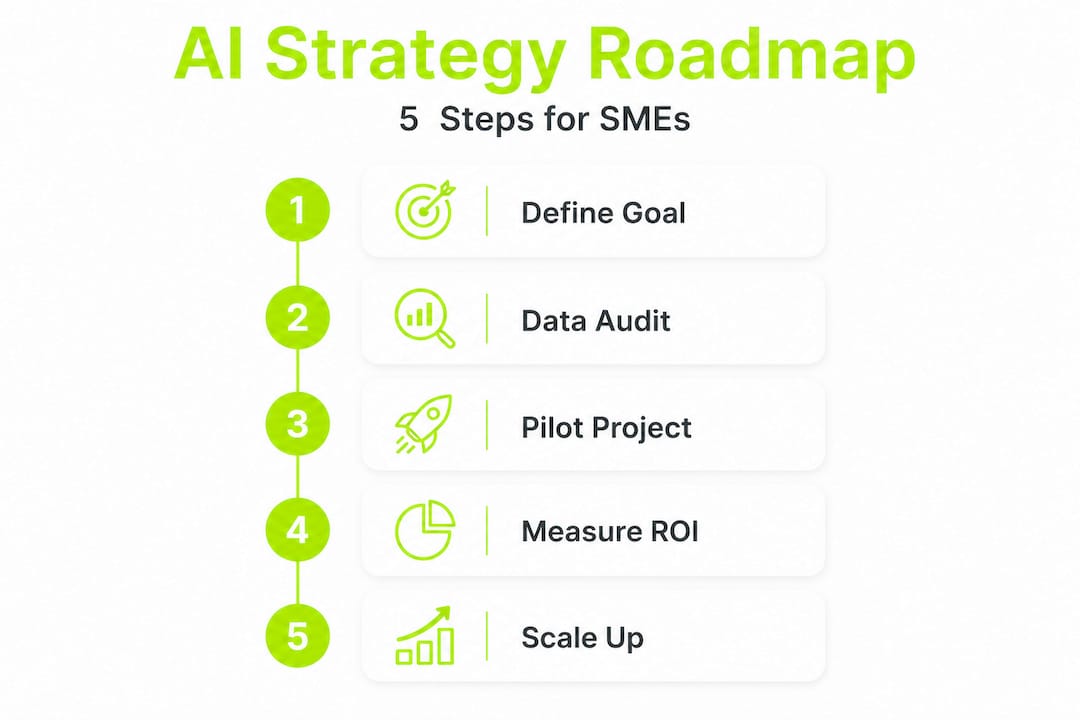
Custom roadmap development. Once goals and constraints are understood, the consultant builds a phased roadmap. This typically includes a quick-win pilot, a defined evaluation period, and a longer-term integration plan. Phasing is critical because it controls risk, keeps costs predictable, and builds internal confidence before scaling.
-
Implementation support. This phase covers tool selection, vendor evaluation, data preparation, and the technical work of connecting AI outputs to existing workflows. A good consultant does not hand you a plan and disappear. They stay involved through implementation, troubleshooting integration issues and adapting the approach when real-world conditions differ from expectations.
-
Change management and training. Deploying a tool without preparing your team is a reliable path to failure. Effective consulting includes communication frameworks for leadership, role-specific training for staff, and mechanisms for collecting feedback so that adoption problems are caught early rather than allowed to fester.
-
Monitoring, feedback loops, and iteration. AI systems are not set-and-forget. Model outputs drift over time as business conditions change, new data is introduced, or customer behaviour shifts. An ongoing monitoring process, with regular performance reviews, keeps the system accurate and the business benefit sustainable.
The table below illustrates the practical difference between an unstructured DIY approach and a structured consulting-led process.

| Factor | DIY approach | Consulting-led approach |
|---|---|---|
| Starting point | Tool selection | Business goal definition |
| Data readiness | Often overlooked | Assessed and improved first |
| Integration planning | Reactive | Built into the roadmap |
| Staff preparation | Minimal | Structured training programme |
| Success measurement | Informal | KPIs defined before launch |
| Ongoing support | None | Scheduled reviews and iteration |
| Typical outcome | Stalled pilot | Sustainable, measured results |
Exploring a clear AI strategy framework before beginning any implementation is worth the time investment. The difference between a project that delivers and one that quietly disappears from the agenda usually comes down to how well the groundwork was laid.
Pro Tip: Ask any prospective AI consultant to show you the criteria they use to evaluate whether a business is ready for AI implementation. If they cannot articulate a clear readiness framework, look elsewhere.
Navigating data, compliance, and regulation: What SMEs need to know
For many SME leaders, regulatory uncertainty sits at the top of the list of reasons to delay AI adoption. The EU AI Act, GDPR, and sector-specific rules can feel like a labyrinth. The good news is that the reality is considerably less daunting than the headlines suggest.
Understanding the regulatory landscape
The EU AI Act classifies AI applications by risk level. Most AI tools used by SMEs in everyday business contexts, such as marketing automation, customer support assistants, HR scheduling tools, or document classification, fall into the low-risk or minimal-risk categories. Regulatory fears around the AI Act are frequently overstated for typical SME use cases. The high-risk provisions apply primarily to AI used in critical infrastructure, employment decisions at scale, or sensitive areas like credit scoring and healthcare diagnostics.
GDPR remains relevant, particularly when AI tools process personal data about customers or employees. However, most reputable AI platforms operating in Europe already offer GDPR-compliant data processing agreements. The key questions to ask are: where is my data stored, who can access it, and how long is it retained? A practical AI compliance guide will help you build a checklist for vendor evaluation rather than treating every tool as a legal minefield.
Assessing and improving data quality
Before any AI implementation, it is worth conducting a focused data audit across your main operational systems. Consider the following dimensions:
- Completeness: Are records missing key fields? Are historical datasets intact or partial?
- Consistency: Are the same data points labelled the same way across different systems? Inconsistent naming conventions are a leading cause of model inaccuracy.
- Timeliness: How frequently is data updated? Real-time AI applications require near-real-time data feeds.
- Accessibility: Can data be exported or accessed via API? Siloed data that exists only in legacy systems with no integration capability creates significant project risk.
Improving data quality does not have to be a multi-year overhaul. In many cases, targeted data cleaning in a specific operational area, focused on a single AI use case, is enough to launch a credible pilot.
Getting employees onboard
The human dimension of AI adoption is underestimated almost universally. Staff who feel informed and involved are far more likely to adopt new tools effectively than those who receive a system update email and a one-hour training session. Effective onboarding includes explaining the purpose of the AI tool, clarifying what it will and will not do, and giving staff a channel to raise concerns or report problems.
Human oversight is particularly important for any AI output that informs a significant decision. Loan approvals, contract terms, medical triage, or employee assessments should always include a human review stage. This is both a regulatory expectation in high-risk applications and a practical safeguard against model errors.
Key statistic: Businesses that include structured change management in their AI deployments are significantly more likely to sustain adoption beyond the initial pilot phase than those that focus solely on technical implementation.
How SMEs can measure real ROI from AI initiatives
Measuring return on investment (ROI) from AI is straightforward in principle and consistently neglected in practice. Defining ROI means connecting AI outputs to business results in financial or operational terms. Measurable KPIs and integration with existing business workflows are the two elements most strongly associated with sustained AI success.
Setting clear KPIs before launch
Every AI project should define at least three measurable KPIs before implementation begins. These might include:
- Efficiency gains: For example, reducing the average time to process an invoice from 12 minutes to under 3 minutes using AI-assisted document processing.
- Revenue impact: Tracking whether AI-driven lead scoring improves the conversion rate of marketing-qualified leads by a defined percentage over a defined period.
- Cost reduction: Measuring the reduction in manual labour hours spent on a specific task, valued at the appropriate hourly cost to the business.
KPIs should be specific, time-bound, and connected to a baseline measurement taken before implementation. Without a baseline, you cannot demonstrate improvement regardless of how well the tool is performing.
Monitoring and adapting over time
AI systems require regular performance reviews. Schedule quarterly check-ins to assess whether outputs remain accurate, whether the business context has changed in ways that affect model performance, and whether users are engaging with the system as intended. If a tool is being bypassed or overridden frequently by staff, that is a signal that either the model needs retraining or the workflow integration needs adjustment.
Practical ROI checklist for SME AI projects
Use this list as a reference when evaluating an AI initiative at the six-month mark:
- Are the pre-defined KPIs being tracked consistently?
- Has the AI output been validated against manual review on a sample basis?
- Are staff using the tool as designed, or have workarounds emerged?
- Has the tool produced any unexpected outputs or errors that required intervention?
- Has the business context changed in ways that might affect model accuracy?
- Is the cost of maintaining and monitoring the tool proportionate to the value delivered?
- Are there adjacent use cases where the same capability could be extended?
Good guidance on measuring AI results alongside broader digital marketing performance helps you situate AI ROI within the full picture of your digital investment. Research consistently shows that AI-enabled marketing programmes can deliver significantly higher returns compared with non-AI approaches when measurement is rigorous and the strategy is well-defined.
Pro Tip: Assign a named internal owner to every AI project. Without someone accountable for tracking performance and raising issues, even well-designed tools become neglected. This person does not need to be a data scientist; they need to care about the outcome and have time allocated to the role.
A consultant’s perspective: Why most AI projects stumble and how to actually move the needle
There is no shortage of frameworks, checklists, and best-practice guides for AI adoption. Most of them are useful. Most projects still stumble. After working with SMEs across sectors and markets, the honest explanation for this gap is rarely technical. It is human.
Generic advice tells you to “align AI with business goals” and “ensure data quality.” What it rarely tells you is that your goals may be contested internally, that the department head most resistant to change is the one whose data quality is worst, or that the person nominally leading your AI project has no real authority to change how other teams work. These are the real dynamics that determine whether a project succeeds.
Transforming a business with AI is as much a leadership challenge as a technology one. The SMEs that make lasting progress tend to share a specific characteristic: their senior leadership does not just sponsor the AI initiative, they actively protect the time and space needed for it to succeed. They shield pilot teams from being pulled back into business-as-usual firefighting. They communicate openly about what the technology is for and, critically, what it is not for.
The second pattern we observe consistently is that businesses which commit to small, well-defined pilots outperform those that plan large-scale transformations. This is counter-intuitive because bigger ambitions feel more strategically significant. In practice, a narrowly scoped project that delivers a clear result builds the internal credibility and organisational learning needed to scale responsibly. Trying to transform everything at once almost always ends in scope creep, budget overruns, and a demoralised team.
There is also a tendency to conflate “AI strategy” with “AI procurement.” Signing contracts for multiple platforms is not a strategy. A strategy means knowing which business problem you are solving first, why that problem is the priority, what data you have to work with, and how you will know whether you have solved it. Procurement follows strategy; it does not substitute for it.
Finally, and perhaps most importantly: AI should earn its place in your operations. If a well-run manual process produces better results than an AI-assisted one, stick with the manual process until you have the data quality and workflow maturity to do better. There is no competitive advantage in adopting AI for its own sake. The advantage comes from solving real problems faster, more accurately, or at lower cost than before. Keep that test at the centre of every decision.
Ready to make AI work for your SME?
Knowing where to start is often the hardest part of any AI journey. Whether you are assessing your first use case or looking to scale an existing pilot into something more robust, working with a specialist who understands both the technology and the business realities of SMEs makes a measurable difference.
At Done.lu, we bring practical, structured AI consulting for SMEs that begins with your business goals, not with a product catalogue. From data audits and roadmap development through to implementation support and team training, we guide you through every stage. Our work spans over 150 completed projects, and our approach is built on transparency, realistic timelines, and measurable outcomes. If you are ready to move from curiosity to capability, explore our digital consulting for SMBs and find out how we can help your business take the next practical step.
Frequently asked questions
Are AI regulations in Europe a real barrier for SME adoption?
For most low-risk applications such as marketing automation, document processing, or customer support tools, European AI regulations are not a significant barrier and tend to be overstated as a concern. Working with a consultant familiar with the EU AI Act and GDPR will help you identify where genuine compliance requirements apply.
What is the first step when an SME wants to implement AI?
The first step is a structured data audit combined with a clear definition of the business outcome you want AI to support, ideally with a consultant who can connect those two elements into a realistic roadmap.
Why do most SME-led AI projects fail?
73% of failures stem from poor data quality, absence of measurable KPIs, integration gaps between the AI tool and existing systems, and insufficient investment in training and change management.
How soon can SMEs expect to see value from AI consulting?
Results depend on the scope and complexity of the project, but well-defined pilots with clear KPIs and solid data foundations typically produce measurable improvements within three to six months of implementation.
Does AI require replacing existing staff or systems?
No. Effective AI consulting is built around integrating AI capabilities with your current people and technology, enhancing what already works rather than dismantling it.