

Inbound marketing ideas that generate real leads in 2026
June 22, 2026
The role of digital communication in business growth
June 24, 2026
TL;DR:
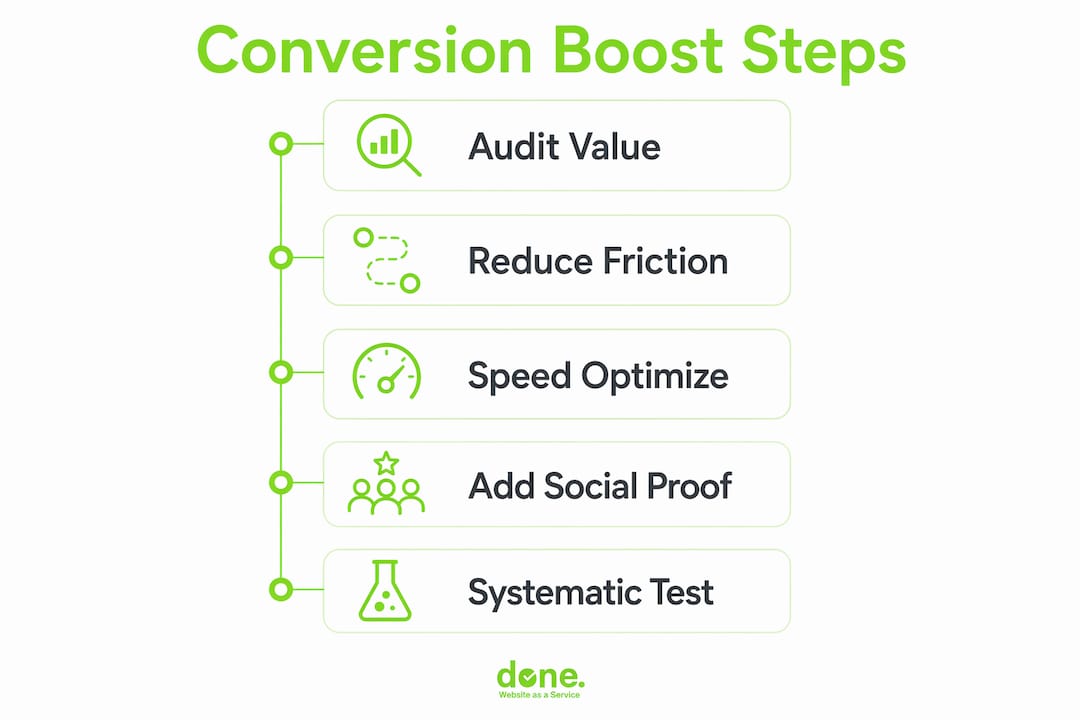
- Improving website conversions relies primarily on clarifying the value proposition and rewriting headlines for better impact. Removing friction, enhancing site speed, adding social proof, and systematic testing further boost conversions over time. Focused changes like headline rewriting and checkout simplification produce measurable results quickly and cost-effectively.
Website conversion is defined as the process of turning a website visitor into a customer, lead, or subscriber through deliberate design, copy, and technical choices. For small and medium-sized businesses, knowing how to boost website conversions is the single most direct route to increasing online sales without spending more on advertising. This guide covers the highest-impact methods, ordered by return on effort, with evidence from research across more than 20,000 tested pages. You will find no vague advice here. Every tactic is specific, measurable, and applicable to businesses operating in Luxembourg and across Europe.
What is the highest-impact method to boost website conversions?
Your value proposition is the single most powerful conversion driver on your website. Research across 20,000+ tested pages shows that value proposition clarity scores three times higher in conversion impact than reducing site friction. That means rewriting your headline delivers more measurable return than redesigning your checkout flow.

Headlines determine whether 80% of visitors engage or leave within the first three seconds. If your headline does not immediately tell a visitor what you do, who you do it for, and why they should care, most of them will leave before reading another word.
How to audit and rewrite your value proposition
A strong value proposition answers three questions in one sentence: what you offer, who it is for, and what makes it better than the alternative. Most SMB websites fail on the third point. They describe the product but not the outcome.
Here is a practical audit process:
- Read your current headline aloud. If a stranger could not guess your business type from it, rewrite it.
- Check specificity. “High-quality web solutions” says nothing. “Responsive websites for Luxembourg SMEs, built in six weeks” says everything.
- Test with real visitors. Tools like Hotjar let you run on-page polls asking visitors what they think your site offers. The gap between their answers and your intended message is your rewrite brief.
- Use Google Analytics to identify your highest-traffic landing pages. These are the pages where your value proposition matters most. Prioritise them first.
- Compare bounce rates before and after rewrites. A lower bounce rate after a headline change is direct evidence of improved clarity.
Headline and value proposition rewrites produce conversion lifts of 50% to 200% or more, consistently outperforming design or technical changes. That is a remarkable finding, and it means your copywriter is more valuable than your developer when it comes to conversion improvement.
Pro Tip: Write three versions of your headline: one focused on the outcome for the customer, one focused on speed or ease, and one focused on trust or credibility. Test all three. The winner is rarely the one you expected.
How does friction reduction improve conversions?
Friction is anything that slows a visitor down or makes them uncertain. Removing friction is the second most effective way to improve conversion rates, and it applies equally to e-commerce checkouts and lead generation forms.
The Baymard Institute, which has conducted usability testing across hundreds of e-commerce sites, identifies cart abandonment as averaging 70% across the industry. Checkout length is one of the primary causes. Reducing checkout steps from five to three recovers 10–15% of lost sales. That is revenue you already earned through marketing, simply lost at the final step.
Five proven friction reduction tactics
-
Offer guest checkout as the default. Guest checkout is no longer optional for e-commerce sites. Forcing account creation before purchase is one of the most common reasons visitors abandon carts. Make it the first and most visible option.
-
Reduce form fields to the minimum required. Every additional field reduces completion rates. For lead generation forms, ask only for name and email at the first touchpoint. Collect additional information later in the customer relationship.
-
Show all costs early. Unexpected shipping fees revealed at the final checkout step cause significant abandonment. Display estimated shipping costs on the product page or basket page, not at payment.
-
Simplify your navigation. Visitors who cannot find what they need within two clicks leave. Review your website navigability and reduce top-level menu items to five or fewer. Use clear, descriptive labels rather than clever ones.
-
Optimise for mobile. A form that works on desktop but requires pinching and zooming on a phone will lose the majority of mobile visitors before they complete it. Test every form and checkout flow on an actual mobile device, not just a browser simulator.
Pro Tip: Record real user sessions with Hotjar or Microsoft Clarity. Watching where visitors hesitate, scroll back, or abandon tells you more about friction than any survey.
Why does site speed matter for conversion rates?
Page load speed is a direct conversion variable, not a technical nicety. A one-second delay in page load time causes a 7% drop in conversions. At three seconds, bounce rates increase by 32%. For an SMB generating 500 enquiries per month, a two-second delay could mean losing more than 100 of them.
Mobile speed carries particular weight. Mobile conversion rates can be 50–60% of desktop rates when the mobile site is slow. Given that the majority of web traffic now arrives via mobile devices, a slow mobile site is a significant revenue problem.
Speed optimisation checklist for SMBs
| Action | Tool | Expected impact |
|---|---|---|
| Compress and convert images to WebP format | Squoosh, ShortPixel | Reduces page weight by 30–50% |
| Use a content delivery network (CDN) | Cloudflare | Cuts load time for international visitors |
| Minify CSS, JavaScript, and HTML | WP Rocket, NitroPack | Reduces file sizes sent to the browser |
| Enable browser caching | Server or plugin settings | Returns visitors load pages faster |
| Measure and monitor regularly | Google PageSpeed Insights, GTmetrix | Identifies regressions before they cost conversions |
Mobile websites should target load times under three seconds for optimal conversion rates. Use Google PageSpeed Insights to get a free score and a prioritised list of fixes. Start with the highest-impact items, which are almost always image compression and unused JavaScript removal.
Pro Tip: Run your PageSpeed Insights test on your actual homepage, your most visited product or service page, and your contact page. These three pages cover the majority of your conversion opportunities.
How does social proof influence purchasing decisions?
Social proof is the evidence that other people have trusted you and found value in what you offer. It is one of the most reliable ways to increase website sales because it reduces the perceived risk of buying from a business a visitor does not yet know.
Products with even a handful of reviews convert 76.7% better than products with no reviews. That figure comes from a PowerReviews survey of 21,279 consumers. The implication is clear: collecting your first ten reviews matters more than perfecting your product photography.
How to collect and display social proof effectively
- Ask for reviews immediately after purchase or project completion. The best time to request a review is within 48 hours of a positive experience, when the customer’s satisfaction is highest.
- Display star ratings with structured data (schema markup). Schema markup makes your star ratings visible in Google search results, which increases click-through rates before a visitor even reaches your site.
- Use customer photos alongside testimonials. A written testimonial with a real name and photo converts better than an anonymous quote. Video testimonials perform even better for higher-value services.
- Address negative reviews professionally and publicly. A business with 4.3 stars and visible responses to criticism appears more trustworthy than one with 5.0 stars and no reviews at all. Responses show you are attentive and accountable.
- Place social proof at decision points. Put testimonials near your call-to-action buttons, on your pricing page, and on your checkout page. These are the moments when doubt is highest and reassurance is most valuable.
Conversion rate improvement and average order value uplift together contribute to 68% of revenue growth, often outperforming traffic increases. Collecting reviews and displaying them well is one of the lowest-cost ways to achieve that uplift.
What role does systematic testing play in improving conversion rates?
Systematic testing, known in the industry as conversion rate optimisation (CRO), is the practice of making one change at a time, measuring the result, and keeping what works. Without testing, you are guessing. With testing, you compound small gains into significant revenue improvements.
MECLABS research across 20,000+ pages shows that 80% of changes fail to improve conversions. Testing prevents you from permanently implementing those changes. The same research shows that iterative testing drives consistent 5–10% gains that compound to 61% improvement over time.
How to run your first A/B tests
-
Identify your highest-traffic pages with the worst conversion rates. Use Google Analytics to find pages where visitors arrive but do not take action. These pages offer the greatest opportunity.
-
Choose one element to test at a time. Test your headline, your call-to-action button text, your hero image, or your form length. Never test multiple elements simultaneously, as you will not know which change caused the result.
-
Set a minimum sample size before reading results. A test with 50 visitors per variant is statistically meaningless. Aim for at least 200–300 visitors per variant before drawing conclusions.
-
Use a dedicated testing tool. Google Optimize was discontinued in 2023, but Optimizely and VWO are widely used alternatives for SMBs. Both offer visual editors that do not require developer involvement for simple tests.
-
Document every test and its result. A test log tells you what you have already tried, prevents repeating failed experiments, and builds institutional knowledge about what your specific audience responds to.
The most valuable tests for SMBs are headline rewrites, call-to-action button copy, and form field reduction. These elements appear on every page and affect every visitor. Improving them by even a few percentage points compounds across your entire traffic volume. For a broader view of how web design drives conversions, the relationship between visual hierarchy and testing outcomes is worth understanding before you begin.
Key takeaways
Boosting website conversions requires prioritising value proposition clarity first, then removing friction, improving page speed, adding social proof, and running systematic tests to compound gains over time.
| Point | Details |
|---|---|
| Value proposition first | Rewriting your headline delivers three times more conversion impact than fixing friction points. |
| Remove checkout friction | Offering guest checkout and reducing steps from five to three recovers 10–15% of lost sales. |
| Speed is a revenue variable | A one-second page load delay causes a 7% drop in conversions; target under three seconds on mobile. |
| Social proof converts | Products with even a few reviews convert 76.7% better than those with none. |
| Test before you commit | 80% of changes fail; systematic A/B testing prevents wasted effort and compounds iterative gains. |
What I have learned working with Luxembourg SMBs on conversions
The most common mistake I see is businesses investing in more traffic before fixing the page that traffic lands on. They spend budget on Google Ads or social media campaigns, drive visitors to a homepage with a vague headline and a slow load time, and then wonder why the return on investment is poor. The problem is not the campaign. The problem is the destination.
The second pattern I notice is an over-reliance on design changes. A new colour scheme or a refreshed layout feels productive, but it rarely moves the conversion needle as much as a rewritten headline or a simplified form. Copy and clarity consistently outperform aesthetics in every test we have run with clients.
Luxembourg SMBs face a specific challenge that businesses in larger markets do not. Your audience is multilingual, and your value proposition needs to work in French, German, Luxembourgish, and English depending on the sector. A headline that converts well in French may fall flat in English if it is a direct translation rather than a culturally adapted rewrite. We have seen this repeatedly with clients in the financial and legal sectors.
My practical advice is to start with one page, one hypothesis, and one test. Do not try to fix everything at once. Pick your highest-traffic landing page, rewrite the headline based on your value proposition audit, and measure the result over four weeks. That single change, done well, will teach you more about your audience than months of analytics reports. Patience and persistence in testing are what separate businesses that grow their conversion rates from those that plateau.
How Done can help you increase website conversions
Done works with SMBs across Luxembourg to improve the specific elements that drive conversions: page speed, copy clarity, user experience, and systematic testing. Every project starts with a technical and content audit, so you know exactly where your biggest opportunities are before any work begins.
Whether you need a faster, better-structured website or a digital marketing strategy that turns traffic into leads, Done brings the experience of 350+ completed projects to your specific situation. The team handles everything from professional web development and UX improvements to conversion-focused copywriting and A/B testing frameworks. If your website is not generating the enquiries your business deserves, the conversation starts with a straightforward audit. Get in touch with Done to find out where your conversions are being lost and what it takes to recover them.
FAQ
What is conversion rate optimisation (CRO)?
Conversion rate optimisation (CRO) is the practice of making structured changes to a website to increase the percentage of visitors who take a desired action, such as making a purchase or submitting an enquiry. It combines copywriting, design, technical improvements, and A/B testing.
How long does it take to see results from conversion improvements?
Simple changes such as headline rewrites or form simplification can show measurable results within two to four weeks, provided you have sufficient traffic. More complex tests require longer periods to reach statistical significance.
What is the most common reason visitors leave without converting?
A weak or unclear value proposition is the leading cause. Research across more than 20,000 tested pages shows that value proposition clarity has three times the conversion impact of any other single factor.
Does page speed really affect conversions for small businesses?
A one-second delay in page load time causes a 7% drop in conversions regardless of business size. For SMBs with limited traffic, each lost conversion carries proportionally more weight, making speed optimisation a high-priority fix.
How many reviews does a product or service need to convert better?
Even a small number of reviews produces a significant lift. A PowerReviews survey of 21,279 consumers found that products with between one and 100 reviews convert 76.7% better than products with no reviews at all.