

What Is Web Development and Why It Matters
February 15, 2026
Why Choose Custom Web Development for Business Impact
February 17, 2026

Optimizing a website for conversions can feel like a moving target when audience expectations keep changing across devices and channels. For digital marketing managers at small and medium businesses in Luxembourg, web design is more than aesthetics—it’s a tool for business growth. A conversion-focused web design transforms digital spaces into lead generation engines by guiding visitors through clear, intuitive paths, reducing uncertainty, and making every interaction count toward your goals.
Table of Contents
- Defining Conversion-Focused Web Design
- Common Web Design Types For Businesses
- Key Design Elements That Boost Conversions
- User Experience And Its Impact On Conversion Rates
- Top Mistakes That Lower Website Conversions
Key Takeaways
| Point | Details |
|---|---|
| Conversion-Focused Design | Prioritize user intent and create clear pathways to guide visitors toward business objectives. |
| Effective User Experience (UX) | Seamless navigation and performance optimization are critical to reducing cognitive friction and improving conversion rates. |
| Strategic Call-to-Action (CTA) Placement | Position clear and prominent CTAs where users are most likely to engage for maximized conversions. |
| Avoid Common Mistakes | Eliminate clutter, slow loading times, and unclear CTAs to enhance user engagement and minimize bounce rates. |
Defining Conversion-Focused Web Design
Conversion-focused web design represents a strategic approach that transforms websites from passive digital brochures into dynamic lead generation machines. By systematically prioritizing user intent, these designs create intuitive pathways that guide visitors toward specific business objectives with remarkable precision.
At its core, conversion-focused web design integrates several critical principles:
- Visual Hierarchy: Strategically arranging design elements to draw attention to key conversion points
- User Experience (UX): Creating seamless, friction-free navigation that reduces user uncertainty
- Psychological Triggers: Incorporating trust signals, social proof, and persuasive design techniques
- Strategic Call-to-Action (CTA) Placement: Positioning conversion prompts where users are most likely to engage
Successful conversion-focused designs do more than look attractive—they function as precision instruments engineered to transform website visitors into qualified leads. Every pixel, color choice, and interactive element serves a deliberate purpose: simplifying user decision-making and reducing cognitive friction.
Effective conversion-focused design balances aesthetic appeal with strategic functionality, turning websites into powerful business assets.
Performance Metrics become crucial in this approach. Digital marketers track specific indicators like click-through rates, time on page, and form completion percentages to continuously refine their design strategies.
Review these website performance metrics to track and improve conversions:
| Metric | What It Measures | Business Impact |
|---|---|---|
| Click-Through Rate | User interaction with CTAs | Reveals engagement levels |
| Time on Page | Visitor session length | Indicates content appeal |
| Form Completion Rate | Successful form submissions | Reflects conversion effectiveness |
| Bounce Rate | Users leaving quickly | Signals possible UX issues |
Pro tip: Conduct regular user experience audits to identify and eliminate potential conversion barriers in your web design.
Common Web Design Types for Businesses
Businesses today have multiple web design approaches to choose from, each offering unique advantages for digital communication and user engagement. Web design layouts range from static to highly adaptive strategies that cater to different organizational needs and user experience requirements.
The primary web design types include:
- Static Design: Fixed layout with unchanging content, ideal for small informational websites
- Liquid (Fluid) Design: Scalable content that adjusts proportionally across different screen sizes
- Adaptive Design: Uses CSS media queries to create device-specific layouts
- Responsive Design: Dynamically adjusts content and layout for optimal viewing across all devices
Each design type serves specific business communication objectives. Static designs work well for companies with minimal content updates, while responsive designs provide maximum flexibility for businesses targeting diverse digital audiences. The choice depends on factors like target market, content complexity, and technical infrastructure.

Here’s a quick comparison of web design types and their ideal business scenarios:
| Web Design Type | Best For | Key Benefit | Limitation |
|---|---|---|---|
| Static | Small businesses, simple content | Easy to launch, low cost | Not flexible for updates |
| Liquid (Fluid) | Mid-sized companies, scalable content | Maintains proportional layout | May cause readability issues |
| Adaptive | Businesses with specific device needs | Customizes for devices | Complex to maintain |
| Responsive | Wide audiences, mobile users | Consistent on all devices | Requires robust development |
Selecting the right web design approach can significantly impact user engagement, brand perception, and conversion potential.
Modern businesses increasingly prioritize responsive design due to its ability to provide consistent user experiences across smartphones, tablets, and desktop computers. This approach ensures that content remains readable, navigation stays intuitive, and visual elements retain their impact regardless of device screen size.
Pro tip: Conduct comprehensive user testing across multiple devices to validate your chosen web design approach’s effectiveness and user experience.
Key Design Elements That Boost Conversions
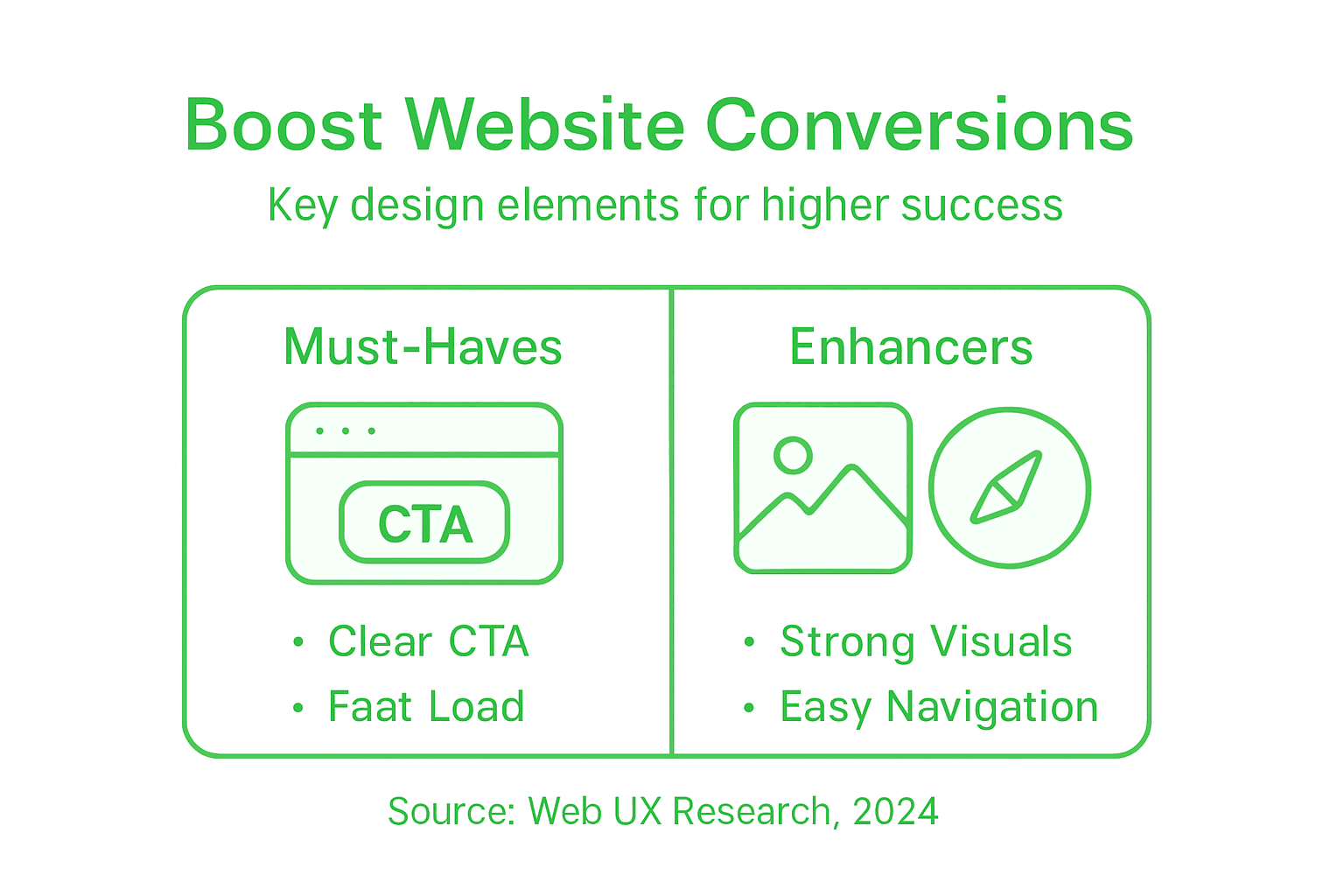
Designing a website that effectively drives conversions requires a strategic approach that goes beyond aesthetic appeal. Improve website navigability by implementing key design elements that guide users seamlessly toward desired actions and minimize friction in their journey.
Critical design elements that significantly impact conversion rates include:
- Clear Call-to-Action (CTA) Buttons: Prominent, contrasting buttons that stand out and communicate exact next steps
- Simplified Navigation: Intuitive menu structures that help users find information quickly
- Visual Hierarchy: Strategically arranged page elements that draw attention to most important conversion points
- Trust Signals: Client testimonials, security badges, and professional design that build credibility
- Whitespace Utilization: Clean, uncluttered layouts that enhance readability and focus user attention
Each design element plays a crucial psychological role in user decision-making. Color psychology, for instance, can dramatically influence user perception and emotional response. Specific color choices can trigger feelings of trust, excitement, or urgency, subtly nudging visitors toward conversion.
Effective web design transforms visual elements from mere decorations into strategic conversion tools that communicate value and inspire action.
Website performance metrics reveal that well-designed interfaces with thoughtful user experience principles can increase conversion rates by up to 200%. The key is creating a design that feels intuitive, professional, and aligned with user expectations.
Pro tip: Conduct A/B testing on individual design elements to systematically understand which configurations drive the highest conversion rates.
User Experience and Its Impact on Conversion Rates
User experience (UX) is the critical bridge between website design and successful conversions. Comprehensive UX research demonstrates that intuitive interactions and smooth navigation directly influence a user’s decision to engage with a business online.
Key UX elements that drive conversion rates include:
- Intuitive Navigation: Clear, logical menu structures that help users find information effortlessly
- Performance Optimization: Fast-loading pages that reduce user frustration and bounce rates
- Responsive Design: Seamless experiences across multiple devices and screen sizes
- Interactive Elements: Engaging features that encourage user participation and exploration
- Clear Information Architecture: Logically organized content that guides users toward conversion goals
Cognitive load plays a crucial role in user decision-making. When websites minimize complexity and provide straightforward paths to information or action, users are more likely to complete desired transactions. The less mental effort required, the higher the probability of conversion.
Exceptional user experience transforms websites from mere information repositories into powerful conversion engines that anticipate and fulfill user needs.
Personalization emerges as a powerful UX strategy, with research indicating that tailored experiences can significantly increase user engagement and conversion potential. By understanding individual user preferences and behaviors, websites can create more meaningful and compelling interactions.
Pro tip: Implement user journey mapping to identify and eliminate potential friction points in your website’s conversion funnel.
Top Mistakes That Lower Website Conversions
Website navigation challenges can dramatically undermine conversion potential, turning promising leads into missed opportunities. Understanding and eliminating common design mistakes is crucial for creating high-performing digital experiences.
Top conversion-killing website mistakes include:
- Cluttered Design: Overwhelming users with too much information or visual complexity
- Slow Page Loading: Extended wait times that increase user frustration and bounce rates
- Unclear Call-to-Action (CTA): Vague or poorly positioned conversion buttons
- Non-Responsive Design: Websites that fail to adapt across different devices
- Excessive Form Fields: Complex registration processes that discourage user engagement
Cognitive friction represents a significant barrier to conversions. When websites require excessive mental effort to navigate or understand, potential customers quickly lose interest and abandon their journey. Streamlining user interactions becomes paramount in maintaining engagement.
Small design mistakes can create substantial barriers between your business and potential conversions, silently eroding your digital marketing efforts.
Technical performance directly impacts user perception and conversion likelihood. Websites that load slowly, display inconsistently across devices, or present confusing navigation structures fundamentally undermine user trust and organizational credibility.
Pro tip: Conduct regular user experience audits and implement heat mapping tools to identify and eliminate conversion-blocking design elements.
Transform Your Website Into a High-Converting Digital Asset
The article highlights how critical conversion-focused web design is to overcoming common challenges such as cluttered layouts, unclear calls to action, and poor user experience that prevent visitors from becoming loyal customers. If your business struggles with slow load times, non-responsive pages, or unfocused navigation, you are likely missing out on valuable leads and growth opportunities. Important concepts like visual hierarchy, strategic CTA placement, and cognitive load reduction are essential to building websites that truly drive results.
At Done.lu, we specialize in crafting fully responsive, growth-driven websites tailored to your unique business goals. Our expert team integrates smart design elements and seamless digital marketing strategies including SEO and automation to unlock your website’s full conversion potential. Benefit from our proven experience with over 150 completed projects for small to medium-sized enterprises across Luxembourg and Europe who demand measurable online success.
Are you ready to boost your conversions today with a website designed strategically from the ground up?
Explore how our tailored approach can transform your online presence. Visit Done.lu now to take the first step toward stronger digital communication and lead generation. Discover the power of combining expert web design with targeted inbound marketing and unlock new business growth.
Frequently Asked Questions
What is conversion-focused web design?
Conversion-focused web design is a strategic approach that transforms websites into effective tools for lead generation, prioritizing user intent and guiding visitors toward specific business objectives with intuitive design elements.
How does user experience (UX) impact conversion rates?
User experience (UX) significantly impacts conversion rates by ensuring intuitive navigation, fast-loading pages, and responsive design, which lead to smoother interactions and higher user engagement, ultimately increasing the likelihood of conversions.
What key design elements can boost conversions on a website?
Key design elements that can boost conversions include clear call-to-action (CTA) buttons, simplified navigation, a strong visual hierarchy, trust signals, and effective use of whitespace to enhance readability and focus user attention.
What are common mistakes that lower website conversions?
Common mistakes include cluttered designs, slow page loading times, unclear CTAs, non-responsive layouts, and excessive form fields that create barriers for users, making it difficult for them to engage and convert.