

Essential digital marketing tips for startups: drive growth
March 28, 2026
Ecommerce branding strategies that drive 23% more sales
March 30, 2026
Most businesses collect contacts. Far fewer collect customers. Research consistently shows that only a fraction convert from initial interest into paying clients, yet many small business owners still measure success by the sheer volume of leads gathered rather than their quality. If you have ever wondered why your pipeline looks full but your revenue does not reflect it, the answer almost certainly lies in how lead generation is being approached. This guide covers every stage of the process, from attracting strangers to converting qualified prospects, with practical benchmarks, cost data, and compliance guidance tailored for European SMBs.
Table of Contents
- What is lead generation? Core concepts and definitions
- How lead generation works: The key stages explained
- Inbound, outbound, and hybrid approaches: Which works for SMBs?
- Lead generation benchmarks and costs for European SMBs
- Nuances for European SMBs: Compliance, quality and market trends
- Action plan: Building your lead generation engine
- How Done can help you master digital lead generation
- Frequently asked questions
Key Takeaways
| Point | Details |
|---|---|
| Lead generation is multi-stage | Successful lead generation requires moving contacts through attraction, capture, nurturing, qualification and conversion. |
| Inbound is cost-effective | Inbound methods like content and SEO usually deliver higher quality leads at lower cost for European businesses. |
| Quality over quantity | Focusing on qualified leads rather than total numbers achieves better conversion rates in Europe. |
| GDPR compliance matters | Permission-based strategies and proper data handling are essential for legal and reputational health. |
| Hybrid strategies win | Combining inbound and outbound approaches, with regular measurement, increases long-term growth and resilience. |
What is lead generation? Core concepts and definitions
Lead generation is the process of attracting and converting strangers into potential customers by capturing their interest and contact information. That definition sounds straightforward, but the reality is more nuanced. Not every person who downloads your brochure or fills in a contact form is ready to buy. Understanding the difference between a raw contact and a high-quality lead is what separates businesses that grow steadily from those that spin their wheels.
The process typically moves through five stages:
- Attract: Draw the right audience to your website, content, or social channels through SEO, paid advertising, or referrals.
- Capture: Collect contact details via forms, landing pages, or lead magnets such as guides, webinars, or free audits.
- Nurture: Build trust over time through email sequences, personalised content, and consistent follow-up.
- Qualify: Assess whether a lead matches your ideal customer profile and is ready for a sales conversation.
- Convert: Turn a qualified lead into a paying customer through a proposal, demo, or direct sale.
Digital lead generation now dominates for most European SMBs, offering measurable results and scalable reach. You can explore practical approaches to generating leads online to see how these stages translate into real campaigns. For a broader strategic overview, the Salesforce lead generation guide offers useful context on how larger organisations structure their pipelines.
How lead generation works: The key stages explained
Knowing the stages is one thing. Understanding what actually happens at each point, and where most businesses lose momentum, is another matter entirely.
- Attract: Content marketing, SEO, and paid social are the primary drivers. Your goal here is relevance, reaching people who have a genuine problem you can solve.
- Capture: A well-designed landing page with a clear value proposition converts visitors into leads. Generic forms with no incentive perform poorly.
- Nurture: Most leads are not ready to buy immediately. A structured digital marketing workflow keeps your brand visible and builds credibility over weeks or months.
- Qualify: Lead scoring assigns points based on behaviour (page visits, email opens, content downloads) and firmographic data (company size, sector, budget). The BANT framework (Budget, Authority, Need, Timeline) remains a reliable qualification tool.
- Convert: This is where marketing hands off to sales. A warm, well-nurtured lead converts far more efficiently than a cold contact.
Funnel benchmarks help you set realistic expectations. The table below shows typical conversion rates for SMBs:
| Funnel stage | Benchmark rate |
|---|---|
| Visitor to lead | 2 to 4% |
| Lead to MQL (Marketing Qualified Lead) | 20 to 30% |
| MQL to SQL (Sales Qualified Lead) | ~13% average |
| SQL to customer | 20 to 30% |
| Ideal LTV to CAC ratio | 3:1 |
These numbers clarify why volume alone is misleading. If your website attracts 1,000 visitors per month and converts at 2%, you have 20 leads. Of those, perhaps 3 become sales-qualified. Your website lead generation setup must be optimised at every stage to make those numbers work. For sector-specific lead cost benchmarks, industry data can help you calibrate your expectations further.

Pro Tip: Focus on improving your MQL-to-SQL conversion rate before scaling ad spend. Doubling that rate effectively doubles your revenue without increasing your marketing budget.
Inbound, outbound, and hybrid approaches: Which works for SMBs?
There are three broad models for generating leads, and each has a distinct risk and reward profile.
Inbound relies on attracting prospects through content, SEO, and lead magnets. It is slower to build but delivers 3x more leads at 62% lower cost per lead compared to outbound, with close rates of 14.6% versus just 1.7% for outbound methods.
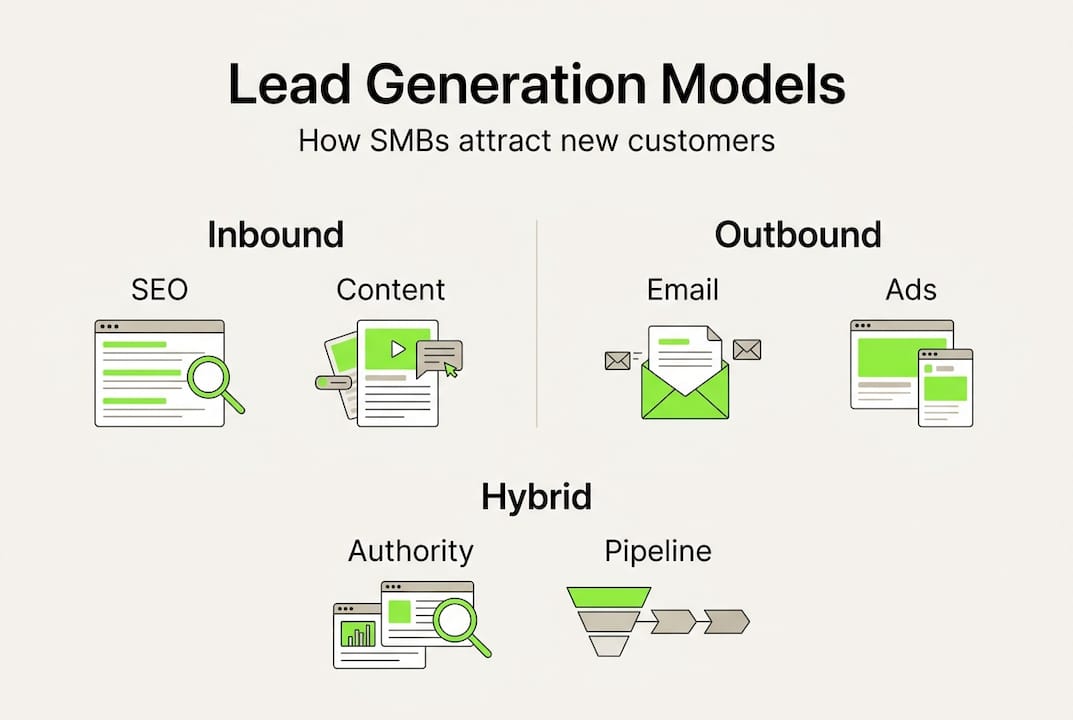
Outbound includes cold email, LinkedIn prospecting, and paid advertising. It generates results faster but carries higher costs and, in Europe, significant legal risk if GDPR consent rules are not followed carefully.
Allbound (hybrid) combines both. You use inbound to build long-term authority while outbound fills short-term pipeline gaps.
| Approach | Cost | Speed | Lead quality | GDPR risk |
|---|---|---|---|---|
| Inbound | Low to medium | Slow | High | Low |
| Outbound | Medium to high | Fast | Variable | Medium to high |
| Hybrid | Medium | Moderate | High | Medium |
For European SMBs, the legal and cultural context matters enormously. Aggressive outbound tactics that work in North American markets often backfire here. Reviewing LinkedIn and email outreach best practices is essential before launching any cold campaign. Meanwhile, social media lead generation through organic content and targeted ads offers a compliant middle ground. The Salesforce inbound vs outbound comparison provides a useful framework for deciding which mix suits your sector.
- Inbound excels when you have a longer sales cycle and can invest in content over time.
- Outbound suits product launches or market entry where speed matters.
- Hybrid works best for established SMBs with both a content library and a sales team.
Pro Tip: If you operate in Germany, Austria, or Switzerland, be aware that DACH buyers are particularly privacy-conscious. Combine inbound with permission-based outreach and always document your legal basis for contact.
Lead generation benchmarks and costs for European SMBs
Budgeting for lead generation without knowing typical costs is like quoting a project without knowing the scope. Here is what the data shows for European B2B markets in 2026.
UK B2B cost per lead varies significantly by channel: AI-assisted cold email sits at £15 to £45 per lead, while LinkedIn campaigns typically cost £50 to £150. The average B2B CPL across channels is £75 or more, and costs have risen 20 to 35% since 2024 due to increased competition and tighter privacy regulations.
Key factors that influence your cost per lead include:
- Channel choice: Paid search is typically more expensive than organic SEO over time.
- Sector: Legal, financial services, and healthcare leads cost significantly more due to longer sales cycles and compliance requirements.
- Data quality: Poor CRM data inflates costs because campaigns reach unqualified audiences.
- Compliance overhead: GDPR-compliant campaigns require additional setup but reduce legal risk and improve trust.
For a detailed breakdown of how SEO drives business growth as a lower-cost lead channel, organic search remains one of the most cost-efficient long-term investments for SMBs. The CPL benchmark index provides updated figures across sectors and regions.
Pro Tip: Track your cost per qualified lead (CPQL), not just your cost per lead. A £20 lead that never converts costs more than a £100 lead that closes within two weeks.
Nuances for European SMBs: Compliance, quality and market trends
Europe is not a single market. The cultural and regulatory differences between, say, the UK and Germany can dramatically affect which lead generation tactics succeed.
GDPR and privacy regulations have firmly shifted the landscape towards permission-based inbound strategies. AI tools can enhance personalisation and progressive profiling (gradually collecting more data over multiple interactions), but only when your CRM data is clean and your consent records are in order.
DACH buyers are notably resistant to aggressive lead capture forms. Conversion rates on multi-field forms in German-speaking markets can fall below 10%, compared to 25% or higher in Anglo markets. Shorter, trust-first forms with clear privacy statements perform significantly better.
Practical considerations for European SMBs:
- Always use opt-in forms with explicit consent language, not pre-ticked boxes.
- Document your legal basis for processing contact data under GDPR Article 6.
- Adapt your content tone to local expectations. Formal, evidence-based content performs better in DACH markets; conversational content suits UK and Irish audiences.
- Economic uncertainty in 2026 is pushing buyers towards longer evaluation cycles, making nurture sequences more important than ever.
Understanding the broader digital marketing advantages available to SMBs helps frame where lead generation fits within your overall growth strategy. For European-specific guidance, the HubSpot B2B lead generation guide covers compliance and cultural nuances in useful detail.
Action plan: Building your lead generation engine
Knowing the theory is valuable. Having a clear sequence of steps to follow is what actually moves the needle. Here is a practical starting point for European SMBs.
- Audit your current channels: Identify where your best existing customers came from and double down on those sources.
- Ensure GDPR compliance from day one: Review your forms, privacy notices, and CRM consent records before launching any campaign.
- Create at least one lead magnet: A practical guide, checklist, or free audit gives visitors a reason to share their contact details.
- Set up a nurture sequence: Lead scoring and multi-touch nurture sequences of seven to eight emails significantly improve conversion rates compared to a single follow-up.
- Implement lead scoring: Assign points for key behaviours (email opens, page visits, content downloads) so your sales team focuses on the most engaged prospects.
- Use AI tools to scale: AI marketing tools can automate personalisation, segment your audience, and flag high-intent leads without adding headcount.
- Optimise your sign-up touchpoints: Practical newsletter sign-up strategies apply equally to lead capture forms across your website and events.
- Measure CPQL, not just CPL: Review your metrics monthly and adjust channel mix based on which sources deliver the most qualified leads. HubSpot’s lead generation resources offer useful templates for tracking these metrics.
Pro Tip: Schedule a monthly alignment meeting between your marketing and sales teams. Misalignment between what marketing calls a lead and what sales considers qualified is one of the most common and costly gaps in SMB lead generation.
How Done can help you master digital lead generation
Building a consistent, compliant, and cost-effective lead generation engine takes more than a good idea. It requires the right technology, a structured workflow, and ongoing optimisation based on real data. That is exactly where a strategic partner makes the difference.
At Done.lu, we work with European SMBs to design and implement digital marketing workflows that attract, capture, and convert the right leads. From GDPR-compliant inbound campaigns to AI-powered personalisation using the best AI tools for SMBs, we bring both the strategy and the technical execution. We also help you transform your website into a genuine lead generation asset, not just a digital brochure. If you are ready to build a pipeline that actually converts, get in touch with our team for a discovery call or a no-obligation digital audit.
Frequently asked questions
What is the difference between a lead and a prospect?
A lead has expressed initial interest and shared contact details, while a prospect is a lead that has been qualified for sales outreach based on fit and readiness to buy.
Which lead generation method is most effective for European SMBs?
Permission-based inbound methods such as SEO, content marketing, and LinkedIn outreach are most cost-effective and compliant, generating 3x more leads at 62% lower cost per lead than outbound.
How do you keep lead generation GDPR compliant?
Use opt-in forms with clear privacy notices, document your legal basis for data processing, and store leads in a properly managed CRM. Permission-based inbound is the safest approach for European markets.
What is a good cost per lead for European B2B companies?
A typical B2B cost per lead in Europe is £75 or more, rising to £150 or higher for LinkedIn campaigns and significantly more in sectors such as legal or financial services.
How long does it take to see results from inbound lead generation?
Inbound lead generation typically takes several weeks to months to gain traction, but it delivers higher quality leads and better long-term ROI than outbound methods once established.