

How AI consulting helps SMBs transform operations and grow online
March 25, 2026
AI and GDPR: A clear guide for European business owners
March 27, 2026
Artificial intelligence isn’t reserved for tech giants with massive budgets anymore. Small and medium-sized businesses across Europe are discovering that AI tools boost operational efficiency, reduce costs, and sharpen competitive edges without requiring data science teams or seven-figure investments. This guide walks you through selecting and implementing AI solutions that deliver measurable results for your SME, covering everything from customer relationship management and marketing automation to compliance with GDPR and practical ROI measurement strategies that work in real-world European business environments.
Table of Contents
- Key takeaways
- Understanding AI tools for small business operations
- Navigating compliance and European data sovereignty in AI adoption
- Measuring ROI and achieving successful AI implementation
- Top AI tools comparison for small businesses in 2026
- Elevate your business with expert digital solutions
- Frequently asked questions
Key Takeaways
| Point | Details |
|---|---|
| ROI first approach | Begin by mapping the team’s most time consuming repetitive tasks to identify AI opportunities with immediate measurable impact. |
| Address bottlenecks | Select AI tools that directly tackle specific pain points rather than adopting technology for its own sake. |
| GDPR and data sovereignty | Choose platforms that clearly document data handling, offer data processing agreements, and respect data localisation within Europe. |
| Human plus AI | Successful adoption combines human judgement with AI assistance to drive disciplined, measurable improvements. |
Understanding AI tools for small business operations
Artificial intelligence has evolved from experimental technology into practical business tools that solve everyday operational challenges. Modern AI platforms integrate seamlessly with existing workflows, automating repetitive tasks whilst providing insights that previously required dedicated analysts.
Salesforce CRM with embedded AI excels in sales and marketing automation, predicting customer behaviour and suggesting next-best actions for your team. Zoho CRM offers predictive analytics that help you identify which leads are most likely to convert, allowing you to focus resources where they’ll generate the greatest return. These systems learn from your historical data, becoming more accurate over time.
Conversational AI platforms like ChatGPT and Claude assist with business planning, content creation, and even customer communication drafts. They handle everything from writing product descriptions to generating social media posts, freeing your team to focus on strategy and relationship building. QuickBooks AI automates accounting tasks including invoice categorisation and expense tracking, whilst Otter.ai captures and transcribes meeting notes automatically, ensuring nothing important gets lost in busy schedules.
Zapier serves as the connective tissue between applications, enabling automation across multiple platforms without coding knowledge. You can create workflows that trigger actions across your entire software stack, such as automatically adding new leads from your website forms into your CRM, then sending personalised welcome emails and creating follow-up tasks for your sales team.
These tools collectively reduce manual workload by 40-60%, speed up customer interactions, and minimise human error in data entry and processing. The key is selecting solutions that address your specific operational bottlenecks rather than adopting technology for its own sake.
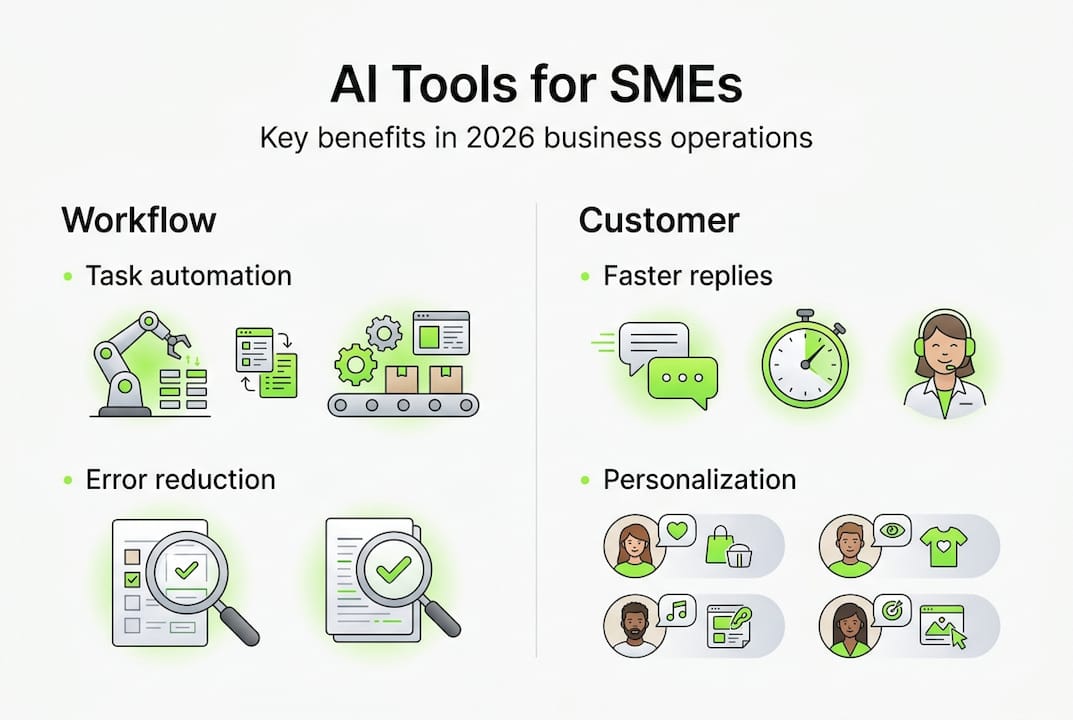
Pro Tip: Start by mapping your team’s most time-consuming repetitive tasks. The activities that generate the most frustration often represent the best opportunities for AI automation with immediate, measurable impact.
Consider which functions consume disproportionate time relative to their strategic value:
- Data entry and transfer between systems
- Scheduling and calendar management
- Basic customer enquiry responses
- Invoice processing and expense categorisation
- Social media content scheduling
- Meeting transcription and action item tracking
For businesses exploring AI tools to boost SME digital marketing, the combination of content generation, audience analysis, and campaign optimisation tools can transform marketing effectiveness whilst reducing agency dependence and associated costs.
Navigating compliance and European data sovereignty in AI adoption
European businesses operate under stricter data protection regulations than most global markets, making compliance a critical factor in AI tool selection. The intersection of GDPR requirements and the emerging EU AI Act creates both challenges and opportunities for SMEs choosing technology partners.
Many AI platforms now comply with GDPR and EU AI Act requirements, but verification requires due diligence. Look for tools that clearly document their data handling practices, offer data processing agreements, and maintain servers within EU jurisdictions. These factors aren’t merely legal formalities but fundamental protections for your business and customer relationships.
Choosing EU-based or zero-retention AI tools reduces compliance risks substantially. European edge GDPR-compliant tools like Nuwacom, Lumo, GreenPT, and KOSMO prioritise EU data sovereignty, ensuring customer information never leaves European servers. Italian SMEs saved €2.3M yearly using AI treasury optimisation through ORPRA.AI, demonstrating that compliance and cost savings aren’t mutually exclusive.
Prioritising sovereignty ensures customer data protection whilst building trust with clients who increasingly scrutinise how businesses handle their information. This consideration becomes particularly critical for SMEs in legal, finance, accounting, and healthcare sectors where data sensitivity demands the highest protection standards.
“Data sovereignty isn’t just about avoiding fines. It’s about building customer confidence in an era where data breaches make headlines daily. European SMEs that prioritise compliant AI solutions gain competitive advantages in trust and reliability.”
Compliance also protects SMEs from fines that can reach 4% of annual turnover under GDPR, potentially devastating for smaller businesses. Beyond financial penalties, reputational damage from data mishandling can destroy customer relationships that took years to build.
When evaluating AI tools, verify these compliance factors:
- Server locations and data residency policies
- Data processing agreements and controller/processor relationships
- Subprocessor lists and their compliance status
- Data retention and deletion policies
- Security certifications like ISO 27001
- Transparency in AI decision-making processes
Businesses implementing social media marketing strategies must ensure their AI tools comply with platform-specific data policies whilst maintaining GDPR standards, particularly when handling customer interactions and targeted advertising data.
Measuring ROI and achieving successful AI implementation
Successful AI adoption requires structured approaches that deliver measurable results rather than vague efficiency improvements. Many SMEs struggle because they deploy too many tools simultaneously without clear success metrics or integration plans.
Start AI adoption with one key pain point, such as customer service automation or invoice processing. This focused approach allows you to measure impact precisely and build organisational confidence before expanding. 80% of SMBs adopt AI but only 30% see major gains because structured implementation and integration are key to success.
Measure ROI by tracking time saved and cost reductions against implementation expenses. Calculate the hours your team previously spent on automated tasks, multiply by their hourly cost, and compare against subscription fees and setup time. Most AI tools reach positive ROI within 3-6 months when properly implemented.
Integrate AI with existing stacks like Microsoft 365, Google Workspace, or ERP systems rather than creating isolated technology islands. Integration ensures data flows seamlessly between platforms, eliminating duplicate entry and enabling AI to access the information needed for accurate predictions and recommendations.
Adopt a human+AI hybrid approach that maintains human oversight whilst leveraging AI efficiency. Humans excel at strategic thinking, relationship building, and handling exceptions, whilst AI excels at processing large data volumes, identifying patterns, and executing repetitive tasks consistently. This combination outperforms either approach alone.
Pro Tip: Create a simple scorecard tracking three metrics: time saved per week, error reduction percentage, and employee satisfaction with the new tool. Review monthly to ensure continued value delivery and identify optimisation opportunities.
Follow this implementation sequence for maximum success:
- Identify the single highest-impact pain point in your operations
- Research AI solutions specifically designed for that function
- Verify GDPR compliance and data sovereignty requirements
- Run a 30-day pilot with a small team subset
- Measure results against baseline metrics established pre-implementation
- Gather user feedback and adjust workflows accordingly
- Roll out organisation-wide with proper training and support
- Monitor ongoing performance and ROI monthly
Avoid data and integration failures through proper planning. Document your current workflows before implementing AI, identify where data originates and flows, and ensure your chosen tools can access necessary information sources. Many implementation failures stem from incomplete data access rather than tool limitations.
| Implementation phase | Timeline | Success metric |
|---|---|---|
| Pain point identification | Week 1 | Clear problem statement with quantified impact |
| Tool research and selection | Weeks 2-3 | Shortlist of 2-3 compliant solutions |
| Pilot programme | Weeks 4-7 | 30% efficiency improvement in target area |
| Training and rollout | Weeks 8-10 | 80% team adoption rate |
| Optimisation | Ongoing | Sustained ROI above 200% annually |
Businesses seeking comprehensive guidance can benefit from AI consulting for SMBs, which provides structured implementation frameworks, tool selection support, and ongoing optimisation to maximise returns whilst avoiding common pitfalls.
Top AI tools comparison for small businesses in 2026
Selecting the right AI tools requires understanding how different platforms address specific business functions. This comparison highlights leading solutions across key operational areas, emphasising features, use cases, costs, and EU compliance status to support informed decision-making.
Salesforce Einstein excels in sales and service automation, offering predictive lead scoring, automated email responses, and intelligent case routing. Zoho Zia provides predictive analytics and conversational AI assistance at lower price points, making it accessible for smaller budgets whilst delivering sophisticated forecasting capabilities.

Nextiva with XBert AI offers 24/7 customer service automation, handling routine enquiries whilst escalating complex issues to human agents. This hybrid approach maintains service quality whilst dramatically reducing response times and support costs.
Flowtly unifies ERP functions for European SMBs with automation, integrating accounting, inventory, and operations management into a single GDPR-compliant platform. Flowtly and ORPRA.AI offer AI-ready ERP and document automation with huge annual savings for EU SMEs, particularly in finance and operations-heavy sectors.
ORPRA.AI automates document handling, extracting data from invoices, contracts, and forms whilst maintaining audit trails. Businesses report saving €100k+ yearly through reduced manual processing and error correction costs.
Canva AI and Grammarly support marketing content creation and design, enabling small teams to produce professional-quality materials without specialised designers or copywriters. These tools democratise creative capabilities whilst maintaining brand consistency.
| Tool | Primary function | EU compliance | Starting price | Best for |
|---|---|---|---|---|
| Salesforce Einstein | CRM and sales automation | Yes, with EU data centres | €25/user/month | Sales teams needing predictive insights |
| Zoho Zia | CRM with predictive analytics | Yes | €14/user/month | Budget-conscious SMEs |
| Nextiva XBert | Customer service automation | Yes | €18/user/month | High-volume support operations |
| Flowtly | ERP automation | Yes, EU-based | €45/user/month | Operations and inventory management |
| ORPRA.AI | Document automation | Yes, EU-based | €200/month | Finance and legal document processing |
| QuickBooks AI | Accounting automation | Partial | €12/month | Basic bookkeeping automation |
| Canva AI | Design and content creation | Yes | €10/user/month | Marketing teams |
When comparing tools, consider total cost of ownership beyond subscription fees. Factor in implementation time, training requirements, integration complexity, and ongoing support needs. The cheapest tool often becomes expensive when hidden costs emerge.
Key selection criteria include:
- Specific pain point alignment with tool capabilities
- Integration compatibility with existing software stack
- GDPR compliance and data residency
- Scalability as your business grows
- Vendor stability and long-term viability
- Quality of customer support and documentation
Businesses staying current with digital marketing trends can leverage AI tools for content optimisation, audience segmentation, and campaign performance analysis, creating competitive advantages in increasingly crowded digital channels.
Elevate your business with expert digital solutions
Transforming operations through AI requires more than selecting the right tools. It demands strategic implementation, proper integration, and ongoing optimisation to deliver sustained value. Many SMEs struggle with the gap between purchasing AI solutions and achieving meaningful results.
Our AI consulting services help SMBs implement AI to transform operations effectively, providing structured frameworks from initial audit through full deployment and team training. We specialise in GDPR-compliant solutions that respect European data sovereignty whilst delivering measurable efficiency gains.
Combining AI implementation with tailored web development and digital marketing strategies amplifies results, creating integrated systems where your website, marketing automation, and operational tools work together seamlessly. This holistic approach delivers greater returns than isolated technology deployments.
Partner with specialists who understand SME challenges and EU compliance requirements. We’ve guided over 150 businesses through digital transformation, focusing on practical solutions that generate ROI rather than impressive technology that sits unused. Let us help you navigate AI adoption with proven expertise, turning confusion into clarity and investment into measurable growth.
Frequently asked questions
What are the easiest AI tools for SMEs to implement?
Conversational AI platforms like ChatGPT for content creation and Zapier for workflow automation require minimal technical expertise and integrate quickly with existing systems. These tools deliver immediate value without extensive training or complex setup processes.
How can small businesses ensure AI solutions comply with GDPR?
Verify that AI vendors maintain EU data centres, provide data processing agreements, and document their compliance certifications. Choose European-based providers when handling sensitive customer information to guarantee data sovereignty and regulatory alignment.
What is the typical ROI timeframe for adopting AI tools?
Most properly implemented AI tools reach positive ROI within 3-6 months through time savings and error reduction. Clear metrics and focused implementation on high-impact pain points accelerate returns compared to broad, unfocused deployments.
Can AI fully replace human customer service in small businesses?
No. The most effective approach combines AI handling routine enquiries with human agents managing complex issues and relationship building. This hybrid model delivers efficiency gains whilst maintaining the personal touch that differentiates small businesses from larger competitors.
How do I start integrating AI with existing business software?
Begin by mapping your current data flows and identifying where information originates. Choose AI tools with native integrations or API connections to your existing platforms, then test data synchronisation in a controlled pilot before full deployment.