

How to use AI tools to boost your SME’s digital marketing
March 22, 2026
Why invest in digital branding for business growth
March 24, 2026
Many Luxembourg business owners treat their website like a finished product. You launch it, celebrate briefly, then move on to other priorities. This mindset creates a dangerous blind spot that exposes your business to security breaches, plummeting search rankings, and frustrated customers who bounce to competitors. Ongoing maintenance is essential for security and performance, yet most SMEs underestimate its strategic value. This guide explains why continuous website care protects your investment, strengthens your market position, and delivers compounding returns that far exceed the monthly cost.
Table of Contents
- Key takeaways
- Understanding the importance of website maintenance
- Routine website maintenance tasks and schedules
- Advanced considerations: testing and strategic integration
- How Done can support your website maintenance journey
- Frequently asked questions
Key Takeaways
| Point | Details |
|---|---|
| Maintenance drives security | Ongoing updates and patches protect customer data and reduce the risk of security breaches. |
| Regular maintenance tasks | Backups, updates, security checks, SEO and UX audits keep websites reliable and visible. |
| Predictable monthly cost | A steady €500 per month prevents costly emergency fixes and downtime. |
| Regulatory compliance focus | Regular GDPR and accessibility compliance checks help avoid penalties. |
Understanding the importance of website maintenance
Your website faces constant threats from hackers probing for vulnerabilities, software updates that introduce compatibility issues, and evolving regulations that demand compliance adjustments. Without regular attention, small problems compound into catastrophic failures. A single unpatched security flaw can expose customer data, trigger GDPR penalties, and destroy years of trust building.
Consider what happens when you ignore routine care. Outdated plugins create entry points for malware. Slow loading times frustrate visitors who expect instant responses. Broken links damage your credibility with both users and search engines. These issues don’t announce themselves with warning sirens. They accumulate silently until a crisis forces expensive emergency intervention.
Web development benefits extend far beyond launch day. The initial build establishes your foundation, but maintenance determines whether that foundation supports growth or crumbles under pressure. Luxembourg businesses face unique challenges including multilingual requirements, strict data protection standards, and a competitive digital marketplace where small advantages matter enormously.
Planned maintenance budgets transform website ownership from reactive firefighting to proactive optimisation. When you allocate €500 monthly for systematic care, you gain predictable costs and continuous improvements. This approach prevents the panic of discovering your site has been down for hours, losing sales and damaging your reputation.
Regular maintenance isn’t an expense, it’s insurance against catastrophic failure and a catalyst for sustained digital growth.
Security updates patch vulnerabilities before attackers exploit them. Performance monitoring catches slowdowns before customers notice. Content refreshes keep your messaging relevant and engaging. These activities compound over time, creating a robust digital presence that competitors struggle to match.
Legal compliance demands particular attention in Luxembourg’s regulatory environment. GDPR requirements evolve as courts interpret new scenarios and enforcement agencies issue updated guidance. Annual compliance audits ensure your data handling practices meet current standards, protecting you from fines that can reach 4 per cent of annual revenue. Ignoring these obligations creates existential risk that no business can afford.
The financial logic is straightforward. Emergency fixes cost three to five times more than preventative maintenance because they require immediate attention, often outside normal business hours. A compromised website might need complete rebuilding, costing thousands of euros and weeks of downtime. Regular maintenance spreads costs evenly while preventing disasters that destroy value far exceeding the investment.
Key maintenance benefits:
- Protects customer data and maintains trust through security updates
- Preserves search rankings via technical optimisation and fresh content
- Ensures legal compliance with evolving GDPR and accessibility standards
- Maintains optimal performance that keeps visitors engaged
- Prevents costly emergency repairs and unexpected downtime
Website redesign insights reveal that businesses often underestimate ongoing costs during initial planning. They focus on launch expenses while treating maintenance as an afterthought. This creates budget surprises and forces difficult choices between necessary updates and other business priorities. Smart planning integrates maintenance from day one, ensuring your digital presence remains an asset rather than becoming a liability.
Routine website maintenance tasks and schedules
Effective maintenance follows a structured schedule that balances thoroughness with efficiency. Breaking activities into daily, weekly, monthly, quarterly, and annual tasks creates manageable routines that prevent overwhelming workloads. This systematic approach ensures nothing falls through the cracks while making responsibilities clear for team members or service providers.
Daily maintenance activities:
- Monitor uptime to catch outages immediately
- Verify automated backups completed successfully
- Check error logs for unusual patterns
- Review security alerts from monitoring tools
These quick checks take minutes but provide early warning of problems. Uptime monitoring alerts you instantly when your site goes down, minimising lost revenue. Backup verification ensures you can restore quickly if disaster strikes. Error logs reveal technical issues before they cascade into major failures.
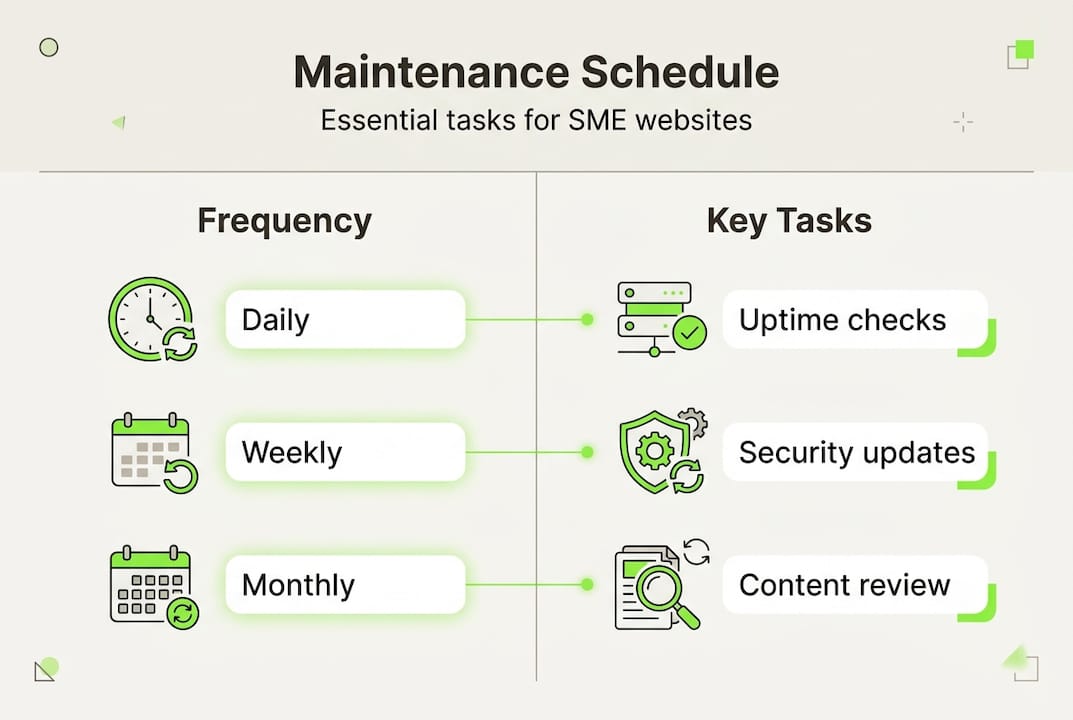
Maintenance involves daily uptime and backup checks, weekly updates and speed tests, monthly security and content reviews, quarterly SEO and user experience audits, and annual comprehensive assessments. This cadence balances vigilance with practical resource allocation.

Weekly tasks address software updates and performance optimisation. Apply security patches for your content management system, plugins, and themes. Run speed tests to identify performance degradation. Review analytics for traffic anomalies that might indicate problems. These activities take one to two hours but prevent the vast majority of technical issues.
Monthly reviews focus on security hardening and content freshness. Scan for malware and vulnerabilities using automated tools. Update copyright notices and contact information. Refresh time-sensitive content like pricing or service descriptions. Review user feedback and support tickets for patterns indicating website problems.
| Frequency | Primary focus | Time investment | Key activities |
|---|---|---|---|
| Daily | Monitoring | 10-15 minutes | Uptime checks, backup verification, error log review |
| Weekly | Updates | 1-2 hours | Software patches, speed tests, analytics review |
| Monthly | Security & content | 2-3 hours | Malware scans, content updates, user feedback analysis |
| Quarterly | Strategic | 4-6 hours | SEO audits, UX testing, conversion optimisation |
| Annual | Comprehensive | 1-2 days | Full security audit, technology review, strategy alignment |
Quarterly audits examine strategic elements that require deeper analysis. Website maintenance checklists should include comprehensive SEO reviews covering keyword rankings, backlink profiles, and technical optimisation opportunities. User experience testing identifies navigation problems and conversion barriers. Accessibility audits ensure compliance with evolving standards.
Annual assessments provide the big picture perspective needed for strategic planning. Review your entire technology stack for outdated components requiring replacement. Evaluate whether your hosting infrastructure still meets performance and security needs. Assess whether your website aligns with current business goals and market positioning. This comprehensive review guides major upgrade decisions and budget planning for the coming year.
Pro Tip: Create a maintenance calendar with automated reminders for each task category. This prevents important activities from being forgotten during busy periods and ensures consistent care regardless of daily operational pressures.
Delegating maintenance to website transformation for leads specialists frees your time for core business activities while ensuring expert attention. Professional services bring specialised knowledge, efficient workflows, and 24/7 monitoring that in-house teams struggle to match. The cost typically represents a fraction of what you’d spend on emergency repairs or lost revenue from preventable problems.
Advanced considerations: testing and strategic integration
Beyond routine maintenance lies a strategic layer that separates thriving digital presences from merely functional ones. Advanced testing methodologies catch edge cases that basic checks miss. Strategic integration aligns maintenance activities with broader business objectives, transforming website care from a technical necessity into a growth driver.
Edge case testing for web applications prevents failures by examining boundaries like maximum inputs and concurrent users. Most businesses test normal scenarios but neglect extreme conditions. What happens when someone submits a form with 10,000 characters? How does your checkout process handle 500 simultaneous users? These edge cases reveal vulnerabilities that surface during traffic spikes or unusual user behaviour.
Testing strategies should include:
- Load testing to verify performance under peak traffic
- Security penetration testing to identify exploitable vulnerabilities
- Cross-browser compatibility checks across devices and platforms
- Accessibility testing with assistive technologies
- Form validation testing with unusual inputs
Strategic maintenance supports SEO business growth strategies by continuously optimising technical and content elements. Search algorithms evolve constantly, rewarding sites that demonstrate expertise, authority, and trustworthiness. Regular content updates signal freshness. Technical optimisation improves crawlability and indexing. User experience enhancements reduce bounce rates, a ranking factor that compounds over time.
Luxembourg SMEs allocate 5-10% of revenue to maintenance to ensure SEO and GDPR compliance and support digital growth. This investment level reflects the strategic value of sustained digital excellence rather than viewing maintenance as a grudging necessity.
Compliance integration transforms regulatory requirements from burdens into competitive advantages. GDPR compliance builds customer trust when you communicate transparently about data practices. Accessibility improvements expand your addressable market while demonstrating social responsibility. Regular compliance audits prevent penalties while positioning your brand as trustworthy and professional.
| Maintenance type | Strategic benefit | Business impact |
|---|---|---|
| Technical SEO | Higher search rankings | Increased organic traffic and qualified leads |
| UX optimisation | Better conversion rates | More customers from existing traffic |
| Security hardening | Customer trust | Reduced churn and stronger reputation |
| Compliance audits | Legal protection | Avoided penalties and enhanced credibility |
| Content updates | Market relevance | Sustained engagement and thought leadership |
Budget allocation requires balancing immediate needs with long-term strategic investments. Basic maintenance prevents disasters but strategic enhancements drive growth. Effective planning dedicates 60 per cent of your budget to routine care and 40 per cent to strategic improvements. This ratio ensures stability while funding continuous advancement.
Pro Tip: Track maintenance ROI by monitoring key metrics before and after major optimisation efforts. Measure changes in organic traffic, conversion rates, page speed scores, and security incidents. This data justifies continued investment and guides resource allocation towards highest-impact activities.
Integrating UX and SEO impact creates multiplicative benefits where improvements in one area strengthen the other. Fast loading times improve both user satisfaction and search rankings. Clear navigation helps visitors and search engine crawlers alike. Mobile optimisation addresses user needs while satisfying Google’s mobile-first indexing requirements.
SEO ecommerce success depends heavily on technical maintenance that many businesses overlook. Product schema markup requires updates as inventory changes. Site speed affects conversion rates more dramatically for ecommerce than informational sites. Security is paramount when handling payment information. These technical elements demand expert attention that pays dividends through increased sales and customer loyalty.
Strategic maintenance planning aligns website activities with annual business cycles. Retail businesses intensify optimisation before peak shopping seasons. B2B companies refresh content around industry events and fiscal year planning periods. This synchronisation ensures your digital presence supports business objectives rather than operating independently.
How Done can support your website maintenance journey
Navigating the complexities of comprehensive website maintenance requires expertise that most Luxembourg SMEs lack in-house. Done brings specialised knowledge across web development, security, SEO, and compliance, ensuring your digital presence remains secure, performant, and strategically aligned with business goals.
Our maintenance services cover everything from daily monitoring to strategic quarterly audits. We handle security updates, performance optimisation, content management, and compliance verification, freeing you to focus on core business activities. With over 150 completed projects, we understand Luxembourg’s unique digital landscape and regulatory environment.
Invest in web development that delivers sustained value rather than treating your website as a one-time project. Our growth-driven approach continuously refines your digital presence based on real user data and evolving business needs. We provide transparent pricing and detailed reporting so you always understand where your investment goes and what results it generates.
Understanding web development as an ongoing partnership rather than a transactional service transforms outcomes. Done web agency Luxembourg combines technical excellence with strategic thinking, ensuring your website remains a powerful growth engine rather than becoming a neglected liability.
Frequently asked questions
How often should I perform website maintenance?
Daily monitoring covers uptime and backups, taking 10 to 15 minutes. Weekly updates address security patches and performance, requiring one to two hours. Monthly reviews focus on content freshness and security scans over two to three hours. Quarterly audits examine SEO and user experience in four to six hours. Annual assessments provide comprehensive technology and strategy reviews spanning one to two days. This website maintenance checklist structure balances thoroughness with practical resource allocation, preventing both neglect and excessive time investment.
What are the risks of neglecting website maintenance?
Unpatched security vulnerabilities invite data breaches that expose customer information and trigger GDPR penalties reaching 4 per cent of annual revenue. Performance degradation frustrates visitors who expect instant loading, increasing bounce rates and damaging search rankings. Outdated content signals neglect to both users and search engines, eroding trust and competitive position. Emergency fixes cost three to five times more than preventative maintenance whilst causing disruptive downtime that loses revenue and damages reputation.
How does website maintenance improve SEO and user experience?
Regular updates fix broken links, optimise page speed, and ensure mobile responsiveness, all factors that search algorithms reward with higher rankings. Content refreshes demonstrate expertise and keep information relevant, encouraging longer visits and repeat traffic. UX on SEO improvements reduce bounce rates whilst increasing engagement metrics that signal quality to search engines. Technical optimisation enhances crawlability, helping search engines index your content effectively and display it for relevant queries.
How much should a Luxembourg SME budget for website maintenance?
Luxembourg SMEs typically allocate 5 to 10 per cent of revenue to website maintenance, with budgets around €500 monthly providing comprehensive coverage. This investment includes security monitoring, performance optimisation, content updates, SEO refinements, and compliance audits. Costs vary based on site complexity, traffic volume, and strategic ambitions, but realistic budgeting prevents emergency expenses whilst supporting steady digital growth. Web development investment delivers compounding returns when maintenance sustains and enhances your initial build rather than allowing it to deteriorate.