

Inbound marketing process: a practical guide for SMBs
June 28, 2026
Why automate marketing campaigns: the SME guide for 2026
June 30, 2026
TL;DR:
- Local SEO allows businesses to appear in local search results, reaching nearby customers ready to buy. It offers a lower cost per lead than paid advertising and builds lasting visibility that grows over time. Regular activity on the Google Business Profile and local citations significantly improve local rankings and conversions.
Local SEO is the practice of optimising a business’s online presence to appear in geographically relevant search results, making it the most direct route to customers who are ready to buy nearby. 46% of all Google searches carry local intent. That figure alone explains why focusing on local SEO is not optional for any business that depends on foot traffic, local calls, or nearby clients. Add to that the fact that 97% of consumers use the internet to find local businesses, and the case becomes impossible to ignore. This guide covers what local SEO actually delivers, where most SMBs go wrong, and which actions produce real results in 2026.
Why focus on local SEO to attract nearby customers?
Local SEO increases your visibility at the exact moment a nearby customer is searching for what you offer. That is fundamentally different from traditional SEO, which targets broad audiences regardless of location or purchase readiness.

Google’s local search results display a “Local Pack,” the map-based block of three businesses that appears above organic results. Businesses ranking in the top 3 of the Local Pack receive 44% of all local clicks, plus up to 126% more traffic and 93% more calls than lower-ranked businesses. If your business does not appear there, the majority of nearby searchers never see you.
The businesses that dominate the Local Pack share three characteristics:
- Consistent NAP data. Name, address, and phone number must be identical across every directory, your website, and your Google Business Profile (GBP). Inconsistency signals unreliability to Google’s algorithm.
- An active, complete GBP. Categories, opening hours, photos, and service descriptions all contribute to how Google ranks your profile against local competitors.
- Positive review volume. Reviews are both a ranking signal and a conversion driver. A business with strong reviews earns clicks even when it ranks second or third.
The engagement signals that local SEO generates, including calls, direction requests, and website clicks from your GBP, feed directly back into your ranking. Google treats high engagement as evidence that your business is relevant and active. This creates a compounding effect: better visibility produces more engagement, which produces better visibility.
Local SEO also targets a fundamentally different type of searcher than generic SEO. Someone searching “accountant Luxembourg City” is not browsing. They are at the bottom of the purchase funnel and likely to contact a business within hours. Local searchers frequently purchase or visit within 24 hours of their search. That conversion speed is something no broad digital marketing channel can match.
Pro Tip: Set up UTM tracking on your GBP website link so you can measure exactly how many visits, calls, and direction requests come from local search each month. Most SMBs skip this and cannot prove local SEO ROI to themselves or their stakeholders.
Does local SEO deliver better ROI than paid advertising?
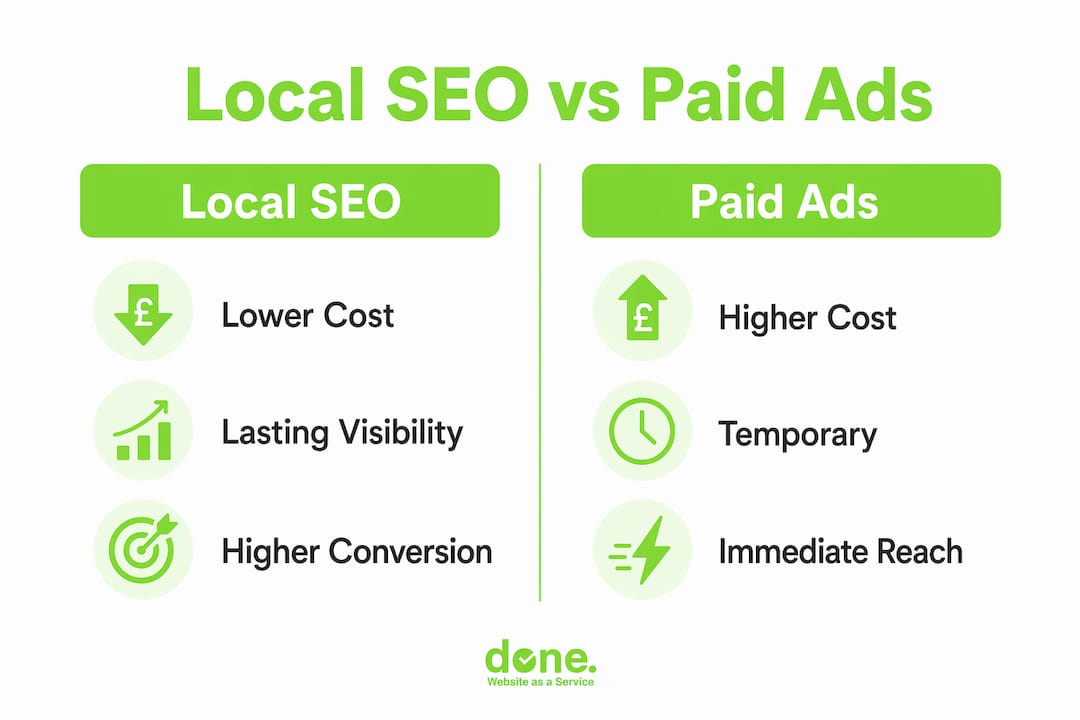
For most SMBs, local SEO produces a lower cost per lead than paid search advertising. The average cost per lead from local SEO is roughly $32, compared to $75–$150 for Google Ads in competitive markets. That gap widens in sectors like legal services, finance, and healthcare, where paid clicks are expensive.
| Channel | Average cost per lead | Visibility duration | Stops when budget stops? |
|---|---|---|---|
| Local SEO | ~$32 | Ongoing, compounds over time | No |
| Google Ads | $75–$150 | Only while ads run | Yes |
| Social media ads | Variable, often $50+ | Only while ads run | Yes |
The table above illustrates the structural difference. Paid advertising delivers immediate visibility but stops the moment you stop paying. Local SEO builds a presence that persists and grows. A well-optimised GBP and a set of strong local citations continue generating leads months after the initial work is done.
Local SEO shifts your marketing from chasing customers to being found at the moment of need. That shift matters enormously for SMB budgets. You are not paying per click. You are investing in a permanent asset.
The conversion rates from local search also outperform most paid channels. Because local searchers have specific, immediate intent, the leads they generate convert at a higher rate. A plumber in Esch-sur-Alzette who ranks in the Local Pack for “emergency plumber Esch” receives calls from people who need help now, not people who are vaguely considering a renovation in six months.
For SMBs in Luxembourg, where advertising budgets are typically modest and competition in paid search is rising, the importance of local SEO as a cost-efficient channel is particularly acute. The compounding nature of local SEO means that businesses who invest consistently now build an advantage that becomes harder for competitors to close over time.
What are the most common local SEO mistakes SMBs make?
Most SMBs treat local SEO as a one-time setup task. They claim their GBP, fill in the basics, and then leave it untouched for months. That approach produces weak results because Google’s algorithm treats GBP like a social media channel.
Google values recent GBP activity including posting updates, responding to reviews, and adding photos. A profile that has not been updated in three months signals to Google that the business may be inactive or disengaged. Regular activity is a ranking signal in itself.
The four most common mistakes SMBs make with local SEO are:
- Ignoring review volume. Businesses with 50 or more reviews are 266% more likely to appear in Local Pack results. Most SMBs have fewer than 20 reviews and never actively ask customers to leave one.
- Relying on generic keywords. Targeting “accountant” instead of “accountant Luxembourg City” or “comptable Kirchberg” misses the geographic specificity that local search requires. Broad keywords attract broad audiences, not nearby buyers.
- Neglecting local citations. A citation is any mention of your business name, address, and phone number on an external website. Directories like Pages Jaunes, local chamber of commerce listings, and industry associations all contribute to your local authority. Missing or inconsistent citations weaken your ranking.
- Building the wrong backlinks. Many SMBs chase high-authority national backlinks when community authority links from local organisations, news sites, or event calendars carry more weight for local rankings. A mention in the Luxembourg Times or a link from the Chambre de Commerce matters more for local SEO than a link from a generic national directory.
Pro Tip: Audit your NAP data across the top 10 directories in your market every six months. A single inconsistent phone number or old address can suppress your Local Pack ranking without any obvious warning sign.
A fifth mistake deserves separate attention: treating your website as the only local SEO asset. Your GBP, local citations, reviews, and optimised local landing pages all work together. Businesses that focus exclusively on on-site keyword optimisation miss the majority of what drives local rankings.
Which local SEO strategies should SMBs prioritise?
Effective local SEO is not complicated, but it requires consistency. The businesses that rank well in local search do the basics thoroughly and keep doing them. Here are the priorities that produce the clearest results:
- Optimise your GBP completely. Choose the most specific primary category available. Add all relevant secondary categories. Upload at least 10 photos. Write a description that includes your city and core services. Set your service area accurately. Post an update at least once per fortnight.
- Build and maintain local citations. Submit your business to the major local and national directories relevant to your market. In Luxembourg, this includes Pages Jaunes, Editus, and sector-specific directories. Check existing listings for NAP consistency and correct any errors.
- Actively collect and respond to reviews. Ask every satisfied customer to leave a Google review. Make it easy by sending a direct link. Respond to every review, positive or negative, within 48 hours. Responses signal to Google that the business is engaged.
- Create targeted local landing pages. Service-specific landing pages that include city or neighbourhood names in URLs, header tags, and metadata perform significantly better than generic service pages. A page titled “Web design services in Luxembourg City” outranks a page titled “Web design services” for local searches.
- Earn local community links. Sponsor a local event, join the Chambre de Commerce, or contribute to a local publication. Community authority links from local organisations consistently outperform generic backlinks for local ranking purposes.
- Track the right metrics. Monitor calls, direction requests, and website clicks from your GBP monthly. These engagement metrics tell you whether your local SEO activity is producing real business outcomes, not just impressions.
Consistent optimisation efforts typically show measurable impact within 4 to 12 weeks. That timeline is faster than most SMBs expect, particularly for businesses in markets where competitors have neglected their GBP.
One underused tactic is building relationships with local websites that publish event calendars, business directories, or community news. A listing in a local neighbourhood association’s website or a mention in a local business journal carries genuine ranking weight. Small businesses gain a real edge in local SEO precisely because they can build authentic community ties that larger national brands cannot replicate. For a deeper look at how SEO drives growth for Luxembourg businesses specifically, the Done guide on SEO for Luxembourg SMEs covers the local market in detail.
Key takeaways
Local SEO is the highest-ROI digital marketing channel available to SMBs because it targets buyers with immediate local intent, builds compounding visibility, and costs a fraction of paid advertising per lead.
| Point | Details |
|---|---|
| Local Pack dominance matters | Top 3 Local Pack results capture 44% of local clicks and generate significantly more calls. |
| Cost per lead is lower | Local SEO averages ~$32 per lead versus $75–$150 for Google Ads in competitive markets. |
| Reviews drive rankings | Businesses with 50+ reviews are 266% more likely to appear in Local Pack results. |
| GBP needs regular activity | Google treats GBP like a social channel; inactive profiles lose ranking ground quickly. |
| Community links outperform national ones | Local citations from chambers of commerce and local directories carry more weight than generic backlinks. |
Why local SEO is the channel I recommend first to every Luxembourg SMB
I have worked with SMBs in Luxembourg across retail, professional services, and hospitality. The pattern is consistent: businesses that invest in local SEO before paid advertising build a more durable presence and spend less per customer acquired.
What surprises most clients is how quickly results appear. We have seen businesses move into the Local Pack within six weeks of a thorough GBP overhaul and a focused citation-building effort. That speed is not typical of SEO broadly, but local SEO operates in a smaller competitive pool.
The Luxembourg market has a specific characteristic that amplifies local SEO value: it is multilingual. A business that optimises its GBP and landing pages in French, German, Luxembourgish, and English reaches genuinely distinct audience segments. Most competitors optimise in one language only. That gap is an opportunity.
The other thing I tell clients is this: local SEO rewards businesses that are genuinely embedded in their community. Google’s algorithm has become remarkably good at detecting authentic local authority. A business that sponsors local events, earns mentions in local publications, and responds to every customer review builds a profile that is very difficult for a competitor to replicate quickly. That is a real competitive advantage, not a technical trick.
The businesses that treat local SEO as ongoing business development, rather than a one-off technical task, consistently outperform those that do not. The Google Business Profile is not a listing. It is a live channel that rewards attention.
— Thomas
How Done supports SMBs with local SEO and web presence
Done is a Luxembourg digital agency with over 350 completed projects for SMBs across multiple sectors. We build and manage local SEO programmes that cover GBP optimisation, citation building, review management, and local landing page creation.

Our approach connects local SEO directly to your website performance. A well-optimised GBP pointing to a slow or poorly structured website loses conversions at the final step. Done handles both sides: the local search presence and the web development investment that turns local traffic into paying customers. We also build lead generation workflows that capture and nurture the enquiries your local SEO activity generates. If you want a clear picture of where your local presence stands today, contact Done for an audit.
FAQ
What is local SEO and how does it differ from traditional SEO?
Local SEO is the practice of optimising a business’s online presence to rank in geographically relevant searches, such as “accountant Luxembourg City.” Traditional SEO targets broad keyword rankings regardless of location, making it less effective for businesses that serve a specific geographic area.
How quickly does local SEO produce results?
Consistent local SEO activity typically produces measurable results within 4 to 12 weeks. GBP optimisation and citation corrections often show impact faster than on-site SEO changes.
Why does the Google Business Profile matter so much for local rankings?
Google treats GBP as a primary signal of local relevance and business activity. Regular updates, photo additions, and review responses all tell Google that the business is active, which directly influences Local Pack ranking.
How many reviews does a business need to rank in the Local Pack?
Businesses with 50 or more reviews are 266% more likely to appear in Local Pack results. Review quality and recency also matter, so a steady flow of new reviews outperforms a single burst of older ones.
Is local SEO worth it for a small business with a limited budget?
Local SEO delivers a lower cost per lead than paid advertising, averaging roughly $32 per lead compared to $75–$150 for Google Ads. For budget-conscious SMBs, it is the most cost-efficient channel for reaching nearby customers with genuine purchase intent.