

Why focus on local SEO: a practical guide for SMBs
June 29, 2026
What is the ecommerce user journey? A practical guide
July 1, 2026
TL;DR:
- Marketing automation uses software and AI to handle repetitive tasks and deliver personalized messages at scale. It helps small businesses save time, improve targeting, and achieve a positive ROI within the first year. Regular monitoring and proper data management are essential for successful automated campaign execution.
Marketing automation is the practice of using software and AI to handle repetitive campaign tasks, deliver personalised messages at scale, and manage audience targeting without manual intervention at every step. For SMEs competing with larger teams and tighter budgets, this is not a nice-to-have. Businesses using marketing automation see an average ROI of $5.44 for every $1 spent, with 76% achieving positive ROI within the first year. That figure alone answers the core question of why automate marketing campaigns. The real conversation is about how to do it well.
Why automate marketing campaigns: the efficiency case
The most immediate reason to automate marketing campaigns is time. Marketing teams save 6–8 hours weekly by automating repetitive tasks such as email scheduling and list cleaning. Across a team of three people, that is up to 24 hours per week returned to work that actually requires human judgement.
The tasks that eat this time are predictable:
- Email scheduling and follow-up sequences triggered by user behaviour, such as a contact downloading a guide or abandoning a checkout
- Contact list segmentation and cleaning, removing duplicates, updating tags, and sorting leads by stage
- Social media post scheduling across multiple channels from a single content calendar
- Lead scoring, assigning numerical values to contacts based on their engagement so sales teams know who to call first
- Performance reporting, pulling campaign data into dashboards automatically rather than building spreadsheets by hand
Each of these tasks is rule-based and time-consuming. Automation handles them consistently, without the errors that creep in when a person is doing the same thing for the fifth time that week.
Consistency is the underrated benefit here. A human might forget to send a follow-up email on day three of a nurture sequence. An automated workflow does not. That reliability directly improves the reader’s experience and your conversion rate.
Pro Tip: Before choosing an automation platform, map your existing workflow on paper first. Identify the three tasks your team repeats most often and confirm the platform handles all three natively. Automating a broken process just makes the problem faster.
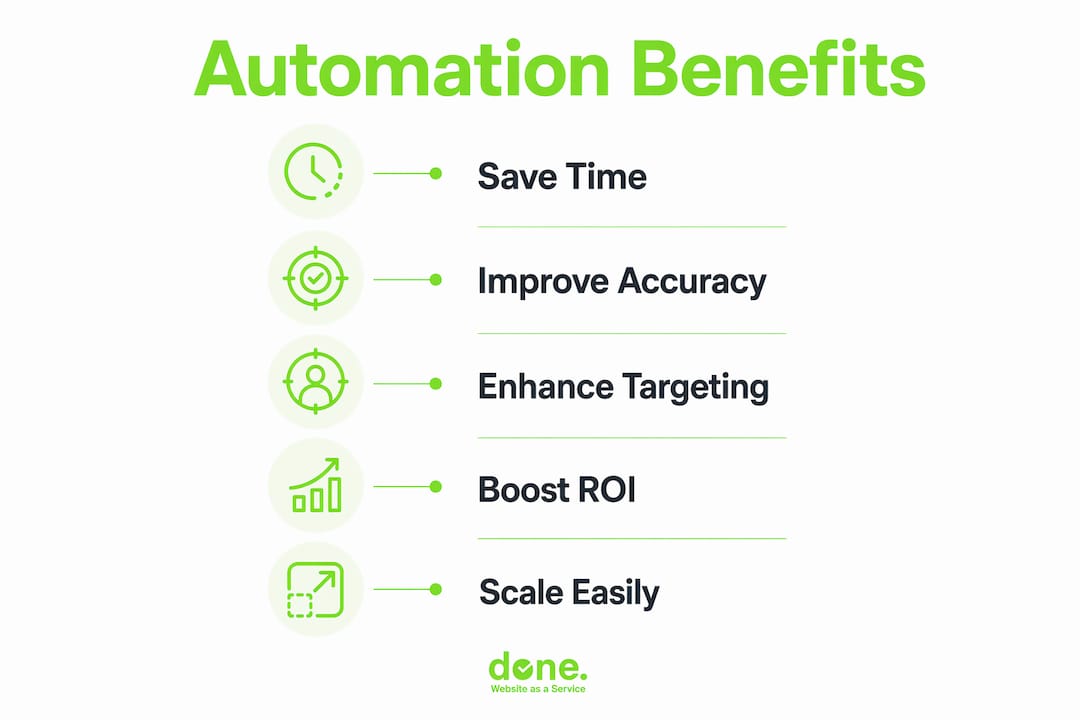
The practical efficiency gains from automation compound over time. A team that reclaims 20 hours per week can redirect that capacity to content strategy, creative testing, and client relationships. Those are the activities that actually differentiate a business.
How does automation improve targeting and campaign precision?
Automation improves targeting by removing the human bottleneck from data analysis. A marketer working manually can segment a list into three or four groups. An automated system can segment continuously, updating audience profiles in real time as contacts interact with your content.

The numbers support this. Research shows that 22% of businesses focus automation specifically on improving targeting, and those businesses see lead management efficiency increase by approximately 85%. That is not a marginal gain. It means your sales team spends time on leads that are genuinely ready to buy, not on contacts who opened one email six months ago.
Here is how automation sharpens precision across the campaign lifecycle:
- Behavioural segmentation: The system tracks what each contact clicks, downloads, or ignores, then adjusts their segment automatically. A contact who reads three articles about GDPR compliance gets tagged differently from one who reads about social media strategy.
- Lead scoring and routing: Contacts accumulate points based on defined actions. When a lead crosses a threshold score, the system alerts the sales team or triggers a specific email sequence without anyone checking a spreadsheet.
- Send-time optimisation: Automation platforms analyse when individual contacts historically open emails and schedule sends accordingly. This alone can lift open rates meaningfully.
- Dynamic content personalisation: The same email template serves different content blocks to different segments. A contact in Luxembourg sees different case studies from one in Belgium, without you writing two separate campaigns.
- Re-engagement workflows: Contacts who go quiet for 60 days trigger a separate sequence designed to win back their attention, rather than sitting in a list that drags down your deliverability metrics.
AI marketing automation goes further still. Modern AI-driven systems move beyond rule-based logic to draft copy, select audience segments, run A/B tests, and adjust campaigns based on live results. The system does not just follow instructions. It learns from outcomes and changes its own behaviour. For an SME without a dedicated data analyst, this capability closes a significant gap.
The value here is not just efficiency. Personalisation at scale is genuinely impossible to achieve manually when your contact list grows beyond a few hundred people. Automation makes it structurally achievable.
What does the impact of marketing automation look like in financial terms?
The Marketing Efficiency Ratio, known as MER, is the clearest financial lens for evaluating automation’s impact. MER measures total revenue divided by total marketing spend across all channels. It gives you a view of overall marketing health that Return on Ad Spend (ROAS) cannot provide.
ROAS tells you how a single campaign or channel performed. MER tells you whether your marketing operation as a whole is profitable. Businesses that confuse the two risk allocating budget behind campaigns that look successful in isolation but drag down overall profitability.
| Metric | What it measures | Limitation |
|---|---|---|
| ROAS | Revenue per £1 spent on a specific ad | Ignores other channels and total costs |
| MER | Total revenue divided by total marketing spend | Requires unified data across all channels |
| Cost per lead | Acquisition cost per new contact | Does not reflect lead quality or close rate |
| Customer acquisition cost | Total cost to acquire one paying customer | Lags behind campaign changes by weeks |
Automation improves MER in two ways. First, it reduces wasted spend by pausing underperforming campaigns automatically. Second, it improves conversion rates through better targeting, which means each pound of spend generates more revenue.
Pro Tip: Set your MER target before you launch any automation. If your business needs £4 in revenue for every £1 in marketing spend to remain profitable, build that number into your reporting dashboard from day one. Do not wait until the end of the quarter to discover you have been running at £2.80.
Automated campaign rules can pause underperforming ads and shift budget dynamically, but they require regular human review. Automation without oversight can amplify bad targeting just as efficiently as it amplifies good targeting. The tool does not know your business goals. You do.
What are the common pitfalls when implementing marketing automation?
The biggest mistake SMEs make is treating automation as a set-and-forget solution. It is not. Automation executes your instructions at scale. If those instructions are wrong, the errors scale too.
The most common pitfalls are:
- Disconnected tools creating data silos: When your CRM, email platform, and ad accounts do not share data, visibility gaps and profiling errors appear. A contact who unsubscribed from email still receives retargeting ads. A lead who converted is still in a nurture sequence. These errors damage trust and waste budget.
- Automating before cleaning your data: Garbage in, garbage out. If your contact list has duplicate entries, outdated job titles, or missing fields, automation will faithfully send the wrong message to the wrong person at the wrong time.
- Removing human oversight entirely: AI-driven automation can draft copy, select segments, and self-optimise. That capability is genuinely useful. It is also capable of drifting in a direction that no longer reflects your brand voice or business priorities without anyone noticing for weeks.
- Trying to automate everything at once: Businesses that attempt a full automation overhaul in one go typically stall. The integration work is heavier than expected, and the team does not have time to learn the platform while also running campaigns.
- Ignoring GDPR requirements: In Luxembourg and across the EU, automated marketing must comply with GDPR. Consent records, data retention rules, and the right to erasure all apply to automated workflows. A platform that does not log consent properly creates legal exposure.
The best approach for SMEs is to start with one workflow, prove the result, and expand from there. Automate your welcome email sequence first. Measure the open rate, click rate, and conversion rate against your previous manual process. Once that workflow is stable, add the next one.
Successful automation depends on the quality of the inputs. Humans must act as editors and strategists, not just operators. The platform handles execution. Your team handles judgement.
Key takeaways
Marketing automation delivers measurable ROI, saves significant team time, and improves campaign precision, but only when implemented with clean data, integrated tools, and consistent human oversight.
| Point | Details |
|---|---|
| ROI is proven and fast | 76% of businesses achieve positive ROI from automation within the first year. |
| Time savings are substantial | Teams reclaim 6–8 hours per week per person by automating repetitive tasks. |
| Targeting improves dramatically | Businesses focused on targeting automation see lead management efficiency rise by 85%. |
| MER beats ROAS as a health metric | Measure total marketing efficiency with MER, not just individual campaign ROAS. |
| Human oversight is non-negotiable | Automation scales your decisions, so review workflows regularly to catch drift early. |
What I have actually seen with SME clients
The businesses that get the most from automation are not the ones with the most sophisticated platforms. They are the ones that started with a clear question: “What is the one task that wastes the most time each week?” In our experience working with SMEs in Luxembourg, that answer is almost always email follow-up. A lead comes in, someone means to follow up within 24 hours, and three days pass. Automation solves that specific problem immediately and visibly.
What I find consistently overlooked is the monitoring side. Business owners invest time in setting up workflows and then check them once a quarter. That is too infrequent. A workflow that was performing well in january can degrade by march because your audience behaviour has shifted, your offer has changed, or a data import introduced errors. I recommend a monthly review of every active workflow, even if it takes only 30 minutes.
The other thing I would push back on is the idea that automation replaces creative thinking. It does not. Automation handles delivery. It does not write a subject line that makes someone stop scrolling. It does not decide which story to tell or which problem to lead with. The businesses I have seen struggle with automation are the ones that assumed the platform would handle strategy. It handles execution. Strategy still requires a person.
For Luxembourg SMEs specifically, the multilingual dimension adds a layer of complexity that generic automation advice ignores. A workflow that works in French needs different timing, different tone, and sometimes different offers for a German-speaking audience. Build that into your segmentation from the start, not as an afterthought.
— Thomas
How Done supports SMEs with marketing automation
Done works with SMEs across Luxembourg and Europe to build digital marketing workflows that connect automation to real business outcomes. The focus is always on practical implementation: clean data, integrated tools, GDPR-compliant processes, and workflows that your team can actually manage and monitor.

If you are ready to move beyond manual campaign management, Done’s digital marketing automation guide covers the full process for SMEs, from first workflow to full funnel. The team brings hands-on experience from 350+ client projects, with transparent pricing and no setup fees. Whether you need a single automation audit or a complete campaign architecture, the starting point is a conversation about what your team actually needs.
FAQ
What is marketing automation?
Marketing automation is software that handles repetitive campaign tasks, such as email scheduling, lead scoring, and audience segmentation, without manual input at each step. It allows marketing teams to deliver personalised messages at scale and focus their time on strategy and creative work.
How quickly does marketing automation deliver ROI?
76% of businesses achieve positive ROI from marketing automation within the first year of implementation. The average return is $5.44 for every $1 spent.
What tasks should SMEs automate first?
Start with email follow-up sequences triggered by specific contact actions, such as a form submission or content download. This delivers immediate time savings and measurable conversion improvements without requiring complex platform configuration.
What is the difference between ROAS and MER?
ROAS measures revenue generated by a specific ad campaign relative to its spend. MER measures total revenue divided by total marketing spend across all channels, giving a more accurate picture of overall marketing profitability.
Does automation work without a large marketing team?
Automation is particularly well-suited to small teams because it handles execution tasks that would otherwise require additional headcount. A team of two can manage campaigns at a scale that previously required five people, provided the workflows are set up correctly and reviewed regularly.