

Master AI change management: Boost your SME’s efficiency
May 3, 2026
AI adoption for SMEs: Practical steps to boost efficiency
May 5, 2026
TL;DR:
- European SMEs often lag behind larger firms in adopting intelligent automation due to limited budgets, data infrastructure, and skills. Start with targeted applications like chatbots, invoice processing, or workflow automation, focusing on a single operational pain point. Small businesses can outperform larger firms by leveraging agility, rapid decision-making, and strategic, phased implementation.
Intelligent automation is not a privilege reserved for large corporations with vast IT budgets. Yet many European small and medium-sized enterprises (SMEs) continue to treat it as something distant and unattainable, leaving genuine efficiency gains on the table. The SME adoption gap versus larger firms is persistent across Europe and varies significantly depending on the specific AI application and the readiness of each business. This guide cuts through the confusion, explains what intelligent automation actually means for your business, and shows you how to start making practical progress today.
Table of Contents
- What is intelligent automation and how does it work?
- Why are European SMEs behind larger firms in AI and automation?
- How to assess your SME’s readiness for intelligent automation
- How SMEs can implement intelligent automation: Practical use cases and steps
- A fresh perspective: Why SMEs should lead the intelligent automation revolution
- Unlock next-level efficiency for your SME with expert support
- Frequently asked questions
Key Takeaways
| Point | Details |
|---|---|
| Understand automation basics | Intelligent automation blends AI and process automation to transform SME operations. |
| Identify SME-specific barriers | European SMEs face distinct challenges in AI adoption, such as data and skills gaps. |
| Assess readiness realistically | Self-assessment across data, skills, and finance enables strategic automation investment. |
| Start with practical use cases | Automating customer service and workflows offers accessible entry points for SMEs. |
| Leverage expert support | Consulting services help SMEs overcome barriers and unlock intelligent automation benefits. |
What is intelligent automation and how does it work?
Having set the context around adoption gaps, the next step is to clarify what intelligent automation actually means and how it applies to your business operations.
Intelligent automation (IA) is the integration of artificial intelligence, machine learning, and process automation into a single, coordinated approach to improving how a business runs. It is not one single tool or software platform. Rather, it is a family of technologies working together to replicate or augment human decision-making and task execution across a wide range of operational processes.
The core technologies within intelligent automation include several distinct but complementary components. Natural language generation (NLG) allows software to produce written or spoken text that sounds human, enabling chatbots, automated reports, and customer communications. Robotic process automation (RPA) uses software “robots” to carry out repetitive, rule-based tasks such as data entry, invoice matching, or form processing, without human involvement. Machine learning enables systems to improve their performance over time by identifying patterns in data, which is how recommendation engines, fraud detection systems, and predictive analytics tools work. Autonomous agents represent a more advanced tier of IA, capable of making complex decisions and executing multi-step actions with minimal human input.
According to the OECD’s 2025 discussion paper, intelligent automation covers this full spectrum of AI applications, from natural language generation to autonomous robots and drones, with adoption limited by SME readiness across data, skills, and financial capacity. The key insight here is that IA is not binary. It does not require you to install the most sophisticated system available from day one. You can start with a narrowly scoped application and build from there.
For European SMEs specifically, the most relevant entry points into intelligent automation include the following applications:
- Customer service automation: AI chatbots and virtual assistants that handle frequently asked questions, appointment bookings, and basic support queries around the clock
- Document and invoice processing: Tools that automatically extract, validate, and route information from invoices, contracts, and forms, eliminating hours of manual data entry each week
- Marketing automation: Platforms that send personalised email sequences, score leads, and trigger follow-up actions based on user behaviour, without requiring manual intervention
- Workflow automation: Systems that connect your existing business applications and automatically pass information between them, reducing handoff delays and human error
- Predictive analytics: Dashboards and tools that analyse historical business data to forecast demand, flag risks, or surface sales opportunities before they become obvious
Understanding AI for SME business growth starts with identifying which of these applications aligns most directly with a clear operational pain point in your business. The technology exists. The real question is whether your business is prepared to use it effectively, which brings us to a harder but very important conversation.
Developing European SME AI strategies requires the same structured thinking that you would apply to any strategic investment. You need a clear understanding of the problem you are solving, the resources available to you, and a realistic timeframe for seeing results.
Why are European SMEs behind larger firms in AI and automation?
Now that intelligent automation is defined, understanding why SMEs fall behind in adoption arms you with a clear view of the specific challenges your business may face and how to address them.
The gap between SME and large-firm adoption of intelligent automation is well documented and persistent. Eurostat 2024 data confirms that European SMEs lag significantly behind large firms across AI applications including natural language generation and autonomous systems. The gap is not simply about awareness or interest. It reflects a cluster of structural and capability challenges that interact with one another.
The table below summarises the key differences in adoption conditions between SMEs and large firms across Europe:
| Factor | Large firms | European SMEs |
|---|---|---|
| Budget for AI investment | High, dedicated R&D budgets | Limited, competing with core operations |
| Internal data infrastructure | Established data warehouses | Often fragmented or incomplete |
| Skilled AI/tech workforce | Specialist teams in-house | Generalist staff with limited AI skills |
| Speed of decision-making | Slower, more bureaucratic | Faster, more flexible |
| Risk appetite for new technology | Moderate, governed by policy | Varies widely, often cautious |
| Access to external expertise | Strong vendor relationships | Often underserved by major vendors |
Several primary obstacles explain why this gap persists. Capability gaps are the most cited barrier, meaning SMEs simply do not have staff who understand how to select, implement, or manage AI tools. Data readiness is equally critical. Many SMEs hold data across disconnected spreadsheets, legacy software, or paper records, making it difficult for AI systems to extract meaningful patterns. Financial constraints prevent SMEs from committing to significant upfront investments, particularly when the return on investment is not immediately visible. Skills shortages compound all of the above, as the pool of AI-literate professionals in Europe remains small relative to demand.
Key statistic: According to OECD analysis, the adoption gap magnitude between SMEs and large firms varies considerably depending on the type of AI application, suggesting that some areas of intelligent automation are far more accessible to SMEs than others.
This is actually encouraging news. It means that blanket comparisons between SME and large-firm adoption rates can be misleading. An SME that targets the right application, with adequate preparation, can close the gap rapidly in a specific operational area. Consulting an AI efficiency roadmap designed specifically for SME contexts is one of the most effective ways to identify where that opportunity lies for your business.
Understanding how AI transforms SMEs requires acknowledging both the structural barriers and the specific areas where smaller businesses already have a natural advantage. Agility, faster decision cycles, and closer relationships with customers are genuine assets in intelligent automation adoption, not weaknesses to be compensated for.

Pro Tip: Rather than attempting to adopt intelligent automation broadly, identify the single workflow in your business that consumes the most manual time or generates the most errors. Focus your first AI investment entirely on that pain point. A narrow, well-chosen application yields faster results and builds the internal confidence needed to expand further.
How to assess your SME’s readiness for intelligent automation
Understanding the barriers is just the first step. The next practical move is to assess your own company’s readiness and begin addressing these factors in a structured, manageable way.
Successful intelligent automation hinges on SME readiness across six interconnected dimensions: connectivity, data quality, algorithms and tooling, compute capacity, skills, and financial planning. Assessing your position across each of these areas before committing to any investment will save you considerable time, money, and frustration.
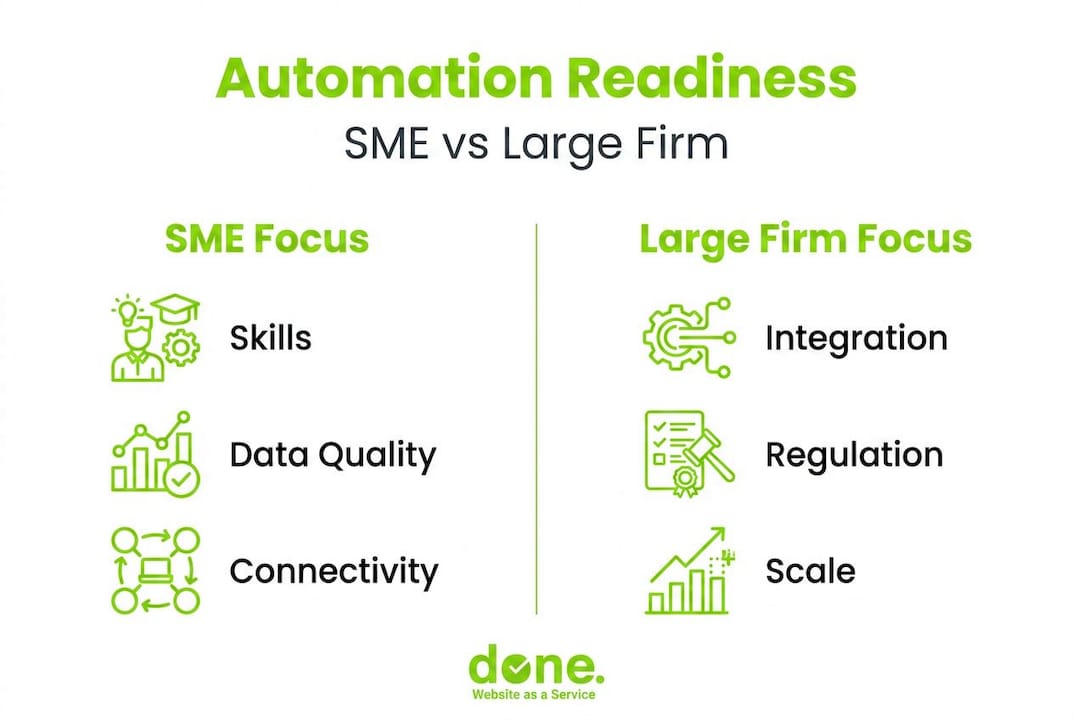
The comparison below shows how readiness factors typically differ between SMEs and large firms, and what a realistic target state looks like for an SME pursuing intelligent automation:
| Readiness dimension | Large firm baseline | SME realistic target |
|---|---|---|
| Connectivity | Cloud-integrated, real-time data flows | Core systems connected, basic API integrations in place |
| Data quality | Clean, structured, centralised | At least one clean data source per target use case |
| Algorithms and tooling | Custom-built or enterprise-licensed | Off-the-shelf or cloud-based AI tools fit for purpose |
| Compute capacity | Dedicated cloud or on-premise infrastructure | Cloud-based services with scalable costs |
| Skills | Dedicated data science and AI teams | At least one internal champion with external support |
| Financial planning | Multi-year AI investment cycles | Phased investment with clear ROI milestones |
Follow these steps to self-assess your business readiness before selecting a specific intelligent automation solution:
-
Audit your current data assets. List every system in your business that generates or holds data, including your CRM, accounting software, email platform, and any spreadsheets used by your team. Assess whether that data is structured, clean, and accessible, or whether it is scattered across disconnected tools.
-
Evaluate internal skills honestly. Identify who in your team has experience with digital tools, data analysis, or technology projects. You do not need a data scientist. You do need at least one person who can act as an internal champion, learn new systems quickly, and communicate between your team and any external partner.
-
Map your most time-intensive manual processes. Ask each department head to list the top three tasks they or their team perform manually every week that feel repetitive and rule-based. These are your highest-potential candidates for automation.
-
Assess your financial capacity for phased investment. Intelligent automation does not require a large one-off budget. Many cloud-based tools operate on monthly subscription models. Define a monthly budget range you are comfortable committing to over a 12-month trial period, including both the tool cost and any external support.
-
Identify your compliance and data sensitivity requirements. For businesses operating in legal, finance, healthcare, or accountancy, data sovereignty and GDPR compliance are non-negotiable. This affects your choice of tools and whether on-premise or private AI deployment is more appropriate than public cloud solutions.
-
Set a success metric for your first use case. Before you begin, define clearly what success looks like. Whether that is a 30% reduction in invoice processing time or a 20% increase in qualified leads, having a measurable target keeps the project focused and accountable.
Consulting a detailed marketing automation guide is particularly valuable if your initial readiness assessment points toward customer-facing processes as your first priority area. Similarly, reviewing AI tools for marketing can help you evaluate specific options suited to your budget and team capabilities.
Pro Tip: Do not attempt to address all six readiness dimensions at once. Start with skills and data quality, as these underpin every other dimension. Even modest improvements in how your team understands and structures data will dramatically increase the success rate of any AI tool you introduce later.
How SMEs can implement intelligent automation: Practical use cases and steps
After you self-assess, the next logical step is to see how intelligent automation applies to real business situations and begin with concrete, measurable action.
The good news is that the most impactful use cases for SMEs are also among the most accessible. You do not need custom-built AI systems to start seeing meaningful operational benefits. Several well-established application categories are available today through affordable, cloud-based platforms that require minimal technical setup:
- Customer service chatbots: Deploy a chatbot on your website or messaging channels to handle repetitive enquiries, qualify leads, and route complex issues to the right team member. This reduces response time, improves customer experience, and frees up staff for higher-value conversations.
- Automated invoice and document processing: Tools such as document intelligence platforms can extract data from PDF invoices, receipts, and contracts, validate it against your records, and post it directly to your accounting software. Businesses processing more than 50 invoices per month typically see a measurable reduction in manual processing time within the first 30 days.
- Lead generation and nurturing automation: AI-enhanced CRM systems and email marketing platforms can score incoming leads based on behaviour, send personalised follow-up sequences, and alert your sales team when a prospect is ready to engage. This is one of the fastest ways to improve conversion rates without increasing headcount.
- Internal workflow automation: Tools like Zapier, Make, or Microsoft Power Automate allow you to connect your existing applications and trigger automated actions when specific conditions are met, such as creating a task when a new lead enters your CRM, or sending a notification when a project deadline is approaching.
- Content and communication automation: AI writing assistants can generate first drafts of marketing copy, product descriptions, and social media posts at scale. This does not replace your team’s judgment or creativity, but it significantly reduces the time required to produce high volumes of consistent content.
“Adoption of intelligent automation offers substantial efficiency gains for SMEs, but these gains are only realised when implementation is aligned with the company’s existing capabilities and broader strategic goals.”
The most effective implementation approach follows a structured progression. Begin by identifying a single pilot process, one that is well-defined, currently manual, and carries a clear time or cost burden. Run the automation in parallel with your existing process for at least four weeks before replacing it entirely. Measure the impact using the success metric you defined during your readiness assessment. Only after validating results in that first area should you consider expanding to a second use case.
Practical tools to boost leads with AI are a strong starting point for SMEs whose primary challenge is pipeline growth rather than internal process efficiency. For businesses where content production is a bottleneck, AI content generation tools offer immediate ROI with a relatively low implementation barrier.
The phased approach matters for another reason beyond managing risk. It builds internal confidence and team buy-in. Staff who see one AI tool improve their daily workflow are far more receptive to further automation initiatives. Businesses that attempt to automate everything simultaneously typically encounter resistance, confusion, and costly rollbacks.
A fresh perspective: Why SMEs should lead the intelligent automation revolution
With implementation steps in hand, it is worth considering a broader and more empowering view of your SME’s role in the intelligent automation landscape.
Here is what most commentary on the SME adoption gap gets wrong. The framing is almost always deficit-based. SMEs are positioned as smaller, slower, less resourced versions of large corporations, perpetually catching up to an enterprise standard they can never quite reach. This framing is not only discouraging, it is factually misleading.
Large firms adopt intelligent automation slowly, not because they are better at it, but because their scale forces them into lengthy procurement processes, complex governance structures, and organisation-wide change management programmes that can take years to complete. An enterprise deploying a new AI system across 5,000 employees in 12 countries faces an entirely different set of challenges than a 30-person SME piloting a chatbot for one product line.
Your SME can design, test, and validate an intelligent automation use case in weeks rather than years. You can make a decision to trial a new tool on a Tuesday and have it running by Thursday. You can course-correct quickly when something is not working, without requiring board approval or a steering committee. This is not a weakness. It is a structural advantage that large firms are spending significant resources trying to replicate through “innovation labs” and “agile squads.”
The OECD data supports this view: SME automation outcomes can outperform large-firm implementations when focused on the right use-case fit and backed by targeted, deliberate investment. The variable that matters most is not budget size. It is the quality of the fit between the automation solution and the specific operational challenge it is addressing.
This perspective should reshape how you approach the decision. Instead of asking “how can we catch up with larger competitors?”, ask “which operational problem, solved through automation, would create the clearest competitive advantage for us in our specific market?” That question leads to far better investment decisions and far better outcomes.
We have seen this first-hand working with SMEs across Luxembourg and Europe at Done.lu. The businesses that achieve the strongest results from AI for compliance and productivity are rarely those with the largest budgets. They are the ones that start with a focused problem, commit to measuring outcomes honestly, and treat automation as a continuous improvement process rather than a one-time project.
Unlock next-level efficiency for your SME with expert support
Intelligent automation offers genuine, measurable value for European SMEs, but the path from concept to operational impact is clearest with experienced guidance alongside you.
At Done.lu, we specialise in helping SMEs across Europe move from readiness assessment to fully operational intelligent automation without the complexity or cost typically associated with enterprise-level deployments. Whether you need support with AI consulting, end-to-end workflow automation, or a broader business automation strategy built around your specific operational context, our team can guide you through every stage of the process. We work with transparent pricing, no setup fees, and a methodology focused on continuous improvement so your investment grows in value over time. Connect with us to start your automation journey today.
Frequently asked questions
What are the first steps for an SME to adopt intelligent automation?
Begin with a readiness assessment covering your data quality, team skills, and available budget, then select one specific use case with a clear operational benefit and measurable success target. SME readiness in data, skills and finance is the critical foundation for any successful automation initiative.
How can intelligent automation increase operational efficiency for SMEs?
Automation eliminates repetitive manual tasks, accelerates information flows between systems, and frees your team to focus on higher-value work, delivering substantial efficiency gains when applied to the right processes. The cumulative time savings across even a small team can be significant within the first few months.
Which intelligent automation applications are most accessible to SMEs?
Customer service chatbots, document and invoice processing, workflow automation between existing business tools, and lead generation systems are all accessible entry points with relatively low implementation barriers. These natural language generation and workflow automation applications are available through affordable cloud-based platforms suited to SME budgets.
What are common mistakes SMEs make when adopting intelligent automation?
The most frequent pitfalls include neglecting to develop internal skills before introducing tools, underestimating how much data quality preparation is required, and attempting to automate too many processes simultaneously. Gradual, capability-aligned implementation consistently produces better outcomes than broad, rapid deployment.